

We have probably seen your problem before. Our smallest client had eight employees. Our largest secures the nuclear power plant of the United Arab Emirates. Whatever shape yours is, tell us about it and we will tell you how we would fix it.
Buyer's Guide · October 2026
Information Security Audit Services: What They Include, What They Cost and How to Choose One
Five kinds of service are sold under one name, and only some of them produce a document your customer, regulator or certification body will accept. This guide separates them, shows what a complete service delivers, what each one costs, and how to choose a provider you will not have to replace.
Almost nobody searches for information security audit services out of curiosity. Something has happened: a prospect's procurement team sent a questionnaire, a regulator announced a review, a cyber insurer asked for evidence at renewal, a board member asked the question nobody could answer, or a competitor lost a deal for want of a report. The search is for a document that will satisfy that person, and the market sells five different documents under the same heading.
Buying the wrong one is the expensive mistake. A readiness assessment will not satisfy a customer who asked for a SOC 2 report. A certificate from a body nobody accredited is worth less than no certificate. An audit that consists of interviews and a questionnaire produces a report that falls apart the first time an auditor on the other side asks for the sample. And a penetration test, however good, answers a different question.
This guide is organised the way a buyer needs it: what the service includes and what it is not, the five service types and who is allowed to perform each, who will accept which output, what the report must contain, how an engagement runs, what it costs, and a 12-point checklist for choosing a provider. If you want the mechanics of how auditors test controls, our guide to security audit procedures covers that in depth; this one is about buying the service well.
What You Are Buying
What Information Security Audit Services Include

An information security audit service is an independent, evidence-based examination of whether the controls that protect your information exist, are designed to address the risks they are meant for, and operated as described over a period. It is measured against a criteria set: ISO/IEC 27001, the SOC 2 Trust Services Criteria, NIST SP 800-53, PCI DSS, the HIPAA Security Rule, CIS Controls, or a regulator's own rulebook. The word information matters: the scope covers paper, people and process as well as technology, which is where it differs from a purely technical review.
A complete service covers four layers, and the evidence request list will reflect all four:
- Governance: policies and their approval, roles and accountability, risk assessment and treatment, management review, supplier management, legal and regulatory register.
- People: screening, onboarding and offboarding, awareness training completion, acceptable use, privileged users, the joiner and leaver reconciliation to HR.
- Process: change management, incident response, business continuity and recovery testing, vulnerability and patch management, access reviews, logging and monitoring, secure development.
- Technology: identity and MFA configuration, endpoint protection, network and perimeter rules, cloud posture across Microsoft 365, Entra ID, AWS, Azure and GCP, encryption, backups, the CI/CD pipeline.
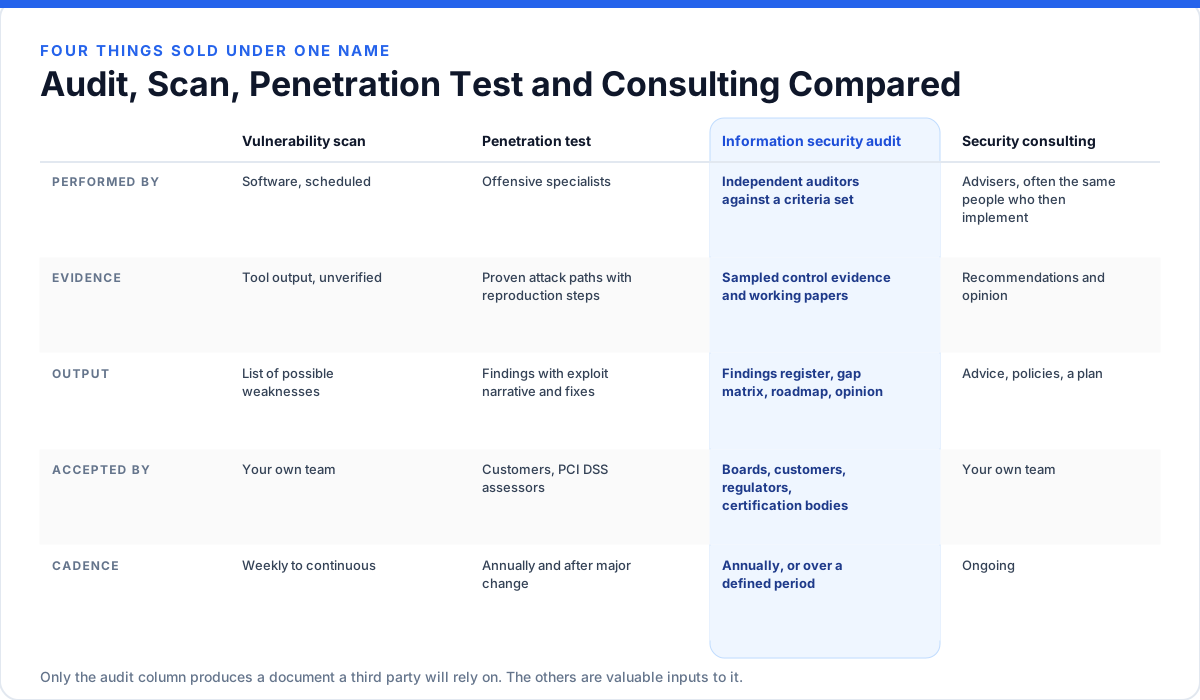
What the service is not matters as much. A vulnerability scan is software comparing versions against a database; it finds possibilities and proves nothing. A penetration test is an adversarial exercise that proves what an attacker can reach, which is why auditors commission one as a procedure when a control failure would expose regulated data; what that engagement looks like is on our penetration testing services site. Security consulting is advice, usually from people who will then implement it, and advice carries no working papers. A questionnaire you fill in yourself is a self-assessment, whatever the vendor's portal calls it. The guide to penetration testing versus IT security audits draws the line in more detail.
The Landscape
The Five Kinds of Information Security Audit Service
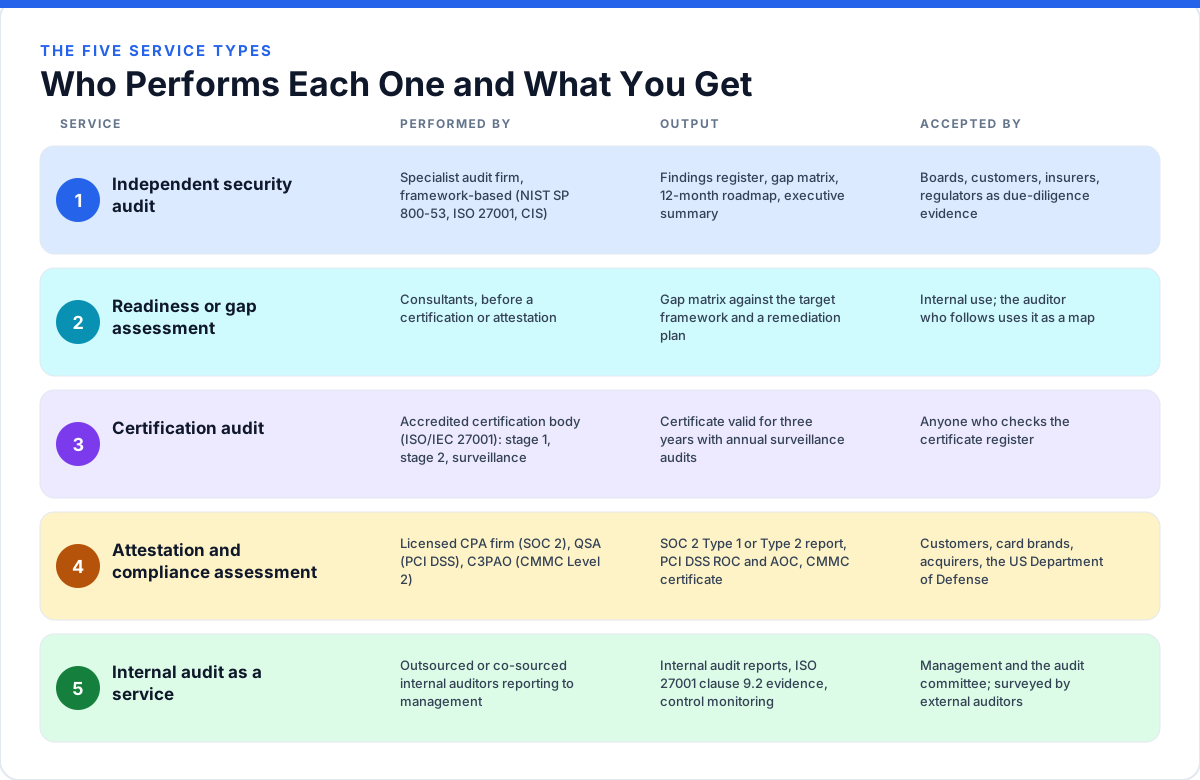
The confusion in the market comes from five distinct services sharing a label. They differ in who is allowed to perform them, what they produce, and who will accept the result.
1. Independent security audit
A specialist firm examines the control set against a framework, usually NIST SP 800-53, ISO 27001 or the CIS Controls, through interviews, document review and technical evidence collection, then delivers a findings register, a gap matrix and a prioritised roadmap. It carries no certificate, which is its strength as well as its limit: it can go deeper and move faster than a certification audit, and it is accepted by boards, insurers and most mid-market customers as evidence of due diligence. It is the service most companies need first, because it tells you where you stand before anyone else does.
Atlant Security's IT security audit is this service: 20 NIST SP 800-53 domains, 14 days, fixed price.
2. Readiness or gap assessment
Performed before a certification or attestation by consultants who know the target standard. The output is a gap matrix and a plan to close it. It is internal in purpose, and the certification body or CPA firm that follows will use it as a map. The independence rules matter here: the firm that builds your ISMS or writes your SOC 2 policies cannot then certify or attest to them, so a readiness partner and the eventual auditor are two different purchases.
SOC 2 readiness and ISO 27001 readiness engagements sit here.
3. Certification audit
For ISO/IEC 27001, performed by a certification body accredited by a national accreditation body (UKAS, ANAB, DAkkS and their peers). Stage 1 reviews the documented ISMS and readiness; stage 2 tests implementation; the certificate is valid for three years with annual surveillance audits and a recertification audit at the end of the cycle. The certificate is what customers can verify on a register, and an unaccredited "certificate" is worth nothing to them.
Ask any body for its accreditation number before you sign.
4. Attestation and compliance assessment
SOC 2 reports are issued by licensed CPA firms under AICPA attestation standards: a Type 1 covers design at a date, a Type 2 covers operation over a period of typically three to twelve months. PCI DSS Reports on Compliance are produced by a Qualified Security Assessor, with Self-Assessment Questionnaires for smaller merchants. CMMC Level 2 certification assessments are performed by authorised C3PAOs. In each case the assessor is bound by a programme's independence and quality rules, and the output is accepted by the party that demanded it: the customer, the card brands and acquirers, or the US Department of Defense.
Our guide to SOC 2 audit firms for startups compares the CPA side.
5. Internal audit as a service
An outsourced or co-sourced internal audit function: the independent-from-operations testing that ISO 27001 clause 9.2 requires, SOX IT general controls testing, and increasingly continuous control monitoring with evidence collected on a schedule. It reports to management and the audit committee, and external auditors rely on its work, which shortens their own testing. For a company without an internal audit department, buying this as a service is how the clause gets met honestly.
ISO 27001 internal audit as a service is the usual entry point; GRC platforms such as Venvera automate the evidence side between audits.
Regulatory examinations are a sixth kind, and you do not buy them: a supervisor, a data protection authority or the US Office for Civil Rights arrives with its own procedures. Every service above exists partly to make that day uneventful.
Match the Service to the Audience
Who Will Accept the Report
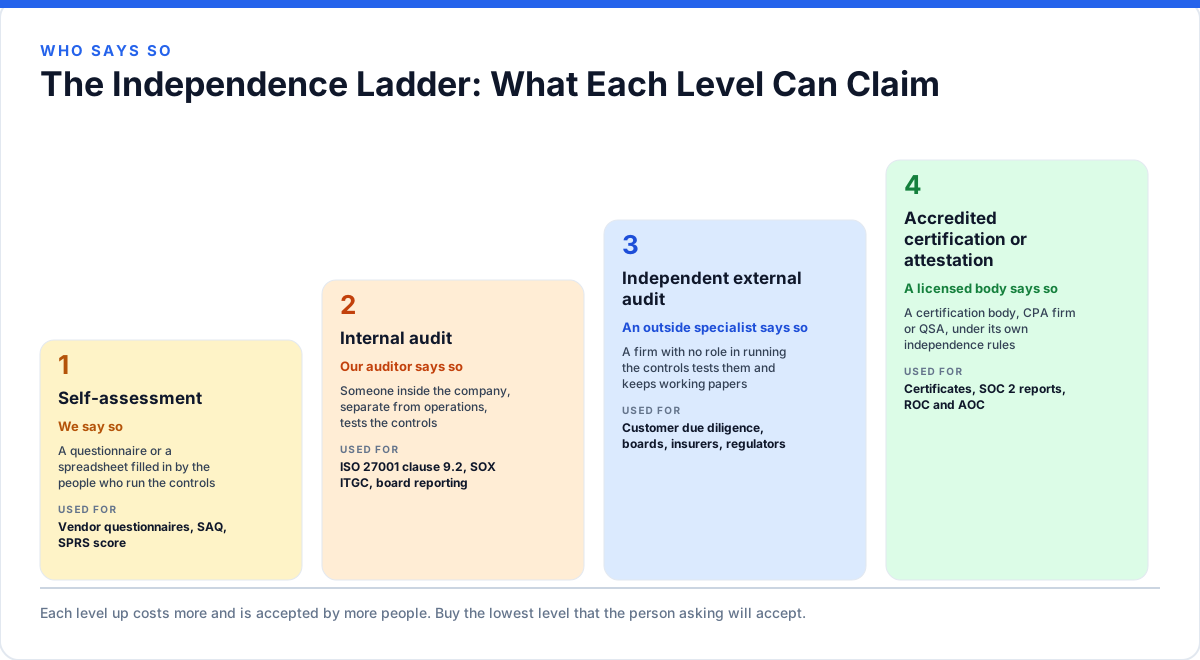
The question to settle before any quote is who will read the result, because each audience accepts a different level of independence. Buy the lowest level the person asking will accept; buying higher wastes money, buying lower wastes the whole engagement.
| Who is asking | What they accept | Practical note |
|---|---|---|
| A prospect's procurement or security team | SOC 2 Type 2 or ISO 27001 certificate where they insist; an independent audit report plus a recent penetration test satisfies most mid-market buyers | Ask what they will accept before buying; many questionnaires say so |
| A regulator or supervisor | Whatever its rulebook names: a risk analysis under HIPAA, an audit under NIS2 national law, a testing programme under DORA Article 25 | Independent audit reports are evidence of the programme, never a substitute for the regulator's own review |
| The board or investors | An executive summary with ranked risks, financial exposure and a dated plan | Due-diligence packages in a sale or funding round reuse the same document |
| A cyber insurer | Evidence that named controls exist and operate: MFA, EDR, tested backups, privileged access management | An audit report answers the renewal questionnaire with evidence attached |
| Card brands and acquirers | PCI DSS ROC and AOC from a QSA, or the applicable SAQ | Only the QSA path counts for larger merchants and service providers |
| A certificate register | An ISO/IEC 27001 certificate from an accredited body | Nothing else appears on the register |
By Framework
Information Security Audit Services by Framework
The same four layers of scope are examined under every framework; what changes is the vocabulary, who may sign, and the cycle. The table is the short version of the decision most buyers face.
| Framework | Who may audit | Output | Note |
|---|---|---|---|
| ISO/IEC 27001:2022 | Accredited certification body (stage 1, stage 2, annual surveillance, recertification at year three) | Certificate on a public register | Readiness consultants may design the ISMS; a different, accredited body must certify it |
| SOC 2 | Licensed CPA firm under AICPA attestation standards | Type 1 (design at a date) or Type 2 (operation over a period) report | The CPA firm must be independent of the readiness work and of the controls |
| PCI DSS v4.0 | Qualified Security Assessor for a Report on Compliance; SAQ for eligible smaller merchants; ISAs internally | ROC and Attestation of Compliance, or SAQ | Requirement 11.4 also demands internal and external penetration testing at least annually |
| HIPAA Security Rule | No certification exists; covered entities and business associates must perform a risk analysis (45 CFR 164.308(a)(1)(ii)(A)) and may commission an independent assessment | Risk analysis, assessment report, remediation plan | The report is evidence for OCR enquiries and customer due diligence |
| NIST SP 800-53, SP 800-171 and CMMC | SP 800-53A procedures for federal systems; SP 800-171 self-assessment with a score; CMMC Level 2 certification by a C3PAO | Assessment report, SPRS score, CMMC certificate | Defence suppliers need the C3PAO path for Level 2 contracts |
| DORA and NIS2 (EU) | Competent authorities supervise; financial entities run a testing programme under DORA Article 25 and designated ones face TLPT under Article 26; NIS2 Article 21 lists the measures | Independent audit reports, testing programme records, incident records | An independent audit is the usual evidence that the measures exist and operate |
| CIS Controls v8 | Self-assessment or an independent review by implementation group | Gap matrix by safeguard | A practical criteria set for companies without a regulatory driver |
One evidence file serves all of them. The populations, samples and exports an independent audit collects against NIST SP 800-53 are the same ones a certification body or CPA firm will ask to see, which is why companies that run an independent audit first walk into certification with the folder already built. Our NIST security audit guide maps the publications to each other.
Quality Markers
What a Good Information Security Audit Service Delivers

A good service is recognisable by three things: a method you can read before you sign, evidence rules that would survive another auditor's scrutiny, and a fixed list of deliverables that someone has to act on.
Method. Every control is tested with a named procedure: inquiry, observation, inspection or re-performance, with populations and samples sized to how often the control runs, the examine, interview and test methods that NIST SP 800-53A describes. The provider should publish or hand over its methodology; if it cannot describe how a sample is chosen, the report is an essay. The full mechanics are in security audit procedures.
Evidence. Exports from systems of record with row counts, configuration files, tickets with approvals, screenshots that show the system, the account and a timestamp, and the auditor's own queries under a read-only account. Each file referenced from exactly one working paper, retained under restricted access, because the evidence file is also a map of your weaknesses.
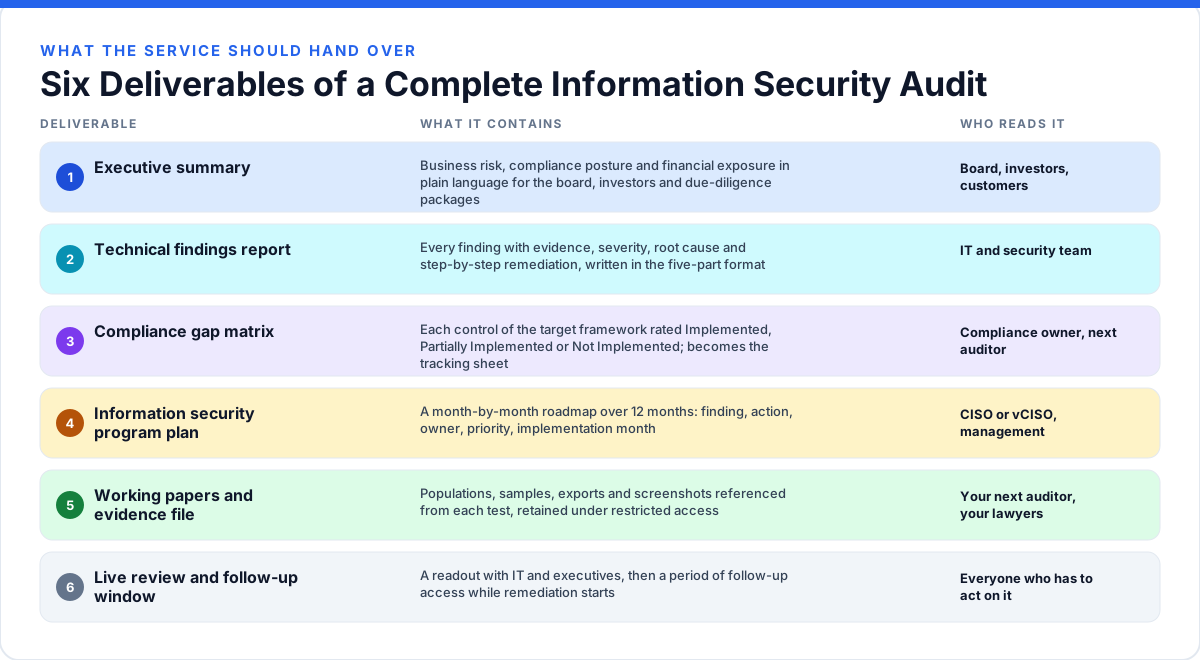
Deliverables. The executive summary for the board, the technical findings report in the five-part format (criteria, condition, cause, effect, corrective action), the compliance gap matrix rated Implemented, Partially Implemented or Not Implemented, the information security program plan as a month-by-month roadmap, the working papers, and a live review with a period of follow-up access. The gap matrix is the one buyers forget to ask for and the one they use most, because it becomes the tracking sheet for the next twelve months and the starting point for the next audit.
Timeline
How an Information Security Audit Engagement Runs
Calendars differ by provider and by scope, and a fixed-scope service should be able to show you one before you sign. This is ours, for an estate of typical mid-market complexity.
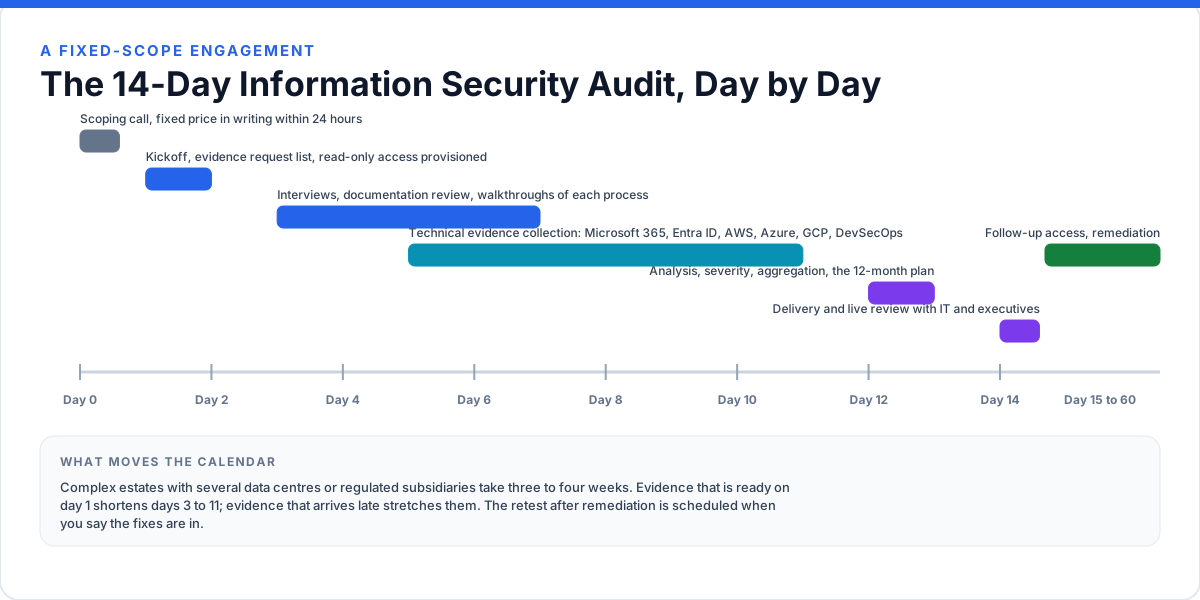
- Scoping call, then a fixed price in writing within 24 hours. Systems, locations, entities, frameworks to map against, the people who will answer for each domain, exclusions.
- Days 1 to 2: kickoff and the evidence request list. Every artefact named with its system of record, owner and due date; read-only audit accounts provisioned for the identity provider, cloud consoles, scanner and log platform.
- Days 3 to 7: interviews, documentation review and walkthroughs. One instance of each process followed end to end with its owner; design conclusions formed; every discussion run as a consulting session you are encouraged to record.
- Days 5 to 11: technical evidence collection. Microsoft 365 across its security settings, Entra ID, AWS, Azure and GCP configuration against baselines, authenticated scanning, privileged access reconciliation, log and alert sampling, the CI/CD pipeline and secure development practices.
- Days 12 to 13: analysis. Exceptions grouped by root cause, severity set by reachability and impact, the gap matrix completed, the 12-month plan written with owners and months.
- Day 14: delivery and live review with your IT team and executive stakeholders, followed by 30 days of follow-up access as implementation begins. Complex environments with several data centres or regulated subsidiaries take three to four weeks.
Preparation moves the calendar more than anything the provider does. The 90-day preparation playbook schedules the evidence collection; a company that arrives with the exports ready finishes fieldwork early and spends the saved days on remediation.
The Numbers
What Information Security Audit Services Cost
Prices are quoted in four ways: a fixed price per scope, a day rate, a per-audit-day fee from a certification body, or a per-report fee from a CPA firm or QSA. The model tells you more about the provider than the number does. Fixed prices come from firms that have scoped the same estate many times; day rates come from firms that expect the scope to move.
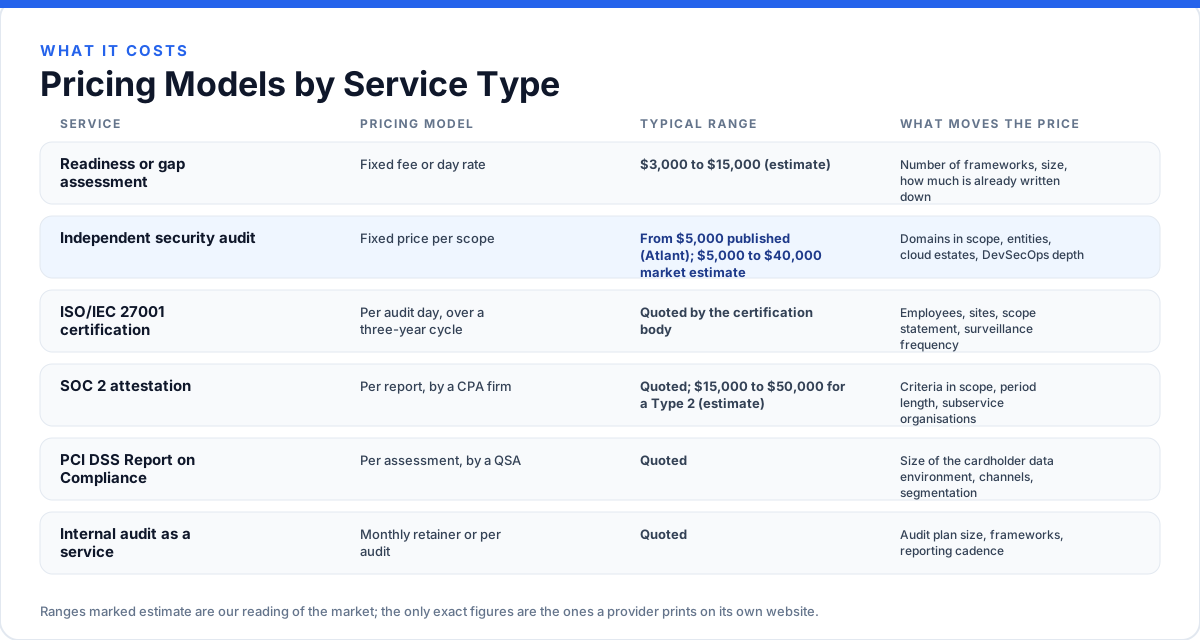
Published prices on this site, for comparison:
- Essentials Audit, from $5,000: the core control families for a smaller estate, with the findings report and roadmap.
- Comprehensive Audit, from $12,000: all 20 NIST SP 800-53 domains with technical evidence collection across on-premises and cloud, the compliance gap matrix and the information security program plan.
- Enterprise Audit, from $25,000: multi-entity, multi-country programmes with all applicable frameworks, a vendor and supply chain risk review, a dedicated engagement manager, a board-ready executive presentation and 60 days of follow-up support.
- Every tier is a fixed price agreed in writing after the scoping call, and you read the full report before you pay.
What moves the price inside any model is scope: the number of control domains, entities and sites, the size of the cloud estate, whether the development pipeline is in scope, and how much evidence already exists. Certification and attestation fees are quoted by the body or firm and sit on top of any readiness work; for SOC 2 our SOC 2 compliance companies guide puts the CPA audit itself at $15,000 to $50,000 for a Type 2. Our comparison of IT security audit companies lists what fifteen providers publish, and the security audit companies comparison covers the pricing conversation in more detail.
Due Diligence
How to Choose an Information Security Audit Provider
Twelve questions separate a service that produces a usable document from one that produces a PDF. Ask all of them before the proposal is signed.
1.Independence
Did the firm design, build or operate anything it will audit? For certification or attestation, is it accredited or licensed for that programme, and will it show the number?
2.Qualifications of the named people
CISA, ISO/IEC 27001 Lead Auditor and CISSP for independent audits; a CPA licence for SOC 2; QSA status for PCI DSS; C3PAO authorisation for CMMC. Ask who specifically will do the work.
3.A written methodology
Procedures per control, sampling rules by control frequency, severity model, aggregation rules. If it is secret, it does not exist.
4.A redacted sample report
Executive summary, one full finding with evidence, the gap matrix format, the roadmap format.
5.Technical depth
Read-only access to the identity provider, cloud consoles and log platform; configuration exports and the auditor's own queries, in addition to interviews.
6.Fixed scope and price in writing
Systems, entities, frameworks, exclusions, days of senior time, and what happens when scope moves.
7.The deliverables list
All six, named, with the gap matrix and the roadmap format shown in advance.
8.Framework mapping
Findings mapped to the clause your customer or regulator will cite: SOC 2 criteria, ISO Annex A controls, PCI DSS requirements, HIPAA sections, DORA and NIS2 articles.
9.Follow-up and retest
A review session, a window of follow-up access, and a defined retest so closure is evidence you can date.
10.Evidence handling
Where the evidence file is stored, who can read it, how long it is retained, and how it is destroyed.
11.References in your sector and size
A firm that has audited two companies like yours knows where the findings will be before it starts.
12.Who signs
A named, qualified individual whose attestation your auditor, customer or regulator can call about.
Red flags that end the conversation:
- A questionnaire you fill in yourself, sold as an audit.
- The same firm selling the audit and the remediation products it will then recommend.
- A "certificate" from a body that cannot name its accreditation.
- Interviews and policy review with no populations, samples or technical evidence.
- A report with severities and no evidence, or findings without a corrective action and an owner.
- Pricing by employee count or device count alone, with the scope left to be discovered on day one.
- Scheduling lead times measured in quarters when your customer's deadline is measured in weeks.
Information Security Audit Services vs IT Security Audit Services vs Cybersecurity Audit Services
The three phrases describe the same engagement from three vantage points. Information security is the ISO vocabulary and includes paper records, people and process alongside systems. IT security emphasises the technical estate: identity, endpoints, network, cloud. Cybersecurity frames the work around external threats. A serious provider covers all three whichever name it uses; a provider that covers only the technical layer under any of the names will leave governance and process findings for the next auditor to discover.
Information Security Audit Services for Small Businesses
A small business needs a service with a published price, a scope that fits one estate, and a report a customer's security team will accept. That points to an independent audit on a fixed price for the annual check, a readiness assessment only when a specific certification is demanded by contract, and no certification body or CPA firm until a customer names the report. A business of twenty people that commissions an ISO 27001 certification cycle because it sounded impressive has usually bought the wrong service in the wrong year. Our guide to small business cybersecurity cost places the audit inside the whole budget.
Remote Information Security Audit Services: Does Location Matter?
Most of the work is remote by nature: identity, cloud, email, endpoints and logs are examined through read-only access, and interviews run over video. Location matters in three cases. Physical and environmental controls need someone on site for a day. Some regulators and certification schemes require auditors in a given jurisdiction or language. And data residency rules may restrict where the evidence file is stored. A remote specialist with the right framework fluency outperforms a local generalist in every other case.
How Often to Buy Information Security Audit Services
Annually is the floor that customers, insurers and most frameworks expect, with an additional review after a major change: a cloud migration, an acquisition, a new product line, a serious incident. Certification cycles fix their own cadence (ISO 27001 surveillance every year, recertification every three), and SOC 2 Type 2 reports are commissioned for consecutive periods so coverage never lapses. Between audits, continuous control monitoring keeps the evidence current, so the next engagement confirms what the file already shows and takes days.
If the audit itself is what you are comparing, the security audit guide explains the types and phases, and the internal versus external audit comparison settles which of the five services your own team can legitimately perform.
In Practice
How Atlant Security Delivers Information Security Audit Services
Our IT security audit is the independent security audit described above, delivered as a fixed-scope service: 20 security domains derived from NIST SP 800-53, each control evaluated for design and operating effectiveness through interviews, documentation review and technical evidence collection across on-premises, cloud (Azure, Entra ID, Microsoft 365, AWS, GCP) and DevSecOps environments, with findings mapped to SOC 2, NIST 800-171, CMMC, ISO 27001:2022, the HIPAA Security Rule and PCI DSS.
The engagement is led by auditors holding CISSP, CEH and CHFI, including our founder, formerly of Microsoft's security consulting team and Mandiant certified, and draws on 200+ security assessments across 14 countries since 2013. Standard delivery is 14 days from the kickoff call. The deliverables are the six in Figure 4: executive summary, technical findings report, compliance gap matrix, the information security program plan as a 12-month roadmap, the working papers behind each test, and a live review followed by 30 days of follow-up access. The price is fixed in writing after a no-obligation scoping call, and you read the full report before you pay.
Common Questions
Frequently Asked Questions
What are information security audit services?
Services in which an independent party examines whether the controls protecting your information exist, are designed to address the relevant risks, and operated over a period, measured against a criteria set such as ISO/IEC 27001, the SOC 2 Trust Services Criteria, NIST SP 800-53, PCI DSS or the HIPAA Security Rule. The output is a report (findings, gap matrix, roadmap), a certificate, or an attestation, depending on which of the five service types you buy.
What is the difference between an information security audit and an IT security audit?
They are the same engagement described from two angles. Information security is the ISO vocabulary and explicitly covers governance, people and process as well as technology; IT security audit emphasises the technical estate. A complete service covers all four layers whichever name it uses.
Who can perform an ISO 27001 certification audit?
Only a certification body accredited for ISO/IEC 27001 by a national accreditation body such as UKAS, ANAB or DAkkS. Consultants can run readiness assessments and internal audits, but the body that certifies must be independent of the people who designed the management system, and an unaccredited certificate does not appear on any register customers check.
Can the same firm do our readiness assessment and the certification or SOC 2 audit?
For certification and attestation, no: certification bodies and CPA firms are bound by independence rules that bar them from auditing controls they helped design or operate. The normal pattern is a readiness partner followed by a separate accredited body or licensed CPA firm. An independent security audit without a certificate has no such restriction and is often the readiness step itself.
How long does an information security audit take?
A fixed-scope independent audit of a mid-market estate takes about 14 days from kickoff to the readout, with three to four weeks for complex, multi-entity environments. ISO 27001 certification runs in two stages over several weeks plus annual surveillance. A SOC 2 Type 2 report covers an observation period of three to twelve months, so the calendar is set by the period, with fieldwork at the end of it.
How much do information security audit services cost?
Independent security audits start from $5,000 at the published rate on this site and range to roughly $40,000 for large scopes across the market; readiness assessments typically run $3,000 to $15,000; certification, SOC 2 and PCI DSS assessment fees are quoted by the certification body, CPA firm or QSA and sit on top of readiness work, with a SOC 2 Type 2 CPA audit commonly $15,000 to $50,000. Scope moves every figure: domains, entities, cloud estates and whether development pipelines are included.
What do we receive at the end?
From a complete independent audit: an executive summary for the board, a technical findings report with evidence and remediation steps, a compliance gap matrix against your target framework, a prioritised program plan or roadmap, the working papers, and a live review with follow-up access. From a certification audit: a certificate and the audit report. From an attestation: the SOC 2 report or the PCI DSS ROC and AOC.
Will one audit satisfy SOC 2, ISO 27001 and HIPAA at the same time?
One evidence file can serve all of them, and a good independent audit maps every finding to the clause each framework cites. The formal outputs remain separate: a SOC 2 report comes only from a CPA firm, an ISO 27001 certificate only from an accredited body, and HIPAA has no certificate at all, only the required risk analysis and the evidence that controls operate.
Is a penetration test part of an information security audit?
It can be commissioned as one procedure inside the audit when a control failure would expose regulated data or administrative privilege, and PCI DSS requires penetration testing in its own right. On its own, a penetration test answers a narrower question (what an attacker can reach) and does not examine governance, people or process.
How should we prepare before buying the service?
Decide who will read the result and what they will accept; name an owner for each domain; build the evidence list yourself from the systems of record; provision read-only audit accounts in advance; and run the obvious reconciliations (accounts to HR, admins to justification, assets to log sources) before the auditor does. Each exception you find first is a finding you can close before it is written.
Which of the five do you need?
Tell us who is asking for the report and what is in scope. We will say which service fits, name the right kind of provider if it is not us, and send a fixed price in writing if it is.
Related Reading
Published: October 2026 · Author: Alexander Sverdlov, Atlant Security
This guide describes the information security audit market as it stands in October 2026: certification under ISO/IEC 27001 through accredited bodies, SOC 2 attestation under AICPA standards, PCI DSS assessment by Qualified Security Assessors, CMMC certification by authorised C3PAOs, and independent audits against NIST SP 800-53 and comparable criteria. Price ranges marked as estimates are our reading of the market and vary by scope and provider; the only exact prices quoted are those published on this site. Atlant Security sells one of the five services described.
Related services from Atlant Security: IT Security Audit, SOC 2 Readiness, ISO 27001 Internal Audit, Penetration Testing. Book a discovery call to discuss your specific situation.
Want the report before the customer asks for it?
A fixed-price IT security audit covers 20 NIST SP 800-53 domains against your live environment in 14 days: findings with evidence, a compliance gap matrix for SOC 2, ISO 27001, CMMC, HIPAA or PCI DSS, and a 12-month program plan with named owners. You read the full report before you pay.
See what the 14-day audit covers