
SaaS Security Assessments & Audits
Cybersecurity Maturity Assessment
Measure your organization's security maturity against industry frameworks and get a clear improvement roadmap.

Expert Led
Microsoft Alumni Leadership
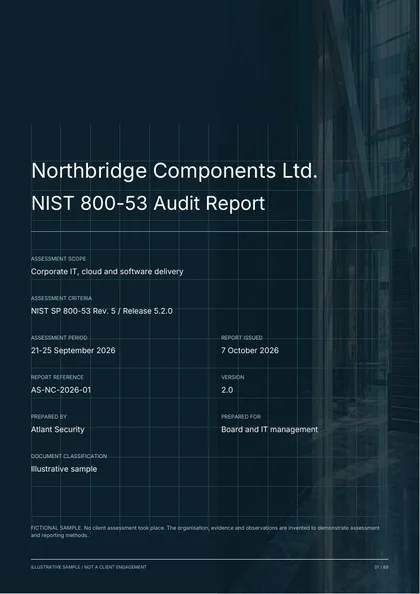
SEE THE DELIVERABLE
See what a useful
audit report looks like.
Review 120 assessment tests across all 20 NIST SP 800-53 control families, including AWS, Microsoft 365, secure software development and DevSecOps. Includes technical findings and a 12-month remediation plan.
89 pages. 20 control families. 32 findings. 13 graphs and diagrams.
Illustrative NIST SP 800-53 assessment. The organisation, evidence and findings are fictional.
Get the sample report
A free PDF. Enter your email and company name, and we’ll email you a download link.
01 / THE DETAIL
What is Cybersecurity Maturity Assessment?
For small projects and ad-hoc work outside our pre-agreed packages or retainers, our standard hourly rate is $460.
02 / THE DETAIL
Who Needs Cybersecurity Maturity Assessment?
Organizations building their first security programme and needing a comprehensive baseline across 22 domains
Companies whose enterprise prospects require documented security maturity before procurement approval
Boards and executive teams that need a clear, scored answer to the question: how secure are we?
PE portfolio companies establishing standardized security baselines across multiple investments
Organizations preparing for SOC 2, ISO 27001, or CMMC that need to understand their current gap before certification
Companies applying for or renewing cyber insurance that need a current security posture assessment
Ready to get started?
Get Your Scope and Price with our Microsoft Security alumni. Fixed-price proposal within 24 hours.
03 / THE DETAIL
Our Methodology
Framework Selection
Choosing the appropriate maturity framework based on your industry and stakeholder requirements.
Assessment
Evaluating your security program across all framework domains through interviews, documentation review, and technical analysis.
Scoring & Analysis
Assigning maturity scores and identifying the highest-impact improvement areas.
Roadmap Delivery
Presenting a prioritized 12-month improvement plan with specific milestones and success metrics.
04 / DELIVERABLES
What You Get with Cybersecurity Maturity Assessment
- Framework-based Maturity Scoring (1-5 Scale)
- NIST CSF Function Mapping (Identify, Protect, Detect, Respond, Recover)
- CIS Controls Implementation Assessment
- Governance & Risk Management Evaluation
- Technical Controls Effectiveness Review
- Security Operations & Monitoring Assessment
- Third-party Risk Management Review
- 12-Month Improvement Roadmap with Milestones
05 / PRICING
Cybersecurity Maturity Assessment Pricing
Standard Assessment
Comprehensive 22-domain maturity assessment with improvement roadmap.
- 22 Security Domain Scoring
- Multi-Framework Mapping
- 14-Day Delivery
- 3-Stage Improvement Plan
- Board-Ready Executive Report
06 / FAQ
Frequently Asked Questions
What frameworks do you assess against?
We primarily use NIST Cybersecurity Framework (CSF) and CIS Controls v8, but can map to ISO 27001, CMMC, HIPAA, PCI DSS, or any framework your stakeholders require. Multiple frameworks can be mapped simultaneously.
How is this different from a security audit?
Audits evaluate pass/fail control existence at a point in time. Maturity assessments evaluate depth, consistency, and sustainability across all 22 domains with ongoing improvement metrics and a prioritized roadmap.
How is this different from a penetration test?
Penetration tests simulate specific attacks against defined technical scope. Maturity assessments evaluate entire security programmes - governance, people, processes, and technology - across 22 domains.
How much does it cost?
Small businesses typically pay $4,000-$10,000 as a fixed-price engagement. Enterprise pricing scales proportionally for complex multi-cloud environments and multiple framework requirements. Payment is due only after receiving and approving the final report.
Can this help with CMMC compliance?
Yes. For DoD contractors, the maturity assessment provides your SPRS score, gap analysis against CMMC practices, and a remediation roadmap - an essential first step before C3PAO assessment.
How often should we do this?
Annually, or after major changes such as cloud migration, acquisitions, personnel changes, regulatory expansion, or security incidents.
Who receives the results?
We provide both a board-ready executive summary and a detailed technical report. The maturity scores and improvement roadmap are designed for C-suite and board presentations.
What is a cybersecurity maturity model?
A cybersecurity maturity model defines levels of security capability - typically scored 1 to 5 - across multiple security domains. Level 1 represents basic, informal practices; level 5 represents continuously improving, optimised security operations. The most widely used models include NIST Cybersecurity Framework, CMMC, and the C2M2 (Cybersecurity Capability Maturity Model).
Does the assessment require access to our systems?
No. We do not require remote access, VPN credentials, administrator accounts, or any form of direct system access. Everything is conducted through screen-sharing sessions with your IT and management teams. You control what is shown, your team is present for every session, and your production environment remains entirely under your control.
Can a maturity assessment help us win enterprise customers?
Directly and measurably. Enterprise procurement teams increasingly require vendor security documentation before signing contracts. A cybersecurity maturity assessment report benchmarked against NIST or ISO 27001 gives your sales team a credible, documented answer to every security questionnaire question. It also accelerates SOC 2 and ISO 27001 certification.
What do I receive at the end of the assessment?
Two deliverables: (1) The Cybersecurity Maturity Assessment Report - a domain-by-domain maturity score against your chosen framework, gap analysis for every control area, and evidence basis for every score. (2) The 3-Stage, 1-Year Security Improvement Plan - every gap scheduled into three implementation phases: months 1-2 for critical issues, months 3-6 for programme foundations, months 7-12 for maturity and continuous improvement.
07 / THE DETAIL
See Where You Stand
Pick a time that works for you - 30 minutes, no obligation.
Choose a time for your scoping call.