

We have probably seen your problem before. Our smallest client had eight employees. Our largest secures the nuclear power plant of the United Arab Emirates. Whatever shape yours is, tell us about it and we will tell you how we would fix it.
Audit Practice · October 2026
Security Audit Procedures: What Auditors Do, Step by Step
The four ways an auditor gathers evidence, the nine phases every security audit runs through, how samples are sized, what a working paper contains, and how a finding is rated and written. Know the procedures and you know what to prepare.
Most guides to security audits describe what gets checked: access control, change management, backups, logging. Very few describe how it gets checked. That gap is why audit preparation so often misses: a team writes a beautiful access-control policy and the auditor asks for the full list of accounts created in the last six months, the HR start dates they map to, and the approval ticket for each one.
A security audit is a set of procedures. Each procedure is a specific action the auditor performs to obtain evidence that a control exists, is designed to work, and worked throughout the period. Once you know the procedures, the evidence request stops being a surprise, the fieldwork takes days where it used to take weeks, and the findings are about your environment because the paperwork was ready.
This guide is written from the auditor's side of the table. It covers the four procedure types and how NIST SP 800-53A and PCI DSS name them, the difference between testing design and testing operation, the nine-phase process, the technical procedures that touch live systems, the working papers behind every conclusion, and the anatomy of a finding. If you want the broader picture first, start with what a security audit is and come back.
If you are choosing a provider and have not bought one yet, the companion guide to information security audit services covers the five service types, who may perform each and what they cost.
The Building Blocks
The Four Procedure Types Every Security Audit Uses

Every test an auditor performs is one of four procedures, or a combination of them. Audit standards use slightly different names, and the names matter because they appear in the evidence request:
- Inquiry. Asking the control owner how the control works, when it runs, who performs it and what happens on exception. Inquiry alone is never sufficient evidence; it tells the auditor where to look.
- Observation. Watching the control performed in real time: a badge reader rejecting a visitor, an engineer approving a change, a restore being run. Observation proves the control can operate; it says nothing about last month.
- Inspection. Examining the record the control left behind: configuration exports, tickets, logs, signed reviews, screenshots with timestamps. This is the workhorse procedure and the one most evidence requests are about.
- Re-performance. The auditor independently repeats the control and compares results: recalculating who should have access and reconciling it to who does, re-running a configuration check, attempting the login that the policy says should fail.
NIST SP 800-53A collapses these into three assessment methods: examine (documents, records, configurations, observed activities), interview (people) and test (mechanisms and processes exercised under specified conditions). It adds two attributes that decide how hard a control is pushed: depth (basic, focused, comprehensive) and coverage (how many instances). PCI DSS v4.0 prints a testing procedure beside every requirement using the verbs examine, interview and observe, which is why a Report on Compliance reads like a procedures manual.
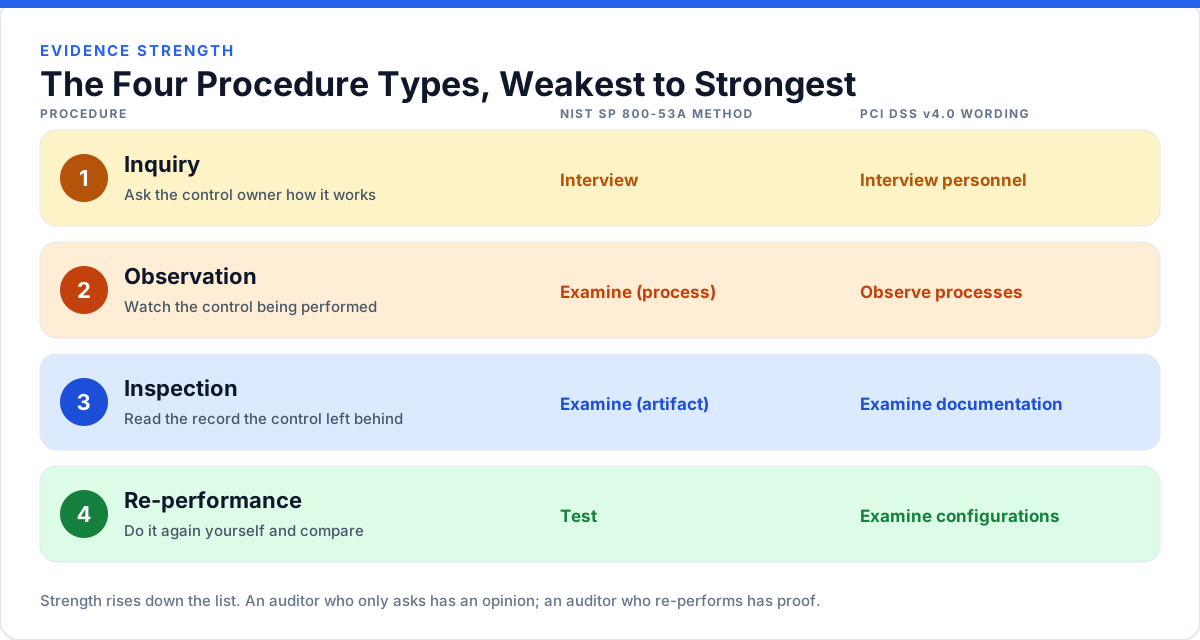
The strength ordering drives everything else. A control supported only by inquiry is a control the auditor has an opinion about. A control supported by inspection of the full population, with two items re-performed, is a control the auditor can sign for. When an audit report feels thin, it is almost always because the procedures stopped at inquiry and observation.
Two Questions Per Control
Design Effectiveness vs Operating Effectiveness
Each control gets two questions, and they need different procedures. The first is whether the control is designed to address the risk: if it were performed exactly as written, would it prevent or detect the thing it exists for? The second is whether it operated consistently across the period under review.
Design is tested with a walkthrough: one instance of the process followed end to end, the policy and configuration read alongside it, the owner asked what happens when the trigger fires. Operation is tested against a population. The auditor asks for the complete list of instances in the period (every change, every new account, every backup job), selects a sample, and inspects or re-performs each sampled item. A missing approval in the sample is an exception; enough exceptions make a finding.
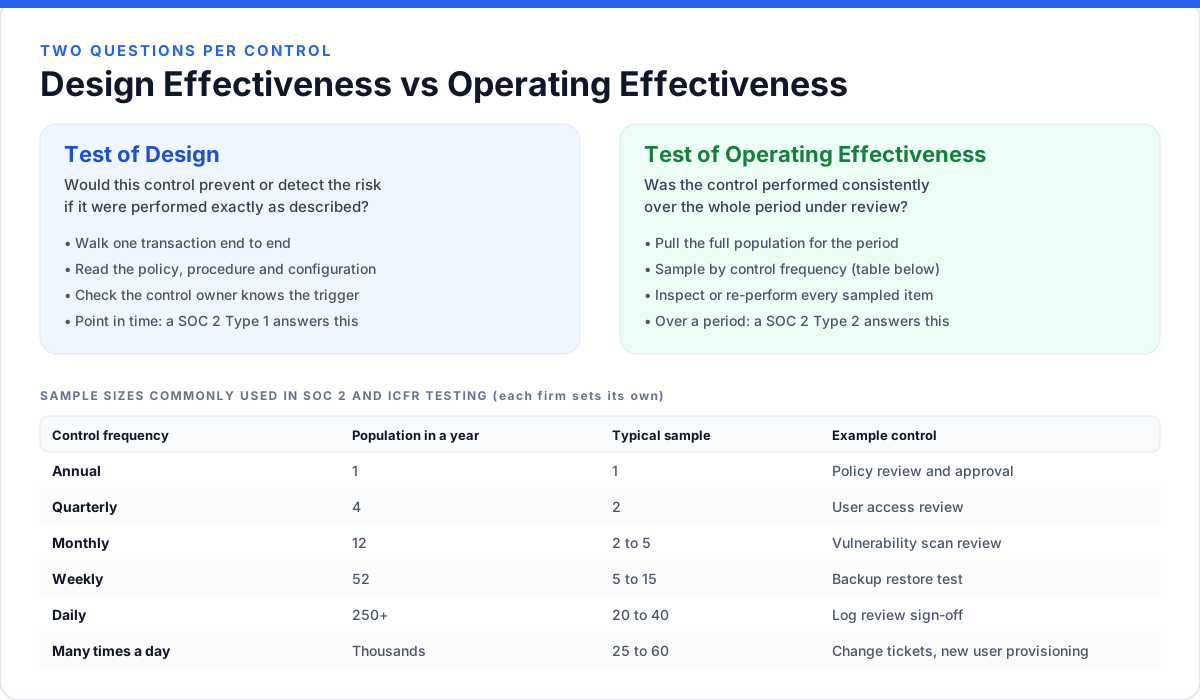
Sample sizes are where auditees get surprised. The ranges in Figure 2 are the ones SOC 2 and internal-control audit firms commonly use, and each firm publishes its own in its methodology: one item for an annual control, two for a quarterly one, up to forty for a daily one, more where the population is very large or earlier years produced exceptions. The population has to be complete and demonstrably so, which is why the auditor asks for the export with its row count and the query that produced it. A spreadsheet someone assembled by hand will be re-requested.
SOC 2 makes the distinction visible: a Type 1 report answers the design question at a date; a Type 2 report answers the operating question over a period, typically three to twelve months. Most security audits that matter to customers are operating-effectiveness audits.
End to End
The Nine-Phase Security Audit Procedure
Audit methodologies differ in vocabulary and agree on sequence. ISO 19011 describes the process for auditing any management system and ISO/IEC 27007 applies it to information security; the AICPA attestation standards shape SOC 2; NIST SP 800-53A shapes federal and defence assessments. Strip the vocabulary and nine phases remain.
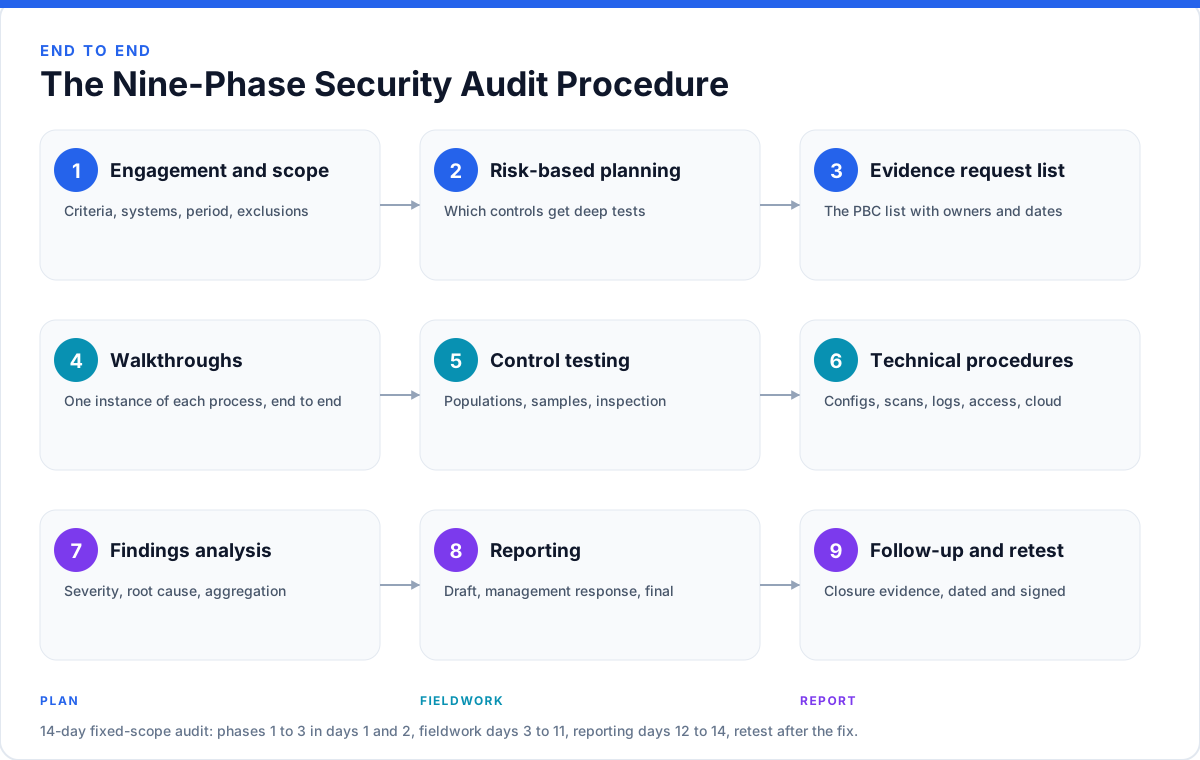
- Engagement and scope. The criteria (which framework or control set), the systems and locations in scope, the period under review, exclusions, and the names of the people who will answer for each domain. Scope written loosely here becomes a dispute in phase 8.
- Risk-based planning. The auditor decides which controls get comprehensive procedures and which get basic ones, based on where the data and the privilege sit. A control that protects cardholder data or domain admin gets re-performance; a visitor log gets inspection.
- Evidence request list. Often called the PBC list (prepared by client): every artefact needed, the period it must cover, the owner and the due date. A good list names the system to export from, which prevents a week of back and forth.
- Walkthroughs. One instance of each process followed end to end with the owner, from trigger to record. Design conclusions are formed here, and the auditor learns where the records live.
- Control testing. Populations requested, samples selected, items inspected or re-performed, exceptions logged. This is the longest phase and the one that benefits most from preparation.
- Technical procedures. Configuration review against baselines, authenticated scans, privileged access reconciliation, log sampling, cloud posture queries, and a penetration test where exploitability has to be proven with a working attack path. Section 5 covers these.
- Findings analysis. Exceptions are grouped by root cause, rated for severity, and checked for aggregation: five low findings that share a cause are one high finding.
- Reporting. A draft goes to management for factual accuracy and a written response with owners and dates. The final report carries the opinion, the findings, the responses and the scope limitations.
- Follow-up and retest. Closure is evidence, dated and signed: a new configuration export, a new population sample, a re-performed test. A finding closed on inquiry alone reopens at the next audit.
In a fixed-scope, 14-day IT security audit the calendar compresses but the phases do not: scoping and the evidence list in the first two days, fieldwork and technical procedures through day eleven, analysis and the readout in the last three, with the retest scheduled after remediation. Longer audits spend the extra time in phases 5 and 6, where the evidence is.
By Control Family
Domain-by-Domain Audit Procedures and Evidence
The table below lists, for the domains that produce the most findings, the procedure an experienced auditor runs and the evidence it needs. Control family references follow NIST SP 800-53; the same procedures satisfy SOC 2, ISO 27001 and PCI DSS auditors with different clause numbers attached.
| Domain | Procedure | Evidence requested |
|---|---|---|
| Access control (AC) | Full account list from the identity provider reconciled to HR; sample joiners and leavers; inspect MFA and conditional access configuration; re-perform one provisioning request | IdP export with row count, HR roster, approval tickets, MFA policy export, screenshots with timestamps |
| Configuration management (CM) | Compare a sample of servers, endpoints and cloud resources against the baseline; inspect the change calendar; walk one emergency change | Baseline document, config exports, diff output, change tickets with approvals and test evidence |
| Vulnerability management (RA, SI) | Read six months of scan reports against the patch policy; inspect ticket ages for criticals; re-run an authenticated scan on a sample | Scan reports, SLA policy, ticket export with dates, re-scan output |
| Audit and accountability (AU) | Confirm log sources against the asset inventory; sample ten dates and inspect the review records; test alerting with a benign event | Log source list, SIEM coverage report, review sign-offs, alert ticket for the test event |
| Contingency planning (CP) | Inspect backup job history for the period; observe or re-perform a restore; read the last exercise report and its actions | Backup console export, restore log with hash comparison, exercise report, action tracker |
| Incident response (IR) | Walk the plan with the on-call lead; inspect a sample of incidents for timeline, containment and post-incident review; check regulatory clocks | IR plan, incident tickets, post-incident reviews, notification records |
| Supply chain risk (SR) | Inspect the vendor inventory and risk tiering; sample critical vendors for assessments and contract clauses; check offboarding of ended vendors | Vendor register, SOC 2 or ISO reports on file, contracts, access removal evidence |
| System and communications protection (SC) | Review firewall and security group rules against documented business need; inspect encryption settings in transit and at rest; test one blocked path | Rule exports with owners, TLS and key management configuration, test output |
| Awareness and training (AT) | Reconcile training completion to the HR roster for the period; inspect phishing simulation results and follow-up | LMS export, HR roster, simulation report, escalation records |
| Physical and environmental (PE) | Observe entry controls; inspect badge access logs for a sample of dates; reconcile badge holders to staff and contractors | Access control system export, visitor logs, badge holder reconciliation |
Two patterns repeat. First, almost every procedure starts with a complete population from the system of record and a reconciliation to a second source (HR, tickets, the asset inventory). Second, every procedure ends with an artefact that carries its own date. Teams that keep those exports and reconciliations as a matter of routine pass audits in days. The IT security audit checklist lists the artefacts by domain if you want to start collecting now.
Where the Audit Touches Systems
Technical Audit Procedures
Document review proves intent. Technical procedures prove reality, and they are where a security audit earns its name. They are performed with read-only access provisioned for the audit and removed afterwards, with every query and export logged.
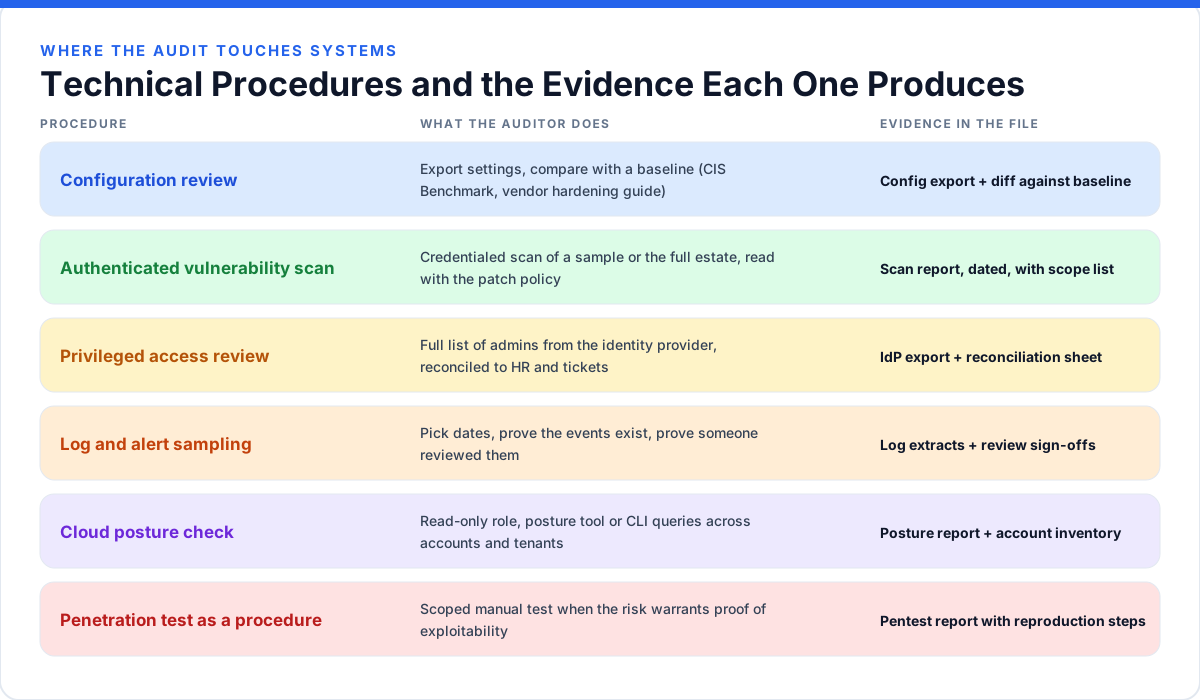
- Configuration review. Settings exported from a sample of systems and compared against the agreed baseline, usually a CIS Benchmark or the vendor hardening guide. The evidence is the export plus the diff, with each deviation accepted, fixed or raised.
- Authenticated vulnerability scanning. A credentialed scan of a sample or the full estate, read together with the patch policy. The finding is rarely the vulnerability itself; it is the gap between the policy's timeline and the ticket ages.
- Privileged access review. Every administrator role from the identity provider, each cloud tenant and the main applications, reconciled to HR and to a business justification. Dormant and shared privileged accounts surface here in almost every first audit.
- Log and alert sampling. Ten dates chosen by the auditor; for each, proof that the expected events exist in the log platform and that a human or an automated rule reviewed them. A benign test event checks that alerting reaches a person.
- Cloud posture. A read-only role per account or tenant, then posture queries for public storage, open security groups, unrotated keys, missing MFA on root and break-glass accounts, and logging gaps. The account inventory itself is a finding when it is incomplete.
- Penetration testing as a procedure. When a control's failure would expose regulated data or administrative privilege, the auditor may commission or review a scoped manual test to prove exploitability with a working attack path. The report then becomes audit evidence. How a pentest fits inside an audit is its own topic; the short version is that it tests the attacker's path while the audit tests the control set. What that evidence looks like, request by request, is shown on our penetration testing services site.
The Audit File
Working Papers and Evidence Standards

Behind every line in an audit report sits a working paper, and the quality of the audit is the quality of that file. A working paper records which control was tested against which criteria, the procedures performed, the population and the sample, references to each piece of evidence, the result, any exceptions in detail, and who performed and who reviewed the test. Without it, the report is an essay.
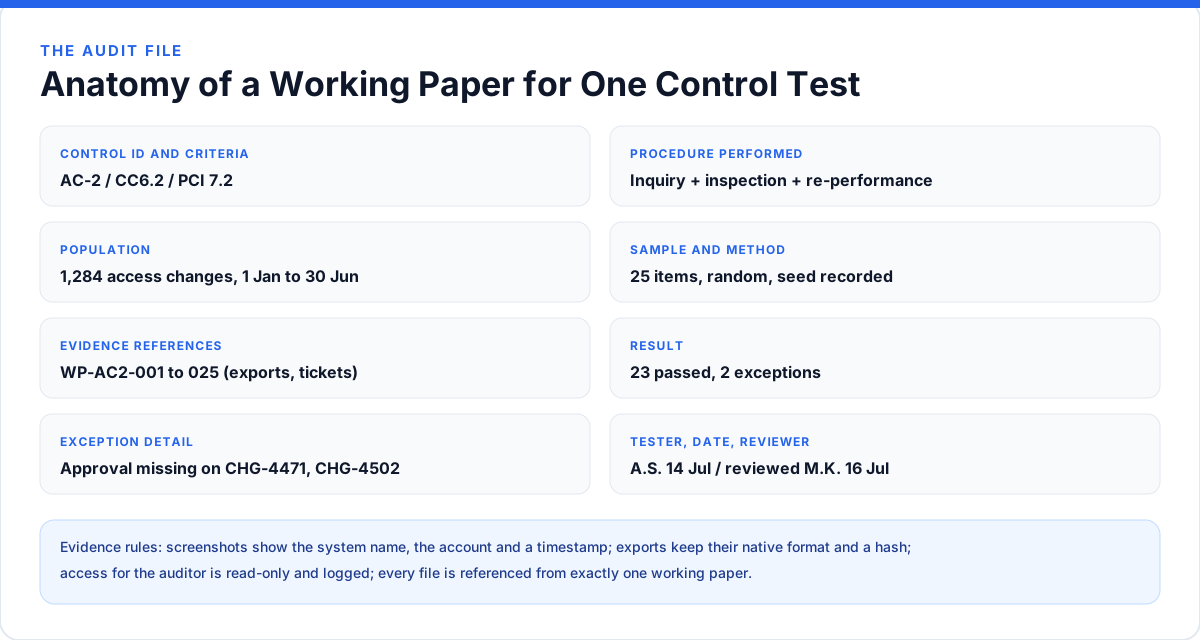
Audit standards describe evidence as needing to be sufficient (enough of it), appropriate (relevant to the assertion and reliable in origin), and obtained by the auditor directly; narration by the auditee does not qualify. In practice that produces a handful of rules worth adopting on the auditee side too:
- Screenshots show the system name, the account used and a visible timestamp; cropped screenshots without context are re-requested.
- Exports keep their native format (CSV, JSON, the console's own report) and travel with a row count and, for anything contested, a hash.
- Evidence generated by the auditor (queries run under the read-only account) outranks evidence prepared by the auditee, and the auditor records the query.
- Each evidence file is referenced from exactly one working paper, so a reviewer can trace any sentence in the report back to a file in minutes.
- The file is retained for the period the framework or the engagement letter specifies, and access to it is restricted, because it is a map of your weaknesses.
Writing It Up
How Findings Are Rated and Written
An exception becomes a finding when it matters, and a finding is only useful when it is written so that the person fixing it, the person funding it and the person auditing it next year all read the same thing. Internal audit practice uses five parts, and security auditors who skip any of them produce reports that get argued about and never acted on.
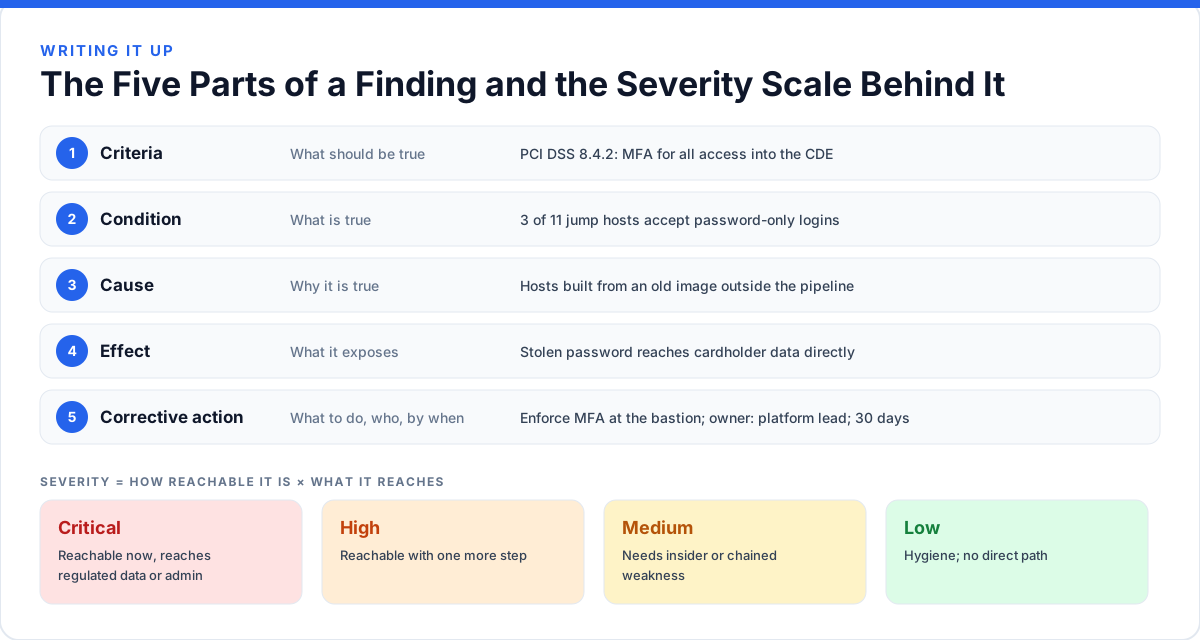
- Criteria: the requirement, quoted. "PCI DSS 8.4.2 requires MFA for all access into the cardholder data environment."
- Condition: what the procedure found, with numbers. "Three of eleven jump hosts accept password-only logins."
- Cause: why, established with the owner. "Built from an older image outside the deployment pipeline."
- Effect: what it exposes, written as the attacker path it opens. "A stolen password reaches cardholder data directly."
- Corrective action: what, who, by when, and what evidence will close it. "Enforce MFA at the bastion; platform lead; 30 days; closure evidence is the bastion policy export and a failed password-only login attempt."
Severity is a judgment, and a defensible one combines two axes: how reachable the weakness is from where an attacker realistically starts, and what it reaches. A missing patch on an isolated test server and the same missing patch on an internet-facing portal with customer data behind it are different findings with the same CVE. Findings are then aggregated: a dozen low-severity exceptions that share a root cause (nobody owns the image pipeline) are reported once, as the high-severity finding they are together.
Framework Differences
Security Audit Procedures by Framework
The procedures above are universal; what changes between frameworks is how prescriptive the procedure wording is and who is allowed to perform it.
| Framework | How procedures are specified | Who performs them | What it means for you |
|---|---|---|---|
| NIST SP 800-53A | Examine, interview, test, with depth and coverage attributes per control | Any qualified assessor; required for federal systems and used for CMMC and NIST 800-171 assessments | The most explicit procedure catalogue; a good basis for any internal methodology |
| PCI DSS v4.0 | A testing procedure printed beside every requirement (examine, interview, observe) | Qualified Security Assessor for a Report on Compliance; self-assessment for smaller merchants | Procedures are mandatory wording, so preparation can be exact |
| SOC 2 (AICPA) | Inquiry, observation, inspection, re-performance against the Trust Services Criteria | Licensed CPA firm | Type 2 tests operation over a period with sampled populations |
| ISO/IEC 27001 with ISO 19011 and 27007 | Audit programme, audit plan, evidence collection, findings, conclusions; risk-based | Accredited certification body for certification; internal auditors for clause 9.2 | Emphasis on the management system and continual improvement, with technical sampling |
| CIS Controls | Self-assessment against safeguards by implementation group | Internal teams, consultants | A practical procedure list for organisations without a regulatory driver |
The same evidence file supports all of them. An organisation that runs its own procedures against NIST SP 800-53A twice a year walks into a SOC 2 Type 2 or an ISO 27001 surveillance audit with the populations, samples and exports already sitting in the folder the auditor will ask for. Our NIST security audit guide covers the mapping between the publications.
The Auditee's Side
How to Prepare for the Procedures
Knowing the procedures changes preparation from guessing to assembling. Six things remove most of the friction:
- Build the evidence list yourself first. For each control in scope, write the population source, the export method and the owner. Hand it to the auditor at kickoff; you will shorten phase 3 by a week.
- Name one owner per domain who can answer inquiry questions and run the exports. Auditors lose days waiting for the one person who knows where the firewall rules are documented.
- Provision read-only audit accounts in advance for the identity provider, the cloud consoles, the scanner and the log platform, with their own logging turned on. Screenshots by your staff are weaker evidence than queries by the auditor.
- Run the reconciliations before the auditor does. Accounts to HR, admins to justification, assets to log sources, vendors to assessments. Every exception you find first is a finding you can close before it is written.
- Keep an evidence room, a folder structure by control with dated exports, so that the artefacts exist as a by-product of operating the controls all year.
- Rehearse the walkthroughs. Pick one change, one new starter, one incident and one restore from the period and follow each from trigger to record. Where the chain breaks is where the finding will be.
The 90-day preparation playbook schedules this work, and internal versus external audits explains which of these procedures your own team can legitimately perform before an external auditor repeats them.
In Practice
How Atlant Security Runs These Procedures
Our IT security audit runs these procedures across 20 NIST SP 800-53 domains against the live environment, with each control evaluated for design and operating effectiveness through interviews, documentation review and technical evidence collection across on-premises, cloud (Azure, Entra ID, Microsoft 365, AWS) and DevSecOps environments. The engagement is fixed-price and agreed in writing, the remediation roadmap is delivered 14 days from kickoff, and you read the full report before you pay.
What the published tiers cover:
- Essentials Audit, from $5,000: the core control families for a smaller estate, with the findings report and roadmap.
- Comprehensive Audit, from $12,000: all 20 domains with technical procedures across on-premises and cloud, the compliance gap matrix and the information security program plan.
- Enterprise Audit, from $25,000: multi-entity or multi-region scopes, extended sampling, and board-level reporting.
- Every tier maps findings to SOC 2, ISO 27001, NIST 800-171, CMMC and HIPAA so the same evidence serves whichever framework your customer asks about.
The deliverables are the ones this guide describes: an executive summary, a technical findings report written in the five-part format, a compliance gap matrix and a program plan, backed by a working-paper file you can hand to your next auditor.
Common Questions
Frequently Asked Questions
What are security audit procedures?
Security audit procedures are the specific actions an auditor performs to obtain evidence about a control: asking the owner how it works (inquiry), watching it operate (observation), examining the records it produces (inspection) and repeating it independently (re-performance). NIST SP 800-53A calls these examine, interview and test. Together they let the auditor conclude whether a control is designed properly and operated consistently over the period.
What is the difference between an audit checklist and audit procedures?
A checklist lists the controls to look at. Procedures describe how each control is tested: which population is pulled, how many items are sampled, what is inspected or re-performed, and what evidence proves the result. Two auditors can use the same checklist and reach different conclusions if their procedures differ in depth.
What are the four types of audit procedures?
Inquiry, observation, inspection and re-performance, in rising order of evidence strength. Some methodologies add analytical procedures (comparing data across periods or sources) and recalculation, which is a form of re-performance. Serious audits combine at least two procedures per control and rely on inspection and re-performance for the controls that protect regulated data or privileged access.
How many samples does a security auditor test?
It depends on how often the control runs. Ranges commonly used in SOC 2 and internal-control audits are one item for an annual control, two for quarterly, two to five for monthly, five to fifteen for weekly, twenty to forty for daily, and twenty-five to sixty for controls that run many times a day. Each firm publishes its own ranges, and samples grow when earlier periods produced exceptions or the population is unusually large.
What is the difference between testing design and testing operating effectiveness?
A test of design asks whether the control would address the risk if performed as described, and is answered with a walkthrough of one instance plus a review of the policy and configuration. A test of operating effectiveness asks whether the control was performed consistently over the whole period, and is answered by sampling the full population and inspecting or re-performing each sampled item. A SOC 2 Type 1 report covers design at a date; a Type 2 report covers operation over a period.
How long do security audit procedures take?
For a focused scope, planning takes one to two days, fieldwork and technical procedures one to two weeks, and analysis plus reporting two to three days; a fixed-scope IT security audit delivers its roadmap 14 days from kickoff. Enterprise and multi-entity audits run for several weeks, almost all of it in control testing. Preparation on the auditee side, especially a ready evidence list and read-only audit accounts, is what moves an audit from weeks to days.
What counts as audit evidence?
Evidence must be sufficient and appropriate: enough of it, relevant to the assertion, and reliable in origin. Exports from systems of record with row counts, configuration files, tickets with approvals, logs with timestamps, screenshots that show the system, account and time, and the auditor's own query results all qualify. Verbal assurance, undated screenshots and spreadsheets assembled by hand are weak evidence and usually re-requested.
Is a penetration test an audit procedure?
It can be one. When a control failure would expose regulated data or administrative privilege, an auditor may commission or review a scoped manual penetration test to prove exploitability with a working attack path, and the report becomes audit evidence. A penetration test on its own is a different engagement: it tests the attacker's path through your systems, while an audit tests the design and operation of the whole control set.
Want the procedures run against your estate?
Tell us what framework your customers or regulators are asking about and what is in scope. We will send a fixed price in writing and a 14-day plan that names the evidence we will ask for on day one.
Related Reading
Published: October 2026 · Author: Alexander Sverdlov, Atlant Security
This guide describes audit procedures as practised under NIST SP 800-53A, PCI DSS v4.0, the AICPA attestation standards for SOC 2 and ISO 19011 with ISO/IEC 27007. Sample size ranges are common practice and vary by firm and by framework. Nothing here replaces the procedures your own auditor or certification body specifies for your engagement.
Related services from Atlant Security: IT Security Audit, Penetration Testing, SOC 2 Readiness. Book a discovery call to discuss your specific situation.
Want to know where you stand before the auditor arrives?
A fixed-price IT security audit answers that in 14 days: 20 NIST 800-53 domains checked against your live environment, each control tested for design and operation, findings written in the five-part format with named owners. You read the full report before you pay.
See what the 14-day audit covers