

There is a persistent confusion I run into on almost every engagement: people use "security audit," "vulnerability scan," and "penetration test" as if they mean the same thing. They do not, and treating them as interchangeable is how organizations end up with a folder full of green checkmarks and a network an attacker walks through in an afternoon. A penetration test is a specific, high-value component of a proper IT security audit, and understanding exactly what it does, and does not do, changes how much value you get from the whole exercise.
I have run and overseen well over 200 assessments across 14 countries since 2013, and the pattern is consistent. The organizations that get real value treat penetration testing as the adversarial reality check inside a broader audit, not as a box to tick. Here is how the pieces fit together and how to make sure your money buys genuine security instead of a nice-looking report. How we scope and evidence a test that sits inside an audit is laid out on our penetration testing services site.
Audit, Scan, and Pentest: Three Different Things
Let me draw the lines clearly, because the distinction is the whole point.
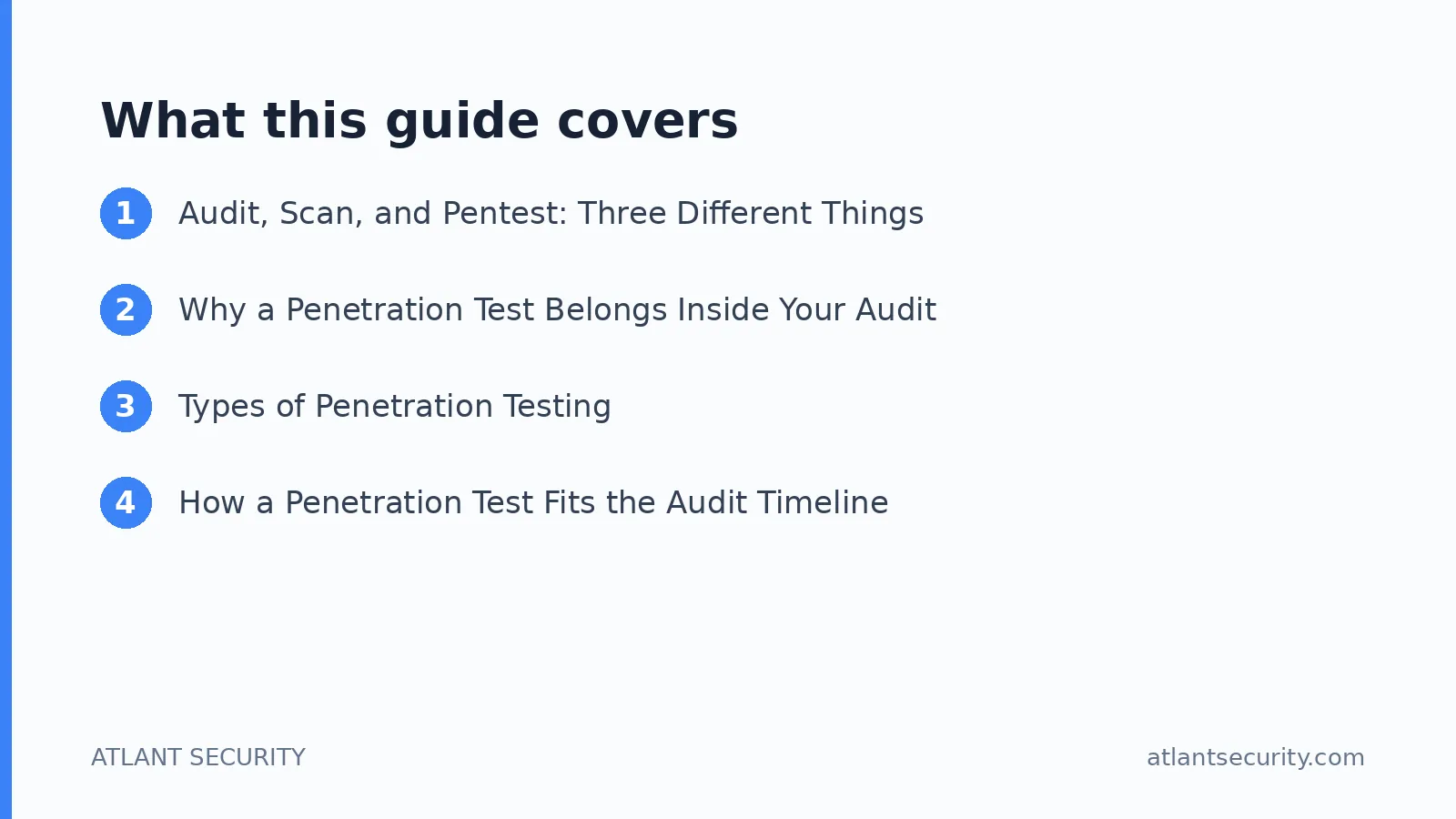
- An IT security audit is the broad evaluation of your security posture against a standard or set of controls. It examines policies, configurations, access management, patching, and processes. It answers "are the right controls in place and working?"
- A vulnerability scan is an automated tool that checks systems against a database of known weaknesses. It is broad, fast, and cheap, but it only finds what it has signatures for and it does not confirm whether a flaw is truly exploitable.
- A penetration test is a human expert actively trying to break in, chaining weaknesses together the way a real attacker would. It answers the question the other two cannot: "if someone genuinely tried, could they get in, and how far?"
The audit tells you whether the controls exist. The penetration test tells you whether they actually hold up under pressure. You need both, and confusing one for the other leaves a dangerous blind spot. This is exactly why our IT security audit engagements incorporate hands-on testing rather than paperwork review alone.
Why a Penetration Test Belongs Inside Your Audit
An audit that only reviews documentation and configurations has a fundamental limitation: it assumes controls work as intended. Real attackers do not care about your intentions. They care about the gap between how a system is supposed to behave and how it actually behaves under a determined, creative assault.
Here is what penetration testing adds that a paper audit cannot:
- Proof of real-world exploitability. A scanner reports a "medium severity" finding. A pentester shows that combining that medium finding with two other overlooked issues gives full domain administrator access. Context changes everything.
- Attack chaining. Real breaches rarely come from one big flaw. They come from stringing together several small ones. Only a human tester replicates that chaining.
- Validation of detection. A good test tells you not just whether the attacker got in, but whether your team noticed. Silence during a penetration test is a finding in itself.
- Prioritization grounded in reality. Instead of a scanner's undifferentiated list of 500 issues, you get a ranked picture of what an attacker would actually exploit first.
Types of Penetration Testing
Not all penetration tests are the same, and choosing the right scope matters for getting useful results.
By knowledge level
- Black box. The tester starts with no inside information, simulating an external attacker with nothing but your company name. Realistic, but slower and may miss internal issues.
- Gray box. The tester has limited knowledge, such as a standard user account. This is my usual recommendation because it balances realism with efficiency and reflects the common "attacker who phished one employee" scenario.
- White box. The tester has full information, including architecture and sometimes source code. Most thorough for finding the deepest issues, ideal for critical systems.
By target
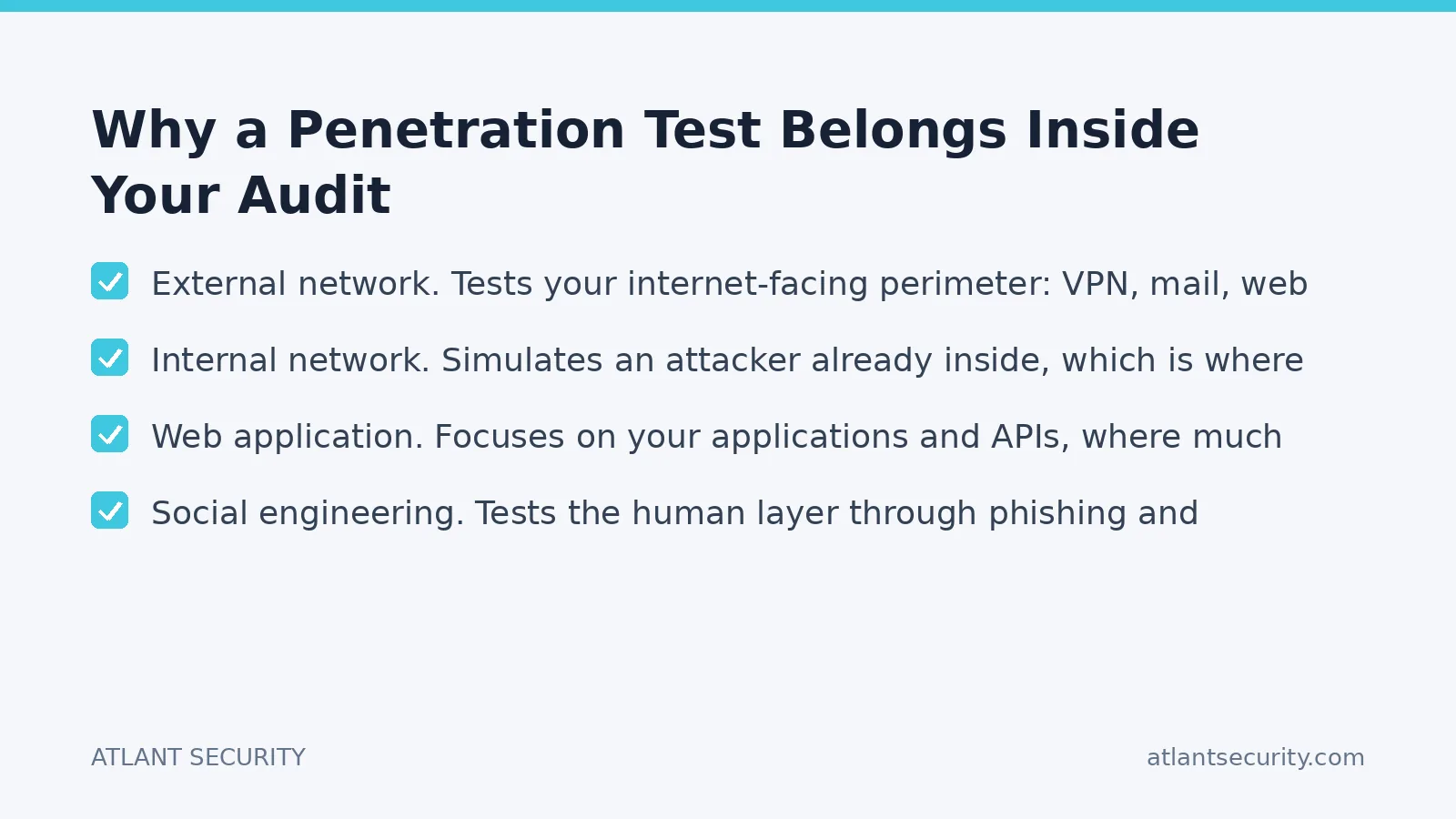
- External network. Tests your internet-facing perimeter: VPN, mail, web servers.
- Internal network. Simulates an attacker already inside, which is where Active Directory weaknesses usually turn a single foothold into total compromise.
- Web application. Focuses on your applications and APIs, where much of modern risk concentrates.
- Social engineering. Tests the human layer through phishing and pretexting, since people are the most common entry point.
How a Penetration Test Fits the Audit Timeline
| Stage | What Happens | Output |
|---|---|---|
| Scoping | Define targets, rules of engagement, goals | Agreed scope and constraints |
| Reconnaissance | Map the attack surface | Inventory of exposed assets |
| Exploitation | Actively attempt to breach and chain flaws | Confirmed, proven attack paths |
| Post-exploitation | Assess how far access reaches | Business-impact picture |
| Reporting | Document findings and fixes by priority | Actionable remediation plan |
| Retest | Verify fixes actually closed the gaps | Confirmation of remediation |
That last row, the retest, is where a lot of engagements fall short. A finding is not closed because someone marked a ticket "done." It is closed when a tester confirms the fix actually works. Insist on a retest as part of the scope.
Penetration Testing and Compliance
Many frameworks either require or strongly expect penetration testing as part of demonstrating a mature security program. If you are pursuing certification or attestation, the test does double duty: it hardens your defenses and it satisfies the assessor.
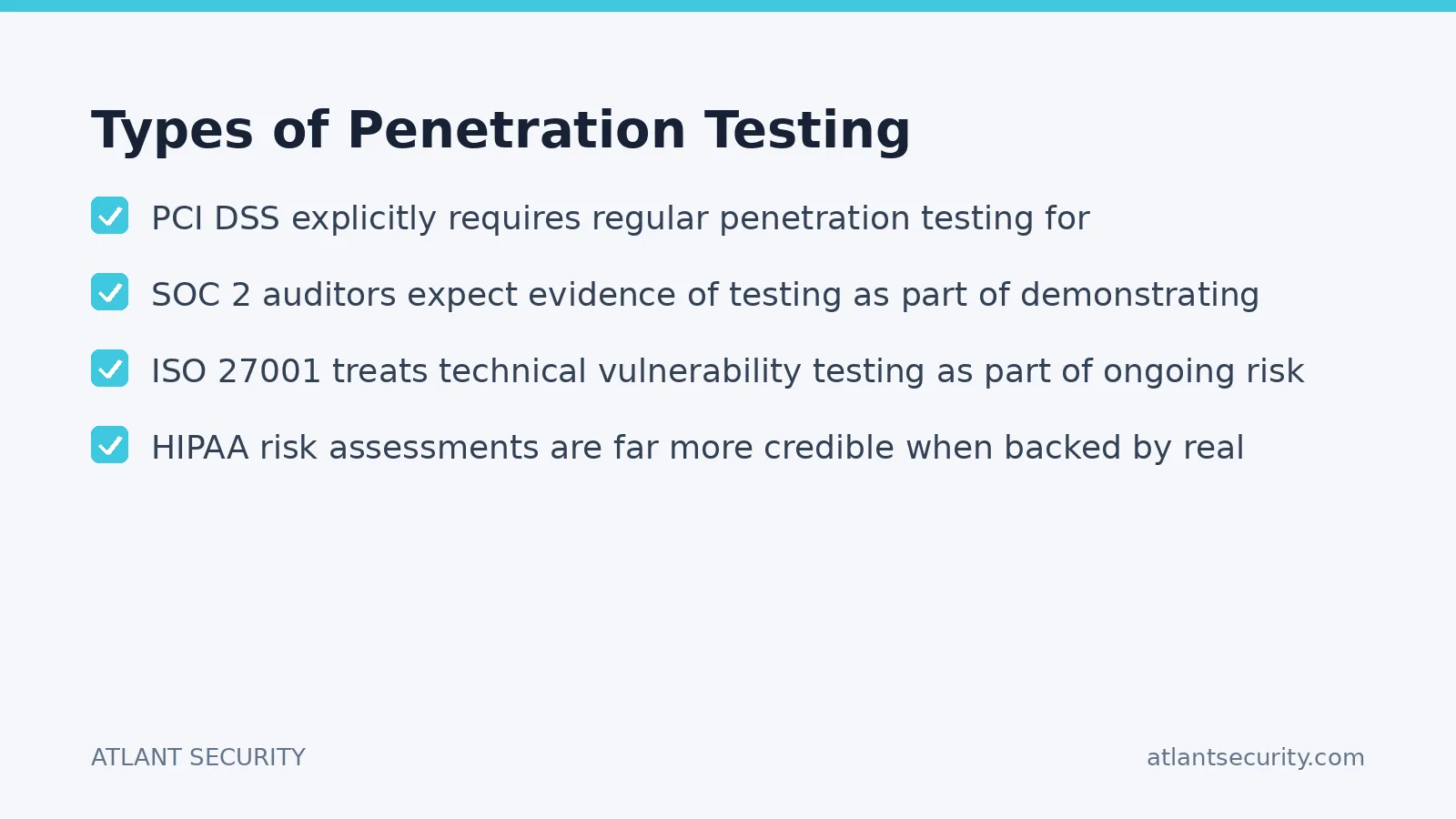
- PCI DSS explicitly requires regular penetration testing for organizations handling cardholder data.
- SOC 2 auditors expect evidence of testing as part of demonstrating effective controls, and it strengthens your SOC 2 readiness considerably.
- ISO 27001 treats technical vulnerability testing as part of ongoing risk management.
- HIPAA risk assessments are far more credible when backed by real testing of the systems handling protected health information.
A word of caution, though: passing a compliance-driven test is the floor, not the ceiling. I have seen organizations pass a narrowly scoped PCI test and remain trivially breachable everywhere the scope did not reach. Scope your testing around real risk, not just the minimum the standard demands.
What Separates a Good Penetration Test From a Bad One
The market is full of "penetration tests" that are really just a vulnerability scan with a logo on the report. Here is how to tell you are getting the real thing.
- Manual effort dominates. Automated tools are a starting point, not the deliverable. Real testing is a skilled human chaining findings that no scanner would connect.
- The report explains impact, not just findings. A good report tells a story: here is how we got in, here is how far we got, here is what it means for your business, here is what to fix first.
- Findings are prioritized and actionable. Not a raw dump of severity ratings, but clear guidance a real team can execute.
- A debrief conversation is included. The tester walks your team through the attack paths so you learn, not just receive a PDF.
- Retest is offered. The engagement is not complete until fixes are verified.
If a proposal is priced suspiciously low and promises results in two days, you are almost certainly buying an automated scan dressed up as a penetration test. Our penetration testing services are built around manual, expert-led testing precisely because the automated-only approach gives false confidence.
Common Findings I See Again and Again
After hundreds of engagements, the same handful of issues account for the majority of successful break-ins. If you fix these before the test, you get more value from it, because the tester spends time on subtle problems instead of the obvious ones.
- Weak and reused passwords on privileged accounts, still the fastest way into most networks.
- Missing multi-factor authentication on remote access and email, turning a single stolen password into full access.
- Unpatched internet-facing services that were vulnerable for months before anyone tested.
- Over-permissioned accounts and flat networks that let one foothold become total compromise.
- No detection whatsoever, so the tester operates for days without a single alert firing.
None of these are exotic. They are the unglamorous fundamentals that get deferred until a test, or a real attacker, forces the issue. A penetration test that keeps finding the same basics year after year is telling you the problem is not the test; it is that remediation never actually happens.
The economics of this changed recently. AI penetration testing runs the same OWASP Top 10, API, cloud and network checks a human tester works through, chains the findings into proof-of-concept evidence, and returns results in five to ten days with retesting included once you have fixed things. That turns testing after every release from an aspiration into a line item.
How Often Should You Test?
At minimum, annually, and after any significant change: a new application, a major infrastructure shift, a merger, or a move to a new cloud environment. Attackers do not wait a year between attempts, and neither should your validation. For fast-moving environments, a continuous or more frequent testing cadence, sometimes combined with ongoing vulnerability assessment, keeps pace with change far better than a once-a-year snapshot.
Frequently Asked Questions
What is the difference between a vulnerability scan and a penetration test?
A vulnerability scan is an automated tool that checks systems against a database of known weaknesses. It is fast and broad but cannot confirm whether a flaw is truly exploitable. A penetration test is a human expert actively trying to break in, chaining weaknesses together the way a real attacker would, and proving what an intruder could actually achieve. You need both.
How is a penetration test part of an IT security audit?
An IT security audit evaluates whether the right controls exist and are configured correctly. A penetration test validates whether those controls actually hold up against a determined attacker. The audit tells you the controls are present; the test proves whether they work. Combining them gives a complete picture instead of a paper-only assessment.
How often should we conduct penetration testing?
At least once a year and after any significant change such as a new application, major infrastructure shift, merger, or cloud migration. Attackers do not pause between attempts, so annual testing is a floor. Fast-changing environments benefit from more frequent testing combined with ongoing vulnerability assessment.
Does penetration testing satisfy compliance requirements?
It supports many frameworks. PCI DSS explicitly requires it, while SOC 2, ISO 27001, and HIPAA assessments are far more credible when backed by real testing. Be aware that a narrowly scoped compliance test is the minimum, not real security. Scope testing around actual risk, not just the standard's baseline.
How can I tell a real penetration test from a glorified scan?
Real testing is dominated by manual, expert effort, produces a report that explains attack paths and business impact rather than a raw list of findings, prioritizes fixes clearly, includes a debrief, and offers a retest to verify remediation. Suspiciously cheap, two-day engagements are usually automated scans with a nicer cover page.
The Bottom Line
A penetration test is the adversarial reality check that turns an IT security audit from a documentation exercise into genuine assurance. The audit confirms your controls exist; the test proves whether they survive contact with a real attacker. Skip the test and you are trusting that everything works as designed, which is exactly the assumption every breach victim made.
If you want testing that reflects how attackers actually operate, complete with proven attack paths, clear priorities, and a retest to confirm the fixes held, get in touch. We will scope it around your real risk, not the minimum a checklist demands.
