
Penetration Testing
Cloud Pentest: Penetration Testing That Proves What One Leaked Key Can Reach. Report in 14 Days, Free Retest.
In AWS, Azure and GCP the perimeter is an identity, so we measure the distance that matters: how many role assumptions sit between a leaked access key and your production database.
Our cloud pentest is scoped around the six boundaries that decide what a compromised identity can reach: IAM and privilege escalation, storage and snapshots, metadata and pipeline secrets, Kubernetes and serverless, network paths, and the hybrid trust from on-premises Active Directory. Every finding is a proven path with its business consequence and the API calls that reproduce it. Fixed price, report in 14 days, free retest.
- Attack paths chained from one identity, with the API calls that prove each step
- Every finding mapped to a CIS Benchmark recommendation and the control your auditor will cite
- Written rules of engagement inside AWS, Azure and Google Cloud terms, with a stop condition

Senior-led testing scoped to the way a cloud estate is built: accounts, the pipeline that deploys into them, the clusters inside, and the directory that signs everyone in.
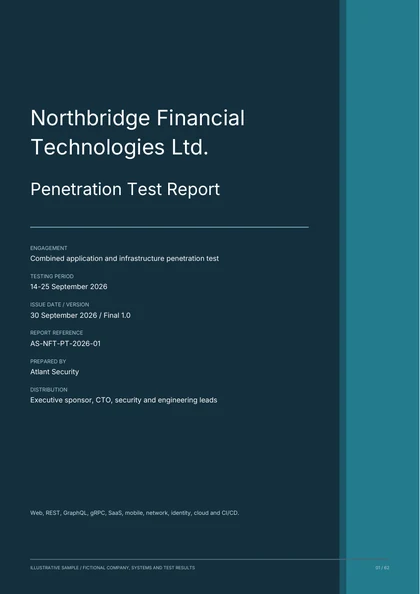
SEE THE DELIVERABLE
See what a useful
penetration test report looks like.
Review a combined engagement covering web, REST and GraphQL APIs, gRPC, SaaS tenant isolation, Android and iOS, networks, cloud, identity and CI/CD. Includes technical evidence, remediation and retest criteria.
62 pages. 24 findings. 14 charts, diagrams and matrices.
Illustrative penetration test. The organisation, systems and findings are fictional.
Get the sample report
A free PDF. Enter your email and company name, and we’ll email you a download link.
DEFINE YOUR SCOPE
Turn your testing requirements into a clear RFP.
Build one request for your applications, APIs, networks, and cloud. Review the scope, download your document, and send a copy to your inbox and our team.
REQUEST RECEIVED
Your RFP is submitted.
Reference: . Email copies are being sent to and Alexander at Atlant Security. Check your spam folder if needed.
You can also book a call to discuss the scope.

Leads every cloud pentest personally, runs the remediation workshop with your engineers and signs the attestation letter your auditor reads.
Connect on LinkedIn01 / THE DETAIL
What a Cloud Pentest Actually Tests
A cloud pentest scopes by what an identity can reach, because in AWS, Azure and GCP a policy document decides more than a firewall rule does. Six boundaries cover almost every environment we assess.
Identity and privilege escalation
IAM users, roles, service principals and service accounts: who can pass a role, attach a policy, update a function or assume into another account, chained from the identity you give us to the highest it can reach.
Storage and data exposure
S3, Blob Storage and Cloud Storage, plus the places teams forget: snapshots shared with every account, backups in a second region, a SAS token in a repository, read as an anonymous user and as a low-privilege identity.
Metadata, pipelines and secrets
The instance metadata service behind an image fetcher, the deploy key printed into a build log, the access key in a pipeline variable. One reachable secret starts most paths on this page.
Kubernetes, containers and serverless
EKS, AKS and GKE: cluster-admin bindings, pod identities and node roles that reach the cloud account, containers that reach the node, and functions whose execution role reads every secret.
Network paths and managed services
Security groups and NSGs open to the world on management ports, peering that flattens segmentation, private endpoints that were never made private, and managed databases reachable from the wrong subnet.
Hybrid trust from on-premises AD
Directory synchronisation, federation and the sync server itself: whether a standard domain user becomes a tenant administrator, and whether a compromised cloud identity flows back into the domain.
02 / THE DETAIL
The Attack Paths That Repeat in AWS, Azure and GCP
These are the findings that recur across the cloud environments we assess, from a single account with one cluster to a multi-account organisation synchronised from on premises. Nothing on this list needs an unpatched system; each one is a permission somebody granted.
A long-lived access key in a build log
Created for a deploy script, committed to a repository, printed by a CI job, never rotated, and still attached to iam:PassRole and s3:* on every resource.
A function that runs as administrator
A developer role may create functions and pass any existing role to them. One of those roles carries AdministratorAccess. One invocation returns administrator credentials.
Metadata credentials behind a web form
A server-side request forgery in an image fetcher reaches the metadata service and returns the instance role’s credentials (OWASP Top 10 A10:2021 Server-Side Request Forgery). On AWS, requiring IMDSv2 closes the simple form.
A public snapshot or a readable bucket of backups
A database snapshot shared with all accounts, a SAS token that never expires, a bucket of nightly dumps whose policy names every principal. The data leaves with every API call returning 200.
Cluster-admin for every pod
A default service account bound to cluster-admin, a pod that mounts the node’s root filesystem, a node role that reads every secret. One container becomes the cluster, then the account.
The sync server that holds both sides
The directory sync server holds a domain account that may replicate password hashes (DCSync, MITRE ATT&CK T1003.006) and a cloud account with a privileged directory role. A domain user who reaches it reaches every synced identity.
03 / THE DETAIL
What the Report Has to Prove, and to Whom
A cloud pentest report has three readers. Your platform engineers want the API call and the Terraform change that closes each path. Your auditor wants evidence that an independent party tested the environment and the risk was closed. Your customers want a date, a scope and a signed letter for the questionnaire.
Ours carries all three. Each finding names the CIS Benchmark recommendation it breaks where one applies, and the SOC 2, ISO 27001 or NIST SP 800-53 control it bears on. The executive summary states what a compromised identity could reach in two paragraphs; the retest and the attestation letter close the audit file.
For a SOC 2 audit the pentest is the evidence asked for under CC7.1 and CC4.1. For cardholder data the scope follows PCI DSS requirement 11.4, with 11.4.5 segmentation checks for the CDE accounts. Health data maps to HIPAA 164.308(a)(8). EU entities under NIS2 Article 21(2)(e) and (f) or DORA Article 25 get the report mapped to those articles; designated financial entities add threat-led testing under Article 26.

04 / THE DETAIL
Rules of Engagement for Production Cloud Environments
A production tenant is tested under a written agreement your platform lead and your risk owner can both read.
- Nothing persists. We never delete resources, modify production data or leave a backdoor. Everything we create carries an agreed name prefix and is removed before the report is issued.
- Availability is protected. Denial-of-service and flooding techniques are excluded, and windows are agreed for anything that touches a production cluster or database.
- A named contact and a stop condition. One escalation contact on each side, reachable throughout, and a written condition under which testing halts immediately.
- Evidence handling. Customer data encountered is redacted at capture and destroyed on a documented date. Any live key we obtain is reported the same day for rotation.
- Provider boundary respected. AWS lists the services you may test without prior approval, Microsoft requires no notification for your own Azure resources, and Google Cloud needs none inside its acceptable use policy. We test your configuration within those terms; the provider’s own infrastructure stays out of scope.
05 / THE DETAIL
How the Engagement Runs
Five steps: price fixed at the first, report inside fourteen days of the third, attestation letter at the fifth.
Scoping call
Which accounts or subscriptions, which identity we start from, which boundaries your auditor cares about. Fixed price and timeline in writing within 24 hours.
Rules of engagement
Test windows, escalation contacts on both sides, the name prefix for anything we create, and a written stop condition.
Manual testing
Senior-led, from the identity you give us outward: escalation chains, storage, pipeline secrets, clusters, network paths and the hybrid trust, each action timestamped against your logs.
Report and workshop
Findings register with the API calls and infrastructure-as-code changes that close each path, an executive summary with control mapping, and a live session with your engineers.
Retest and attestation
Free retest after you fix, then an attestation letter signed by a named qualified individual for the audit file and the customer questionnaire.
06 / PRICING
Cloud Pentest Pricing
Each scope is a fixed price agreed in writing. Larger or combined scopes are priced in one proposal with volume pricing, and you approve the total before anything starts.
| Scope | What is covered | Testing | Price |
|---|---|---|---|
| Cloud infrastructure | One AWS, Azure or GCP environment: IAM, storage, secrets, clusters, network | 7-10 days | From $6,000 |
| External perimeter | Public IP ranges, load balancers, management ports, DNS, mail | 5-7 days | From $4,000 |
| Internal network and Active Directory | Internal ranges plus the privileged path into the tenant | 7-10 days | From $5,000 |
| Web application | 1 application, all roles | 7-10 days | From $5,000 |
| API | Up to 50 endpoints behind API Gateway or API Management | 5-7 days | From $4,000 |
| SaaS multi-tenant platform | Tenant isolation in the application and the account beneath it | 10-14 days | From $6,000 |
Every scope includes the findings register with CLI and infrastructure-as-code remediation, the executive summary with control mapping, the remediation workshop, a free retest and the attestation letter. A CIS Benchmark configuration review without exploitation is described under AWS security assessment and cloud security consulting; the full price list is on the pricing page.
For small projects and ad-hoc work outside our pre-agreed packages or retainers, our standard hourly rate is $460.
07 / THE DETAIL
Cloud Pentest or Vulnerability Scan
A CSPM dashboard and a vulnerability scanner answer one question: what is misconfigured. A pentest answers the other: what a misconfiguration lets an identity do. Auditors ask for both.
08 / THE DETAIL
Who Commissions a Cloud Pentest
09 / THE DETAIL
Find Out What One Leaked Key Can Reach
One scoping call. Bring your architecture diagram, your last CSPM export, your auditor’s request, or nothing at all. You will leave with a scope written as questions, a fixed price, and a date for the report.
Scope My Cloud Pentest10 / THE DETAIL
Book the Scoping Call
Choose a time for your scoping call.
11 / FAQ
Cloud Pentest FAQ
What is a cloud pentest?
How is a cloud pentest different from a CSPM tool or a vulnerability scan?
Do we need to tell AWS, Azure or Google before you test?
What access do you need, and do you also test from the outside?
Is it safe to test our production environment?
Do you test Kubernetes, containers and serverless functions?
Do you test our CI/CD pipelines and repositories?
Do you test the path from our on-premises Active Directory into the tenant?
Which compliance requirements does a cloud pentest satisfy?
What does the report include, and who is it written for?
How long does a cloud pentest take, and what does it cost?
12 / THE DETAIL
Related Services
Penetration testing - AWS security assessment - Cloud security consulting - SaaS pentest - API pentest - Network pentest - Active Directory security assessment - SOC 2 compliance - continuous penetration testing with Pentestas