
SaaS Security Assessments & Audits
DFNS & Stablecoin Configuration Audit
Audit Your DFNS Configuration and Stablecoin Operations. Examiner-Ready Report in 4 Weeks.

Expert Led
Microsoft Alumni Leadership
SEE THE DELIVERABLE
See what a useful
audit report looks like.
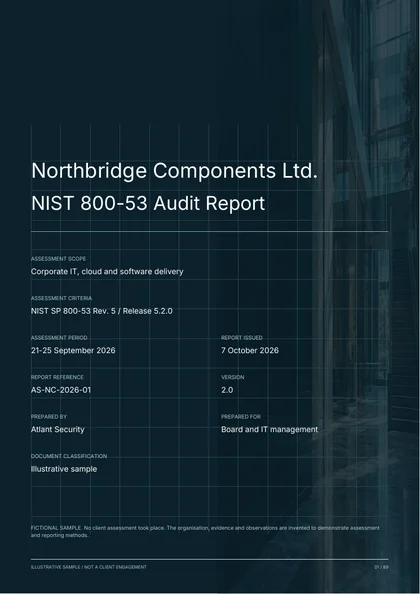
Review 120 assessment tests across all 20 NIST SP 800-53 control families, including AWS, Microsoft 365, secure software development and DevSecOps. Includes technical findings and a 12-month remediation plan.
89 pages. 20 control families. 32 findings. 13 graphs and diagrams.
Illustrative NIST SP 800-53 assessment. The organisation, evidence and findings are fictional.
Get the sample report
A free PDF. Enter your email and company name, and we’ll email you a download link.
01 / THE DETAIL
What is DFNS & Stablecoin Configuration Audit?
For small projects and ad-hoc work outside our pre-agreed packages or retainers, our standard hourly rate is $460.
02 / THE DETAIL
Who Needs DFNS & Stablecoin Configuration Audit?
Banks Issuing Stablecoins - FDIC-supervised banks, OCC-chartered trust companies, state-chartered crypto banks, and international banks under MiCA, FINMA, or MAS launching USD, EUR, or commodity-backed stablecoins. Whether you are pre-launch, pre-examiner, or post-incident.
Fintechs and Neobanks Issuing Tokenized Value - payment fintechs, lending platforms, and neobanks issuing branded stablecoins, deposit tokens, or tokenized cash equivalents through DFNS, Fireblocks, or similar infrastructure. SOC 2 and ISO 27001 do not cover this surface; this audit does.
Wallet-as-a-Service Operators - WaaS providers offering custody, signing, or policy services to downstream clients. Your own configuration is your product's security posture. Customers and their regulators will increasingly ask for evidence of an independent review.
Regulated Custodians and Trust Companies - qualified custodians and trust companies holding digital assets for institutional clients. The operational control plane - DFNS, Fireblocks, BitGo, Copper, Anchorage - is your single point of trust.
Tokenization Platforms and RWA Issuers - real-world asset tokenization platforms, money market fund token issuers, and treasury bill tokenization operations. The mint, burn, and transfer authority configuration is the audit surface regulators care about most.
Stablecoin Issuers Preparing for MiCA - EU-licensed e-money institutions and credit institutions issuing electronic money tokens or asset-referenced tokens under MiCA. The operational risk and outsourcing requirements in MiCA map directly to the domains in this audit.
Ready to get started?
Get Your Scope and Price with our Microsoft Security alumni. Fixed-price proposal within 24 hours.
03 / THE DETAIL
Our Methodology
Scoping Call & Document Request
Free, confidential 30-minute call. NDA on request. We understand your product, your wallet platform, your chains, and your regulator. You receive a fixed-price scope document and document request list within 24 hours.
Walkthrough & Evidence Collection
Two to three structured walkthrough sessions covering tenant tour, user and permission inventory, policy review with a live policy test, on-chain authority verification, and the dealer or counterparty integration flow. Conducted via screen-share or read-only API access.
Analysis & Framework Mapping
Every finding rated Critical, High, Medium, or Low. Each finding mapped to FFIEC, FDIC, NYDFS, MiCA, FATF, and NIST CSF as applicable. Remediation prioritized by risk and implementation complexity.
Report Delivery & Examiner Briefing
Final report delivered in week 4. Technical Findings Report for engineering and operations, Executive and Examiner Summary for risk committee and regulator. Includes findings walkthrough call and compliance advisory call.
04 / DELIVERABLES
What You Get with DFNS & Stablecoin Configuration Audit
- User and Identity Inventory - every human user, service account, application, and personal access token enumerated and mapped to a real person or system
- Permission Model Review - effective permissions per principal, least-privilege analysis, identification of over-privileged operators and orphaned credentials
- Policy Rule Engine - approval quorums, threshold rules, velocity limits, allowlists, blocklists, and whether the policy itself is protected from unauthorized modification
- Segregation of Duties - whether initiators and approvers are actually independent, whether risk and compliance sit in the approval group, whether one team can complete a mint unilaterally
- Credential Hygiene - WebAuthn or passkey enforcement, MFA coverage, recovery credential setup, credential rotation, and detection of stale or shared credentials
- Mint, Burn, and Redeem Flows - end-to-end review of how new supply enters circulation and exits it, who authorizes each step, and where reconciliation breaks happen
- On-Chain Token Authorities - SPL token mint, freeze, close, and update authorities on Solana; ERC-20 role configuration on Ethereum; Token-2022 extension review; multisig and timelock placement
- Freeze Authority and OFAC Readiness - whether freeze authority is retained, who can exercise it, the documented procedure, and time-to-freeze tested against a tabletop scenario
- Dealer and Counterparty Onboarding - third-party due diligence aligned with the 2023 Interagency Guidance, KYC and AML touchpoints, contractual security obligations
- API and Integration Security - backend integration authentication, API credential storage and rotation, IP allowlisting where supported, replay and idempotency protection
- Webhook Configuration - signature verification, replay protection, endpoint hardening, and downstream event handling
- Logging, Monitoring, and SIEM Ingestion - coverage of sensitive events (policy changes, permission changes, signing operations), retention period, alerting thresholds, and incident detection latency
- Key Recovery and Disaster Recovery - recovery credential custody, geographic distribution, recovery procedure documentation, last-tested date, and tabletop exercise
- Change Management - how policy changes, permission changes, and new wallets are proposed, reviewed, approved, and audited after the fact
- Data Residency and Sovereignty - DFNS or vendor deployment region, data location, contractual residency commitments, and alignment with the bank's regulator expectations
- Reserve and Attestation Controls - for fiat-backed stablecoins: how the bank reconciles on-chain supply with off-chain reserves, attestation cadence, and segregation from operational float
- Incident Response and Forensics - runbooks for lost credential, suspected insider, suspected counterparty compromise, and regulator inquiry
- Vendor Security Posture - review of DFNS, Fireblocks, or your wallet platform's published SOC 2, ISO 27001, and penetration test attestations, and what they do and do not cover
- FFIEC, NYDFS, MiCA, and FATF Mapping - every finding cross-referenced to the specific control objective in the relevant framework, ready for the examiner
- Executive and Board Readiness - a report your CRO, board risk committee, and external examiner can each read at their own depth without separate documents
05 / PRICING
DFNS & Stablecoin Configuration Audit Pricing
Essentials Audit
Initial audit for new stablecoin products and small-footprint deployments.
- Up to 25 users and 10 wallets
- Single chain (Solana, Ethereum, or L2)
- Single wallet platform (DFNS, Fireblocks, or equivalent)
- Up to 5 policies reviewed
- Up to 2 integration counterparties
- Walkthrough-based evidence collection
- Technical Findings Report
- Executive and Examiner Summary
- 4-week delivery
- Compliance advisory call included
Comprehensive Audit
Full-scope audit for scaling issuers and multi-chain operators.
- Up to 100 users and 50 wallets
- Multi-chain (Solana + Ethereum + L2s)
- Single or multi-platform (DFNS + Fireblocks + custody partners)
- Unlimited policies reviewed
- Up to 10 integration counterparties
- Read-only API access where supported
- Technical Findings Report
- Executive and Examiner Summary
- Regulatory Mapping Matrix (FFIEC + NYDFS + MiCA + NIST CSF)
- 8-week remediation roadmap with owner assignments
- Two compliance advisory calls
- 30-day follow-up Q&A
Enterprise & Recurring Audit
Annual program for established issuers, custodians, and WaaS operators.
- Unlimited users, wallets, and chains
- All major wallet platforms
- All applicable regulatory frameworks simultaneously
- Quarterly configuration drift reviews
- Annual full re-audit
- Dedicated engagement manager
- Board-ready quarterly briefings
- Examiner-response support
- Incident-driven re-audit included on request
- Priority response SLA
06 / THE DETAIL
What Our Clients Say
"Alexander is professional, reliable and available. He is clearly an expert in his field. Building trust in cybersecurity is obviously essential and Alexander has constantly demonstrated that my trust is well-placed."
Helen Cook
Principal, GNE Advisory
"The assessment was really imposing and remarkable. It was beyond my expectations, very detailed, and things were very closely inspected and discussed. It was a great experience working with you."
Syed Haris Ahmed
Manager IT Infrastructure, Qordata
07 / FAQ
Frequently Asked Questions
What is a DFNS configuration audit?
A DFNS configuration audit is a structured review of the operational control plane behind your stablecoin or digital asset product, with DFNS as the wallet infrastructure. It covers user and service-account permissions, policy rules, approval quorums, credential hygiene, webhook and logging configuration, on-chain token authorities, and integration controls, mapped to your regulator's framework.
How is this different from a smart contract audit?
A smart contract audit reviews deployed Solidity, Move, or Rust code for exploitable bugs. A configuration audit reviews the operational controls that determine who can call those contracts, with what authority, under what approval workflow. Most stablecoin and custody incidents originate in configuration, not in contract code. A regulated issuer typically needs both.
Do you audit Fireblocks, Copper, BitGo, and Anchorage in addition to DFNS?
Yes. The audit methodology applies to any wallet-as-a-service or institutional custody platform. DFNS, Fireblocks, Copper, BitGo, Anchorage, Coinbase Custody, and similar platforms all expose the same conceptual surfaces - users, permissions, policies, signing, recovery - and our audit covers all of them.
What chains do you cover?
Solana (including SPL and Token-2022), Ethereum and major L2s (Arbitrum, Optimism, Base, Polygon), Avalanche, and Stellar are covered as standard. Other chains by scope on request.
How long does the audit take?
Four weeks from kickoff to final report for a standard engagement. The Comprehensive and Enterprise scopes can extend by one to three weeks depending on the number of integrations and chains.
Will the report satisfy our FDIC, NYDFS, OCC, BaFin, FINMA, or MAS examiner?
The report is structured to anticipate examiner questions and is mapped to the relevant regulatory frameworks for each jurisdiction. Examiners ultimately make their own determinations, but the report is designed to be handed to an examiner without translation. The included compliance advisory call helps you position findings and remediation evidence for the examiner conversation.
Do you require API access to our DFNS tenant?
No. For small and new deployments, screen-shared walkthroughs are sufficient and often preferable. For larger deployments, read-only API access materially reduces walkthrough time. We work to either model.
Can you audit a pre-launch stablecoin?
Yes, and we recommend it. The cheapest time to find a configuration finding is before the first mint, not after the first examiner letter. Pre-launch audits typically scope to the Essentials tier.
Do you provide remediation support after the audit?
The audit fee includes a compliance advisory call and 30 days of follow-up Q&A by email. Deeper remediation support (interim CISO, policy authoring, control implementation) is available through our vCISO services.
Is there an annual or recurring engagement option?
Yes - the Enterprise tier is a recurring annual program with quarterly drift reviews and an annual full re-audit. Most regulated issuers move to this model after the first point-in-time audit.
What does the audit cost?
Essentials engagements start at $30,000. Comprehensive engagements typically range from $55,000 to $75,000. Enterprise recurring programs start at $90,000 per year. Fixed-price after the scoping call, never hourly.
Is the audit disruptive to operations?
No. The walkthroughs typically consume four to eight hours of your team's time spread over two weeks. No production access is required. No transactions are blocked. No customer-facing systems are touched.
Who actually performs the audit?
A senior auditor leads every engagement end to end. We do not outsource, do not staff junior consultants on engagements, and do not use offshore review teams. The same person who runs your scoping call writes the report and presents the findings.
Will you sign an NDA before the scoping call?
Yes. We are happy to sign your NDA before any product or configuration detail is discussed.
08 / THE DETAIL
See Where You Stand
Pick a time that works for you - 30 minutes, no obligation.
Choose a time for your scoping call.