
Penetration Testing
Network Pentest: Penetration Testing That Proves How Far One Workstation Can Reach. Report in 14 Days, Free Retest.
Most networks fall through an ordinary credential. A reused local administrator password, or a service account whose Kerberos ticket cracks overnight, carries an intruder from one workstation to the whole domain.
Our network pentest is scoped around the paths an attacker actually travels: the internet-facing perimeter, lateral movement once someone is inside, the Active Directory privileged paths that end at Domain Admin, and the segmentation meant to keep your card-data and server zones apart from the rest. Every finding is a proven path with the hosts it reaches and the single change that closes it, mapped to the PCI DSS, NIST or DORA control your assessor will cite. Fixed price, report in 14 days, free retest.
- External and internal testing, from the public internet and from a foothold inside
- Active Directory paths walked to Domain Admin, each with the one change that closes it
- Written rules of engagement, agreed windows and a stop condition both sides sign

Senior-led testing scoped the way a network is actually built: an exposed perimeter, a flat core, Active Directory in the middle, and the segmentation meant to hold it together.
SEE THE DELIVERABLE
See what a useful
penetration test report looks like.
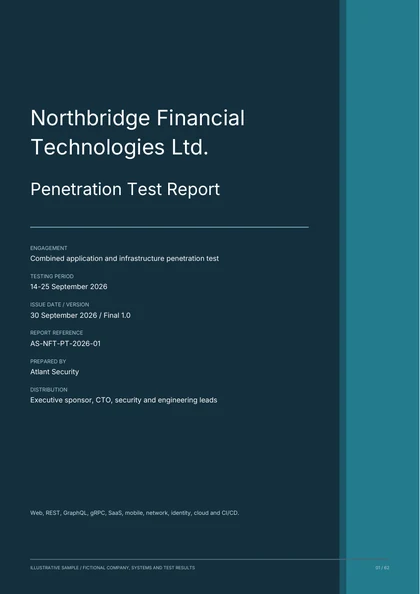
Review a combined engagement covering web, REST and GraphQL APIs, gRPC, SaaS tenant isolation, Android and iOS, networks, cloud, identity and CI/CD. Includes technical evidence, remediation and retest criteria.
62 pages. 24 findings. 14 charts, diagrams and matrices.
Illustrative penetration test. The organisation, systems and findings are fictional.
Get the sample report
A free PDF. Enter your email and company name, and we’ll email you a download link.
DEFINE YOUR SCOPE
Turn your testing requirements into a clear RFP.
Build one request for your applications, APIs, networks, and cloud. Review the scope, download your document, and send a copy to your inbox and our team.
REQUEST RECEIVED
Your RFP is submitted.
Reference: . Email copies are being sent to and Alexander at Atlant Security. Check your spam folder if needed.
You can also book a call to discuss the scope.

Leads every network engagement personally, walks the Active Directory paths by hand, runs the remediation workshop with your engineers and signs the attestation letter your assessor reads.
Connect on LinkedIn01 / THE DETAIL
What a Network Pentest Actually Tests
A network pentest scopes by the paths an attacker travels, because that is how a foothold becomes a breach. Six boundaries cover almost every environment we assess, from a single-site office with one domain controller to a multi-site group carrying trusts from an old acquisition.
External perimeter
Every service you publish to the internet: web and mail servers, VPN and remote access gateways, DNS, and the hosts an old project left exposed and nobody retired.
Internal lateral movement
What a single foothold reaches. Local administrator reuse, cached credentials, open file shares and the management ports that let one workstation become many.
Active Directory privileged paths
The routes from a standard user to Domain Admin: Kerberoastable service accounts, AS-REP roasting, delegation, and certificate services left in an insecure default.
Segmentation between zones
Whether a user network can reach the server and card-data zones it is meant to be walled off from. PCI DSS 11.4.5 segmentation, tested by attempting the crossing.
Management and legacy protocols
Switch, firewall and hypervisor consoles, out-of-band management, and legacy protocols like LLMNR, NBT-NS and unsigned SMB that hand over credentials on a quiet network.
Wireless and remote access
Corporate and guest wireless, pre-shared keys and rogue access points, plus the VPN and split-tunnelling paths that connect a home or branch network to the core.
02 / THE DETAIL
The Attack Paths That Repeat in Networks
These recur across the environments we assess, from a flat single-domain office to a group carrying old acquisition trusts. Most are invisible to a vulnerability scanner because every box is patched. The weakness is in who can reach what, and which credential unlocks the next host.
A service account with a crackable password
The account that runs backups, monitoring or a database job, registered with a weak password years ago and never rotated. Kerberoasting pulls the ticket and it cracks offline.
One local administrator password on every machine
A single local admin credential imaged across the whole fleet. One workstation gives up the hash and it unlocks all the others, with no exploit involved.
LLMNR and NBT-NS poisoning on a flat network
Legacy name resolution left enabled hands an attacker a credential from any workstation that mistypes a share name. Minutes of listening, a domain account captured.
Certificate services in their default state
A template that lets a standard user request a certificate for any identity. One request becomes authentication as Domain Admin, the ESC1 class of misconfiguration.
A forgotten internet-facing host
An old VPN appliance, test server or management portal still published, still running a version with a public exploit, outside the patch programme nobody mapped it to.
A flat path between office and card-data
Firewall rules meant to isolate the cardholder environment that still allow a management port or a dual-homed host to bridge in from an ordinary user network.
03 / THE DETAIL
What the Report Has to Prove, and to Whom
A network pentest report answers to two readers. Your engineers want reproduction steps and a fix. Your assessor wants proof that you tested inside and outside, understood the exposure and closed it. We write both into one document.
Every finding carries the control it bears on. For card environments the external, internal and segmentation checks are scoped to PCI DSS requirement 11.4. For US public-sector and defence suppliers the test supports the NIST SP 800-171 assessment that CMMC Level 2 relies on.
For EU financial entities it feeds DORA Article 25 testing, and designated entities move on to threat-led testing under DORA TLPT. A full configuration review of the directory is the Active Directory security assessment.

04 / THE DETAIL
Rules of Engagement for Live Network Infrastructure
Testing a live network is a safety exercise as much as a security one. Before a single packet is sent in anger, both sides sign rules that a change-advisory board can read.
- Destructive techniques excluded. We avoid denial-of-service, we do not run exploits that risk corrupting a service, and fragile legacy hosts are agreed as read-only before testing starts.
- Agreed windows. Anything that touches production routing, authentication or the core switch fabric runs inside a window you set, with rollback steps written down before use.
- A named contact and a stop condition. One escalation contact on each side, reachable throughout, and a written condition under which testing halts within minutes.
- Evidence handling. Any credentials or data we capture are held encrypted for the engagement only and destroyed on a documented date. Captured hashes are wiped at the end.
- Platform and vendor boundary. Hosted and managed infrastructure is tested at the access surface you control, inside the rules of engagement each cloud provider publishes for AWS, Azure and GCP.
05 / THE DETAIL
How the Engagement Runs
Five steps, the price fixed at the first one, the report inside fourteen days of the third.
Scoping call
Which ranges are external, which are internal, whether Active Directory and segmentation are in scope, and where the card-data environment sits. Fixed price and timeline in writing.
Rules of engagement
Test windows, escalation contacts on both sides, the no-destructive-technique rule, the legacy hosts held read-only, and a written stop condition.
Manual testing
Senior-led. Authenticated scanning for breadth, then the path work by hand: lateral movement, Active Directory escalation and the segmentation crossings that matter.
Report and workshop
Findings register with reproduction steps, executive summary with control mapping, network diagrams of each path, and a live remediation session with your engineers.
Retest and attestation
Free retest after you remediate, then an attestation letter signed by a named qualified individual, addressed to your board or your assessor.
06 / PRICING
Network Pentest Pricing
Each scope is a fixed price. A combined external and internal engagement goes into one proposal with volume pricing, and you approve the total before anything starts.
| Scope | What is covered | Testing | Price |
|---|---|---|---|
| External perimeter | Internet-facing IP ranges, VPN and remote access, mail, DNS, forgotten hosts | 5-7 days | From $4,000 |
| Internal network and Active Directory | Internal ranges, lateral movement, AD privileged paths, segmentation checks | 7-10 days | From $5,000 |
Every scope includes the findings register, the executive summary with control mapping, network diagrams of the attack paths, the remediation workshop, a free retest and the attestation letter. A deeper configuration review of Active Directory with examiner-ready evidence is scoped on the AD security assessment page.
For small projects and ad-hoc work outside our pre-agreed packages or retainers, our standard hourly rate is $460.
07 / THE DETAIL
Network Pentest or Vulnerability Scan
Two controls that get bought as if they were one. Assessors know the difference, and the report has to show you do too.
PCI DSS requirement 11.4 and NIST SP 800-53 expect both controls. We run authenticated scanning for coverage, then spend the engagement on the paths only a person walking the network will find. A standalone vulnerability assessment is available when scanning is all the scope calls for.
08 / THE DETAIL
Who Commissions a Network Pentest
09 / THE DETAIL
Find Out How Far One Workstation Can Reach
One scoping call. Bring your last pentest report, your PCI scope, your network diagram, or nothing at all. You will leave with a scope written as the questions an attacker would ask, a fixed price, and a date for the report.
Scope My Network Pentest10 / THE DETAIL
Book the Scoping Call
Choose a time for your scoping call.
11 / FAQ
Network Pentest FAQ
What is a network penetration test?
What is the difference between an external and an internal network pentest?
How is a network pentest different from a vulnerability scan?
Do you test Active Directory?
Will the test disrupt production?
How long does a network pentest take, and when do we get the report?
How much does a network penetration test cost?
Do you test network segmentation for PCI DSS?
Can you test wireless and remote access?
What is in the report, and will it satisfy an auditor?
12 / THE DETAIL
Related Services
Penetration testing - Web app pentest - API pentest - Cloud pentest - SaaS pentest - Mobile app pentest - Active Directory security assessment - Vulnerability assessment - PCI DSS compliance - Cloud security consulting - DORA compliance - Bank pentest - continuous AI penetration testing