
SaaS Security Assessments & Audits
Know Which Five Risks Actually Matter. In Three Weeks, for a Fixed Price.
A fixed-scope risk assessment that finds what could actually hurt your business, scores it against your appetite, and hands you a ranked treatment plan and a board summary. Mapped to SOC 2, ISO 27001, HIPAA, NIS 2 or NIST CSF, whichever you report against.
Report in three weeks. From $6,900 fixed, pay after you review it.

Risk is assessed against what you actually run, not against a generic threat list.
SEE THE DELIVERABLE
See what a useful
audit report looks like.
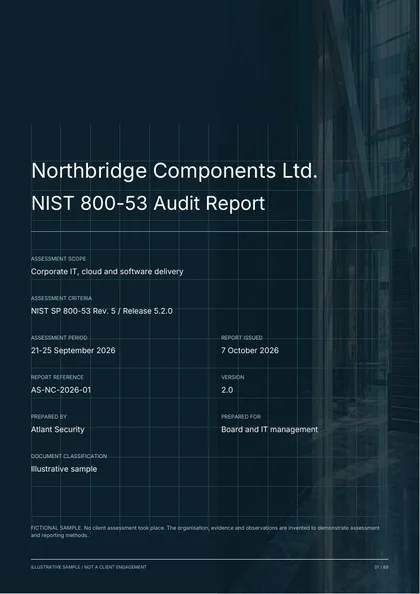
Review 120 assessment tests across all 20 NIST SP 800-53 control families, including AWS, Microsoft 365, secure software development and DevSecOps. Includes technical findings and a 12-month remediation plan.
89 pages. 20 control families. 32 findings. 13 graphs and diagrams.
Illustrative NIST SP 800-53 assessment. The organisation, evidence and findings are fictional.
Get the sample report
A free PDF. Enter your email and company name, and we’ll email you a download link.

Runs the risk assessment and names the five risks that actually matter.
Connect on LinkedIn01 / THE DETAIL
Why Companies Commission a Risk Assessment
Someone asked for your risk assessment and you do not have one
Enterprise customers, cyber insurers, SOC 2 and ISO 27001 auditors, HIPAA and NIS 2 all require a documented risk assessment. It is the first artefact requested and the one most companies under 500 staff have never produced, because the person who could write it is the person running everything else.
You have controls but no idea which risks they cover
Security spending without a risk assessment buys tools against the last vendor pitch rather than the most likely loss. The assessment ranks what could actually hurt the business, so the next budget goes to the top of the list and the board can see why.
The consultancy wants a six-month engagement to tell you what you already suspect
A risk assessment for a single legal entity is a three-week piece of work when it is done by someone who has done 200 of them. Fixed scope, fixed price, no retainer, no lengthy commitment, and you pay after you have read the report.


02 / THE DETAIL
What the Risk Assessment Covers
Eight areas, each examined in the systems themselves rather than in a questionnaire. The output is one register, because a risk in vendor management and a risk in identity are competing for the same budget and the board needs to see them side by side.

03 / PRICING
How Much a Cybersecurity Risk Assessment Costs
The market runs from about $2,000 for a questionnaire-based exercise, which produces a document and not much insight, to $50,000 and beyond for enterprise engagements by large firms, which produce a great deal of both. For a company of 20 to 500 staff the honest price for a full assessment done in the live environment by a senior practitioner is between $5,000 and $15,000.

Ours is from $6,900, fixed, for a single legal entity, and you pay after you have read the report. The price does not change if we find more than expected, because the scope was agreed before we started. Multi-entity groups and operational technology sites are quoted in writing, and plants and utilities are assessed under the NIST SP 800-82 OT audit instead.
What you are paying for is judgement: which of the forty things that could go wrong are the five that will, and in what order to fix them. That is what 200+ assessments across 14 countries since 2013 buys you in three weeks.
04 / THE DETAIL
Who Needs It
05 / THE DETAIL
Compared With the Usual Engagement
| Atlant Security | Typical engagement | |
|---|---|---|
| Evidence | Risks identified in the systems themselves | A workshop and a spreadsheet of opinions |
| Scoring | Likelihood and impact against your stated risk appetite, defended line by line | Traffic-light colours nobody can explain |
| Output | Register, treatment plan with owners and dates, board summary | A 90-page PDF with no ranking |
| Timeline | Two to three weeks, fixed scope | A multi-month engagement that grows |
| Pricing | $6,900 fixed, published, pay after review | Day rates, quoted after the discovery phase |
06 / PROCESS
How the Risk Assessment Works
Scoping and asset map
Systems, data, people, vendors and the business processes they support, agreed in writing with the threats that matter for your sector. This takes one call and a short questionnaire, not a workshop programme.
Identification in the live environment
Vulnerabilities and control gaps found by looking at the systems themselves: identity consoles, endpoints, cloud configuration, backups, email and network exposure. Interviews confirm process and ownership; screenshots from your IT team do not count as evidence.
Analysis and evaluation
Each risk scored for likelihood and impact against the appetite your management sets, ranked, and mapped to the framework you report against, whether that is NIST, ISO 27005, SOC 2, HIPAA or NIS 2.
Treatment plan and briefing
A prioritised treatment plan with owners, effort and dates, an executive summary written for the board, and a one-hour briefing where we defend every score. Optional annual reassessment keeps the register current.


07 / PRICING
Pricing
Fixed prices, scoped in writing, and you pay for the assessment after you have reviewed the report.
Cybersecurity Risk Assessment
One legal entity, all eight areas, two to three weeks.
- Scoping and asset map
- Risks identified in the live environment
- Scored, ranked risk register with evidence
- Treatment plan with owners, effort and dates
- Control gaps mapped to your framework
- Executive summary and one-hour board briefing
Risk Management Programme
The assessment plus the register kept alive for a year.
- Everything in the assessment
- Register maintained as systems and vendors change
- Mid-year reassessment of the top risks
- Quarterly one-hour review with management
- Auditor and insurer questionnaire support
- Reassessment after any major change or incident
08 / THE DETAIL
Know What to Fix First
A free scoping call confirms what the assessment would cover for your company and what it would not. Three weeks later you hold a register your board can read and your auditor can accept.
Get Your Fixed Price09 / PRICING
Get Your Scope and Price
Choose a time for your scoping call.
10 / FAQ
Cybersecurity Risk Assessment FAQ
How much does a cybersecurity risk assessment cost?
What is the difference between a risk assessment, a security audit and a penetration test?
Which frameworks does the assessment follow?
How long does it take?
Do we need a risk assessment for SOC 2 or ISO 27001?
Is this a rapid assessment or a long engagement?
What do we receive?
How often should we repeat it?
11 / THE DETAIL