I get the same questions about cybersecurity risk assessments in almost every first conversation with a new client, whether they are a 20-person SaaS startup or a regional bank. There is a lot of confusion about what a risk assessment actually is, how it differs from a vulnerability scan or a penetration test, and whether it is worth the effort. Having run more than 200 assessments across 14 countries since 2013, I want to answer those questions honestly, without the vendor spin that usually surrounds this topic.
There is a middle option between an annual manual engagement and nothing at all. AI-run penetration testing automates the exhaustive part, the parameter-by-parameter work where human testers tire, and hands back proof-of-concept evidence with remediation steps.
A risk assessment is not a scan you buy, run, and file away. Done properly, it is the decision-making backbone of your entire security program. It tells you what could hurt you, how badly, how likely it is, and therefore where your limited time and money should go first. Get it right and every other security decision becomes easier to justify. Get it wrong, or skip it, and you end up spending on the wrong things while your real exposures sit untouched.
Need the assessment done rather than described? Our cybersecurity risk assessment services deliver a scored risk register, a treatment plan and a board summary in three weeks for $6,900 fixed, paid after you review the report.
What exactly is a cybersecurity risk assessment?
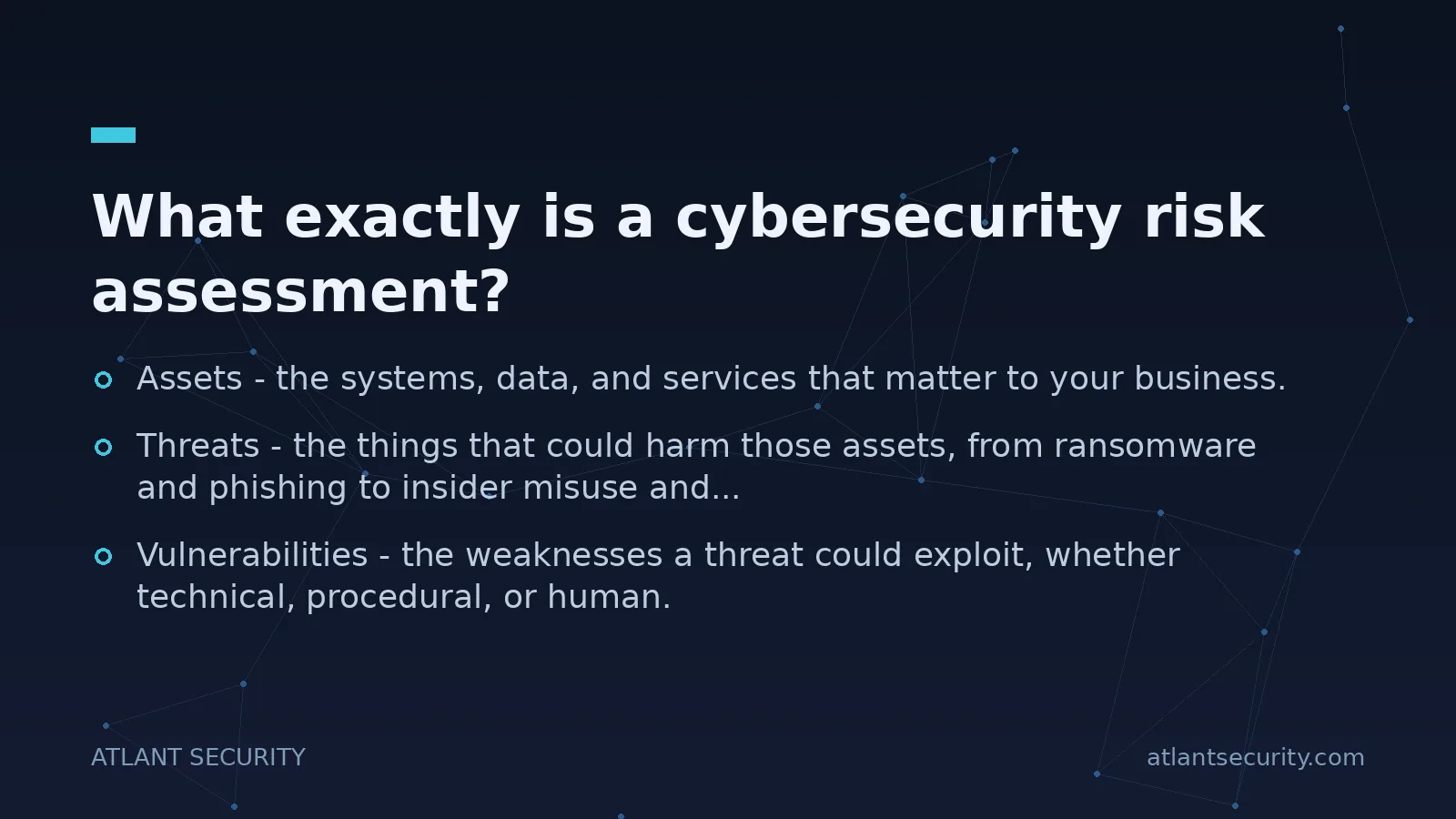
A cybersecurity risk assessment is the structured process of identifying what could go wrong in your IT environment, how likely each of those things is, and what the impact would be if they happened. It brings together three ingredients:
- Assets - the systems, data, and services that matter to your business.
- Threats - the things that could harm those assets, from ransomware and phishing to insider misuse and third-party failure.
- Vulnerabilities - the weaknesses a threat could exploit, whether technical, procedural, or human.
Risk lives at the intersection of the three: a threat that can exploit a vulnerability to damage a valuable asset. The output is not a list of technical bugs. It is a prioritized picture of business risk that a non-technical executive can read and act on. That distinction is the whole point. A CFO cannot make a funding decision from a 400-page scanner report, but they can make one from a ranked list of the ten risks most likely to cause real damage.
How is a risk assessment different from a scan or a pen test?
These three are constantly confused, and the confusion leads people to buy the wrong thing. Here is how they actually relate:
| Activity | Question it answers | Output |
|---|---|---|
| Vulnerability scan | What known weaknesses exist on my systems? | A technical list of findings |
| Penetration test | What can an attacker actually do? | Demonstrated attack paths and proof of impact |
| Risk assessment | What should the business worry about, and in what order? | Prioritized business risks and a remediation roadmap |
A vulnerability assessment and a penetration test are inputs to a good risk assessment. They tell you about the technical weaknesses. The risk assessment wraps business context around those findings so you can decide what to fix first. You need all three, but they are not interchangeable.
Why bother doing it regularly?
The honest answer is that your environment and your threats both change constantly, and a one-time assessment goes stale fast. Every new SaaS tool, every new employee, every cloud migration, and every acquisition changes your risk picture. Meanwhile attackers keep evolving their techniques. A risk profile that was accurate last year is misleading this year.
Regular assessment gives you three concrete benefits:
- Current visibility. You always know where your real exposure sits rather than where it sat when you last looked.
- Efficient spending. You direct budget at the risks that matter instead of buying tools because a vendor scared you.
- Defensible decisions. When a board member, auditor, or customer asks why you did or did not do something, you have documented reasoning.
For most organizations, a full assessment annually is the baseline, with a fresh look triggered by any significant change: a new product, a merger, a major cloud migration, or an incident. Higher-risk businesses, regulated firms, and anyone handling large volumes of sensitive data should reassess more often.
The steps in a real risk assessment
When I run a risk assessment, the process follows a consistent arc. The frameworks differ in vocabulary, but the substance is the same across ISO 27001, the NIST approach, and the requirements behind SOC 2 and HIPAA.
1. Scope and context
Define what is in and out. Which systems, data, business units, and third parties are we assessing? Getting scope wrong here wastes the entire exercise, either by boiling the ocean or by missing the crown jewels.
2. Asset identification
Inventory the assets that matter and understand what each is worth to the business. You cannot protect what you do not know you have, and most organizations have significant blind spots here, especially in the cloud and in shadow IT.
3. Threat identification
Map the realistic threats to those assets: ransomware, credential theft, phishing, insider misuse, supply-chain compromise, and so on. The emphasis is on realistic. Your threat model should reflect your industry, size, and exposure, not a generic list.
4. Vulnerability assessment
Identify the weaknesses a threat could exploit, drawing on scans, penetration testing, configuration review, and process review. This is where the technical inputs feed in.
5. Risk analysis
For each realistic threat-vulnerability pairing, estimate likelihood and impact. This can be qualitative (high/medium/low) or quantitative (modeled financial loss). Most organizations start qualitative and mature toward quantitative over time.
6. Risk evaluation and prioritization
Compare each risk against your risk tolerance and rank them. This is where the assessment earns its keep: it turns a formless anxiety about cyber threats into an ordered list.
7. Treatment
Decide what to do with each risk. There are only four honest choices: reduce it with controls, transfer it (for example, to insurance), avoid it by not doing the risky thing, or accept it consciously and document that decision. Accepting a risk is legitimate as long as it is deliberate and signed off by someone with the authority to own it.
8. Documentation and follow-through
Record the findings, the analysis, and the treatment decisions, then actually track remediation to completion. The report is worthless if it sits in a drawer.
The mistakes that undermine risk assessments
The value of an assessment is destroyed by a handful of recurring errors. I see these constantly:
- Treating it as a one-time compliance chore. An assessment done once to satisfy an auditor and never revisited is theater.
- Confusing a scan for an assessment. A scanner output is an ingredient, not a risk assessment.
- Ignoring the human and process layers. Phishing, weak procedures, and untrained staff cause more incidents than exotic technical exploits.
- No business context. Ranking risks by technical severity instead of business impact leads you to fix the wrong things.
- No follow-through. Identifying risks and then not treating them is arguably worse than not assessing, because now the risk is documented and knowingly ignored.
If you want a deeper look at where these go wrong, I have written separately about the most common risk assessment mistakes and the tools that support the process.
How to get real value from your assessments
The difference between an assessment that changes your security posture and one that gathers dust comes down to a few practices:
- Involve the right people. IT, security, legal, and business leaders all need a seat. Risk is a business conversation, not just a technical one.
- Assign ownership. Every accepted risk and every remediation item needs a named owner with the authority to act.
- Feed results into real decisions. Budget, roadmap, and vendor choices should reflect what the assessment found.
- Keep the profile alive. Update it as the environment changes rather than waiting for the annual cycle.
- Get an outside perspective. Internal teams inherit the blind spots that created the risks. An independent assessor sees what familiarity hides.
Risk assessment and compliance
Nearly every serious framework and regulation puts risk assessment at its foundation. ISO 27001 requires it. SOC 2 expects it. HIPAA mandates it for covered entities and business associates. GDPR requires risk-based thinking about personal data. This is not a coincidence: regulators understand that you cannot protect what you have not honestly evaluated.
The practical implication is that a well-run risk assessment does double duty. It improves your actual security and it produces much of the evidence auditors want to see. If you are working toward SOC 2, ISO 27001, or HIPAA, the risk assessment is not a side task, it is the spine of the whole program. Build it well and the compliance work becomes far less painful.
Frequently Asked Questions
How long does a cybersecurity risk assessment take?
For a small to mid-sized organization, a focused assessment typically takes a few weeks from scoping to final report, depending on the size of the environment and how readily available your asset and system information is. Larger or more complex organizations take longer. The biggest variable is usually how quickly the organization can provide access and answer questions, not the analysis itself.
Can we do a risk assessment ourselves, or do we need outside help?
You can, and building internal capability is worthwhile. The limitation is objectivity and experience. Internal teams inherit the same assumptions and blind spots that created the gaps, and they rarely have seen the breadth of environments an external assessor has. Many organizations do internal assessments regularly and bring in an outside expert periodically for an independent view, especially before an audit or after significant change.
What is the difference between qualitative and quantitative risk analysis?
Qualitative analysis rates risks in relative terms such as high, medium, and low. It is fast and accessible, which is why most organizations start there. Quantitative analysis assigns numbers, often modeled financial loss and probability, which supports sharper cost-benefit decisions but requires more data and effort. Most mature programs use qualitative ranking broadly and quantitative modeling for their most significant risks.
How often should we reassess?
At least annually as a baseline, with an additional assessment triggered by any major change: a new product or system, a merger or acquisition, a significant cloud migration, or a security incident. Regulated and high-risk organizations should reassess more frequently.
What happens after the assessment is finished?
The report is the beginning, not the end. Each identified risk should be assigned an owner and a treatment decision: reduce, transfer, avoid, or consciously accept. Remediation items go into a tracked plan with deadlines, and progress is reviewed regularly. An assessment with no follow-through delivers almost none of its potential value.
Does a risk assessment guarantee we will not be breached?
No, and anyone who promises that is selling something. Nothing eliminates cyber risk entirely. What a good assessment does is make your risk visible, ranked, and manageable, so you reduce the likelihood and limit the impact of an incident, and you can demonstrate that you acted responsibly. That is a realistic and valuable goal.
Getting started
If your organization has never had an independent risk assessment, or your last one was a compliance formality that nobody acted on, that is the gap worth closing. A well-run assessment gives you an honest, prioritized understanding of your real exposure and a roadmap you can actually execute. If you would like help scoping one to your environment, whether you are pursuing a specific framework or just want to know where you stand, reach out and we can talk through what makes sense for your situation. For organizations that need ongoing guidance rather than a one-off engagement, a virtual CISO can own the assessment cycle and make sure the findings turn into real improvement.