
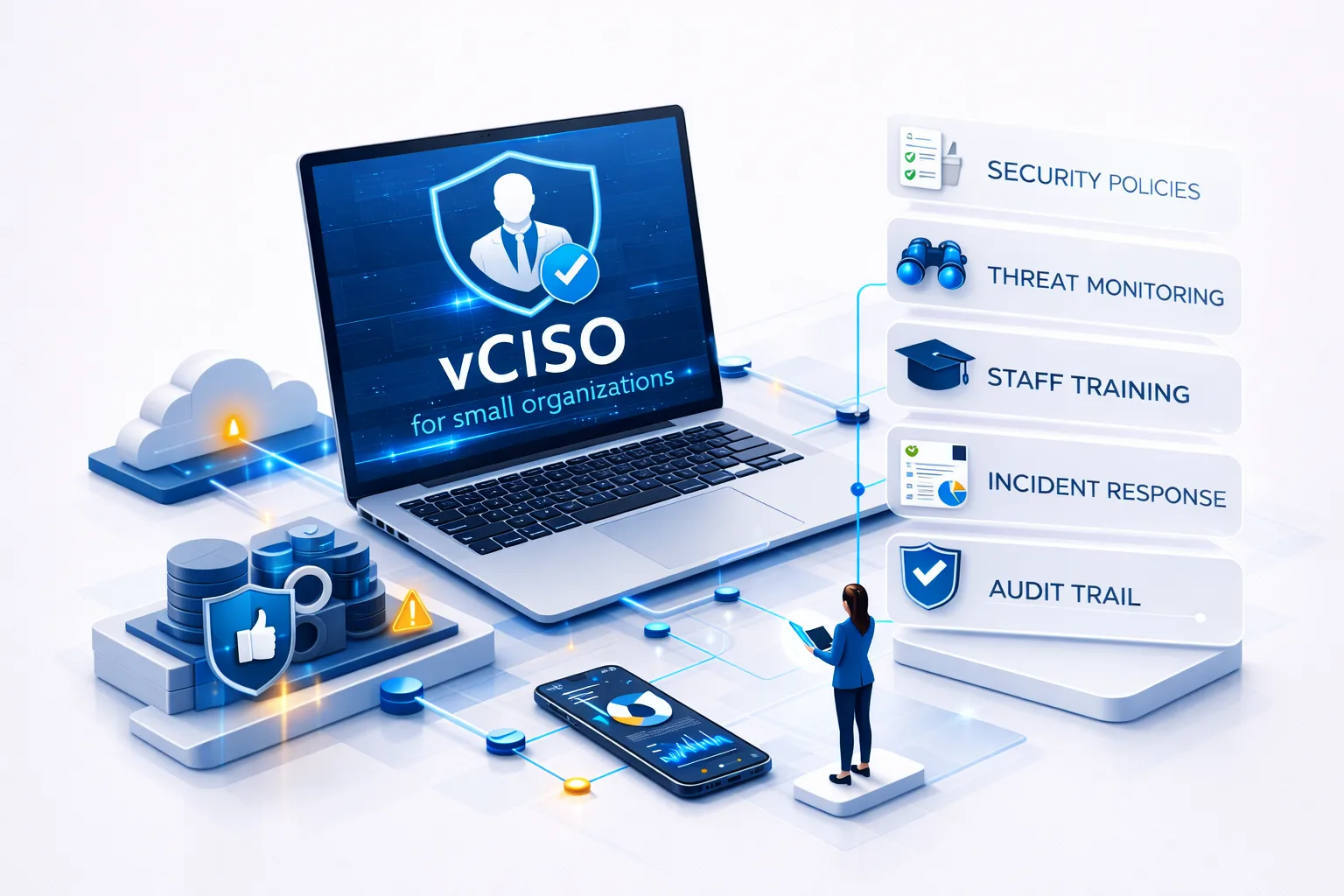
We have probably seen your problem before. Our smallest client had eight employees. Our largest secures the nuclear power plant of the United Arab Emirates. Whatever shape yours is, tell us about it and we will tell you how we would fix it.
Expert Review · Updated October 2026
We analyzed dozens of virtual CISO companies across pricing, team depth, specialization, and client outcomes. Here are the 15 that stand out-plus a framework to evaluate any provider yourself.
Key Takeaways
- Virtual CISO companies provide outsourced security leadership at 30-60% of the cost of a full-time CISO hire
- The best providers combine strategic advisory with hands-on implementation-not just policy templates
- Monthly retainers typically range from $3,000 to $15,000 depending on scope and company size
- Use our 8-point evaluation framework and 15 due-diligence questions to compare providers objectively
- Team depth, vendor independence, and industry experience matter more than certifications alone
Table of Contents
- What Is a Virtual CISO Company?
- Why Companies Hire vCISO Providers
- Types of Virtual CISO Companies
- Top 15 Virtual CISO Companies
- Side-by-Side Comparison Table
- How to Choose a vCISO Company
- 15 Questions to Ask Before Signing
- Common Mistakes to Avoid
- vCISO vs. In-House CISO vs. MSSP
- How Much Do vCISO Companies Charge?
- What Sets the Best Apart
- FAQ
Definition
What Is a Virtual CISO Company?

A virtual CISO company is a cybersecurity firm that provides outsourced Chief Information Security Officer services on a fractional, part-time, or contract basis. Instead of hiring a full-time CISO (which costs $250K-$600K+ annually in total compensation), organizations engage a virtual CISO provider for a fraction of that cost while still getting executive-level security leadership.
Virtual CISO companies typically deliver:
Security Strategy & Governance
Risk assessments, security roadmaps, program development, board-level reporting
Compliance Management
SOC 2, ISO 27001, HIPAA, PCI DSS, CMMC, GDPR readiness and audit support
Policy & Process Development
Information security policies, incident response plans, vendor risk management
Security Team Leadership
Mentoring internal staff, managing security vendors, coordinating incident response
The key distinction: a virtual CISO company provides strategic security leadership, not just technical monitoring. An MSSP watches your logs. A vCISO sets the strategy, builds the program, manages compliance, and reports to your board. If the log-watching part is what you need, that is a separate purchase; our managed security services site defines it platform by platform, with ownership, onboarding and response authority spelled out.
For the providers who do the watching, read what a managed security service provider is, with 35 MSSPs and MDR services compared.
Market Context
Why Companies Are Hiring Virtual CISO Companies in 2026

The demand for virtual CISO companies has surged. Four forces are driving this shift:
1. The CISO Talent Gap Is Real
There are an estimated 3.5 million unfilled cybersecurity positions globally. At the CISO level, the shortage is more acute. Experienced CISOs command $300K-$600K in total compensation, and they’re typically not interested in joining companies under 500 employees. For most mid-market organizations, the talent simply isn’t available at an affordable price point.
2. Compliance Requirements Keep Multiplying
SOC 2 used to be optional for most companies. Now it’s table stakes for selling to enterprise customers. Add HIPAA, GDPR, PCI DSS, CMMC, ISO 27001, NIST, state privacy laws, and the SEC’s cyber disclosure rules, and you need someone who understands multiple frameworks and how they overlap. That’s exactly what the best vCISO solutions deliver.
3. Boards and Investors Are Asking Questions
SEC cyber disclosure rules, investor due diligence, and customer trust requirements mean that security governance is a board-level issue. Organizations need someone who can speak the language of risk to business stakeholders-not just IT. A virtual CISO company fills that gap.
4. Cyber Insurance Demands Are Increasing
Insurers now require documented security programs, risk assessments, and executive oversight before issuing or renewing cyber liability policies. Organizations without a named security leader-even a virtual one-face higher premiums or outright denials.
Provider Landscape
Types of Virtual CISO Companies
Not all virtual CISO companies are built the same way. Understanding the four provider types helps you know what you’re actually buying:
| Provider Type | Description | Strengths | Weaknesses | Best For |
|---|---|---|---|---|
| Solo Practitioner | Independent consultant offering vCISO services | Deep personal expertise, lower cost | Key-person risk, limited bandwidth, single perspective | Very small orgs, limited scope |
| vCISO-First Firm | Dedicated firm where vCISO is the core service offering | Purpose-built processes, team depth, specialized methodology | May not offer technical services (pen testing, SOC) | SMBs to mid-market needing full program |
| MSSP with vCISO Add-On | Managed security provider that added vCISO to their menu | Can bundle monitoring + leadership, integrated tools | vCISO may be secondary focus, potential tool bias | Orgs needing monitoring + strategy together |
| Big 4 / Enterprise Firm | Large consulting firm offering fractional CISO services | Brand credibility, deep regulatory expertise | Expensive, junior staff doing work, slow to start | Large enterprises, highly regulated industries |
Which type is right for you? Most mid-market companies (50-1,000 employees) get the best results from vCISO-first firms. They offer the depth of a dedicated team without the overhead of enterprise consulting or the risk of a solo practitioner. Read more about the benefits of CISO as a Service.
2026 Rankings
Top 15 Virtual CISO Companies for 2026
We evaluated virtual CISO companies based on team depth, methodology, industry specialization, pricing transparency, client outcomes, and vendor independence. Here are the 15 providers that consistently stand out.
Disclosure: Atlant Security publishes this guide and appears in the list below. We have placed ourselves where we think we honestly belong rather than at the top, and we say plainly which entries are the better call for situations we do not serve well. Every other company is assessed from public information, published pricing, client reviews and industry reputation. No company paid for placement.
1. Fractional CISO

Website: fractionalciso.com
Best for: Organizations wanting a named, senior CISO with deep hands-on experience
One of the earliest dedicated vCISO firms in the market. Fractional CISO focuses exclusively on providing virtual CISO services, with a bench of senior practitioners who have held in-house CISO roles at well-known organizations. They emphasize placing experienced leaders, not junior consultants.
Standout: Deep bench of practitioners with in-house CISO experience · Focus: Strategic leadership & compliance · Size fit: SMB to mid-market
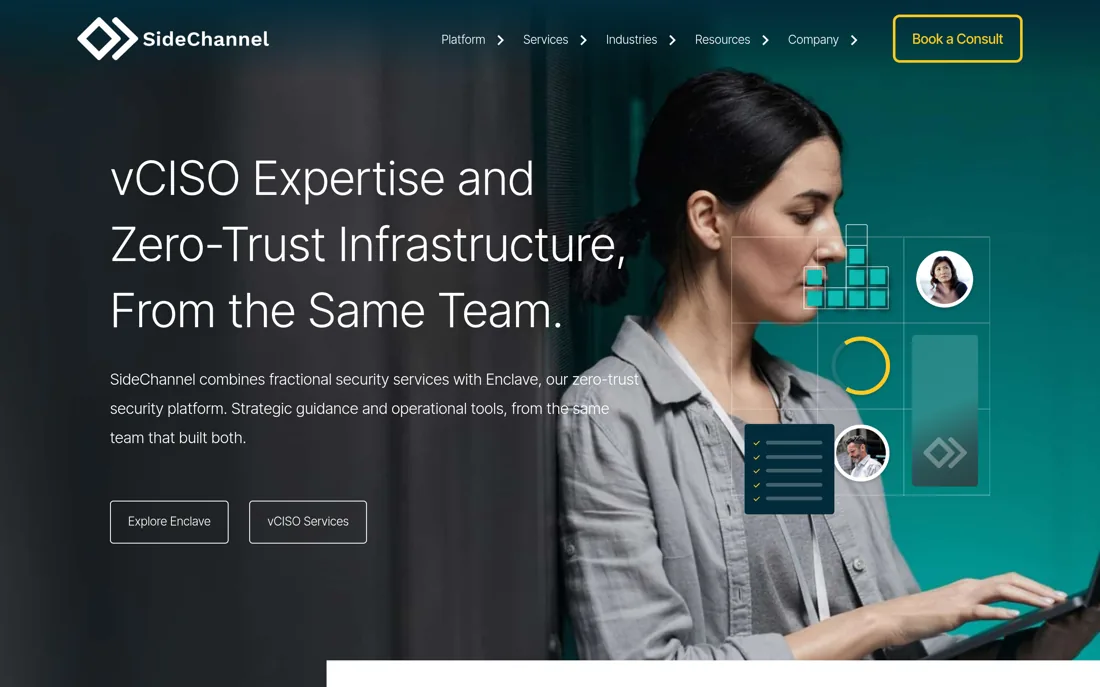
2. SideChannel
Website: sidechannel.com
Best for: Startups and fast-growing companies building their first security program
SideChannel’s team includes former Fortune 500 and federal government CISOs. They specialize in helping startups and rapidly scaling companies design and implement security programs from the ground up-bridging the gap between having zero security leadership and enterprise-grade governance.
Standout: Former Fortune 500 and federal CISOs on staff · Focus: Early-stage program build-out · Size fit: Startups to SMBs
3. Atlant Security
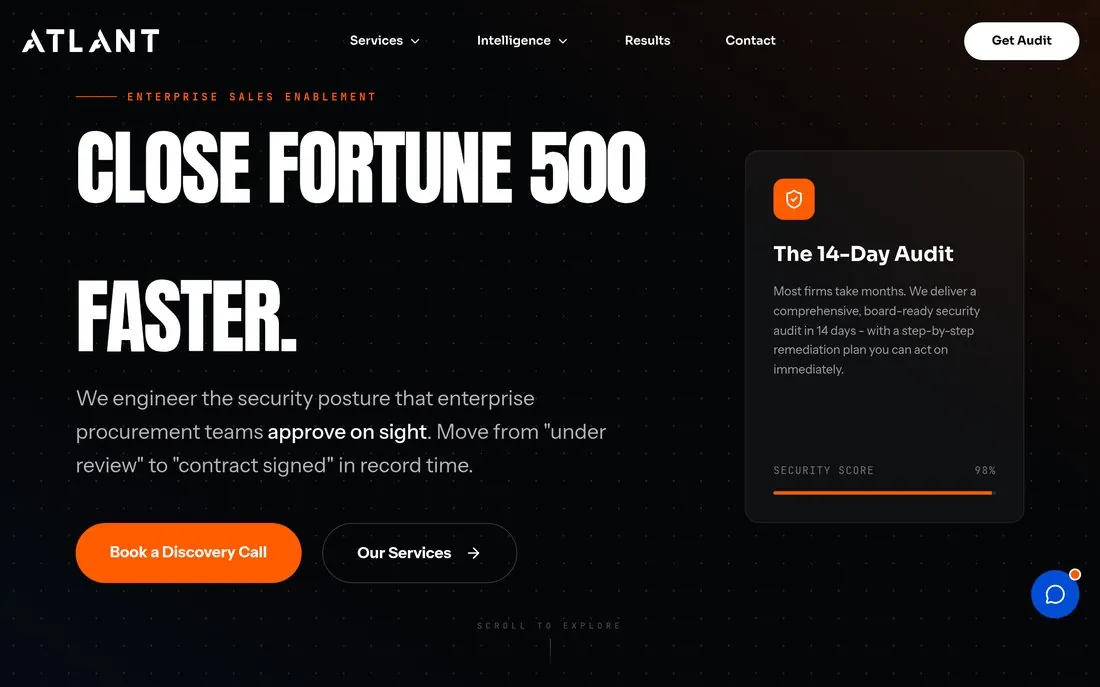
Best for: SMBs and mid-market companies needing full-program security leadership
Atlant Security is a vCISO-first firm that delivers team-backed virtual CISO services. Rather than assigning a single consultant, Atlant pairs each client with a team of security professionals-ensuring continuity, diverse expertise, and backup coverage. Their approach starts with understanding the business model and growth plans before writing a single policy.
Key Services
Security program development, compliance readiness (SOC 2, ISO 27001, HIPAA, GDPR), risk assessments, board reporting, policy creation, vendor risk management, incident response planning
Differentiators
Team-backed model (no single point of failure), vendor-neutral recommendations, flexible month-to-month terms, business-first methodology
Pricing model: Monthly retainer · Contract terms: Flexible, no multi-year lock-in · Industries: Technology, SaaS, healthcare, financial services, professional services
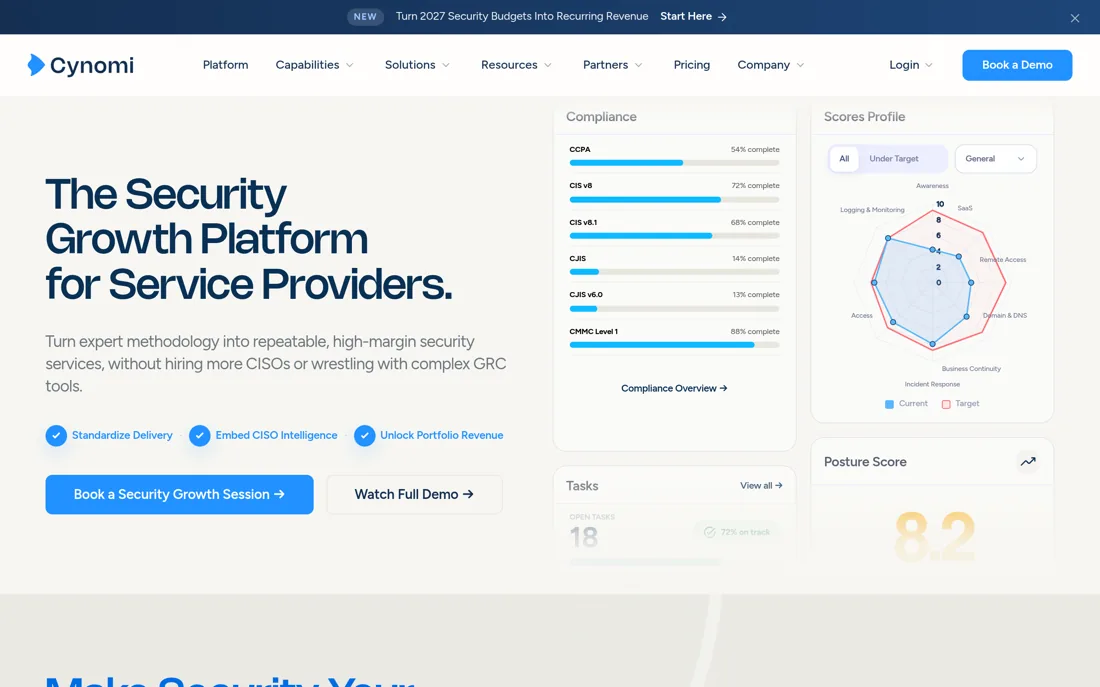
4. Cynomi
Website: cynomi.com
Best for: MSPs and MSSPs looking for an AI-powered vCISO platform to serve their clients
Cynomi takes a technology-first approach, offering an AI-powered virtual CISO platform that automates risk assessments, policy generation, and compliance tracking. Their model is designed primarily for MSPs and MSSPs who want to add vCISO services to their portfolio using a scalable platform.
Standout: AI-powered automation platform · Focus: Scalable vCISO delivery for MSPs/MSSPs · Size fit: Channel-focused (MSP/MSSP clients)
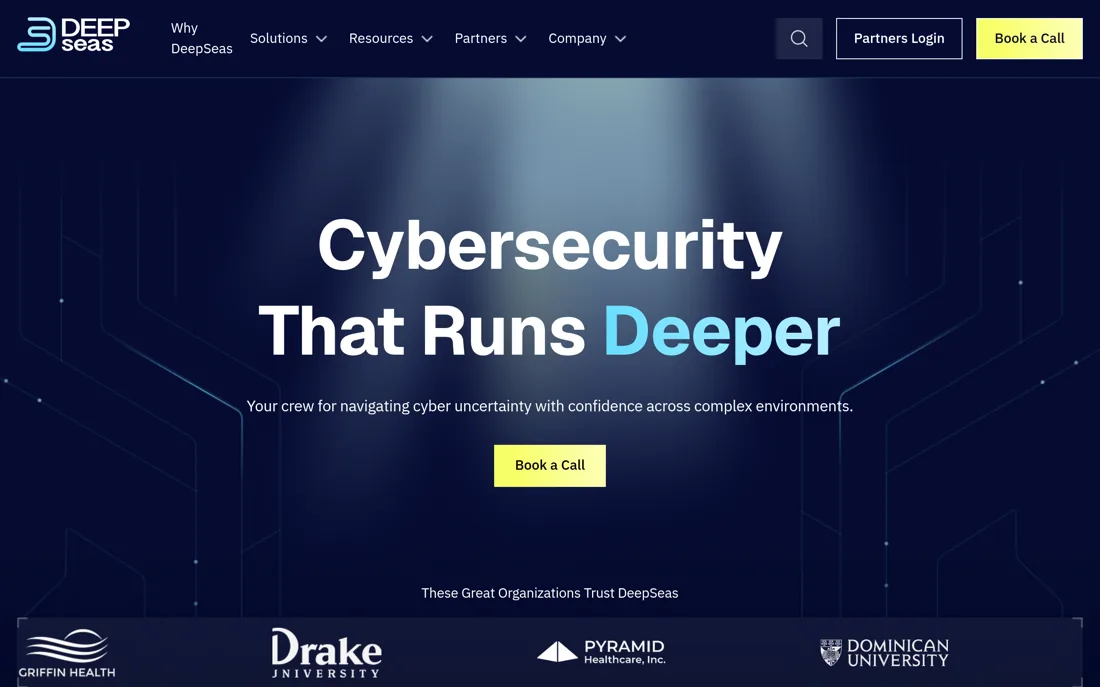
5. DeepSeas
Website: deepseas.com
Best for: Companies pursuing SOC 2 or ISO 27001 with accelerated timelines
DeepSeas integrates AI-powered threat intelligence and risk analysis into their vCISO services. They offer documented control templates and AI-powered gap analysis, making them a strong choice for organizations that need accelerated compliance framework implementation.
Standout: AI-integrated gap analysis and control templates · Focus: Compliance acceleration · Size fit: Startups to mid-market
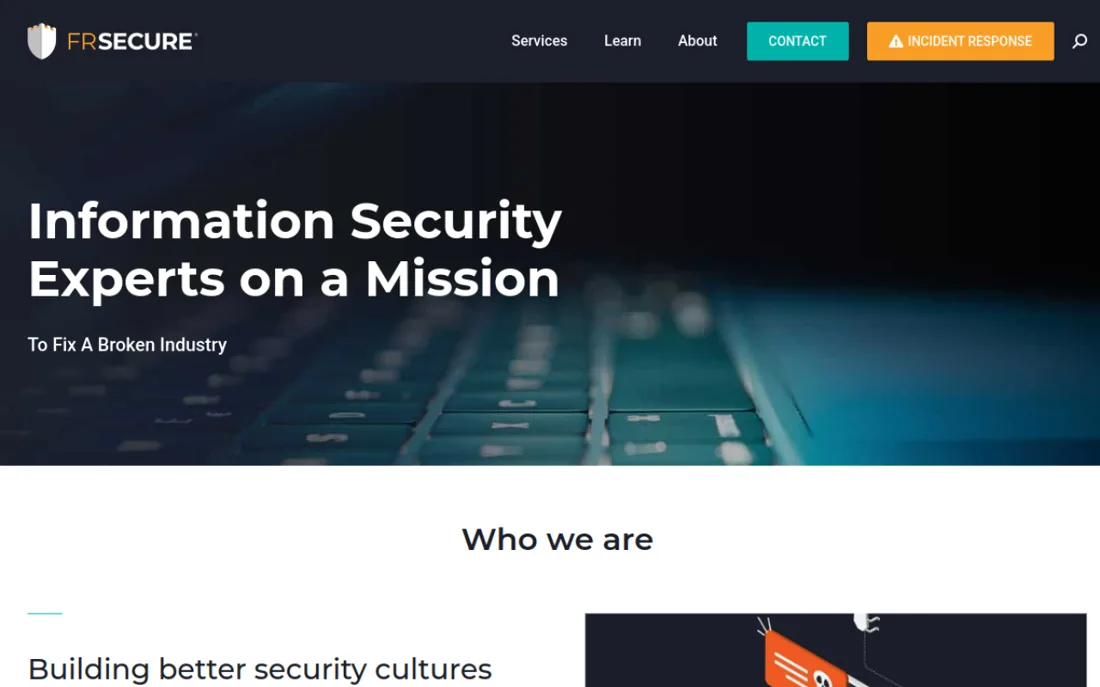
6. FRSecure
Website: frsecure.com
Best for: Organizations that want assessment-driven security program development
FRSecure maintains a strong bench of virtual CISOs and is known for their thorough assessment services that establish a baseline understanding of an organization’s security posture. They use these assessments to build data-driven security roadmaps.
Standout: Assessment-first methodology · Focus: Risk-based program development · Size fit: SMB to mid-market
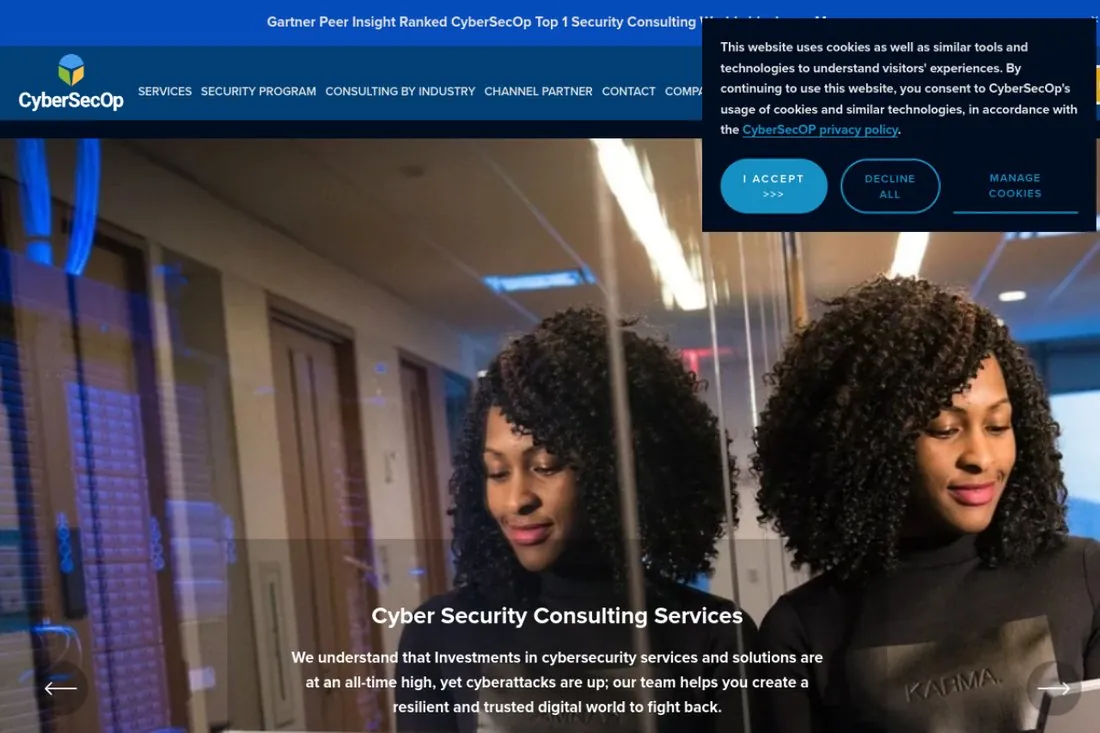
7. CyberSecOp
Website: cybersecop.com
Best for: Defense contractors and organizations needing CMMC compliance
CyberSecOp is a CMMC-AB Registered Provider Organization (RPO) and ISO 27001 certified firm. They offer comprehensive vCISO programs alongside managed security, incident response, and ransomware recovery services. Their government and defense industry expertise is a key differentiator.
Standout: CMMC-AB RPO and ISO 27001 certified · Focus: Government/defense compliance · Size fit: SMB to enterprise
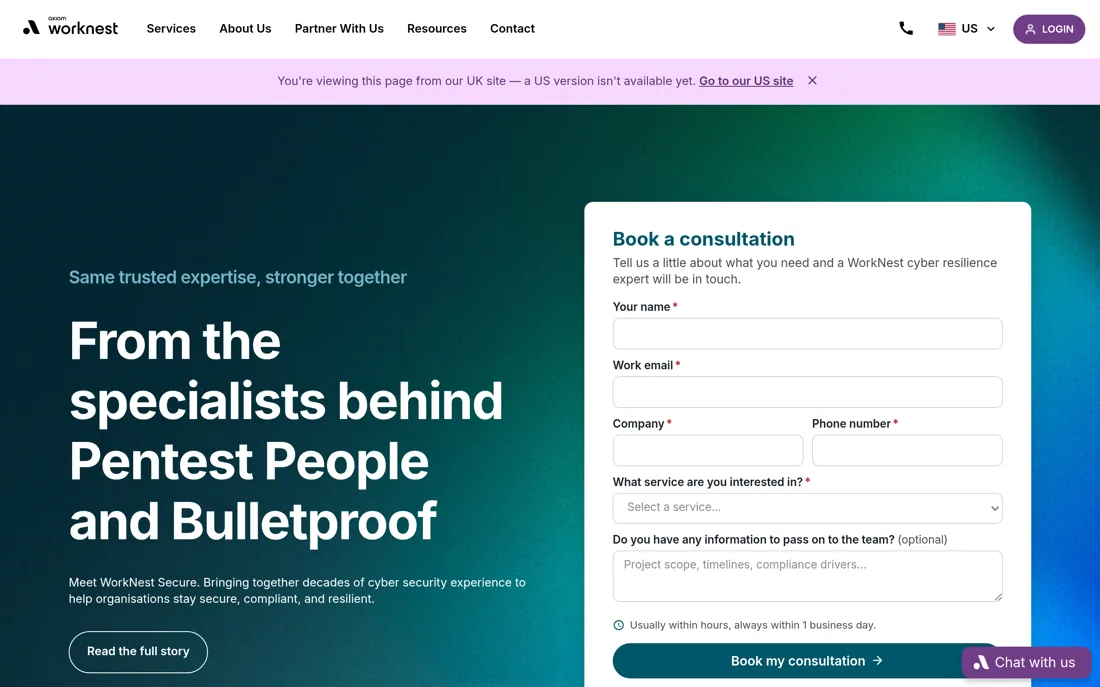
8. Bulletproof
Website: bulletproof.co.uk
Best for: Companies wanting vCISO services bundled with pen testing and technical assessments
Bulletproof offers their “Bulletproof CISO” service with flexible packages that combine strategic security leadership with hands-on technical services including penetration testing, ISO and SOC certifications, and cybersecurity operations.
One practical note on frequency: continuous AI penetration testing makes it realistic to test on your release cadence rather than your budget cycle, because the AI does the exhaustive parameter work and retesting after remediation is included.
Standout: Combined strategy + pen testing delivery · Focus: Technical + strategic hybrid · Size fit: SMB to mid-market
9. Secureworks
Website: secureworks.com
Best for: Large enterprises needing vCISO services backed by a global threat intelligence operation
Secureworks is a major cybersecurity company whose vCISO services are backed by extensive threat research capabilities and their Taegis XDR platform. Their virtual CISO engagements come with access to a broader security ecosystem, making them suited for large organizations with complex environments.
Standout: Enterprise-grade threat intelligence backing · Focus: Large-scale enterprise security governance · Size fit: Mid-market to enterprise
10. Echelon Risk + Cyber
Website: echeloncyber.com
Best for: U.S.-based small and medium businesses looking for a hands-on vCISO partner
Echelon Risk + Cyber focuses specifically on providing vCISO services to small and medium-sized businesses in the United States. They position themselves as a hands-on partner rather than a remote advisory service, with practical implementation support alongside strategic guidance.
Standout: SMB-focused, practical implementation support · Focus: Hands-on program management · Size fit: Small to medium businesses
11. Pivot Point Security
Website: pivotpointsecurity.com
Best for: Companies needing vCISO alongside ISO 27001 and SOC 2 audit preparation
Pivot Point Security combines virtual CISO services with deep expertise in ISO 27001 and SOC 2 audit preparation. Their vCISO engagements often center around helping organizations build and maintain certification-ready security programs.
Standout: Certification-focused vCISO delivery · Focus: Audit preparation and compliance · Size fit: SMB to mid-market
12. Cleared Systems
Website: clearedsystems.com
Best for: Government contractors and organizations requiring clearance-level security leadership
Cleared Systems serves organizations in the government contracting space, offering vCISO services with an emphasis on FedRAMP, CMMC, NIST 800-171, and other federal compliance requirements. Their consultants are experienced in navigating government-specific security frameworks.
Standout: Federal compliance specialization · Focus: Government contracting security · Size fit: Government contractors of all sizes
13. Vistrada
Website: vistrada.com
Best for: Mid-market companies needing ongoing CISO-as-a-Service (CaaS) with IT strategy alignment
Vistrada offers CISO-as-a-Service as part of a broader IT leadership portfolio. They position their vCISO offering within the context of overall IT strategy, making them a fit for organizations that want security leadership aligned with broader technology initiatives.
Standout: IT strategy + security leadership integration · Focus: Holistic IT governance · Size fit: Mid-market
14. Trava Security
Website: travasecurity.com
Best for: Organizations wanting vCISO services integrated with cyber risk management and insurance
Trava Security connects virtual CISO services with cyber risk quantification and insurance readiness. Their platform-driven approach helps organizations understand their risk posture in financial terms, which is valuable for board-level reporting and cyber insurance negotiations.
Standout: Cyber risk quantification + insurance integration · Focus: Risk-based decision making · Size fit: SMB to mid-market
15. Eden Data
Website: edendata.com
Best for: Startups and SaaS companies needing compliance-first vCISO leadership
Eden Data provides vCISO and CISO-as-a-Service offerings with a focus on helping technology startups and SaaS companies navigate compliance requirements while building scalable security programs. They emphasize a modern, startup-friendly approach to security leadership.
Standout: Startup-native security approach · Focus: SaaS compliance & program building · Size fit: Startups to growth-stage
Looking for a provider tailored to startups or small organizations? We’ve written dedicated guides for each.
Quick Reference
Virtual CISO Companies: Side-by-Side Comparison
| Company | Best For | Provider Type | Team Model | Compliance Focus | Flexible Terms |
|---|---|---|---|---|---|
| Atlant Security | SMB - Mid-Market | vCISO-First | Team-backed | SOC 2, ISO, HIPAA, GDPR | ✓ |
| Fractional CISO | SMB - Mid-Market | vCISO-First | Named CISO | Multi-framework | ✓ |
| SideChannel | Startups | vCISO-First | Named CISO | SOC 2, NIST | ✓ |
| Cynomi | MSPs / MSSPs | Platform | AI + Human | Multi-framework | ✓ |
| DeepSeas | Compliance-Driven | MSSP + vCISO | AI + Team | SOC 2, ISO, NIST | ✓ |
| FRSecure | Assessment-Driven | vCISO-First | Team | Multi-framework | ✓ |
| CyberSecOp | Gov / Defense | MSSP + vCISO | Team | CMMC, ISO, NIST | ✓ |
| Bulletproof | Technical + Strategy | MSSP + vCISO | Team | ISO, SOC 2 | ✓ |
| Secureworks | Enterprise | Enterprise | Team + Platform | Multi-framework | - |
| Echelon Risk + Cyber | U.S. SMBs | vCISO-First | Named CISO | SOC 2, NIST | ✓ |
Table shows a representative subset. For detailed pricing, see the pricing section below.
Evaluation Framework
How to Choose a Virtual CISO Company: The 8-Point Framework
Use this framework to objectively score and compare virtual CISO companies. Rate each provider on a 1-5 scale for each criterion. A provider scoring below 30 out of 40 should raise questions. This is the same framework we recommend in our virtual CISO consulting services guide.
| # | Criterion | What to Look For | Red Flag |
|---|---|---|---|
| 1 | Technical Expertise | CISSP, CISM, CISA certifications. Hands-on security background, not just GRC | Only compliance-focused with no technical depth |
| 2 | Industry Experience | Proven track record in your specific industry with relevant compliance frameworks | No references or case studies in your sector |
| 3 | Team Depth | Multiple practitioners with overlapping skills, backup coverage, knowledge continuity | Single consultant with no team behind them |
| 4 | Methodology | Defined processes for onboarding, assessment, roadmap creation, ongoing management | No structured methodology, every engagement is “custom” |
| 5 | Deliverables | Clear, documented deliverables with timelines. Policies, reports, and assessments included | Vague scope, “advisory” only, no tangible output |
| 6 | Flexibility | Month-to-month or quarterly terms, ability to scale up/down, no punitive exit clauses | Required multi-year commitment, rigid scope |
| 7 | Pricing Transparency | Clear pricing structure, no hidden fees, defined what’s included vs. add-on | Won’t discuss pricing until “discovery call,” unclear scoping |
| 8 | Vendor Independence | No commissions from tool vendors, recommendations based on your needs only | Pushes specific tools, won’t disclose vendor relationships |
Scoring Guide
35-40: Excellent fit - strong across all dimensions. 28-34: Good fit - minor gaps that may be acceptable. 20-27: Proceed with caution - significant gaps in key areas. Below 20: Not recommended - too many critical weaknesses.
Due Diligence
15 Questions to Ask Before Signing with a Virtual CISO Company
These questions cut through marketing and reveal what a virtual CISO company is really like to work with. Ask all of them. A quality provider will answer every one directly.
1. Who will be my primary contact?
Understand their seniority, certifications, and how many other clients they manage.
2. What happens if that person leaves?
Tests team depth and knowledge transfer processes. Single-person firms can’t answer this well.
3. How many clients does each vCISO manage?
More than 8-10 suggests thin coverage and reactive-only service.
4. Can I see a sample risk assessment?
Evaluates quality and thoroughness of their work product.
5. Do you receive commissions from vendors?
Reveals potential conflicts of interest in tool recommendations.
6. What’s your experience in my industry?
Generic answers mean generic service. Ask for specific client examples.
7. What does the first 30 days look like?
Tests whether they have a defined onboarding and assessment process.
8. What’s included vs. what costs extra?
Prevents scope surprise and budget creep after you’ve signed.
9. How do you handle incidents?
24/7 availability or business-hours only? What’s their response time SLA?
10. Can I speak with current clients?
Refusal is a major red flag. Ask for 2-3 references in similar industries.
11. What’s your minimum commitment?
Month-to-month terms show confidence in their delivery quality.
12. How do you measure success?
Look for specific KPIs and metrics, not vague “security improvement.”
13. Do you carry professional liability insurance?
Protects your organization if their advice leads to a security failure.
14. How do you handle board-level reporting?
Tests whether they can translate technical risk into business language for executives.
15. What does offboarding look like?
You should retain all policies, documentation, and institutional knowledge if you leave.
Avoid These Pitfalls
5 Common Mistakes When Choosing a Virtual CISO Company
1. Choosing on price alone
The cheapest vCISO is almost never the best value. A $2,000/month engagement that delivers generic templates and a monthly call doesn’t protect your business-it creates a false sense of security. Compare what you get, not just what you pay. See our full breakdown of vCISO rates and pricing.
2. Confusing MSSP monitoring with vCISO leadership
An MSSP watches your logs and alerts. A virtual CISO company sets the strategy, manages compliance, builds the program, and reports to your board. They solve different problems. You might need both, but they’re not interchangeable. Read our guide on CISO as a Service vs. full-time CISO for more.
3. Not checking references
Ask to speak with two or three current clients. Not testimonials on a website-actual conversations. Ask those clients: did the vCISO deliver what was promised? How responsive are they? What would they change?
4. Hiring based on certifications alone
Certifications matter, but they don’t tell you if someone can communicate security risk to your board, manage a compliance audit, or prioritize a roadmap for a company your size. Ask for work samples and scenario-based responses.
5. Ignoring the contract exit terms
Some virtual CISO companies lock clients into multi-year agreements with penalties for early termination. If a provider is confident in their value, they’ll offer month-to-month or quarterly terms. Always read the exit clause before you sign.
Comparison
Virtual CISO Company vs. In-House CISO vs. MSSP
Understanding how virtual CISO companies compare to the alternatives helps you determine the right model for your organization:
| Factor | Virtual CISO Company | In-House CISO | MSSP |
|---|---|---|---|
| Annual Cost | $36K-$180K | $250K-$600K+ | $24K-$120K |
| Strategic Leadership | ✓ Yes | ✓ Yes | ✗ No |
| Board Reporting | ✓ Yes | ✓ Yes | ✗ No |
| 24/7 Monitoring | Varies | ✗ Needs team | ✓ Yes |
| Multi-Framework Expertise | ✓ Broad | Varies by hire | Limited |
| Time to Value | 2-4 weeks | 3-6 months | 1-2 weeks |
| Flexibility to Scale | ✓ High | ✗ Fixed | ✓ High |
| Reports To | Executives / Board | CEO / Board | IT Manager |
Bottom line: Many organizations use a virtual CISO company and an MSSP together. The vCISO sets priorities and success measures; the MSSP runs the day-to-day controls. For a deeper comparison, see our article on CISO as a Service vs. full-time CISO.
Pricing Guide
How Much Do Virtual CISO Companies Charge in 2026?
Virtual CISO pricing varies based on scope, provider type, and engagement model. Here’s what the market looks like in 2026:
| Pricing Model | Typical Range | Best For |
|---|---|---|
| Monthly Retainer | $3,000 - $15,000/mo | Ongoing security program management and compliance |
| Hourly Rate | $150 - $350/hr | Project-based work or occasional advisory |
| Project-Based | $10,000 - $50,000+ | Specific initiatives (risk assessment, compliance prep, incident response) |
| Full-Time CISO (comparison) | $250,000 - $600,000+/yr | Large enterprises requiring dedicated, full-time leadership |
What Drives the Price Up?
- Multiple compliance frameworks (SOC 2 + HIPAA + ISO)
- Board-level reporting and executive access
- Incident response on-call requirements
- Hands-on implementation vs. advisory-only
- Regulated industries requiring specialized expertise
For a detailed cost breakdown with benchmarks by company size and industry, read our full guide to vCISO rates and pricing.
The Differentiators
What Sets the Best Virtual CISO Companies Apart
After evaluating dozens of providers, certain qualities consistently separate the excellent virtual CISO companies from the adequate ones:
Lead with Business Context
They understand your business model, revenue drivers, and growth plans before writing a single policy. Security strategy follows business strategy, not the other way around.
Deliver Outcomes, Not Reports
You get a functioning security program, not a stack of PDFs. Policies that people actually follow. Compliance readiness, not just gap lists. Measurable risk reduction over time.
Stay Vendor-Neutral
No kickbacks, no preferred vendor lists. They recommend the tools that are right for your size, budget, and risk profile-even if that means the free open-source option.
Communicate in Plain Language
They can explain a risk to your CEO, present a roadmap to your board, and train your sales team on responding to security questions-all without jargon.
Frequently Asked Questions
Virtual CISO Services vs Virtual CISO Companies: What You Are Actually Buying
Searches for virtual CISO services and virtual CISO companies land on the same fifteen names, but the contract underneath differs. A virtual CISO service is a defined scope: hours per month, a named person, deliverables such as a risk register, policies, board reporting and audit ownership. A virtual CISO company is the business that sells it, and the important question is whether the person you meet in the sales call is the person who holds your seat. At the platform-led firms (Cynomi, Trava, Vistrada) you buy a system plus advisers. At the practitioner-led firms (Fractional CISO, SideChannel, FRSecure, Atlant Security) you buy a specific senior person. Ask for the name and the CV before you ask for the price.
vCISO vs CISO: When a Virtual CISO Company Is the Wrong Answer
A virtual CISO is the right answer when the company needs senior judgement a few days a month and cannot justify a $250,000 salary plus a team. It is the wrong answer in three cases: a regulator or customer contract requires a full-time, in-house security officer; the environment needs daily hands-on operations rather than direction; or the organisation is over roughly 2,000 staff with several security engineers who need a manager, not an adviser. The full comparison is in vCISO vs CISO, and the price side in how much a virtual CISO costs.
Virtual CISO Companies for SaaS, Fintech and EU-Regulated Firms
Sector matters more than size when choosing from this list. SaaS companies selling to enterprise buyers need a vCISO who has taken companies through SOC 2 and ISO 27001 personally; see SaaS virtual CISO. Fintechs and payment firms need someone who can face a supervisor, hold the DORA ICT risk management function and speak PCI DSS; see fintech virtual CISO. Companies in scope of NIS 2 need a seat that can also train the board every two years and stand behind an independent audit; see NIS 2 compliance. Of the fifteen companies above, only Atlant Security, Bulletproof and Cleared Systems publish a starting price, which is worth remembering when the others say "it depends".
Virtual CISO Companies Outside the US: UK, EU, APAC and Africa
The fifteen companies above are the ones most buyers in North America and Western Europe shortlist. If your headquarters, regulator or board sits elsewhere, these eight are the names that come up, with an honest note on fit. None of them publish a starting price.
SureCloud (United Kingdom)
Website: surecloud.com
Best for: Mid-size and large UK and EU companies that want the vCISO bundled with a GRC platform
Combines the virtual CISO seat with risk scoring, control tracking and audit evidence in one tool. Easier board reporting and a governance structure for regulated environments; the trade-off is platform lock-in and a price that reflects the software.
Kroll (United States, global)
Website: kroll.com
Best for: Companies whose main worry is a breach, an investigation or a regulator
Kroll is known for forensics and incident response, and its vCISO offer sits on top of that. The right choice when reputational and regulatory risk dominate; heavier than most companies under 1,000 staff need day to day.
CyberCX (Australia and Singapore)
Website: cybercx.com.au
Best for: APAC-headquartered companies that need regional leadership
Large presence in Australia, New Zealand and Singapore, strong in critical infrastructure and government work, with governance, risk, incident planning and training under one roof.
Deloitte Cyber (global)
Website: deloitte.com
Best for: Enterprises that want a recognised brand in front of the board
The vCISO integrates with existing risk and audit relationships and draws on a wide expert pool. Board optics and industry coverage are the reasons to pay the premium.
Kudelski Security (Switzerland and United States)
Website: kudelskisecurity.com
Best for: Companies that want strategy and managed detection from one partner
Pairs the vCISO seat with MDR, so roadmap decisions and security operations sit with a single accountable provider.
Nclose (South Africa, global reach)
Website: nclose.com
Best for: Mid-size companies wanting cost-effective coverage with SOC integration
The vCISO comes packaged with a security team, which keeps the link between advice and execution short and the price reasonable.
Wipro Cybersecurity (India, global)
Website: wipro.com
Best for: Larger companies with an offshore delivery strategy
A vCISO backed by a large delivery organisation, with the ability to add scaled support teams under one contract. Cost control and vendor consolidation are the draws.
SolCyber (United States)
Website: solcyber.com
Best for: Smaller US companies that want tools, SOC and a light vCISO in one subscription
Fast to onboard and predictable in cost. The vCISO component is guidance rather than a named senior seat, so match it to the depth you need.
Pricing Models You Will See
Every provider on this page uses one of four models. Knowing which one you are being offered prevents most overpriced contracts.
| Model | How it works | Good for | Watch out for |
|---|---|---|---|
| Monthly retainer | Fixed hours each month | Predictable budget | Unused hours are rarely carried over |
| Project based | Fixed scope and timeline | SOC 2 or ISO 27001 programmes | Anything outside scope is billed extra |
| Hybrid | Base retainer plus flexible hours | Growing companies | Track hour usage every month |
| Bundled | vCISO included with tools or a SOC | Small teams | Tool lock-in and a thin advisory layer |
Typical monthly cost ranges
| Provider type | Monthly cost range |
|---|---|
| Solo virtual CISO consultant | $3,000 to $7,000 |
| Boutique firm (Atlant Security sits here) | $3,300 to $15,000 |
| Regional advisory brands | $10,000 to $35,000 |
| Big global firms | $30,000 to $120,000 |
| Bundled SOC plus vCISO | $2,000 to $10,000 |
ROI: Virtual CISO vs Full-Time CISO
A full-time CISO in the US costs roughly $355,000 a year once salary, benefits, bonus and hiring are counted. A mid-tier virtual CISO at $16,000 a month costs $192,000, and most companies under 1,000 staff need far fewer hours than that, which is why the Atlant Security seat starts at $3,300 a month. Add the value side: faster enterprise deals because security questionnaires get answered properly, no audit delays, and a lower breach probability. If the seat helps close one enterprise deal or prevents one incident, it has paid for the year. The detailed numbers are in how much a virtual CISO costs.
Contract Structure That Protects You
- Term of six months with an extension option, not a locked year.
- Weekly or fortnightly working sessions written into the contract.
- Named deliverables per quarter: risk register, policy set, board report, audit ownership.
- Cancellation on 30 days notice.
- Hours visible every month, and the name of the person holding the seat.
Internal Readiness Checklist Before You Start
- Appoint one internal point of contact with authority to make decisions.
- Grant least-privilege access to your SaaS and cloud consoles before day one.
- Collect existing policies, the vendor list and the last audit or pentest report.
- Write down your top three business priorities for the next two quarters so the vCISO aligns to them rather than inventing new ones.
FAQ: Virtual CISO Companies
What does a virtual CISO company do?
A virtual CISO company provides outsourced security leadership. This includes developing security strategy, managing compliance programs (SOC 2, ISO 27001, HIPAA), conducting risk assessments, creating security policies, reporting to boards and executives, and coordinating incident response. They function as your security executive without the full-time salary.
How much does a virtual CISO cost per month?
Most virtual CISO companies charge between $3,000 and $15,000 per month on a retainer basis. The exact cost depends on scope, number of compliance frameworks, company size, and whether the engagement is advisory-only or includes hands-on implementation. Hourly rates typically range from $150 to $350. For full benchmarks, see our vCISO pricing guide.
What is the difference between a vCISO and an MSSP?
An MSSP (Managed Security Service Provider) handles day-to-day security operations like log monitoring, endpoint protection, and alert triage. A virtual CISO company provides strategic leadership: setting security strategy, managing compliance, building security programs, and reporting to the board. Many organizations use both, with the vCISO defining priorities and the MSSP executing operations.
Who needs a virtual CISO company?
Organizations with 50 to 1,000 employees that need security leadership but can’t justify or afford a full-time CISO. This includes companies pursuing compliance certifications, those responding to customer or investor security requirements, and organizations in regulated industries like healthcare, finance, and government contracting. Small organizations and startups are increasingly common clients.
How do I evaluate virtual CISO companies?
Use our 8-point evaluation framework above. Score each provider on technical expertise, industry experience, team depth, methodology, deliverables, flexibility, pricing transparency, and vendor independence. A provider scoring below 30 out of 40 should raise questions. Always check references with current clients.
Can a virtual CISO help with SOC 2 or ISO 27001 compliance?
Yes. Compliance management is one of the primary reasons organizations hire virtual CISO companies. A good vCISO provider will manage the entire process: gap analysis, control implementation, policy development, evidence collection, and auditor coordination. Most experienced providers have guided dozens of organizations through successful certifications.
How quickly can a virtual CISO company start delivering value?
Most virtual CISO engagements show meaningful progress within 30 to 60 days. The first 2-4 weeks are typically dedicated to onboarding, initial assessment, and understanding the business. By day 30, you should have a clear picture of your risk posture and a prioritized roadmap. Compare this to 3-6 months for recruiting and onboarding a full-time CISO.
What’s the difference between a virtual CISO and a fractional CISO?
The terms are often used interchangeably. In practice, “fractional CISO” typically implies a higher time commitment (e.g., 2-3 days per week) and deeper integration with the organization, while “virtual CISO” may involve lighter-touch engagement with more remote delivery. Both describe outsourced security leadership from a vCISO consulting provider.
Do virtual CISO companies help with incident response?
Most do, but the level of involvement varies. Some virtual CISO companies provide incident response planning and coordination (developing the plan, running tabletop exercises, coordinating during an event). Others offer on-call incident response support. Ask specifically what their response time commitment is and whether incident response is included in the base retainer or billed separately.
Should I hire a virtual CISO company or a full-time CISO?
For most organizations under 500-1,000 employees, a virtual CISO company delivers better value. You get broader expertise (team vs. individual), faster time to value, and significantly lower cost. A full-time CISO makes sense when you need dedicated, daily security leadership-typically at 1,000+ employees or in highly regulated environments. Many organizations start with a vCISO and transition to full-time as they scale. Read our full vCISO vs. full-time CISO comparison.
Looking for a Virtual CISO Company That Delivers?
Atlant Security provides team-backed virtual CISO services with vendor-neutral recommendations, flexible terms, and a process that starts with understanding your business-not selling you tools.
Last Updated: September 2026 · Author: Alexander Sverdlov, CISSP, Founder and Principal Security Consultant
This article is for informational purposes only. While Atlant Security is a virtual CISO provider and is included in this list, all companies are evaluated based on publicly available information and industry reputation. Organizations should conduct their own due diligence when selecting a security partner. Company details reflect publicly available information at time of publication and may have changed.
Ready to get started? Atlant Security helps companies close security gaps and pass compliance fast, led personally by a former Microsoft security consultant with 200+ assessments across 14 countries. Book a free strategy call and get a fixed-price proposal within 24 hours.
