
Penetration Testing
API Pentest: Penetration Testing That Proves Which Records a Token Can Reach. Report in 14 Days, Free Retest.
The finding that matters in an API is a valid, low-privilege token reaching a record it was never issued for.
Our API pentest is scoped around the six places where authorisation is decided, from object level access to the inventory of versions and consumers. REST, GraphQL and gRPC are tested by hand against the OWASP API Security Top 10 (2023). Every finding is a replayable request and response pair with its business consequence, mapped to the PCI DSS, SOC 2, ISO 27001 or GDPR clause your auditor will cite. Fixed price, report in 14 days, free retest.
- Every endpoint called with every role and a second account, so cross-account access is proven or ruled out
- Findings delivered as request and response pairs your developers can replay in minutes
- Written rules of engagement: test accounts only, agreed request ceilings, a named contact and a stop condition

Senior-led testing that starts from whatever you have: an OpenAPI specification, a Postman collection, a GraphQL schema or raw traffic.
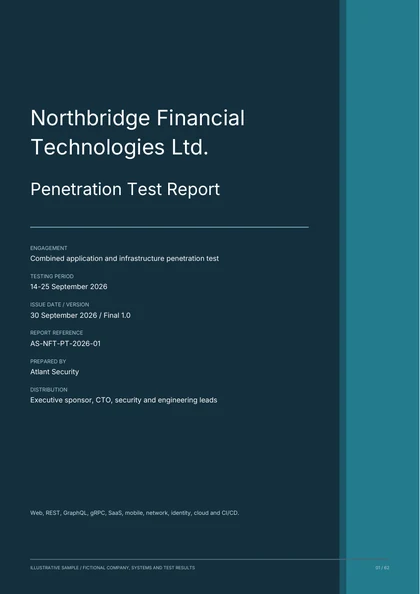
SEE THE DELIVERABLE
See what a useful
penetration test report looks like.
Review a combined engagement covering web, REST and GraphQL APIs, gRPC, SaaS tenant isolation, Android and iOS, networks, cloud, identity and CI/CD. Includes technical evidence, remediation and retest criteria.
62 pages. 24 findings. 14 charts, diagrams and matrices.
Illustrative penetration test. The organisation, systems and findings are fictional.
Get the sample report
A free PDF. Enter your email and company name, and we’ll email you a download link.
DEFINE YOUR SCOPE
Turn your testing requirements into a clear RFP.
Build one request for your applications, APIs, networks, and cloud. Review the scope, download your document, and send a copy to your inbox and our team.
REQUEST RECEIVED
Your RFP is submitted.
Reference: . Email copies are being sent to and Alexander at Atlant Security. Check your spam folder if needed.
You can also book a call to discuss the scope.

Leads every API pentest personally, runs the remediation workshop with your developers and signs the attestation letter your auditor reads.
Connect on LinkedIn01 / THE DETAIL
What an API Pentest Actually Tests
An API pentest is scoped by authorisation decision, because that is where the data is protected and where it leaks. Six decision points cover almost every API we have assessed, from a single REST service behind a mobile app to a GraphQL gateway in front of a fleet of microservices.
Object and property level authorisation
Every endpoint that takes an identifier is called with a second account’s identifier. Every write is sent fields the client never shows: role, tenant_id, price, email_verified. API1 and API3, where customer records leak.
Authentication and token handling
JWT signature and algorithm checks, expiry and revocation on logout, refresh token rotation, API keys in query strings and logs, OAuth redirect and PKCE handling, and whether a token issued to the mobile app is accepted by the admin API.
Function level authorisation
Admin, support and internal routes called with an ordinary user’s token: the DELETE on a resource the UI only reads, the /admin prefix, the export endpoint the front end hides, the method the gateway forgot to list.
Business flows and resource limits
Signup, checkout, coupon redemption, password reset and OTP verification replayed, raced and run at volume. Query depth, page size, upload size and per-token rate ceilings are tested where they are enforced and where they are missing.
Server-side requests and service trust
Every parameter that accepts a URL, from webhooks to image import, is pointed at internal addresses and cloud metadata endpoints. Calls between your own services are checked for a shared secret, a trusted header or an unauthenticated port.
Inventory and upstream consumption
The v1 that still answers, the staging host in public DNS, the debug route left in a handler, and the partner API whose response is written to your database without validation. API9 and API10.
02 / THE DETAIL
The Attack Paths That Repeat in APIs
These are the findings that recur across the APIs we assess. Every component involved is patched and current. The weakness is in which token can reach which record, and it shows up only when a second account asks.
Sequential identifiers and a check that stops at the token
GET /customers/1042 returns the record for any valid token. The handler verifies the signature and never compares the owner. With sequential IDs and no rate ceiling, the customer table is one scripted loop away.
Mass assignment on the profile update
PATCH /users/me accepts the fields the form shows and, because the handler binds the whole JSON body to the model, also role, tenant_id and email_verified.
A token that outlives its session
Logout clears the client and leaves the access token valid until expiry. Refresh tokens are reused without rotation, the signing key is shared with staging, and the alg header is still read from the token.
Admin routes guarded by the user interface
The web app hides the export button from ordinary users. The API serves /admin/export to any token with a valid signature, because the role check lives in the front end.
Business flows with no ceiling
A six-digit OTP with unlimited attempts, a coupon endpoint that honours the same code in parallel requests, a GraphQL query that nests until the database gives up.
Shadow versions and trusted upstreams
/api/v1 was removed from the documentation and still runs the authorisation code from three releases ago. A supplier’s API response is written straight into the order table, HTML and all.
03 / THE DETAIL
What the Report Has to Prove, and to Whom
An API pentest report has two readers. Your developers want the exact request that crossed the boundary, the response that proved it, and the fix. Your auditor wants evidence that the API was tested independently against a recognised method and that the findings were closed. The report carries both: a findings register of replayable request and response pairs, and an executive summary with each finding mapped to its OWASP API Security Top 10 category and the clause it bears on.
For card-data flows the scope is written to PCI DSS requirement 11.4. For a SOC 2 audit the report, the retest record and the attestation letter are the CC7.1 evidence. For ISO/IEC 27001 the report answers Annex A 8.29. APIs that carry patient data fall under the HIPAA Security Rule evaluation standard, and EU financial entities under DORA Article 25, with threat-led testing as a separate regime for designated entities.

04 / THE DETAIL
Rules of Engagement for Production APIs
Testing an API that serves live customers is a governance exercise as much as a technical one. Before the first request is sent, both sides sign rules that your engineering lead and your risk owner can read.
- Test accounts only. Cross-account checks run between accounts we create or you provision. The proof of a finding is one test record reaching another; real customer records stay untouched.
- Agreed request ceilings. Volume, replay and race tests run under a ceiling you set, in a window you choose. Denial-of-service techniques stay out of scope; payment and messaging providers are exercised with sandbox credentials.
- A named contact and a stop condition. One escalation contact on each side, reachable throughout, and a written condition under which testing halts immediately, such as an error-rate alarm on the gateway.
- Evidence handling. Personal data that appears in a response is redacted at capture, held encrypted for the engagement only, and destroyed on a documented date. Every token we are issued is revoked at the end.
- Platform boundary respected. Your gateway, identity provider and cloud platform are tested at the configuration you control, inside AWS’s customer penetration testing policy, Microsoft’s Azure rules of engagement and Google Cloud’s acceptable use policy.
05 / THE DETAIL
How the Engagement Runs
Five steps, fixed price agreed at the first one, report inside fourteen days of the third.
Scoping call
Which APIs, how many endpoints, which roles, tenants and consumers, which audit the report is for. Fixed price and timeline in writing, proposal within 24 hours.
Rules of engagement
Test accounts per role, request ceilings and windows for volume tests, an escalation contact on each side, and a written stop condition.
Manual testing
Senior-led. Every endpoint called with every role and a second account, every flow replayed and raced. Tools map the surface; people find the authorisation gaps.
Report and workshop
Findings register with replayable request and response pairs, executive summary with OWASP and regulatory mapping, and a live remediation session with your developers.
Retest and attestation
Free retest after you deploy the fixes, then an attestation letter signed by a named qualified individual for your auditor or your enterprise customer.
06 / PRICING
API Pentest Pricing
An API of up to 50 endpoints is one fixed price. The application, mobile app or platform that consumes it can be added in the same proposal with volume pricing, and you approve the total before anything starts.
| Scope | What is covered | Testing | Price |
|---|---|---|---|
| API | Up to 50 endpoints, REST, GraphQL or gRPC, all roles | 5-7 days | From $4,000 |
| Web application | 1 application, all roles | 7-10 days | From $5,000 |
| Mobile app plus its API | iOS or Android, with the backend API | 10-14 days | From $6,000 |
| SaaS multi-tenant platform | Tenant isolation, roles, SSO and integration tokens | 10-14 days | From $6,000 |
| Cloud infrastructure | AWS, Azure or GCP: IAM, storage, metadata, CI/CD | 7-10 days | From $6,000 |
| External network perimeter | Internet-facing ranges, DNS, mail, remote access | 5-7 days | From $4,000 |
Every scope includes the findings register with replayable requests, the executive summary with OWASP and regulatory mapping, the remediation workshop, a free retest and the attestation letter. Larger API estates, with more than 50 endpoints or several services, are priced in one proposal with volume pricing. The full price list is on the pricing page.
For small projects and ad-hoc work outside our pre-agreed packages or retainers, our standard hourly rate is $460.
07 / THE DETAIL
API Pentest or Vulnerability Scan
Two controls with different jobs, often bought under one name. NIST SP 800-53 lists them separately, as RA-5 and CA-8, and the audit file needs both.
Need the scanning control as well? Our vulnerability assessment covers it on a schedule.
08 / THE DETAIL
Who Commissions an API Pentest
09 / THE DETAIL
Find Out Which Records Your Tokens Can Reach
One scoping call. Bring your OpenAPI specification, your last pentest report, the security questionnaire your customer sent, or nothing at all. You will leave with a scope written as questions, a fixed price, and a date for the report.
Scope My API Pentest10 / THE DETAIL
Book the Scoping Call
Choose a time for your scoping call.
11 / FAQ
API Pentest FAQ
What is an API pentest?
How is an API pentest different from an API vulnerability scan?
What do you need from us to start?
Do you test GraphQL and gRPC?
How do you prove cross-account access without touching real customer data?
Do you test against production?
How long does an API pentest take?
What does an API pentest cost?
Which audits and regulations accept the report?
What does the report include?
Do you retest after we fix the findings?
12 / THE DETAIL
Related Services
Penetration testing - Network pentest - Web application pentest - Mobile app pentest - SaaS pentest - Cloud pentest - Vulnerability assessment - SOC 2 readiness - SaaS virtual CISO - continuous AI penetration testing with Pentestas