

We have probably seen your problem before. Our smallest client had eight employees. Our largest secures the nuclear power plant of the United Arab Emirates. Whatever shape yours is, tell us about it and we will tell you how we would fix it.
Expert Review · Updated September 2026
Most startups hire a CPA firm for their SOC 2 audit and think they’re done. But the auditor only attests to your controls-they don’t build them, fix them, or tell you which ones you need. Here’s how to choose the right readiness partner AND the right audit firm to get a SOC 2 report that actually means something.
Key Takeaways
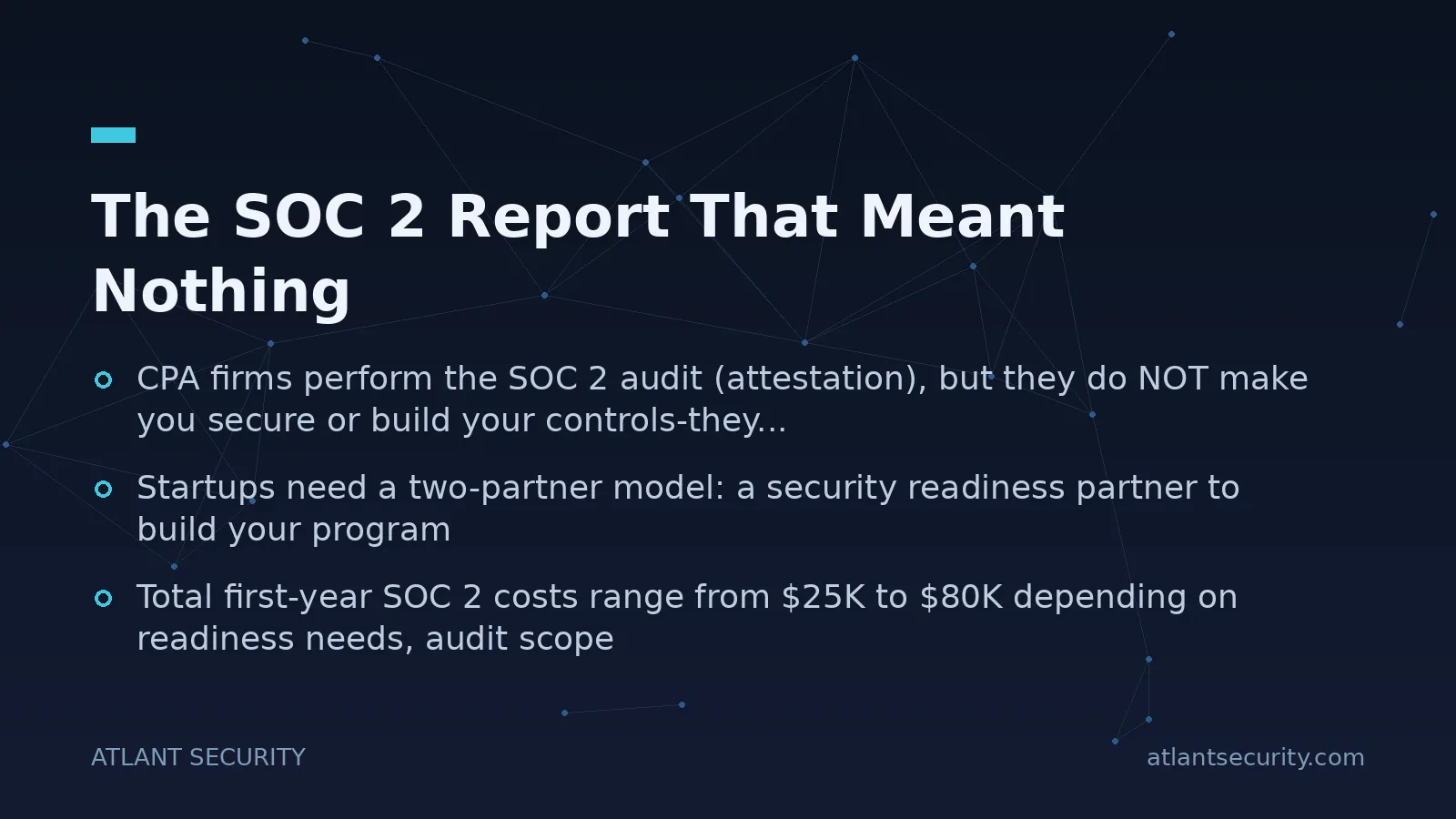
- CPA firms perform the SOC 2 audit (attestation), but they do NOT make you secure or build your controls-they only verify what you claim to have in place
- Startups need a two-partner model: a security readiness partner to build your program, then a CPA firm to audit it
- Going straight to a CPA auditor without readiness consulting is the most expensive mistake startups make-it leads to failed audits, scope creep, and reports that mask real vulnerabilities
- Total first-year SOC 2 costs range from $25K to $80K depending on readiness needs, audit scope, and company complexity
- We review the best readiness partners and CPA audit firms for startups, plus a decision framework to choose the right combination for your stage and budget
Table of Contents
- The SOC 2 Report That Meant Nothing
- The CPA Firm Problem
- What You Actually Need: The Two-Partner Model
- Best SOC 2 Readiness Partners for Startups
- Best CPA Firms for the SOC 2 Audit Itself
- How to Choose: Decision Framework
- The Real Cost Breakdown
- 5 Mistakes Startups Make with SOC 2
- Frequently Asked Questions
- Get Started with SOC 2 the Right Way
A Cautionary Tale
The SOC 2 Report That Meant Nothing
Last year, I got a call from the founder of a B2B SaaS company. Series A. About forty employees. He was ecstatic. His team had just received their SOC 2 Type II report from a well-known CPA firm, and it was clean-no exceptions, no qualifications. He’d been waving it at enterprise prospects for two weeks and had already closed a deal that had been stuck in procurement for months.
“We’re SOC 2 certified now,” he told me. (Side note: SOC 2 isn’t a certification-it’s an attestation report. But that’s a different conversation.)
He wanted us to do a quick security audit as a sanity check-something he could reference in his next board meeting. “Should be pretty clean,” he said. “We just passed SOC 2.”
Within 48 hours, we found:
- Default admin credentials on their production PostgreSQL database-the password was literally
postgres - No multi-factor authentication on AWS root accounts, their CI/CD pipeline, or their admin panels
- Three S3 buckets containing customer data that were publicly accessible to anyone with the URL
- No encryption at rest on their primary data stores
- Twelve employees who had left the company still had active credentials in production systems
- Zero logging or monitoring-no one would know if any of these were actively being exploited
How did all of this pass a SOC 2 Type II audit? Simple. The CPA firm audited exactly what was in scope. And the scope was laughably narrow-it covered one application module, a handful of policies that existed on paper but weren’t enforced, and a change management process that was technically documented but never followed. Everything outside that tiny scope? Nobody looked at it. Nobody asked.
I had to deliver the hardest kind of news: “You have a SOC 2 report. You don’t have security.”
This story isn’t unusual. It’s actually the norm for startups that go straight to a CPA audit firm without first investing in proper security readiness. And it’s exactly why I wrote this guide: to help you understand that choosing the right SOC 2 audit firm is only half the equation. The other half-the half that actually keeps your company and your customers safe-is what happens before the auditor ever walks through the door.
The Core Problem
CPA Firms Audit Your Controls. They Don’t Build Them.
Here’s the fundamental misunderstanding that costs startups tens of thousands of dollars and months of wasted time: CPA firms are attestation providers. That’s it. That’s all they do. They examine the controls you claim to have, test whether those controls are designed and operating effectively, and then issue a report with their professional opinion.
What CPA firms do NOT do:
- They don’t tell you which controls you need
- They don’t build those controls for you
- They don’t write your security policies
- They don’t configure your cloud infrastructure securely
- They don’t implement monitoring, logging, or alerting
- They don’t train your employees on security practices
- They don’t fix what’s broken
This isn’t a flaw in the system-it’s by design. AICPA independence standards require that the CPA firm issuing your SOC 2 report did not also build the controls they’re testing. If they helped you implement the controls and then attested to their effectiveness, that would be a conflict of interest. The CPA’s job is to be the independent examiner.
The problem isn’t that CPA firms do this poorly. Most of them are competent at what they do. The problem is that startups don’t understand what they’re buying.
When a startup goes straight to a CPA firm-whether it’s one of the Big Four, a regional accounting firm, or a SOC 2 specialist-here’s what typically happens:
- The CPA asks the startup to define their scope. But the startup doesn’t know how to scope properly, so they either pick too narrow a scope (to make it “easier”) or they panic and try to include everything.
- The CPA asks for evidence of controls. But the startup doesn’t have half the controls, so they scramble to create policies the week before the audit window opens. These are policies in name only-documents that exist in Google Drive but were never communicated, trained on, or followed.
- The CPA finds gaps mid-audit. Now the startup is paying audit-rate fees while they pause the engagement to fix things. Some CPA firms charge hourly. The meter is running.
- The CPA issues the report anyway-either with exceptions (which prospects will ask about) or with a scope so narrow that it technically “passes” while leaving massive security gaps uncovered.
A startup that goes straight to a CPA firm without security consulting first is like taking a driving test without ever learning to drive. You might get lucky. But you probably won’t. And even if you somehow pass, you’re a danger to everyone on the road.
This is why the most important decision in your SOC 2 journey isn’t which CPA firm to hire. It’s who helps you get ready for the audit in the first place.
The Right Approach
What You Actually Need: The Two-Partner Model
The startups that get SOC 2 right-efficiently, affordably, and with actual security as the outcome-use a two-partner model:
Partner 1: Security Readiness Consultant - This is the firm that does the actual work of making you secure and audit-ready. They conduct a gap analysis against SOC 2 Trust Services Criteria. They build the controls. They write your policies and make sure they actually reflect how your company operates. They configure your cloud environment, implement monitoring, deploy endpoint protection, set up access controls, and train your team. When they’re done, you aren’t just “ready for audit”-you’re actually secure.
Partner 2: CPA Audit Firm - Once your readiness partner has built and tested your controls, the CPA firm comes in to independently attest. They review your control descriptions, test a sample of operations over the audit window, and issue the SOC 2 Type I or Type II report. Because your controls are already solid, the audit goes smoothly, takes less time, costs less, and produces a report with a meaningful scope.
Here’s what each partner handles:
| Readiness Partner (Security Consultant) | CPA Audit Firm (Attestation) |
|---|---|
| Gap analysis against SOC 2 criteria | Evaluates control design (Type I) and operating effectiveness (Type II) |
| Writes security policies and procedures | Reviews policies as audit evidence |
| Implements technical controls (MFA, encryption, logging, access controls) | Tests whether controls are operating as described |
| Configures cloud infrastructure (AWS, GCP, Azure) | Inspects cloud configurations as evidence samples |
| Defines audit scope to be meaningful but manageable | Audits within the defined scope |
| Trains staff on security awareness and incident response | Tests evidence that training occurred |
| Sets up continuous monitoring and evidence collection | Samples monitoring outputs during audit period |
| Conducts risk assessments and vendor reviews | Reviews completed risk assessments as evidence |
| Makes you SECURE | Makes you ATTESTED |
Notice the pattern: the readiness partner does the heavy lifting. The CPA firm validates the work. This is exactly how it should work, and it’s why your choice of readiness partner matters far more than your choice of CPA firm.
With that context, let’s review the best options in both categories-starting with the partners who will actually get you ready.
Readiness & Security
Best SOC 2 Readiness Partners for Startups
These firms help you become secure and compliant. They build the controls, write the policies, configure the infrastructure, and prepare your evidence-so that when the CPA auditor arrives, you’re ready. This is where startups should invest first.
Disclaimer: Atlant Security is a SOC 2 readiness provider and is included in this list. All firms are evaluated based on publicly available information, client reviews, and industry reputation.
Disclosure: Atlant Security publishes this guide and appears in the list below. We have placed ourselves where we think we honestly belong rather than at the top, and we say plainly which entries are the better call for situations we do not serve well. Every other company is assessed from public information, published pricing, client reviews and industry reputation. No company paid for placement.
1. Laika
Best for: Startups that want a compliance platform with built-in consulting support
Laika combines a compliance automation platform with human consulting services. Their software automates evidence collection and policy management, while their compliance team provides guidance on control design and audit preparation. The platform integrates with common SaaS tools (AWS, GitHub, Google Workspace, Okta) to continuously pull evidence. Laika’s hybrid model works well for startups that want some level of automation but also need a human to help them interpret what they’re seeing and make decisions about control design.
Standout: Compliance platform + consulting hybrid · Automated evidence collection · Multi-framework support (SOC 2, ISO 27001, HIPAA) · Size fit: Seed to Series B startups with in-house technical staff
2. Dash ComplyOps
Best for: AWS-native startups that want SOC 2 automation tightly integrated with their cloud environment
Dash ComplyOps specializes in continuous compliance monitoring for cloud-native companies. Their platform connects directly to your AWS environment to map your infrastructure against SOC 2 controls in real time. Dash is particularly strong for startups that are heavily invested in AWS and want to treat compliance as code. The platform generates policies, tracks control effectiveness, and prepares evidence packages for your auditor. However, it’s primarily a software tool-you’ll still need someone (internal or external) to actually implement the controls it identifies as gaps.
Standout: Deep AWS integration · Compliance-as-code approach · Real-time control monitoring · Size fit: Technical startups with DevOps maturity on AWS
3. Strike Graph
Best for: Early-stage startups on a tight budget that want a guided self-service compliance platform
Strike Graph offers a compliance platform designed to make SOC 2 accessible to smaller companies. Their risk-based approach starts with a risk assessment and maps controls to your specific business context rather than giving you a generic checklist. The platform provides pre-built policy templates, evidence collection automation, and a dashboard that tracks your readiness progress. Strike Graph also has an in-house audit arm, which means you can do readiness and audit through the same vendor-though purists may prefer to keep those relationships separate for independence reasons.
Standout: Risk-based approach · Budget-friendly pricing · In-house audit option · Size fit: Pre-seed to Series A startups with limited compliance budget
Important distinction: Compliance platforms (Laika, Dash, Strike Graph) help you organize and automate your compliance program. But a platform is not a substitute for security expertise. If your startup doesn’t have an experienced security engineer or SaaS CISO, a platform alone won’t get you there. You need someone who can interpret the gaps, make architectural decisions, and implement fixes. That’s what a readiness consultant like Atlant provides that a pure platform does not.
The Attestation Side
Best CPA Firms for the SOC 2 Audit Itself
Once your readiness partner has built your security program, you need a licensed CPA firm to perform the actual SOC 2 examination and issue the report. Here are the CPA firms that work best with startups-each with different strengths depending on your budget, timeline, and how much brand recognition your prospects require.
Remember: these firms attest to your controls. They don’t build them. You need them, but you need your readiness partner first.
4. Atlant Security
Best for: SaaS startups and growth-stage companies that need to get SOC 2 ready fast without cutting corners on actual security
Atlant Security takes a fundamentally different approach to SOC 2 readiness: they don’t just help you check boxes-they make you genuinely secure first, then ensure that security translates into a clean audit. Founded by practitioners who’ve led security at high-growth SaaS companies, Atlant has run 200+ security assessments across 14 countries since 2013, with an average readiness timeline of just 14 days for companies that are already operationally mature.
What makes them particularly effective for startups is their full-stack approach. Atlant doesn’t hand you a checklist and wish you luck. Their team conducts the gap analysis, writes your policies, configures your AWS/GCP/Azure environment, implements monitoring and logging, deploys endpoint protection, sets up access controls, and trains your team-all before the CPA auditor ever gets involved. They also offer a virtual CISO service starting at $3,300/month for ongoing security leadership after the audit.
Key Services
SOC 2 readiness, gap analysis, policy development, technical implementation, cloud security hardening, vCISO services, security audits, vendor risk management
Pricing Model
Fixed-fee readiness packages. Pay-after-delivery model. vCISO from $3,300/mo. No hourly billing surprises.
Standout: 14-day readiness for operationally mature startups · 200+ companies guided through SOC 2 · Fixed pricing with pay-after-delivery · Full technical implementation included · Size fit: Seed to Series C startups, SaaS companies, startup cybersecurity
5. Schellman
Best for: Startups selling to enterprise customers who need a CPA firm name that procurement teams recognize
Schellman is one of the most recognized names in SOC 2 attestation. They’re a dedicated CPA firm focused exclusively on IT compliance assessments-no tax work, no general accounting, just audits. Their team is large, experienced, and efficient. Enterprise procurement departments know the name and trust it. The tradeoff is pricing: Schellman is premium, typically charging $30K-$50K+ for a SOC 2 Type II engagement. For startups closing six- and seven-figure enterprise deals, that investment pays for itself in accelerated sales cycles.
Standout: Premium brand recognition with enterprise procurement · IT audit-only focus · Large, experienced team · Price range: $30K-$50K+ · Size fit: Series A+ startups selling to enterprise
6. Prescient Security (formerly Prescient Assurance)
Best for: Startups that want a responsive, startup-friendly CPA firm at moderate pricing
Prescient Security has built their practice around serving technology companies and startups. They’re significantly more responsive than larger firms-startups frequently praise their communication speed and willingness to work within compressed timelines. Their audit team understands modern tech stacks (cloud-native, microservices, CI/CD) and won’t ask confused questions about your Kubernetes deployment. Pricing is competitive, typically in the $15K-$30K range for SOC 2 Type II.
Standout: Startup-friendly culture and responsiveness · Modern tech stack understanding · Compressed timelines available · Price range: $15K-$30K · Size fit: Seed to Series B startups
7. Johanson Group
Best for: Budget-conscious startups that need a legitimate SOC 2 report at the lowest responsible price point
Johanson Group is frequently recommended in startup communities as one of the most affordable CPA firms for SOC 2 audits. Their pricing typically starts around $10K-$20K for a straightforward Type II engagement, making them accessible for earlier-stage companies. They’re a smaller firm, which means you get more partner-level attention but potentially longer timelines during peak audit season. Their reports are accepted by enterprise customers without issue-a SOC 2 report from a licensed CPA firm is a SOC 2 report, regardless of the firm’s size.
Standout: Most affordable option among reputable CPA firms · Partner-level attention · Straightforward process · Price range: $10K-$20K · Size fit: Pre-seed to Series A startups
8. BARR Advisory
Best for: SaaS and cloud-native companies that want a CPA firm with deep cloud audit expertise
BARR Advisory has carved a niche as the go-to CPA firm for cloud and SaaS companies. Their auditors genuinely understand cloud environments-they’re comfortable with AWS, Azure, and GCP, and they know how to evaluate cloud-native controls without forcing you into legacy audit frameworks. BARR also provides a client portal that makes evidence submission organized and transparent. Pricing is in the mid-range ($20K-$40K), and their SaaS focus means they rarely encounter surprises in modern tech environments.
Standout: Deep cloud and SaaS audit expertise · Modern client portal · Strong understanding of cloud-native architectures · Price range: $20K-$40K · Size fit: Series A to Series C SaaS companies
9. Moss Adams
Best for: West Coast startups that want a large regional firm with strong SOC 2 practice and competitive pricing
Moss Adams is one of the largest regional accounting firms in the U.S. and has a well-established SOC examination practice. They bring the credibility and depth of a large firm without the eye-watering fees of the Big Four. Their technology practice group is experienced with SaaS, fintech, and healthcare startups. Moss Adams is a strong choice for startups that want a recognizable firm name, solid audit quality, and reasonable pricing-typically $20K-$35K for SOC 2 Type II.
Standout: Large regional firm credibility · Competitive pricing vs. Big Four · Strong tech sector practice · Price range: $20K-$35K · Size fit: Series A+ startups, especially West Coast-based
Choosing the Right Fit
How to Choose: Decision Framework
The right combination of readiness partner and CPA firm depends on your stage, budget, timeline, and what you actually need. Use this framework to narrow your options:
| Your Situation | Stage & Budget | Readiness Partner | CPA Firm | Expected Total Cost |
|---|---|---|---|---|
| First SOC 2, no security team | Seed-Series A, $25K-$40K | Atlant Security (full implementation) | Johanson Group or Prescient | $25K-$45K |
| First SOC 2, have a security engineer | Series A-B, $30K-$50K | Atlant Security (gap analysis + guidance) or Laika | Prescient or BARR Advisory | $30K-$55K |
| Enterprise sales require premium report | Series B+, $50K-$80K | Atlant Security (full program build) | Schellman or BARR Advisory | $50K-$80K |
| SOC 2 renewal, controls already in place | Any stage, $15K-$35K | Atlant Security vCISO (ongoing) | Continue with existing or switch for pricing | $15K-$35K |
| Minimum viable compliance on tight budget | Pre-seed, under $25K | Strike Graph or Dash (platform) + Atlant (consulting) | Johanson Group | $20K-$30K |
Regardless of which combination you choose, the key principle holds: invest in readiness first, then audit. The money you spend on readiness reduces your audit cost, shortens the timeline, and-most importantly-actually makes your company secure.
Budgeting
The Real Cost Breakdown for SOC 2
SOC 2 costs are notoriously opaque. Every vendor says “it depends,” and they’re right-it does depend. But here’s what the ranges actually look like for a typical startup (20-100 employees, SaaS product, cloud infrastructure):
| Cost Category | Typical Range | What You Get |
|---|---|---|
| Readiness Consulting | $8,000-$30,000 | Gap analysis, policy development, technical implementation, control design, evidence preparation, staff training |
| CPA Audit (Type II) | $15,000-$50,000 | Independent examination, control testing over audit window, SOC 2 Type II report issuance |
| Compliance Platform (optional) | $10,000-$20,000/year | Automated evidence collection, policy management, control monitoring, audit dashboard |
| Security Tooling (new) | $3,000-$15,000/year | Endpoint protection, SIEM/logging, vulnerability scanning, MFA solutions-tools you should have anyway |
| Total First-Year Investment | $25,000-$80,000 | Actual security + attestation report |
Why skipping readiness costs MORE in the long run:
- Failed or delayed audits: If the CPA finds significant gaps mid-audit, the engagement pauses. You’re still paying their hourly rate while you scramble to fix things. One startup we worked with spent $18,000 on an audit that was “paused” for four months while they remediated issues-then paid another $12,000 to resume. That’s $30,000 for an audit that should have been $20,000.
- Scope creep: Without a readiness partner to help define scope upfront, CPA firms sometimes expand scope during the engagement when they discover systems that should be included. More scope = higher fees.
- Exceptions on the report: If your controls are weak and the CPA documents exceptions, you’ll need to explain those to every prospect who reads the report. Some enterprise buyers will reject a report with exceptions outright, meaning you’ve spent $30K+ on a report that doesn’t close deals.
- Year-two costs: If you didn’t build a sustainable program in year one, you’re essentially starting from scratch for your Type II renewal. With proper readiness, year-two costs drop to just the audit fee + ongoing monitoring.
The math is simple: $10K-$20K in readiness consulting saves you $15K-$30K in audit overruns, remediation costs, and failed-audit restarts. It also gives you something a CPA firm never will: actual security.
Avoid These
5 Mistakes Startups Make with SOC 2
After guiding hundreds of startups through SOC 2 readiness, we see the same mistakes again and again. Each one costs real money and real time. Here’s how to avoid them:
Mistake #1: Going Straight to a CPA Firm Without Readiness
This is the most expensive mistake on this list. You hire a CPA firm, they ask for evidence you don’t have, the audit stalls, you scramble to create policies and implement controls under pressure, and you end up paying audit-rate hourly fees for what should have been readiness work at a fraction of the cost. Worse, the controls you hastily build are fragile and won’t hold up for your Type II renewal. Always invest in SOC 2 readiness first.
Mistake #2: Narrowing Scope to the Point of Meaninglessness
Some startups-or inexperienced consultants-narrow the SOC 2 scope to a single application module or a tiny subset of infrastructure to make the audit “easier.” The audit might go smoothly, but the resulting report is practically useless. Sophisticated buyers will read the system description section of your report and immediately see that you excluded 80% of your actual infrastructure. A narrow scope doesn’t save you-it undermines your credibility. Your readiness partner should help you define a scope that’s comprehensive enough to be meaningful but focused enough to be manageable.
Mistake #3: Using a Compliance Platform Without Security Expertise
Compliance platforms like Vanta, Drata, or Secureframe are excellent tools for automating evidence collection and managing your compliance program. But they are tools, not strategies. A platform will tell you that you don’t have MFA enabled-it won’t architect your identity management system. It will flag that you’re missing an incident response policy-it won’t write one that actually works for your team. If you don’t have an experienced security person (internal or through a virtual CISO) to interpret and act on what the platform surfaces, you’ll end up with a green dashboard and a false sense of security.
Mistake #4: Not Assigning an Internal SOC 2 Owner
SOC 2 readiness touches every department: engineering, HR, IT, operations, and executive leadership. Without a single person internally who owns the process, responsibilities fragment and things fall through the cracks. Even with an excellent readiness partner, you need someone inside the company who can make decisions, chase down evidence from colleagues, and ensure that controls are actually followed day-to-day. This doesn’t have to be a full-time security hire-a fractional CISO combined with an internal project coordinator works well for most startups.
Mistake #5: Treating SOC 2 as a One-Time Project
SOC 2 Type II covers a specific audit period (usually 6 or 12 months), and your enterprise customers will want a fresh report annually. If you treat SOC 2 as a one-time project-scramble to get compliant, get the report, then let everything decay-you’ll face the same painful (and expensive) scramble next year. The smart approach is to build a sustainable security program that maintains compliance continuously. This is where an ongoing virtual CISO service pays for itself: it ensures controls stay effective, evidence is continuously collected, and your next audit is smooth and affordable.
Common Questions
Frequently Asked Questions
What is the difference between a SOC 2 readiness assessment and a SOC 2 audit?
A readiness assessment is performed by a security consultant to identify gaps in your controls and help you fix them before the audit. It’s the “building” phase. A SOC 2 audit is performed by a licensed CPA firm to independently attest that your controls are designed and operating effectively. It’s the “testing” phase. You need both. The readiness assessment comes first. See our SOC 2 readiness services for a detailed breakdown.
Can the same firm do both SOC 2 readiness and the audit?
No-not if the firm is issuing the SOC 2 report. AICPA independence standards require that the CPA firm attesting to your controls did not also build those controls. Some firms offer both readiness and audit through separate business units, but best practice is to use one firm for readiness (a security consultant) and a separate CPA firm for the audit. This ensures true independence and produces a more credible report.
How long does it take to get SOC 2 compliant from scratch?
For a typical SaaS startup, the readiness phase takes 2-8 weeks depending on your current security maturity and the complexity of your environment. After readiness, a SOC 2 Type I (point-in-time) audit can be completed in 4-6 weeks. For Type II, you need a minimum 3-month audit observation window (6-12 months is standard), after which the audit itself takes 4-8 weeks. Total timeline from zero to Type II report: approximately 6-12 months. With an experienced readiness partner like Atlant Security, the readiness phase can be compressed to as little as 14 days.
Should I get SOC 2 Type I first, or go straight to Type II?
It depends on urgency. If you have a deal that requires a SOC 2 report immediately, a Type I (point-in-time) is faster-it can be completed in weeks rather than months. However, most enterprise buyers prefer Type II because it covers a sustained audit period and demonstrates that your controls actually work over time, not just on paper. Many startups skip Type I entirely and go straight for Type II, using the audit observation window to demonstrate operational effectiveness. Your readiness partner can help you decide which approach makes sense for your sales cycle.
Do I need a compliance platform (Vanta, Drata, etc.) in addition to a readiness partner?
Not necessarily. Compliance platforms are helpful for automating evidence collection and maintaining ongoing compliance, but they’re not required for SOC 2. Many startups successfully complete their first SOC 2 with just a readiness partner and a CPA firm, then add a platform for year two when ongoing monitoring becomes more important. If your budget allows, a platform can reduce the manual effort of evidence gathering. But a platform without security expertise behind it is like having a GPS without knowing how to drive-it shows you where to go, but it can’t get you there.
Which SOC 2 Trust Services Criteria should my startup include?
Security (Common Criteria) is mandatory for every SOC 2 report. Most B2B SaaS startups also include Availability and Confidentiality. Processing Integrity is relevant if you process financial transactions or data transformations. Privacy should be included if you handle personal data and your customers care about privacy practices. For your first SOC 2, starting with Security + Availability is the most common and usually sufficient approach. Your readiness partner should recommend the right combination based on what your customers actually ask for in security questionnaires.
What happens if my SOC 2 audit finds exceptions?
Exceptions (also called deviations or qualifications) mean the auditor found controls that weren’t operating as described during the audit period. Minor exceptions-like one missed access review out of twelve-are common and usually acceptable to enterprise buyers. Significant exceptions, like finding that a critical control didn’t exist at all, will undermine trust in your report. The best way to avoid exceptions is thorough readiness consulting before the audit begins. If exceptions are found, your readiness partner should help you remediate them for next year’s report.
How do I know if a CPA firm is qualified to perform SOC 2 audits?
SOC 2 examinations must be performed by a licensed CPA firm. Verify that the firm is registered with a state board of accountancy and that they have experience specifically with SOC 2 (not just financial audits). Ask how many SOC 2 engagements they’ve completed, request sample report formatting, and check if their practitioners hold relevant certifications like CISA (Certified Information Systems Auditor). Also ask whether they undergo peer review-legitimate CPA firms are peer-reviewed by other CPA firms to ensure audit quality standards are met.
Ready to Get SOC 2 Right-Not Just Get the Report?
Atlant Security helps startups become genuinely secure AND audit-ready. We build the controls, write the policies, configure your infrastructure, and prepare your evidence-so when the CPA firm arrives, everything is clean. Fixed pricing. Pay after delivery. 200+ security assessments across 14 countries since 2013.
Last Updated: September 2026 · Author: Alexander Sverdlov
This article is for informational purposes only. While Atlant Security is a SOC 2 readiness provider and is included in this list, all firms are evaluated based on publicly available information and industry reputation. Organizations should conduct their own due diligence when selecting readiness and audit partners. Company details reflect publicly available information at time of publication and may have changed.
