

One of the most common conversations I have with prospective clients starts with a mix-up. They ask for a penetration test when what they actually need is an audit, or they buy an audit and expect it to tell them whether an attacker could break in. These two services sound similar, they are often sold by the same firms, and they both produce a report full of findings. But they answer completely different questions, and confusing them wastes money and, worse, creates a false sense of safety.
After running more than 200 security assessments across 14 countries since 2013, I can put the distinction in one sentence. A penetration test asks "can someone break in, and how far can they get?" An IT security audit asks "are the right controls in place, working, and documented?" You usually need both, but not always at the same time, and rarely in the same quarter. This article explains what each one really does, when to choose which, and how to avoid paying for the wrong thing.
What a Penetration Test Actually Is
A penetration test is an authorized, simulated attack against your systems, performed by people whose job is to think and act like a real adversary. The goal is not to produce a tidy list of theoretical weaknesses. The goal is to prove, with evidence, what an attacker could actually do: which door opens, what is behind it, and how far the intrusion spreads once they are inside. Our penetration testing services page shows what that evidence looks like in practice: requests, responses and results you can inspect.
A good pen test goes well beyond running a scanner. Automated tools find known vulnerabilities, but they do not chain three low-severity issues into a full domain takeover, and they do not reason about business logic. A skilled tester does. The value is in the manual work: the creative exploitation, the pivoting between systems, the privilege escalation that no automated tool would have found. That is why a scan and a penetration test are not the same thing, even though vendors sometimes blur the line.
Common Types of Penetration Testing
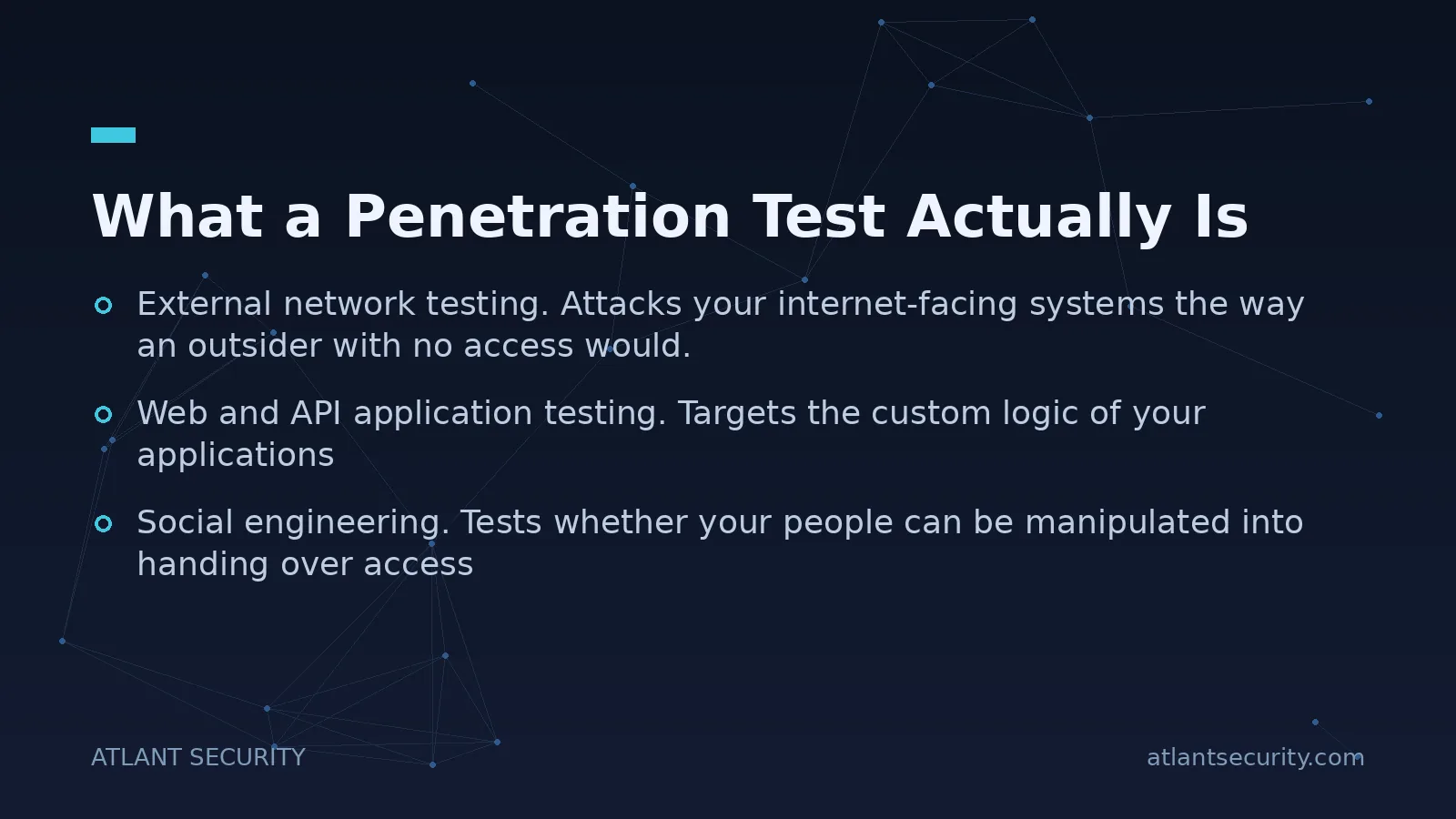
- External network testing. Attacks your internet-facing systems the way an outsider with no access would.
- Internal network testing. Simulates an attacker who already has a foothold, such as a compromised laptop or a malicious insider, and measures how far they can move.
- Web and API application testing. Targets the custom logic of your applications, where the most damaging flaws usually live.
- Social engineering. Tests whether your people can be manipulated into handing over access, often the fastest way in.
The deliverable that matters is not the vulnerability count. It is a clear narrative of attack paths, ranked by real business impact, with concrete remediation steps. If you want to understand the scope and depth of a proper engagement, our penetration testing service page lays out how we approach it.
What an IT Security Audit Actually Is
An IT security audit is a structured, systematic evaluation of your security program against a defined benchmark. That benchmark might be an industry framework, a regulatory requirement, or your own internal policies. Where a pen test is adversarial and depth-first, an audit is methodical and breadth-first. It looks across the whole program: governance, policies, access management, logging, patching, backups, physical security, vendor management, and more.
The audit answers questions a pen test cannot. Do you have a written access control policy, and does reality match it? Are privileged accounts reviewed on a schedule? Is logging turned on where it needs to be, and does anyone actually look at the logs? Are your backups documented and tested? An auditor gathers evidence through document review, interviews, configuration checks, and sampling, then measures the gap between what should be in place and what is.
This is the work that underpins compliance. If you are pursuing SOC 2, ISO 27001, HIPAA, or PCI DSS, an audit-style assessment is how you find out where you stand before a formal examination. Our IT security audit is built to give you that honest baseline and a prioritized roadmap.
Penetration Test vs. IT Security Audit: The Core Differences
| Dimension | Penetration Test | IT Security Audit |
|---|---|---|
| Core question | Can an attacker break in, and how far? | Are the right controls present and working? |
| Approach | Adversarial, depth-first, hands-on exploitation | Systematic, breadth-first, evidence review |
| Output | Proven attack paths and business impact | Control gaps against a framework |
| Best for | Testing real-world resilience | Compliance, governance, coverage |
| Typical trigger | New app, major change, customer requirement | Certification, regulation, annual review |
| Blind spot if used alone | Misses undocumented, unmonitored, or policy gaps | Misses whether controls stop a real attacker |
Why You Should Not Substitute One for the Other
Here is the trap I see most often. A company passes an audit with flying colors, every box ticked, and assumes it is secure. Then a pen test walks straight through the front door because a single misconfigured service was never in scope for the audit, or because the documented control existed on paper but had quietly stopped working. The audit measured intent and coverage. It did not measure whether the controls hold up against pressure.
The reverse trap is just as common. A company runs a pen test, fixes the handful of findings, and believes it has "done security." But the test only covered a slice of the environment at one moment in time. It said nothing about whether access reviews happen, whether logs are monitored, whether the next new server will be configured correctly, or whether the business would even notice a breach. Those are governance questions, and only an audit surfaces them.
The economics of this changed recently. AI-run penetration testing runs the same OWASP Top 10, API, cloud and network checks a human tester works through, chains the findings into proof-of-concept evidence, and returns results in five to ten days with retesting included once you have fixed things. That turns testing after every release from an aspiration into a line item.
The two are complementary because they check different failure modes. An audit catches the systemic and procedural gaps that let problems recur. A pen test catches the concrete, exploitable holes that a checklist would never reveal. Mature security programs use both on a rhythm, and they feed each other: audit findings shape what the next pen test should probe, and pen test findings expose which controls need to be added to the audit scope.
Which One Do You Need First?
If you are early in building a security program, start with an audit. You need to know what you have, what you are missing, and where the biggest gaps are before it makes sense to test how well any of it holds. Spending on a deep pen test when you already know large parts of your program are absent is usually premature. Fix the obvious structural gaps first, then test.
Choose a penetration test first when:
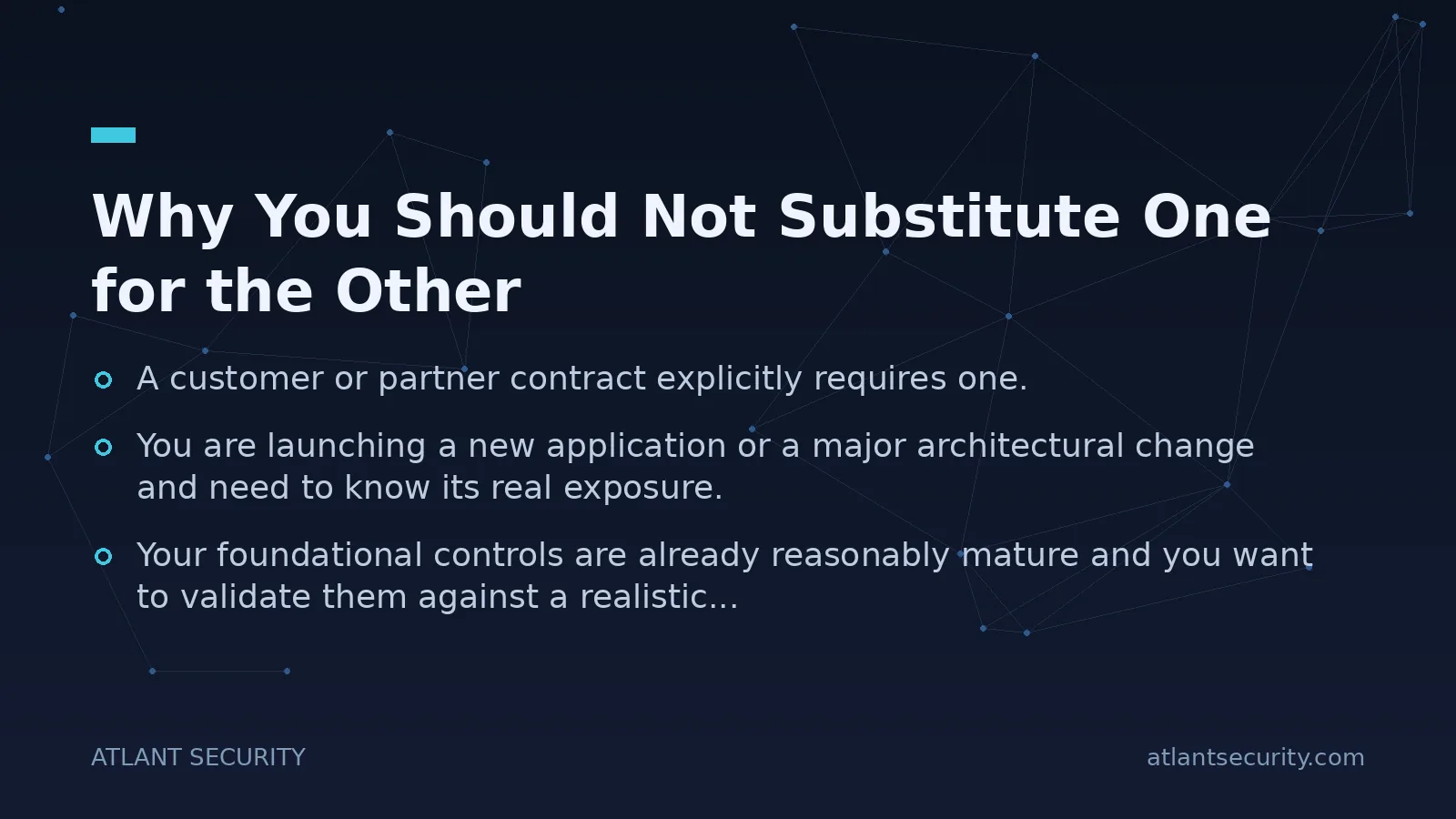
- A customer or partner contract explicitly requires one.
- You are launching a new application or a major architectural change and need to know its real exposure.
- Your foundational controls are already reasonably mature and you want to validate them against a realistic attacker.
- You suspect a specific risk (an exposed service, a legacy system) and want concrete proof of its impact.
Choose an audit first when:
- You are pursuing a compliance certification or preparing for a regulatory examination.
- You have never mapped your controls against any framework.
- Leadership needs a clear, prioritized picture of security posture to make budget decisions.
- You have grown quickly and suspect policy and reality have drifted apart.
If you are unsure which fits your situation, that decision itself is worth an expert conversation. Ongoing guidance from a virtual CISO or an experienced cyber security consultant often saves far more than the cost of the engagement by making sure you buy the right assessment at the right time.
How the Two Fit Into a Yearly Rhythm
For most organizations, a sensible cadence looks like this: an annual audit to keep the program honest and aligned with whatever framework applies, plus a penetration test whenever something material changes and at least once a year against your most important systems. Between those milestones, continuous vulnerability management fills the gap so that new weaknesses are caught early rather than waiting for the next scheduled test. A vulnerability assessment program is the low-cost connective tissue that keeps both the audit and the pen test from becoming annual surprises.
The point is not to buy one expensive assessment and relax. It is to build a repeating loop: measure the program, test the reality, fix what you find, and measure again. That loop is what actually reduces risk over time.
Frequently Asked Questions
Is a vulnerability scan the same as a penetration test?
No. A vulnerability scan is automated and identifies known weaknesses, which is useful and cheap to run often. A penetration test uses a skilled human to exploit and chain those weaknesses to prove real impact. A scan tells you a door might be unlocked, a pen test walks through it and shows you what is in the room.
Can an IT security audit replace a penetration test for compliance?
It depends on the specific requirement. Some frameworks and contracts explicitly require penetration testing, while others accept a broader security assessment. Read the requirement carefully, because assuming an audit satisfies a pen test clause (or vice versa) is a common and expensive mistake. When in doubt, confirm with the party imposing the requirement.
How often should we do each one?
A reasonable baseline is an audit annually and after major organizational change, plus a penetration test annually against critical systems and whenever you deploy a significant new application or infrastructure. High-risk or heavily regulated businesses often test more frequently. Continuous vulnerability scanning should run in the background regardless.
We are a small company. Do we really need both?
Not necessarily at once. Smaller organizations usually get more value from an audit first, because it reveals the structural gaps that matter most and it is cheaper to act on. Add penetration testing once your foundational controls are in place or when a customer requires it. Sequencing sensibly matters more than doing everything immediately.
Who should perform these assessments?
Ideally an independent party without a stake in the result. Internal teams know the environment well but tend to have blind spots and conflicts of interest when grading their own work. An outside assessor brings fresh eyes, cross-industry experience, and the credibility that customers and auditors expect from the report.
What should a good report contain?
A pen test report should describe attack paths, business impact, and prioritized, actionable fixes, not just a raw list of tool output. An audit report should map findings to the chosen framework, rate severity, and give a clear remediation roadmap. In both cases, if the report is unreadable to your leadership, it has failed at its most important job.
If you are still not sure which assessment your organization needs next, that is exactly the kind of question worth a short conversation. Reach out and we will help you choose the right one for where you are, rather than selling you the more expensive engagement by default.
