The single most common mistake I see in security programs is treating the audit as an event. Once a year, a team scrambles for two weeks, a consultant produces a report, everyone exhales, and the document goes into a folder nobody opens again until next year. Meanwhile the environment it described has already changed. New servers were spun up, a contractor was granted admin rights, a SaaS app was adopted by marketing without anyone telling IT, and a critical patch was deferred. By the time the annual audit rolls around again, the report is describing a company that no longer exists.
That gap between the last audit and the actual state of your systems is exactly where attackers operate. In more than a decade of assessments across 14 countries, almost every serious incident I have investigated traced back to something that changed after the last review and was never checked again. This is the core argument for continuous IT security auditing: your risk changes every day, so your assurance has to keep pace.
In this article I will explain why the annual model is failing, what "continuous" actually means in practice (it is not marketing), how to build a rolling audit program that fits a real organization, and how to avoid the trap of drowning in alerts while missing the things that matter.
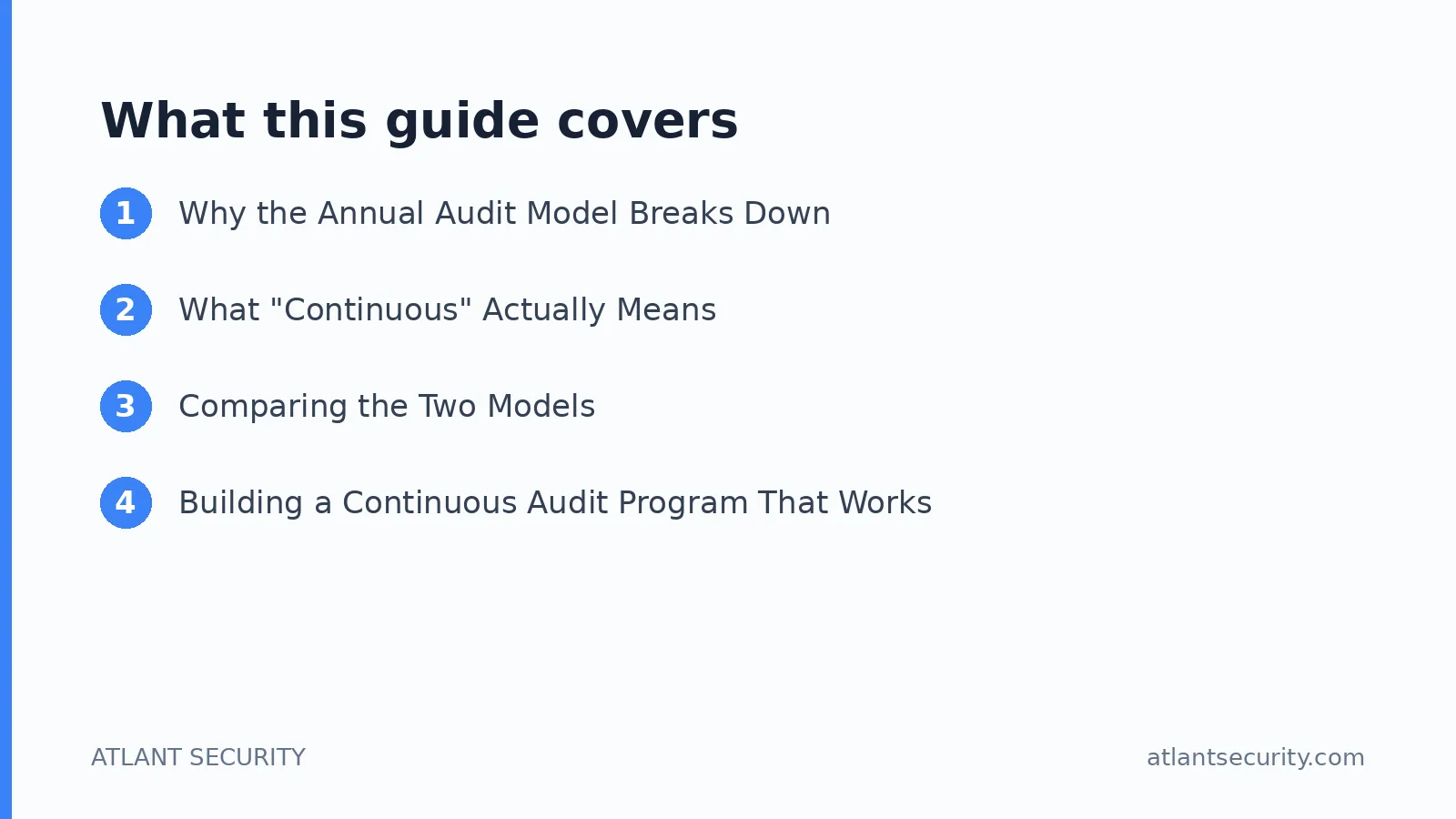
Why the Annual Audit Model Breaks Down
The point-in-time audit was designed for a slower world. It assumes your infrastructure is relatively stable, that change is deliberate and documented, and that a snapshot taken in March is still broadly accurate in September. None of that holds anymore.
Several forces have made the environment change faster than any annual cycle can track:
- Cloud and infrastructure as code. A single engineer can create and destroy dozens of servers, storage buckets, and network rules in an afternoon. A misconfigured storage bucket exposed on Tuesday will not be caught by an audit scheduled for the following spring.
- Remote and hybrid work. Your security perimeter now includes home networks, personal devices, and coffee-shop Wi-Fi. The controls that made sense for an office everyone commuted to no longer describe how work happens.
- SaaS sprawl and shadow IT. Teams adopt new tools independently, each one a new place your data lives and a new set of credentials to protect. Most organizations genuinely do not know the full list of applications touching their data.
- Faster, more automated attacks. Attackers scan the entire internet for a newly disclosed vulnerability within hours of its publication. If your assurance operates on an annual clock and theirs operates on an hourly one, you are structurally behind.
- Shifting regulations. Compliance obligations under frameworks like SOC 2, ISO 27001, HIPAA, and NIS2 increasingly expect ongoing monitoring, not a once-a-year snapshot.
The result is a widening window of exposure between audits. Continuous auditing exists to close that window.
What "Continuous" Actually Means
Let me be precise, because the word gets abused. Continuous auditing does not mean a human auditor sitting at your desk 365 days a year, and it does not mean buying a dashboard and declaring victory. It means designing a program where different checks run at the cadence their risk demands, and where findings feed a loop of remediation and verification rather than a static annual report.
In practice a mature program layers several tempos:
- Automated, always-on checks for things that can be machine-verified continuously: configuration drift, exposed services, unpatched systems, new privileged accounts, disabled logging, public cloud resources.
- Frequent lightweight reviews, monthly or quarterly, of access rights, new SaaS adoption, vendor changes, and the status of previously identified findings.
- Periodic deep assessments, still done well and by skilled humans, including penetration testing and architecture review, that probe for the complex, chained weaknesses automation cannot find.
The distinction that matters is not "automated versus manual." It is "always changing therefore always verified" versus "verified once and assumed static." A good IT security audit program blends both tempos so nothing important goes unwatched for a year at a time.
Comparing the Two Models
| Dimension | Annual point-in-time audit | Continuous auditing |
|---|---|---|
| Coverage window | One day per year | Every day, at varying depth |
| Time to detect drift | Up to twelve months | Hours to days |
| Handles cloud change | Poorly | Well |
| Cost pattern | Large annual spike | Steady, predictable |
| Compliance fit | Meets minimum | Produces continuous evidence |
| Relationship to attackers | Structurally behind | Keeps pace |
Building a Continuous Audit Program That Works
You do not need to boil the ocean. A program that actually gets used beats a perfect one that overwhelms your team. Here is the sequence I recommend.
1. Know What You Have
You cannot audit what you cannot see. Start with an asset inventory that is itself kept current: servers, endpoints, cloud accounts, SaaS applications, data stores, and the people with privileged access to each. This inventory is the foundation everything else stands on, and in most organizations building it honestly is where the first uncomfortable surprises appear.
2. Automate the High-Frequency Checks
Instrument the things that change constantly and can be machine-verified. Configuration baselines, patch status, exposed ports, encryption settings, logging health, and cloud posture all belong here. The goal is that a dangerous change generates a finding within hours, not at the next annual review. This is also where a focused vulnerability assessment capability becomes an ongoing feed rather than a yearly snapshot.
3. Set Cadences by Risk
Not everything needs the same tempo. Internet-facing systems and privileged access deserve frequent scrutiny. A rarely changed internal document server needs far less. Match effort to risk so your team spends attention where it actually reduces exposure.
4. Close the Loop on Findings
This is where most programs quietly fail. Detecting an issue is worthless if nothing happens next. Every finding needs an owner, a severity, a deadline, and a verification step confirming it was actually fixed. A continuous program is a loop, detect, prioritize, remediate, verify, not a stream of alerts nobody owns.
5. Keep the Deep Human Assessments
Automation catches the known and the obvious. It does not think like an attacker chaining three low-severity issues into a full compromise. Retain regular expert-led testing and architecture review for that. The best programs use automation to keep the baseline clean so human experts can spend their time on the genuinely hard problems. Many teams that lack this expertise internally bring in a virtual CISO to own the program and interpret what the tooling surfaces.
The Trap: Drowning in Alerts
The most common way continuous programs go wrong is not too little data, it is too much. Turn on every scanner at maximum sensitivity and you will generate thousands of findings, most of them low priority or false positives. The team burns out, learns to ignore the dashboard, and the real critical finding gets lost in the noise. This is alert fatigue, and it is genuinely dangerous because it produces a false sense of coverage.
The discipline that prevents it is ruthless prioritization. Tune out the noise. Rank by real exploitability and business impact, not by a raw CVSS score in isolation. A medium-severity flaw on an internet-facing server holding customer data outranks a high-severity flaw on an isolated internal test box. Continuous auditing succeeds only when it makes the important few things impossible to miss, not when it surfaces everything equally.
How This Supports Compliance
A well-run continuous program is a gift at audit time. Instead of scrambling to reconstruct evidence for the past year, you already have a running record of control status, findings, and remediation. Frameworks increasingly reward this. SOC 2 in particular is fundamentally about controls operating effectively over a period of time, which is exactly what continuous monitoring demonstrates. If you are working toward SOC 2 or ISO 27001, building continuous auditing now means the certification largely documents itself rather than becoming a fire drill.
It is also worth noting that many of the worst gaps I find are not in your own systems but in your vendors. Continuous attention to third-party risk belongs in any modern program, a subject I cover in depth in this piece on the critical role of third-party risk management. And if you want to avoid the pitfalls teams routinely stumble into, the most common IT security audit mistakes are worth reading before you start.
Frequently Asked Questions
Does continuous auditing replace the annual audit entirely?
No, and it should not. It changes what the periodic deep audit is for. Instead of trying to discover everything in a two-week scramble, the annual assessment validates that your continuous program is working, probes for complex chained weaknesses automation misses, and provides independent assurance. The two are complementary, not competing.
Is continuous auditing only for large enterprises?
No. Smaller organizations often benefit more, because they lack the staff to notice drift manually and cannot absorb the disruption of an annual scramble. The tooling scales down, and the cadence can be lighter. A small business can run a meaningful continuous program with modest investment, especially with fractional expert guidance.
How is continuous auditing different from just running security tools?
Tools generate data. Auditing turns that data into verified assurance and action. The difference is the loop: findings get owners, deadlines, and verification, and the program is measured on whether risk actually goes down. Buying a dashboard and never acting on it is not continuous auditing, it is expensive noise.
What is the biggest risk when adopting continuous auditing?
Alert fatigue. Teams turn on everything at maximum sensitivity, drown in low-priority findings, and start ignoring the dashboard, which is worse than having no dashboard because it creates false confidence. Ruthless prioritization by real-world exploitability and business impact is what keeps the program effective.
Where should a company start if it only does annual audits today?
Begin with a current asset inventory and automated monitoring of your highest-risk, internet-facing systems and privileged accounts. Get the detect-remediate-verify loop working there first, then expand cadence and coverage. Trying to instrument everything at once is the fastest way to overwhelm the team and abandon the effort.
Keep Pace With Your Own Risk
Your systems change every day, and so does the threat against them. An annual snapshot cannot describe a moving target. Continuous auditing is how you keep assurance current, close the exposure window attackers exploit, and turn compliance from a yearly fire drill into a byproduct of doing the work well. If you want help designing a continuous audit program that fits your environment and does not drown your team in noise, book a discovery call and we will build a plan around your actual risk.