

I have run more than 200 IT security audits and assessments across 14 countries since 2013, and I have also been on the receiving end of plenty of other people's audit reports when clients hand me the binder from last year's engagement. The uncomfortable truth is that a large share of security audits produce very little real security. They generate paper. They tick boxes. They reassure a board. And then the company gets breached through a gap the audit never looked at.
An audit is only worth doing if it changes what you do afterward. Below are the mistakes I see most often, on both sides of the table, and exactly how to avoid each one. If you are commissioning an audit, buying one, or running one internally, read this first. It will save you from paying for a document that makes you feel safe while leaving you exposed.
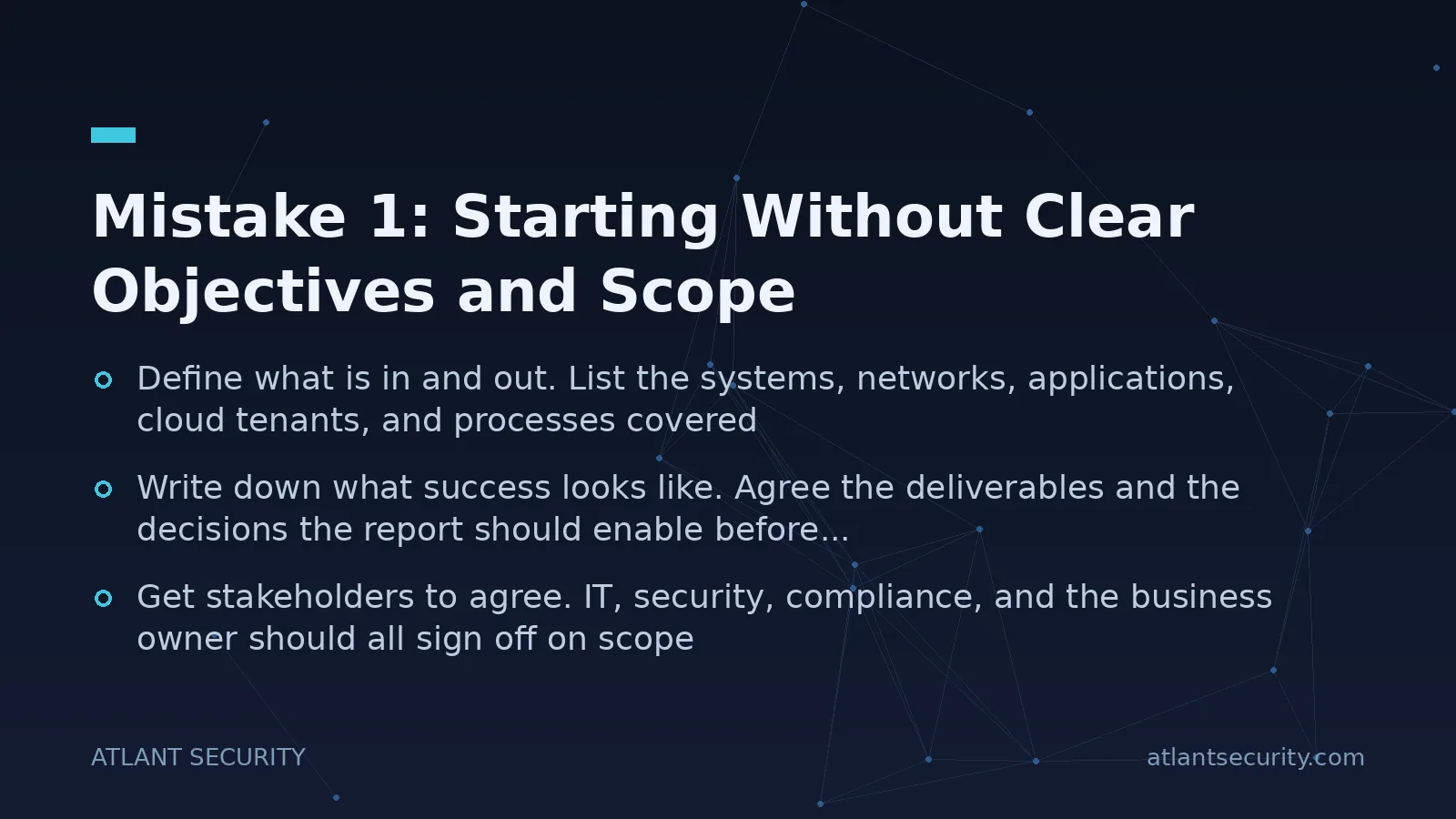
Mistake 1: Starting Without Clear Objectives and Scope
The single most expensive mistake happens before any testing begins. If you cannot state, in one sentence, what the audit is supposed to answer, the audit will wander. It will sample a bit of everything, go deep on nothing, and miss the systems that actually matter. Vague scope is how a company ends up with a thick report that never touched the domain controller, the payment flow, or the cloud account where the crown jewels live.
How to avoid it:
- Name the goal. Is this a compliance audit for a specific framework, a risk-driven assessment of your most sensitive systems, or a validation that last year's fixes held? Each drives a different plan.
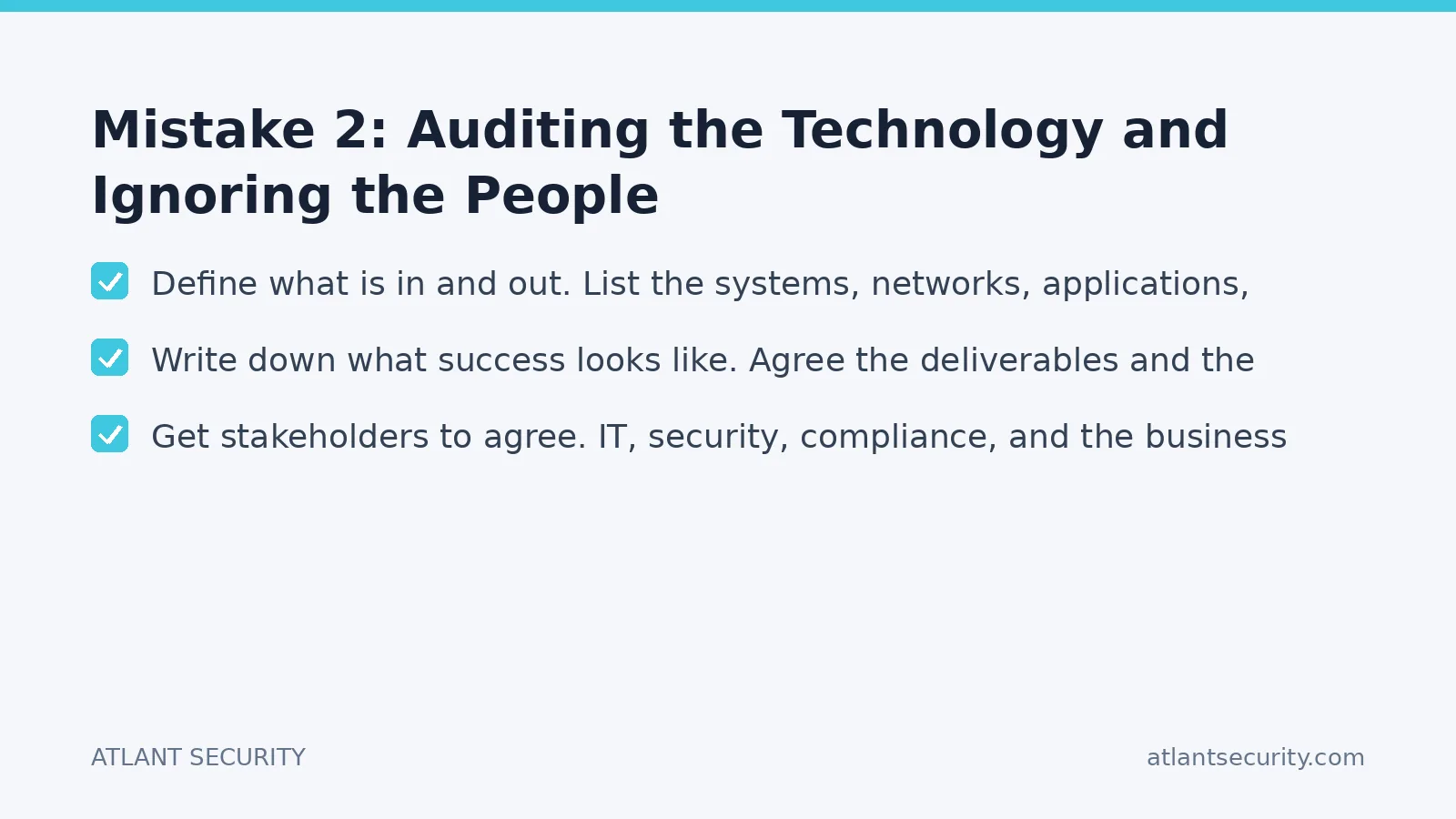
- Define what is in and out. List the systems, networks, applications, cloud tenants, and processes covered, and explicitly note what is excluded and why.
- Write down what success looks like. Agree the deliverables and the decisions the report should enable before work starts.
- Get stakeholders to agree. IT, security, compliance, and the business owner should all sign off on scope, so no one is surprised by the findings or the gaps.
A tightly scoped audit that goes deep on the systems that matter beats a broad, shallow sweep every time. If you are unsure where to draw the line, that is exactly the conversation to have at the start of an IT security audit, not after the invoice arrives.
Mistake 2: Auditing the Technology and Ignoring the People
Most audits over-index on infrastructure and barely touch human behavior. Yet in nearly every serious incident I have investigated, a person was the entry point. Someone clicked, someone approved an MFA prompt they did not initiate, someone paid an invoice that was never real. If your audit never tested whether staff would fall for a phishing email or hand credentials to a caller claiming to be IT, it audited half the attack surface.
How to avoid it:
- Include people in scope. Interview staff across departments, not just IT, about how they actually handle access, data, and suspicious messages. What people do differs from what the policy says.
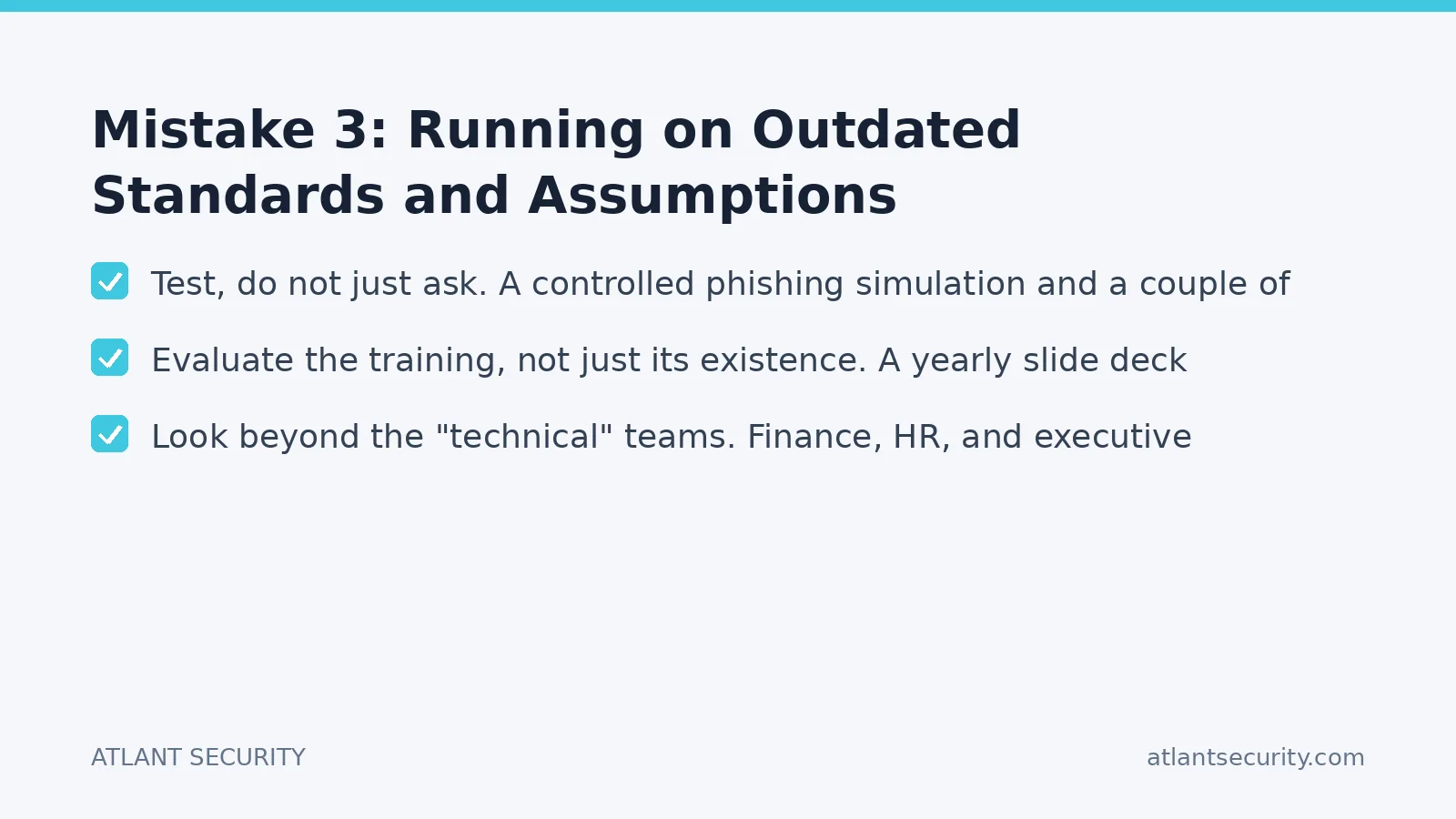
- Test, do not just ask. A controlled phishing simulation and a couple of pretext phone calls tell you more about real risk than a questionnaire ever will.
- Evaluate the training, not just its existence. A yearly slide deck nobody remembers is not a control. Check whether awareness efforts change behavior.
- Look beyond the "technical" teams. Finance, HR, and executive assistants are prime targets precisely because attackers know they hold approvals and access.
Mistake 3: Running on Outdated Standards and Assumptions
Threats and requirements move. An audit that measures you against last decade's checklist can hand you a clean bill of health while leaving you noncompliant with current regulation and blind to current attack techniques. I still see audits that ignore cloud misconfiguration, identity-based attacks, and supply-chain risk because the methodology predates them.
How to avoid it:
- Confirm the methodology is current. Ask which frameworks and threat models the audit is based on and when they were last updated.
- Map to the regulations that apply to you now. Whether that is SOC 2, ISO 27001, HIPAA, PCI DSS, or NIS 2, the audit should reflect the version you are actually accountable for. Readiness work like SOC 2 readiness or ISO 27001 readiness keeps the target current.
- Cover modern attack surface. Identity, SaaS, cloud, and third-party integrations should be in scope, not just the on-premise network.
Mistake 4: Weak Reporting Nobody Can Act On
A finding that a busy executive cannot understand and an engineer cannot reproduce is a wasted finding. I have read reports that list a hundred "vulnerabilities" with no severity, no context, and no fix, which is worse than useless because it buries the three issues that would actually get you breached under ninety-seven that do not matter. Good reporting is where an audit earns its fee.
What a usable report looks like:
- Prioritized by real risk. Findings ranked by likelihood and business impact, so the team fixes what matters first, not what is alphabetically first.
- Two layers. An executive summary that a non-technical decision-maker can act on, plus technical detail with reproduction steps and evidence for the engineers who will fix it.
- Specific remediation. Every finding paired with a concrete recommendation, not a generic "improve access controls."
- Owned and scheduled. The report should feed a plan with owners, deadlines, and a re-test date, not sit in a shared drive.
Mistake 5: Trusting Automated Scanners to Do the Whole Job
Vulnerability scanners are useful and I use them on every engagement. But a scan is a starting point, not an audit. Scanners are blind to business logic flaws, chained attacks, process failures, physical exposure, and the human factor. An attacker does not care that your scanner reported "no critical findings" if they can phish an admin and pivot through a flat network to your data.
How to avoid it:
- Pair automation with manual testing. A skilled tester chains together medium findings that a scanner rates as harmless in isolation. That is how real breaches happen. This is the core of proper penetration testing as opposed to a raw vulnerability assessment.
- Know the tool's limits. Treat scanner output as one input, validated by a human, not as a verdict.
- Get an independent set of eyes. An external assessor with no stake in the environment will question assumptions your internal team stopped noticing years ago.
A Quick Comparison: Weak Audit vs Audit Worth Paying For
| Dimension | Weak audit | Audit worth paying for |
|---|---|---|
| Scope | Vague, "everything" | Defined, risk-driven, agreed up front |
| Human factor | Not tested | Phishing and pretext testing included |
| Method | Scanner output only | Automated plus manual, current threat model |
| Report | Long list, no priorities | Risk-ranked, two-layer, actionable |
| Follow-through | Filed and forgotten | Owners, deadlines, re-test |
Make the Audit Change Something
The best audit I can run for you is one that ends with a short list of the things that would actually get you compromised, ranked, explained, and paired with fixes your team can execute, followed by a re-test that proves the fixes held. Everything else is theatre. If you are a smaller organization without a dedicated security team, this discipline matters even more, because you cannot afford to spend a budget on reassurance instead of protection. That is exactly the gap our small-business cybersecurity services and virtual CISO work are designed to close.
Frequently Asked Questions
How often should we run an IT security audit?
At least annually, and after any significant change such as a cloud migration, a merger, a major new application, or a security incident. Between full audits, continuous monitoring and periodic targeted testing catch the drift that accumulates over the year. Compliance frameworks may also mandate a specific cadence you have to meet regardless.
What is the difference between a vulnerability scan and a security audit?
A vulnerability scan is an automated check for known weaknesses on your systems. A security audit is a broader evaluation of controls, processes, configuration, and often human behavior, using scans as one input among many. A scan tells you which doors have known-weak locks; an audit tells you whether the whole building is defensible, including the people who hold the keys.
Should we use an internal team or an external auditor?
Use both, for different purposes. Internal teams know the environment and can monitor continuously. External auditors bring independence, current threat knowledge, and the willingness to question assumptions your own team no longer sees. For anything tied to compliance or board assurance, independence is what makes the result credible.
How do we know if an audit was actually good?
A good audit produces a short, prioritized list of the issues that matter most, each with clear evidence and a specific fix, and it includes the human and process layers, not just infrastructure. If the report is a long undifferentiated list of scanner output with no priorities and no reproduction steps, you paid for a scan dressed up as an audit.
How much should an IT security audit cost?
It depends on scope, the number and complexity of systems, and whether penetration testing and social engineering are included. The wrong question is "what is the cheapest audit." The right question is "what scope actually reduces our risk," and then price against that. A cheap audit that misses your crown jewels is the most expensive thing you can buy.
Want an audit that changes something? I run risk-driven IT security audits that end with a short, prioritized, testable list of fixes, not a binder of scanner output. Book a free strategy call and get a fixed-price proposal within 24 hours.
