

Most cloud breaches I have investigated since 2013 did not start with a clever attacker. They started with a rushed migration. A team lifted a workload out of a datacenter it understood, dropped it into an environment it did not, and inherited a stack of default settings that quietly exposed data to the internet. The cloud did exactly what it was told to do. The problem was what it was told.
Cloud migration - moving data, applications, and infrastructure from on-premises systems to a cloud platform, or between clouds - is one of the highest-leverage moves a business can make. It is also one of the easiest to get wrong from a security standpoint, because the security model changes underneath you at the same time everything else does. This guide walks through how to migrate without opening holes, based on the patterns I see over and over in real assessments.
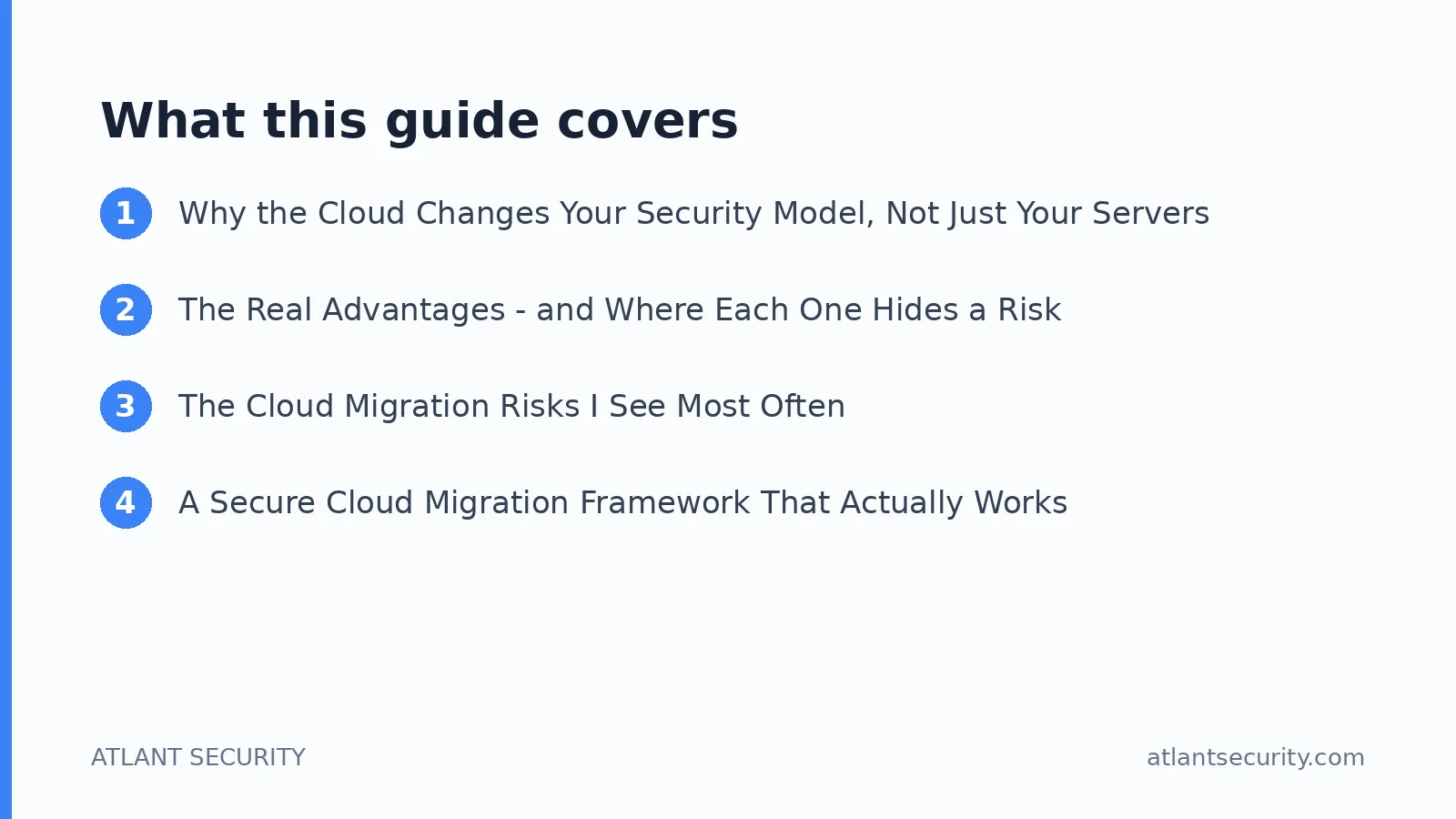
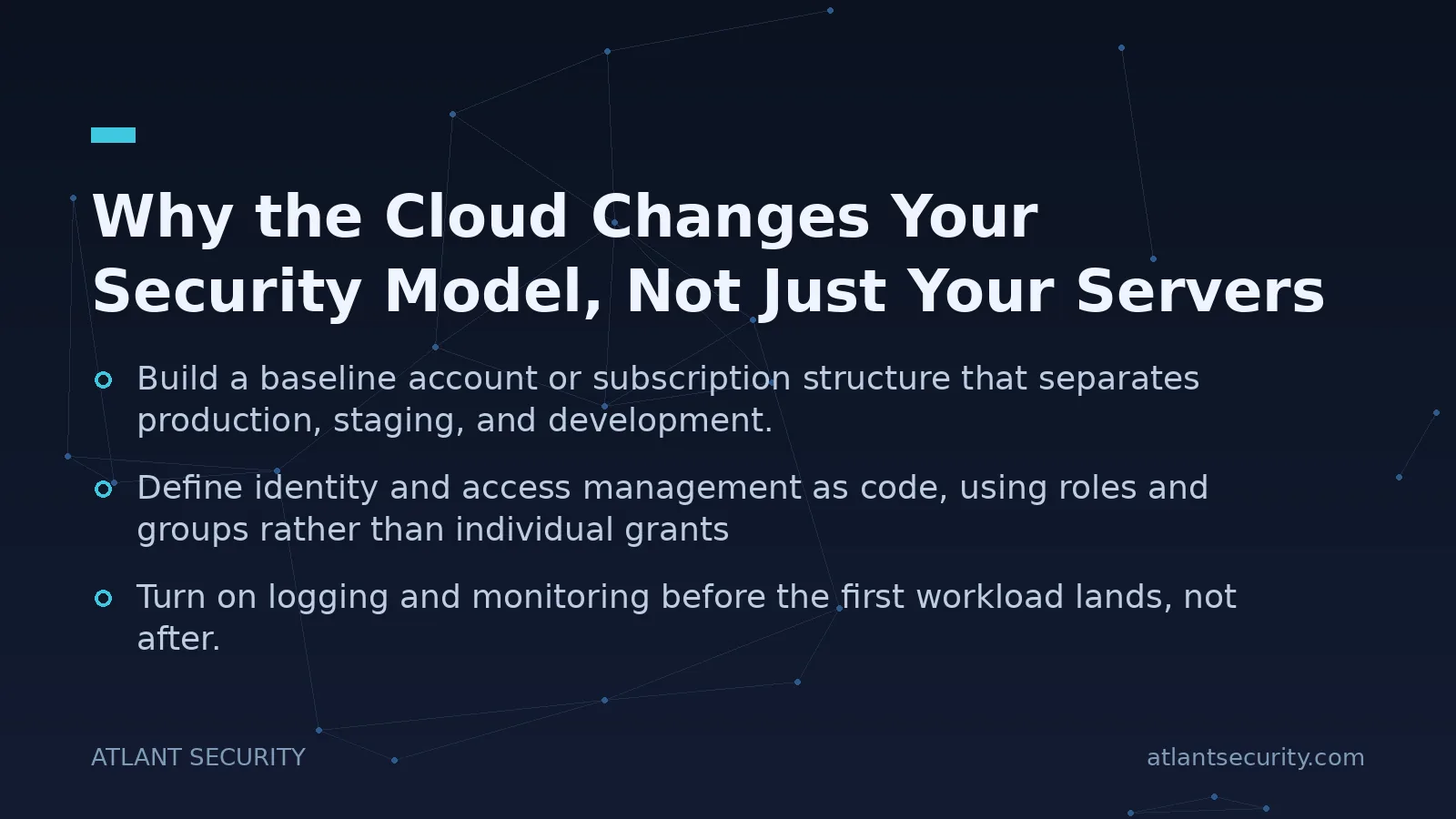
Why the Cloud Changes Your Security Model, Not Just Your Servers
On-premises, you owned the whole stack: the building, the network, the hypervisor, the operating system, the application, and the data. In the cloud you own a shrinking slice of that depending on the service. This is the shared responsibility model, and misunderstanding it is the single most common root cause of the incidents I see.
- Infrastructure as a Service (IaaS): the provider secures the physical hardware and hypervisor. You are still responsible for the operating system, patching, network configuration, identity, and data. This is closest to what you had on-premises, and the trap is assuming the provider now handles more than it does.
- Platform as a Service (PaaS): the provider manages the operating system and runtime. You own your code, your configuration, your access controls, and your data.
- Software as a Service (SaaS): the provider runs almost everything, but you still own your data, your user accounts, and how you configure sharing and access. Most SaaS breaches come from customer-side misconfiguration, not the vendor being hacked.
The line moves depending on the service, but one thing never moves: your data and your identities are always your responsibility. Plan the migration around protecting those two things first.
The Real Advantages - and Where Each One Hides a Risk
Cloud migration is worth doing. I am not here to talk anyone out of it. But every benefit has a security cost that has to be managed deliberately.
| Benefit | The hidden security cost |
|---|---|
| Cost savings from paying only for what you use | Easy provisioning means shadow resources and forgotten storage buckets nobody is monitoring |
| Elastic scalability | A misconfiguration scales just as fast as a good design; one bad template replicates across hundreds of instances |
| Access from anywhere | Your perimeter is now identity, not the office network; a stolen password is a full breach |
| Built-in redundancy and disaster recovery | Replication copies your mistakes and your ransomware across regions unless you design for it |
The Cloud Migration Risks I See Most Often
1. Publicly exposed storage and databases
Object storage buckets and managed databases left open to the internet remain the most common serious finding in cloud assessments. It usually happens because a developer needed to test something, opened access "temporarily," and never closed it. Treat every storage resource as private by default and require an explicit, reviewed exception to make anything public.
2. Over-permissioned identities
Migrations move fast, and the fastest way to make something work is to grant broad permissions. I routinely find service accounts and human users with administrator-equivalent rights they have never needed. When one of those credentials leaks, the blast radius is the entire environment.
3. Inconsistent security between on-prem and cloud
During a migration you run in a hybrid state, sometimes for months. Security controls that were enforced on-premises - logging, segmentation, endpoint protection - often do not get reproduced in the cloud, so the new environment is weaker than the one it replaced.
4. Data loss and integrity issues during transfer
Moving terabytes of data creates windows where data is in transit, partially copied, or duplicated in temporary locations. Without validation, you can silently corrupt records or leave copies of sensitive data in staging areas that never get cleaned up.
A note on tooling, since it comes up every time: continuous AI penetration testing sits between a vulnerability scanner and a manual engagement. It exploits rather than just flags, chains attacks, and produces remediation code, not a CVE list.
5. Compliance drift
Data that lived in one jurisdiction on-premises can end up replicated across regions in the cloud, which can violate GDPR, HIPAA, PCI DSS, or contractual data-residency requirements you did not think to check.
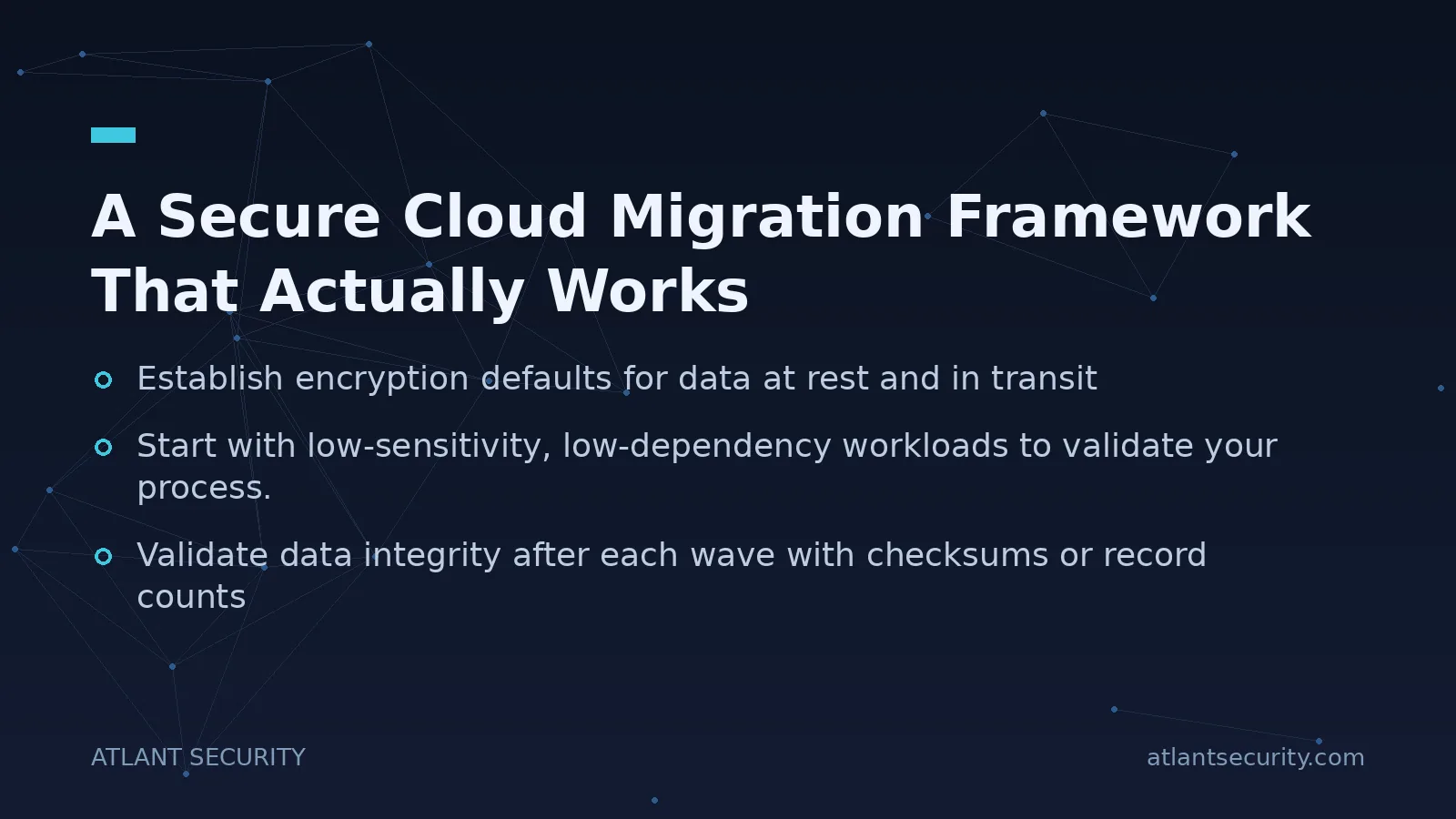
A Secure Cloud Migration Framework That Actually Works
Across 200-plus assessments in 14 countries, the migrations that stayed secure followed a similar shape. Here is the sequence I recommend.
Phase 1: Discover and classify before you move anything
- Inventory every application, data store, and dependency you plan to move. You cannot secure what you have not mapped.
- Classify your data by sensitivity: public, internal, confidential, regulated. This classification drives every encryption and access decision that follows.
- Identify regulatory obligations tied to each dataset - which data must stay in a specific region, which is subject to HIPAA or PCI, which triggers breach-notification rules.
- Decide, per workload, whether to rehost as-is, refactor for the cloud, or retire it. Not everything should move, and dead applications should not be migrated at all.
Phase 2: Design security into the landing zone
- Build a baseline account or subscription structure that separates production, staging, and development. Blast-radius control starts with account boundaries.
- Define identity and access management as code, using roles and groups rather than individual grants, and enforce least privilege from day one.
- Turn on logging and monitoring before the first workload lands, not after. You want the audit trail from the very first action.
- Establish encryption defaults for data at rest and in transit, with keys you control where the sensitivity of the data justifies it.
Phase 3: Migrate in controlled waves
- Start with low-sensitivity, low-dependency workloads to validate your process.
- Validate data integrity after each wave with checksums or record counts, and confirm the source and destination match before decommissioning anything.
- Securely wipe temporary staging locations once each wave is verified.
- Keep the old environment available and rollback-ready until the new one is proven in production.
Phase 4: Harden, monitor, and verify continuously
- Run a configuration review against a recognized cloud benchmark and remediate the findings.
- Enable continuous posture monitoring so new misconfigurations are caught within minutes, not at the next audit.
- Test the environment adversarially with a penetration test once workloads are live, because a real attacker finds the gaps a checklist misses.
Identity Is Your New Perimeter
The most important shift to internalize: in the cloud, identity is the perimeter. Firewalls still matter, but the fastest path into a cloud environment is a valid credential. That is why I insist on a few non-negotiables:
- Multi-factor authentication everywhere, especially for administrators and any account that can change infrastructure. Phishing-resistant methods where possible.
- Least privilege by default, with just-in-time elevation for high-privilege tasks instead of standing admin rights.
- No long-lived static keys embedded in code or configuration. Use short-lived, automatically rotated credentials.
- Regular access reviews to remove permissions that were granted for a one-time task and never revoked.
If you are moving fast and want a second set of expert eyes on the design, this is exactly the kind of work our cloud security consulting team does, and where a virtual CISO can keep security decisions aligned with the migration timeline instead of trailing behind it.
Common Mistakes That Turn a Good Migration Into a Breach
- Treating migration as an infrastructure project only. If security is not represented in the planning room, it will be bolted on afterward, badly.
- Lifting and shifting without review. Moving a poorly configured on-prem system to the cloud gives you a poorly configured cloud system that is now reachable from anywhere.
- Forgetting the decommissioning phase. Old systems and staging copies left running are unmonitored liabilities holding real data.
- Assuming the provider secures your data. They secure the platform. Your configuration and your data are yours.
- Skipping the post-migration test. The environment you designed and the environment you actually built are rarely identical.
Frequently Asked Questions
Is the cloud more secure than on-premises infrastructure?
The underlying platform from a major provider is usually more secure than what most organizations can build and maintain themselves, because the provider invests heavily in physical and infrastructure security. But that security only covers their layer. The majority of cloud breaches come from customer-side misconfiguration and identity mistakes, which the provider cannot fix for you. The cloud can be more secure, but only if you hold up your side of the shared responsibility model.
How long should a secure cloud migration take?
It depends on the number and complexity of workloads, but rushing is the enemy of security. A migration done in controlled waves with validation between each wave takes longer on paper than a big-bang cutover, yet it is far less likely to produce an incident. Budget time explicitly for the discovery, design, and post-migration hardening phases, not just the data transfer itself.
What is the single most common cloud migration security mistake?
Over-permissioned identities and publicly exposed storage tie for first place in my experience. Both come from prioritizing "make it work now" over "make it work safely," and both are the direct cause of many of the large breaches you read about. Enforcing least privilege and defaulting all storage to private prevents the majority of serious exposures.
Do we still need penetration testing after migrating to the cloud?
Yes. Configuration reviews and posture monitoring catch known misbehaviors, but a penetration test validates how those pieces actually combine in your live environment and finds the chained weaknesses that automated tools miss. Test after the environment is live and again after any major architectural change.
How do we keep the migration compliant with regulations like GDPR or HIPAA?
Start by classifying your data and mapping each dataset to its regulatory obligations before you move anything. Control which regions data is stored and replicated to, ensure encryption and access logging meet the standard, and confirm your provider will sign the appropriate agreements such as a Business Associate Agreement for HIPAA. Compliance is far cheaper to design in than to retrofit.
Should a small business handle cloud migration security in-house?
Small teams can absolutely run a secure migration, but the identity design and landing-zone setup are where a small mistake becomes a big exposure. If you do not have dedicated cloud security expertise, bringing in help for the design and post-migration review is money well spent. Our small business cybersecurity services are built for exactly this situation.
Move to the Cloud Without Moving Your Risk With It
Cloud migration is not risky because the cloud is dangerous. It is risky because it compresses a huge number of security decisions into a short window, and every default you accept without thinking becomes part of your attack surface. Plan around your data and identities, design the security before you move, migrate in waves, and verify the result adversarially. Do that and the cloud becomes what it should be: more scalable, more resilient, and more secure than the datacenter you left behind.
If you want experienced eyes on your migration plan before you commit, get in touch with Atlant Security and we will walk through your specific environment. You may also want to read our guide to cloud security best practices and how to detect and defend against stealthy cyber attacks.
