In more than 200 security assessments across 14 countries, the breaches that stung the most were rarely the work of a nation-state kicking down the front door. They were quieter than that. A departing engineer who copied the customer database to a personal drive on his last week. A finance clerk who wired money to an attacker because she believed the email came from the CFO. An admin who kept access to a system he had not touched in two years, until his credentials were phished and used to move laterally through the network. Every one of those events came from inside the trust boundary, and every one was preventable.
Insider threats are uncomfortable to think about because they force you to accept that the people you hired, trained, and pay can also hurt you. Most will never intend to. That is exactly why insider risk is so hard: the majority of damaging insider incidents involve no malice at all, just a mistake, a shortcut, or a credential that ended up in the wrong hands. This article breaks down the real categories of insider threat, how to detect them without turning your workplace into a surveillance state, and the controls that actually reduce the risk in practice rather than on paper.
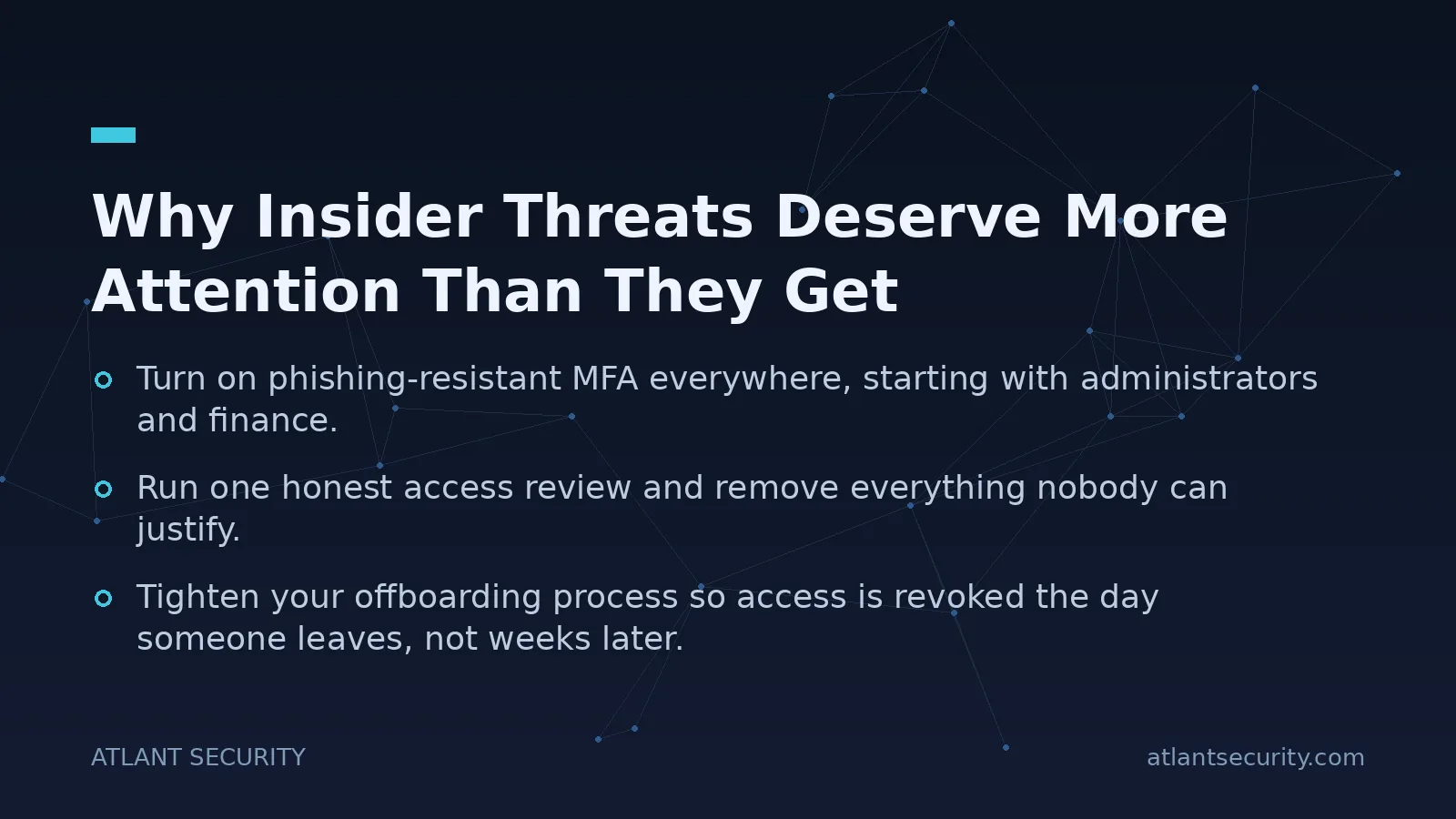
Why Insider Threats Deserve More Attention Than They Get
External attackers have to work to get in. An insider is already in. They hold valid credentials, they know where the sensitive data lives, and their activity blends into the normal noise of the business. That combination makes insider incidents both more likely to succeed and slower to detect than a smash-and-grab from outside.
There is also a psychological blind spot. Leadership teams invest heavily in firewalls, endpoint protection, and threat intelligence aimed outward, then leave the internal environment wide open on the assumption that trusted people behave predictably. They mostly do. But you do not manage risk for the average case. You manage it for the tail: the one disgruntled employee, the one account that gets compromised, the one contractor whose laptop is riddled with malware. The cost of that tail event, in stolen data, regulatory exposure, and lost customer trust, is what justifies taking insider risk seriously.
The Four Types of Insider Threat
Not every insider is a villain, and treating them all the same wastes effort and damages culture. I sort insider threats into four categories, because the defense for each is genuinely different.
1. Malicious Insiders
These are people who deliberately abuse their access. The motive is usually one of a short list: money, revenge, ideology, or the desire to take value with them to a competitor. The classic example is the employee who has already accepted another job and spends their notice period quietly exfiltrating client lists, source code, or pricing models. Malicious insiders are the smallest category by count but often the most damaging per incident, because they know exactly what to take and how to cover their tracks.
2. Negligent Insiders
This is the largest group by a wide margin. Negligent insiders mean no harm. They reuse passwords, they click a convincing phishing link, they email a spreadsheet of personal data to the wrong address, they leave a laptop unlocked in a coffee shop, or they store company files in an unsanctioned personal cloud account because it is more convenient. The damage is real even though the intent is absent. Most of your insider risk budget should go toward reducing negligence, because that is where the volume is.
3. Compromised Insiders
Here the person is a victim, not the actor. An attacker steals or phishes an employee's credentials and then operates as that employee. From the logs, the activity looks internal and legitimate, which is precisely why credential theft is the entry point for so many serious breaches. A compromised insider can be your most senior administrator, which means the blast radius can be the entire environment.
4. Third-Party and Supply-Chain Insiders
Contractors, managed service providers, auditors, and vendors often hold standing access to your systems. They sit inside your trust boundary but outside your direct control. If their security hygiene is weaker than yours, they become your weakest link. Third-party insiders can be malicious, negligent, or compromised just like employees, but you have far less visibility into which.
| Type | Intent | Primary Defense |
|---|---|---|
| Malicious | Deliberate harm | Least privilege, activity monitoring, offboarding discipline |
| Negligent | None (carelessness) | Training, guardrails, data loss prevention, phishing-resistant MFA |
| Compromised | None (victim) | MFA, anomaly detection, credential hygiene, EDR |
| Third-party | Varies | Vendor risk management, scoped access, contractual controls |
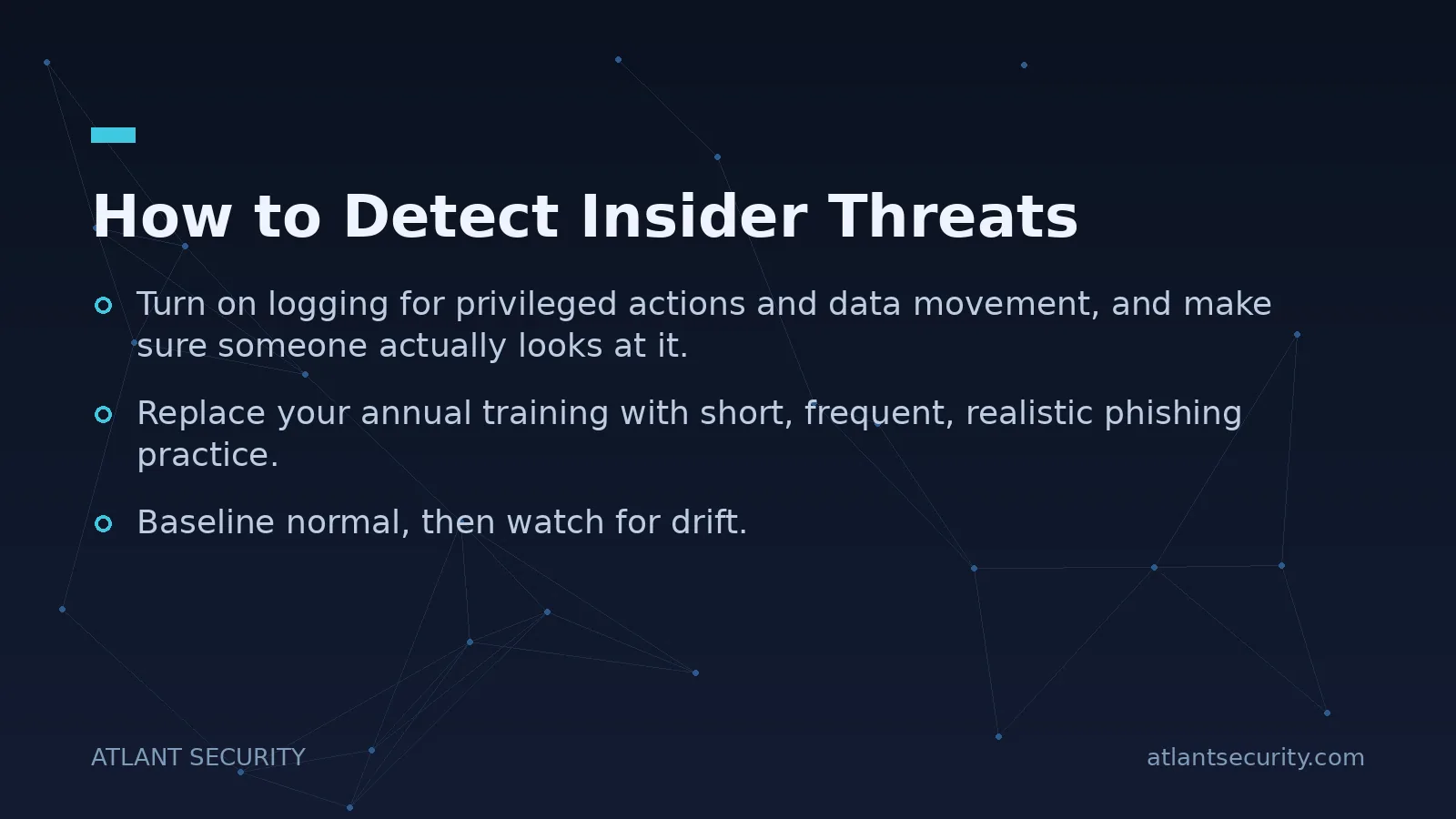
How to Detect Insider Threats
Detection is hard precisely because insiders use legitimate access. You cannot rely on a signature that says "this is an attack." Instead you look for deviation from established normal behavior, and you correlate signals rather than trusting any single one. Here is what actually works.
- Baseline normal, then watch for drift. You cannot spot the abnormal until you know what normal looks like for each role. A support agent who suddenly queries the entire customer table, an account that logs in at 3 a.m. from a new country, a user who starts touching file shares they have never opened before: these matter only against a baseline.
- Monitor data movement, not just data access. The signal that separates a curious employee from an exfiltration event is usually volume and destination. Large downloads, bulk copies to USB, uploads to personal cloud storage, or unusual email attachments to external addresses are the telltales. Data loss prevention tooling exists for exactly this.
- Track privilege use and escalation. Sudden use of admin rights, creation of new accounts, changes to permissions, or attempts to disable logging are high-value signals. Legitimate admin work leaves a predictable pattern; an attacker operating a compromised admin account rarely matches it.
- Correlate HR context with technical signals. A resignation, a poor performance review, or a role change is a leading indicator. I am not suggesting you spy on unhappy staff. I am saying that when someone gives notice, that is the moment to tighten monitoring on their access to intellectual property, because the departing-employee data grab is one of the most common insider incidents there is.
- Reduce false positives or you will drown. The fastest way to kill an insider-threat program is to flood the security team with alerts that turn out to be nothing. Tune your detections, use risk scoring, and require multiple corroborating signals before escalating to a human investigation.
A structured IT security audit is often where these detection gaps first become visible, because it forces you to answer a simple question: if an insider abused their access right now, would you even know?
Preventing Insider Threats
Detection tells you something went wrong. Prevention keeps it from happening in the first place, and it is where the return on investment is highest. These are the controls I recommend in nearly every engagement.
Enforce Least Privilege, and Actually Review It
Give people the minimum access they need to do their job, and nothing more. This single principle limits the blast radius of every category of insider threat at once. The hard part is not granting least privilege on day one, it is preventing privilege creep over years as people change roles and accumulate access no one ever revokes. Run access reviews on a schedule. If a manager cannot explain why someone still has a permission, remove it. Active Directory environments are especially prone to this, which is why a dedicated Active Directory security assessment so often uncovers dormant admin rights and over-permissioned accounts.
Make Phishing-Resistant MFA Non-Negotiable
Multi-factor authentication is the highest-leverage control against compromised insiders. Attackers who phish a password hit a wall if they cannot also defeat the second factor. Prefer phishing-resistant methods such as hardware security keys or platform passkeys over SMS codes, which can be intercepted. This one control shuts down a large share of credential-based intrusions.
Invest in Training That Changes Behavior
Since negligence is the biggest slice of insider risk, awareness training pays for itself. But annual click-through slides do almost nothing. What works is frequent, realistic, role-specific practice: simulated phishing that teaches people to recognize modern lures, clear guidance on how to report something suspicious without fear of blame, and short reinforcement tied to real incidents. The goal is not to trick employees, it is to build reflexes.
Vet People and Vendors Before You Trust Them
Background checks proportionate to the sensitivity of the role, clear contractual security obligations for vendors, and scoped time-limited access for contractors all reduce the standing risk. For third parties specifically, do not assume their security matches yours. Ask for evidence, whether that is a SOC 2 report, an ISO 27001 certification, or the results of an independent assessment.
Build Guardrails, Not Just Rules
A policy that says "do not upload company data to personal cloud accounts" is worth far less than a technical control that blocks it. Wherever you can, replace human diligence with a system that makes the wrong action difficult or impossible. Disable USB mass storage where it is not needed. Apply data loss prevention on email and endpoints. Sandbox risky file types. People make mistakes; guardrails catch them.
Mitigating and Responding to Insider Incidents
You will never drive insider risk to zero, so you must be ready to respond when something happens. A good response plan for insider incidents differs from an external one in an important way: it involves people, HR, and legal, not just technology.
- Have an insider-specific incident response plan. Your general IR plan probably assumes an outside attacker. Add a branch for the case where the actor is an employee or contractor. Who is notified? How do you preserve evidence without tipping off the subject? When do legal and HR get involved? Decide this before you need it, not during a live event.
- Preserve evidence carefully. Insider cases frequently end in disciplinary action, termination, or litigation. If you handle the investigation sloppily, you can lose the ability to act on it. Log integrity, chain of custody, and a documented timeline matter.
- Coordinate across departments. Security, HR, legal, and often the affected business unit all have a role. Acting alone, security can violate employment law or tip off a malicious insider. Build these relationships in advance.
- Contain proportionately. A negligent employee who clicked a phishing link needs their session revoked and their machine cleaned, not a hostile confrontation. A confirmed malicious actor needs immediate, coordinated access revocation. Match the response to the category.
- Run regular risk assessments and learn from every incident. After each event, whether it was a genuine threat or a false alarm, ask what control would have prevented or caught it earlier, and close that gap. Insider risk management is a loop, not a project.
For organizations without a dedicated security leader, this coordination is often where a virtual CISO earns their keep, translating between the technical, legal, and human sides of an insider incident and making sure the plan exists before the crisis does.
A Practical Starting Point
If insider risk feels overwhelming, do not try to boil the ocean. Start with the controls that cover the most ground for the least effort:
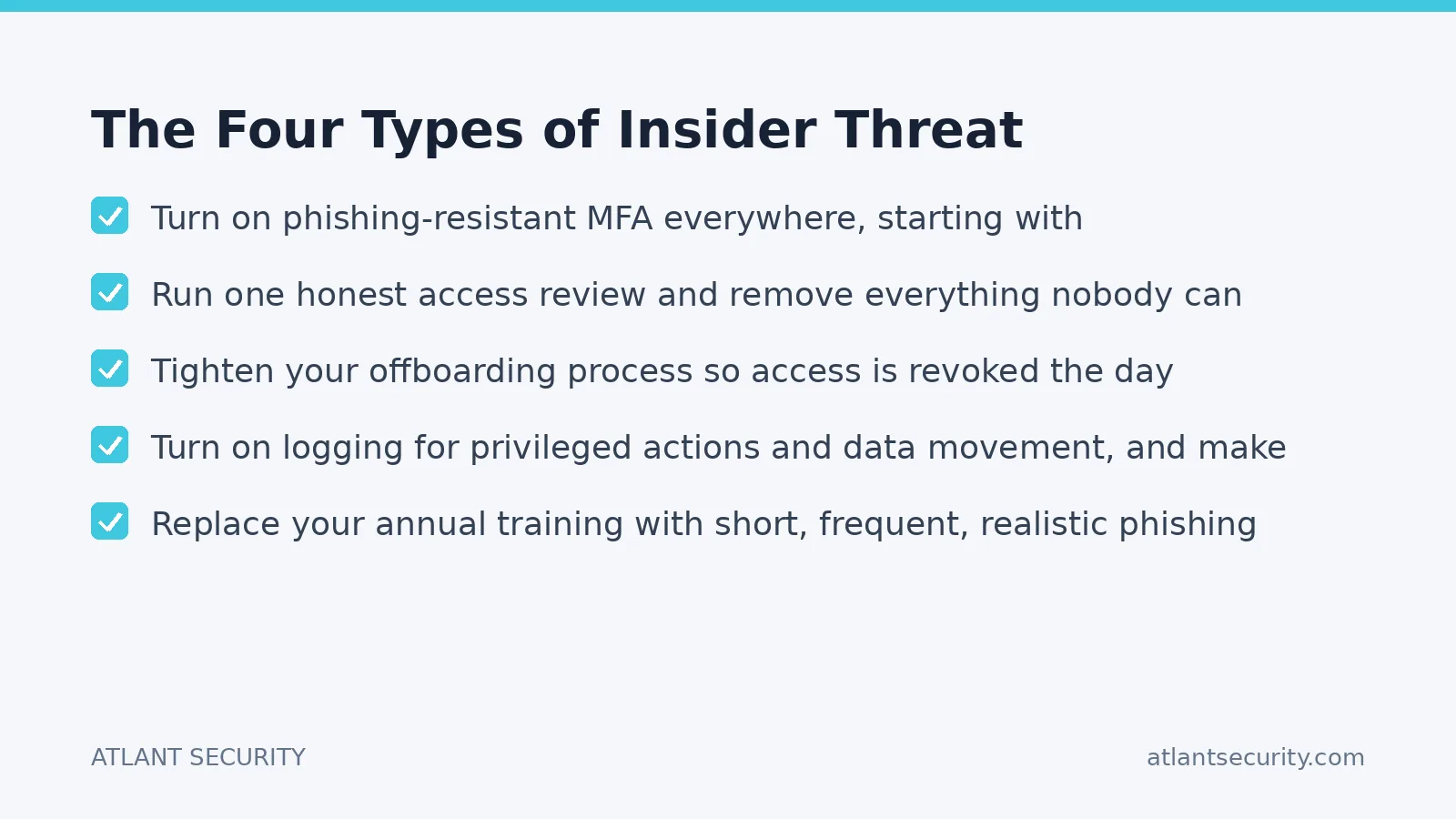
- Turn on phishing-resistant MFA everywhere, starting with administrators and finance.
- Run one honest access review and remove everything nobody can justify.
- Tighten your offboarding process so access is revoked the day someone leaves, not weeks later.
- Turn on logging for privileged actions and data movement, and make sure someone actually looks at it.
- Replace your annual training with short, frequent, realistic phishing practice.
Those five steps will reduce your insider risk more than any expensive tool bought before the fundamentals are in place. Culture matters as much as technology here: people who feel trusted, treated fairly, and safe to report mistakes are both less likely to become malicious and more likely to catch negligence early.
Frequently Asked Questions
What is the most common type of insider threat?
Negligent insiders are by far the most common. The typical damaging insider event is not a saboteur but an ordinary employee who fell for a phishing email, misconfigured a share, or emailed sensitive data to the wrong recipient. This is good news, because negligence responds well to training, guardrails, and better default settings.
How is an insider threat different from an external attack?
An insider already has legitimate access and knowledge of where valuable data sits, so their activity blends into normal operations and is harder to detect. External attackers first have to breach the perimeter, which usually generates more obvious signals. Notably, a compromised insider is really an external attacker operating through stolen internal credentials, which blurs the line.
Can monitoring for insider threats violate employee privacy?
It can if done carelessly, and it can also damage trust. The right approach is proportionate, transparent monitoring focused on systems and data rather than surveilling individuals. Log access to sensitive assets, watch for anomalous data movement, and involve legal and HR to stay within employment and privacy law. Tell employees what is monitored and why; secrecy breeds resentment and rarely improves security.
What is the single most effective control against insider threats?
There is no single silver bullet, but least privilege comes closest because it limits the damage every category of insider can do. Combined with phishing-resistant MFA, which blocks most credential compromise, these two controls together address the largest share of insider risk for the least ongoing effort.
How do we handle insider risk from contractors and vendors?
Treat third-party access as a first-class risk. Grant scoped, time-limited access rather than standing credentials, require evidence of their security posture such as a SOC 2 or ISO 27001 report, put security obligations in the contract, and monitor what they do inside your environment just as you would an employee. Their weakest link becomes yours.
Where should a small organization start if it has no security team?
Start with MFA, an access review, disciplined offboarding, and basic logging of privileged actions and data movement. These require process more than budget. If you lack in-house expertise, engaging a small-business cybersecurity partner or a part-time security leader is far cheaper than absorbing a serious insider incident.
Reduce Your Insider Risk With a Focused Assessment
Insider threats will never disappear, but they can be measured, reduced, and managed. If you want to know whether an insider could abuse their access right now without you noticing, that is exactly the question an independent assessment answers. Get in touch to discuss an IT security audit scoped to your environment, and we will show you where your real insider exposure lives and how to close it.