
The Australian Cyber Security Centre's Essential Eight is usually pitched as a defensive checklist. That framing undersells it. In my work assessing SaaS companies across multiple markets, the businesses that treat the Essential Eight as a commercial asset rather than a compliance chore end up closing enterprise deals faster, passing vendor security reviews with less friction, and spending less on remediation later. This guide explains how to reach a defensible maturity level and how to turn that work into a growth advantage without overstating what the framework actually does.
What the Essential Eight actually is
The Essential Eight is a set of eight mitigation strategies published by the ACSC to help organisations protect against the most common attack techniques. It is not a certification you pass once. It is a maturity model measured across four levels (Maturity Level Zero through Maturity Level Three), where the appropriate target depends on your threat exposure. Most commercial SaaS companies should be aiming for Maturity Level One or Two; only organisations facing well-resourced, targeted adversaries need to justify the cost of Level Three across every control.
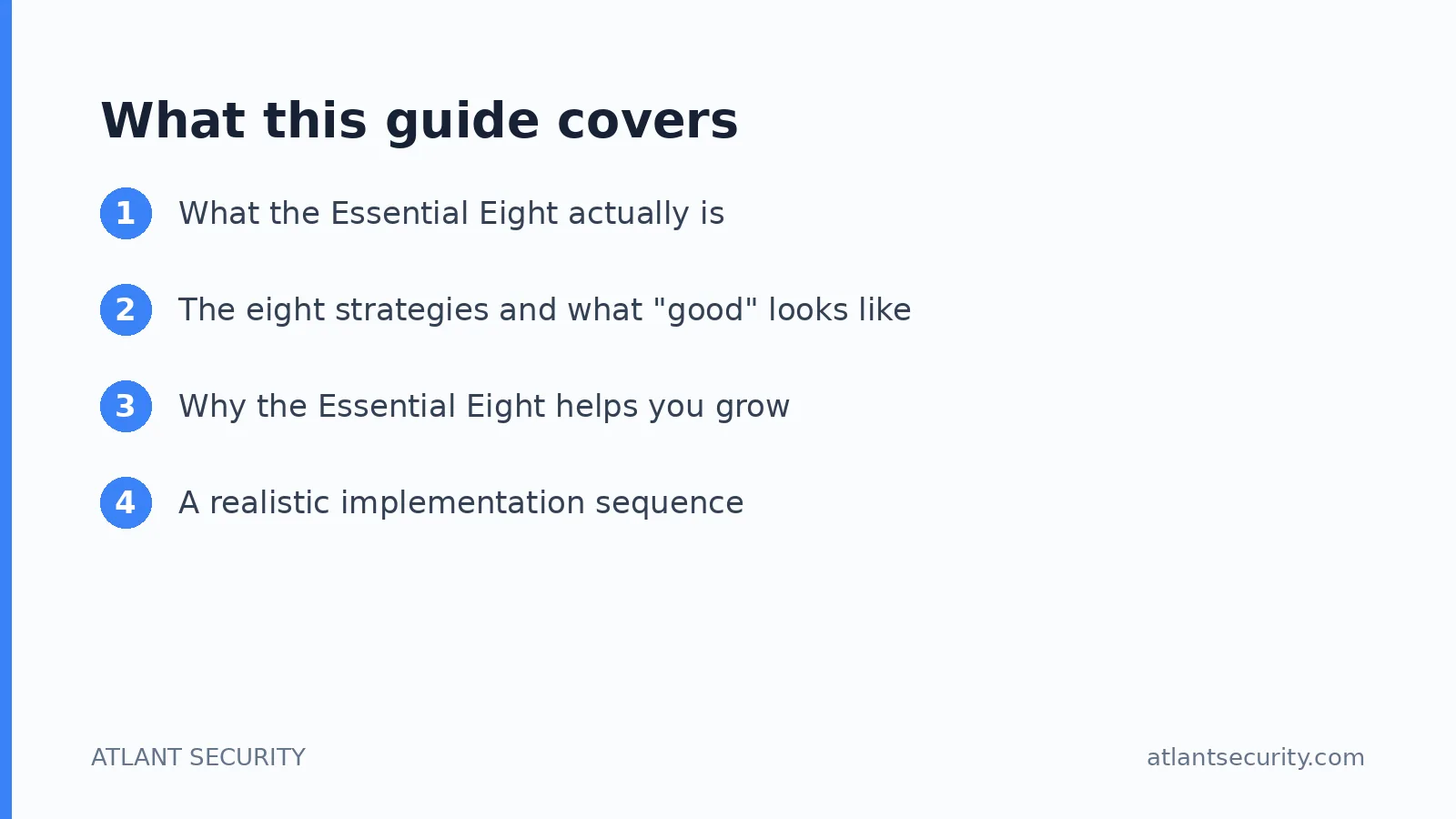
The eight strategies group into three objectives:
- Prevent malware execution: application control, patch applications, configure Microsoft Office macro settings, user application hardening.
- Limit the extent of incidents: restrict administrative privileges, patch operating systems, multi-factor authentication.
- Recover data and system availability: regular backups.
The reason these eight were chosen is empirical: they block the techniques that actually show up in incidents most often. Phishing that lands a malicious macro, an unpatched internet-facing service, a stolen password reused without MFA, ransomware that succeeds because backups were online and got encrypted too. None of this is exotic. The Essential Eight is deliberately unglamorous, and that is its strength.
The eight strategies and what "good" looks like
| Strategy | What it prevents | Practical Maturity Level 2 target |
|---|---|---|
| Application control | Unapproved executables and scripts running | Allowlisting enforced on workstations and servers for executables, libraries, scripts and installers |
| Patch applications | Exploitation of known software flaws | Critical patches for internet-facing apps within 48 hours; others within two weeks |
| Office macro settings | Macro-based malware from documents | Macros blocked from the internet; only vetted, signed macros allowed |
| User application hardening | Browser and plugin abuse | Web browsers configured to block Flash, ads and Java from the internet; unneeded features disabled |
| Restrict admin privileges | Lateral movement and privilege escalation | Privileged access validated, time-limited, and separated from internet and email |
| Patch operating systems | Exploitation of OS-level vulnerabilities | Critical OS patches within 48 hours; no unsupported operating systems |
| Multi-factor authentication | Credential theft and reuse | MFA on all remote access, privileged actions, and important data repositories |
| Regular backups | Data loss from ransomware or failure | Backups tested for restoration, retained per business need, and protected from unprivileged deletion |
Note the pattern: each control has a specific, measurable target. "We have MFA" is not a maturity claim. "We enforce MFA on all remote access, all privileged operations, and access to important data repositories, and we log the authentication events" is. When you engage an assessor, this specificity is what gets tested. A serious IT security audit maps your current state against these targets control by control.
Why the Essential Eight helps you grow
Here is the commercial reality I see repeatedly. When a mid-market or enterprise buyer evaluates a SaaS vendor, their security team sends a questionnaire. In Australia and increasingly among Australian government-adjacent buyers, those questionnaires ask directly about Essential Eight alignment. If you can answer with a documented maturity assessment and evidence, you shorten the review cycle from weeks to days. If you cannot, you become the deal that stalls in procurement.
Three concrete ways alignment converts to growth:
- You pass vendor security reviews faster. A completed self-assessment plus supporting evidence answers most of a standard questionnaire before the buyer even asks.
- You qualify for buyers you otherwise could not. Government suppliers and regulated industries treat Essential Eight maturity as a gate. Without it you are not in the running.
- You lower your own operating risk. Every control that reduces incident likelihood also reduces the chance of an outage or breach that costs you customers and forces expensive emergency work.
What I want to be clear about: the Essential Eight is not a marketing slogan. Overselling it ("we are Essential Eight certified") when you have only partial coverage will fail the moment a competent buyer asks for evidence. The growth comes from being able to prove your posture, not from claiming it.
If you want this more often than once a year without a retainer, AI penetration testing is the route: AI-driven testing across web, API, cloud, network and mobile, with results back in five to ten days.
A realistic implementation sequence
You do not implement all eight at once, and you should not. Sequence the work by risk reduction per unit of effort.
Phase 1: The quick, high-impact wins
- MFA everywhere it matters. Remote access, admin consoles, email, and your cloud provider accounts. This is the single highest-value control for most SaaS teams and can often be enforced within days.
- Patch cadence for internet-facing systems. Define and enforce a 48-hour window for critical patches on anything exposed to the internet. Automate detection so you are not relying on someone remembering.
- Backups you have actually restored from. Untested backups are a liability, not a control. Run a real restore and document it.
Phase 2: The structural controls
- Restrict administrative privileges. Inventory who has admin, remove standing access, and move to just-in-time elevation where you can. Separate admin accounts from daily email and browsing.
- Operating system patching. Extend your patch discipline to the OS layer and retire anything unsupported.
- Office macro control and browser hardening. Block macros from the internet and lock down browser plugins via policy.
Phase 3: The demanding control
- Application control (allowlisting). This is the hardest to operationalise because it requires knowing exactly what should run in your environment. Start in audit mode, build your allowlist from real telemetry, then enforce. Rushing this generates support tickets and erodes trust in the whole programme.
If your platform runs primarily in AWS, Azure or GCP, several of these controls translate into cloud-native configurations rather than endpoint agents. Getting that mapping right is where cloud security consulting pays for itself, because a poorly translated control looks compliant on paper and fails in practice.
How the Essential Eight fits with SOC 2 and ISO 27001
Australian SaaS companies selling internationally rarely stop at the Essential Eight. The controls overlap heavily with the technical requirements of other frameworks, so the work compounds. MFA, patching, access restriction, and backups all map onto SOC 2 Common Criteria and ISO 27001 Annex A controls. If you build your Essential Eight programme with documentation and evidence collection in mind, you have already done a large share of the groundwork for SOC 2 or ISO 27001 readiness.
| Dimension | Essential Eight | SOC 2 / ISO 27001 |
|---|---|---|
| Primary audience | Australian and government-adjacent buyers | Global and US enterprise buyers |
| Nature | Technical maturity model | Audited controls and processes |
| Output | Self or independent maturity assessment | Auditor report / certificate |
| Overlap | MFA, patching, least privilege, backups, logging map across all three | |
My advice: decide your target markets first, then sequence frameworks so each one reuses the previous one's evidence. Doing them in isolation wastes money.
Common mistakes I see
- Claiming a maturity level you cannot evidence. Buyers who care will ask for proof. Get an independent assessment before you make public claims.
- Treating MFA as a checkbox. SMS-based codes and MFA that excludes privileged operations leave the exact gaps attackers exploit.
- Enforcing application control without an inventory. This breaks production and burns political capital. Audit first.
- Untested backups. The only backup that counts is one you have restored under realistic conditions.
- Stopping at Level One and never revisiting. Maturity decays. New systems, new staff, and configuration drift pull you backward unless you reassess.
How Atlant Security helps
We assess your current maturity against each of the eight strategies, give you an honest gap report with evidence requirements, and build a prioritised roadmap that fits how your engineering team actually works. Where you need ongoing ownership rather than a one-off project, our virtual CISO services put an experienced security leader in the room to run the programme, handle buyer security reviews, and keep your maturity from drifting. If you want to start with an outside read on where you stand, get in touch and we will scope an Essential Eight assessment.
Frequently Asked Questions
Is Essential Eight compliance mandatory for Australian SaaS companies?
It is mandatory for non-corporate Commonwealth entities and is increasingly required contractually when you sell to government or regulated buyers. For private commercial SaaS it is not legally mandated, but it is fast becoming a de facto requirement in vendor security reviews, so treating it as optional limits your addressable market.
What maturity level should we target?
Most commercial SaaS companies should aim for Maturity Level One as a baseline and Level Two where they handle sensitive customer data or sell to security-conscious buyers. Level Three is expensive to sustain and is only justified when you face targeted, well-resourced adversaries.
How long does it take to reach Maturity Level Two?
For a typical small-to-mid SaaS team, the quick wins take a few weeks, and reaching a defensible Level Two across all eight strategies usually takes three to six months. Application control is almost always the long pole because it requires building an allowlist from real environment data.
Can we self-assess or do we need an external assessor?
You can self-assess for internal planning, and that is a sensible first step. However, buyers place far more weight on an independent assessment, and an external assessor will catch evidence gaps you are likely to miss in your own environment. Self-assess to plan, then validate independently before you make claims.
How does the Essential Eight relate to penetration testing?
They answer different questions. The Essential Eight measures whether your preventive controls are in place; a penetration test validates whether those controls actually stop an attacker in your specific environment. Mature programmes use both, because a control can be present in configuration and still fail in practice.
