

People use "security audit" and "risk assessment" as if they are the same thing. They are not, and confusing them is one reason so many organizations spend money on security and still get breached. An audit checks whether your controls match a standard. A risk assessment decides which risks matter enough to spend money on in the first place. You need both, in the right order, and this article explains how they fit together to build an organization that can actually take a hit and keep running.
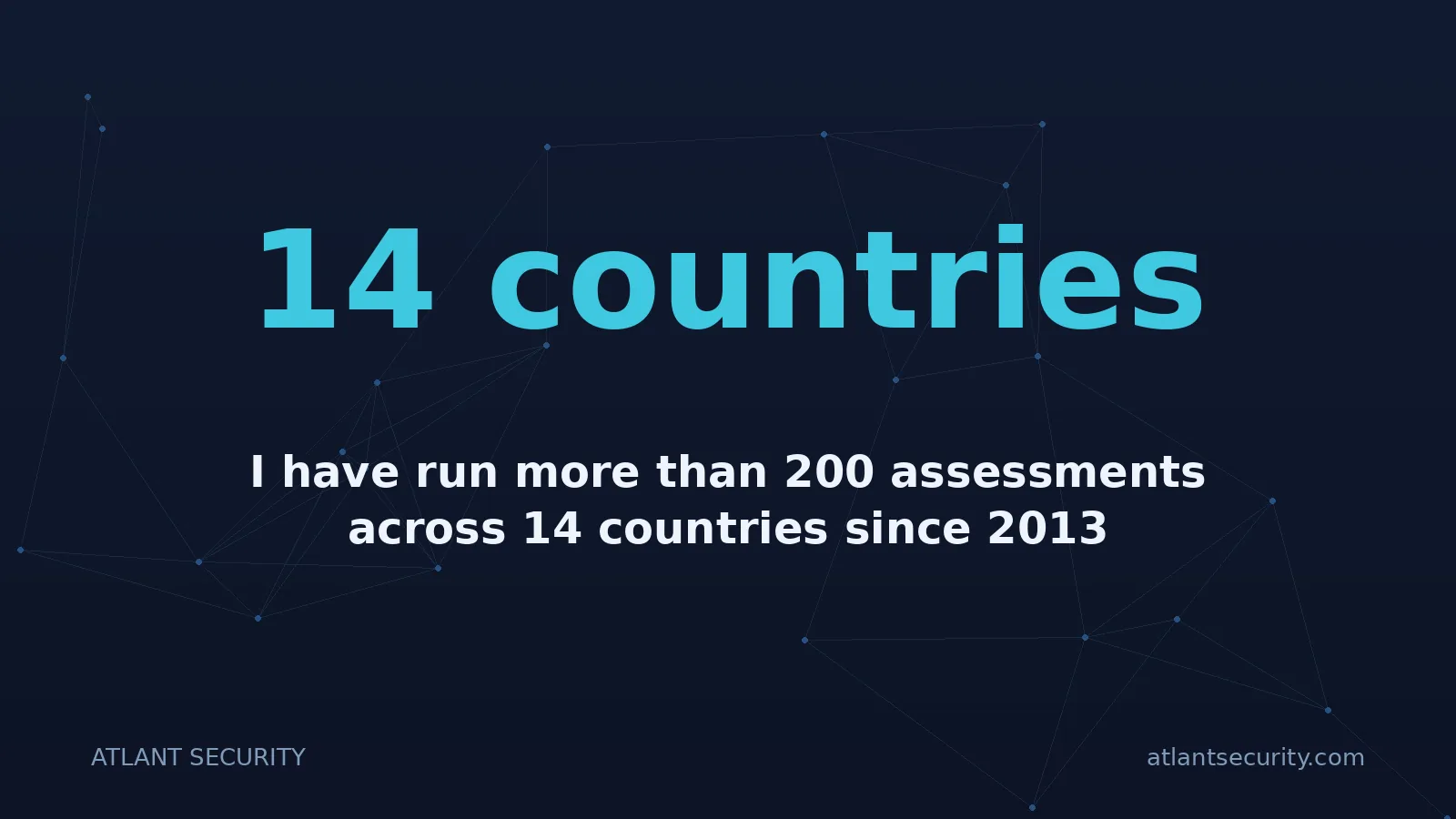
I have run more than 200 assessments across 14 countries since 2013, and the pattern is consistent: cyber-resilient organizations are not the ones with the most tools. They are the ones who understand their risks clearly, verify their controls honestly, and repeat that cycle as their environment changes. Tools are downstream of that discipline.
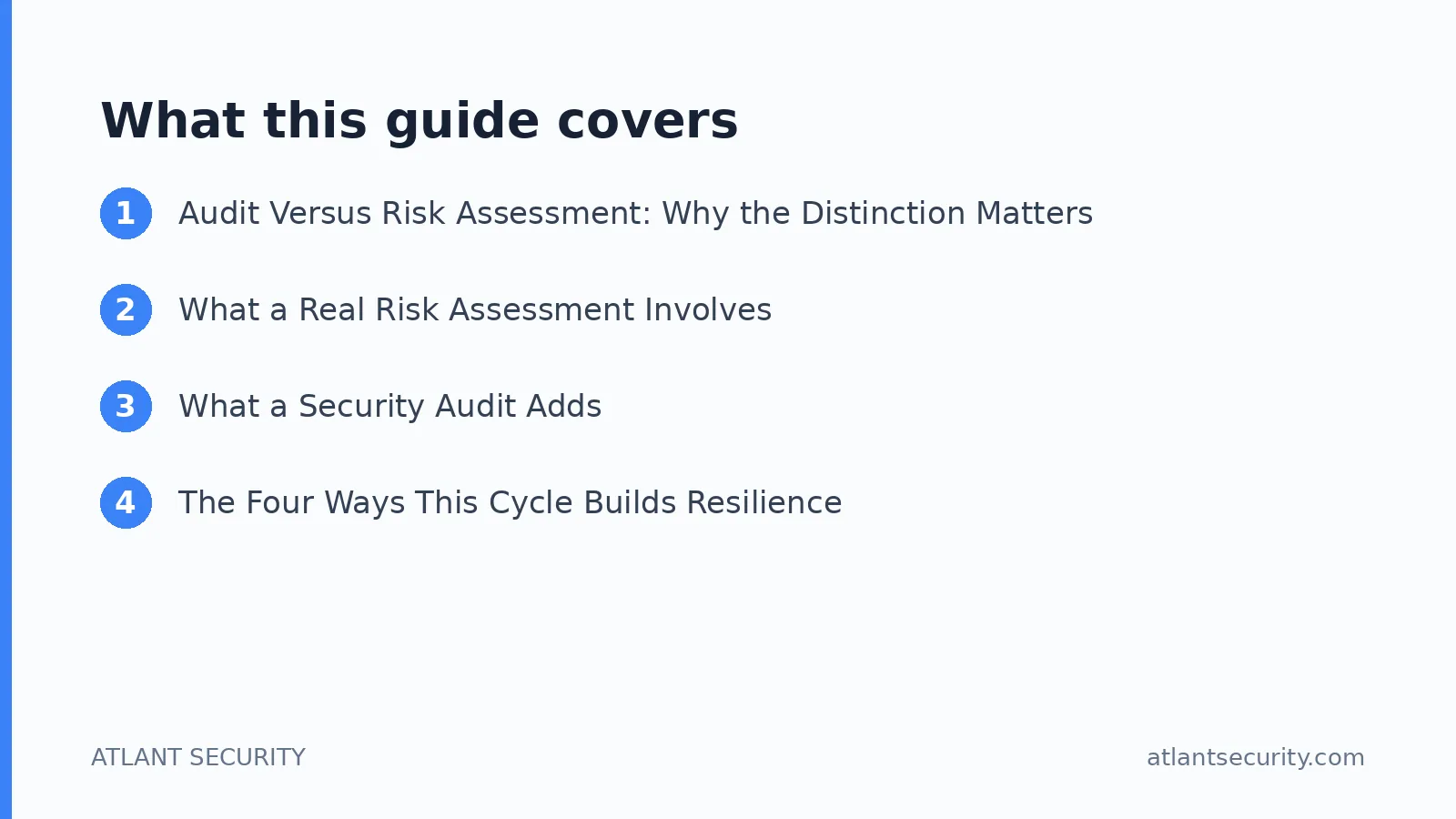
Audit Versus Risk Assessment: Why the Distinction Matters
These two activities answer fundamentally different questions, and doing one while thinking you have done the other leaves a gap attackers exploit.
| Aspect | Risk assessment | Security audit |
|---|---|---|
| Core question | What could harm us, how likely, and how badly? | Do our controls meet the required standard? |
| Output | Prioritized risks and treatment decisions | Findings of compliance and control gaps |
| Drives | Where to invest and what to accept | What to remediate to pass |
| Best done | First, to set priorities | To verify the controls those priorities justified |
In practice: the risk assessment tells you that a ransomware hit on your primary database would be catastrophic and is plausible, so you invest in immutable backups and segmentation. The audit then verifies those backups are actually immutable, tested, and out of reach. Skip the risk assessment and you buy controls for the wrong threats. Skip the audit and you never find out your controls do not work.
What a Real Risk Assessment Involves
A risk assessment is not a spreadsheet of vague worries. Done properly it is a structured process that produces defensible decisions.
- Identify assets. What data, systems, and processes matter, and what is the business impact if each is lost, exposed, or unavailable?
- Identify threats and vulnerabilities. What could go wrong - ransomware, insider error, a compromised vendor, a misconfigured cloud service - and what weaknesses make each plausible?
- Analyze likelihood and impact. Rate each risk by how probable it is and how much damage it would cause. This is where judgment and experience matter more than any tool.
- Prioritize. Rank risks so leadership can focus money and attention on the ones that matter, not the ones that are merely loud.
- Decide treatment. For each significant risk, choose to reduce it, transfer it (for example via insurance), avoid it, or knowingly accept it. Accepting a risk is a legitimate choice; accepting one you never identified is negligence.
What a Security Audit Adds
Where the risk assessment sets direction, the audit provides ground truth. It examines your actual systems, configurations, access, and processes and reports where reality diverges from what you believe or what a standard requires. A good IT security audit confirms the controls you invested in are present, correctly configured, and effective, and it surfaces the gaps that quietly opened up as your environment changed.
Crucially, the audit closes the loop on the risk assessment. If you decided ransomware was your top risk and funded backups and segmentation to address it, the audit is where you find out whether those controls would actually survive contact with an attacker. Without that verification, your risk treatment is a hopeful assumption.
The Four Ways This Cycle Builds Resilience
1. It focuses spending on real exposure
Security budgets are finite. The risk-then-audit cycle ensures money flows to the threats most likely to cause serious harm, rather than to whatever product had the best sales pitch. This is the difference between security theater and security.
2. It keeps you compliant without making compliance the goal
Regulations like GDPR, PCI DSS, and HIPAA exist for good reasons, and audits demonstrate you meet them. But compliance is a floor, not a ceiling. A risk-led program clears the compliance bar as a byproduct of managing real risk, which is a far stronger position than treating the checklist as the finish line. If a specific standard is your driver, our readiness work for SOC 2, ISO 27001, HIPAA, and PCI DSS maps directly onto this cycle.
3. It gives leadership visibility to make decisions
Executives cannot manage a risk they cannot see. The combination of a prioritized risk register and honest audit findings gives leadership a clear, current picture of where the organization stands, so they can allocate resources and accept or reject risk deliberately rather than by default.
4. It builds a security-first culture
When risk assessment and audit become routine rather than a once-a-year fire drill, security stops being the security team's problem and becomes part of how the organization operates. People start considering risk before they build, not after they are breached.
Turning Assessment Results Into Resilience
Neither activity is worth anything if the output sits in a drawer. The organizations that get real value follow through:
- Maintain a living risk register. Update it as the business, the threat landscape, and your systems change. A risk assessment is a snapshot; resilience needs a moving picture.
- Track remediation to closure. Every significant audit finding gets an owner, a due date, and a re-test. Unowned findings are just documented risk.
- Test your incident response. Resilience is not only prevention; it is the ability to detect, respond, and recover. Run tabletop exercises so your plan is more than a document.
- Repeat on a cadence. Reassess risk and re-audit on a regular schedule and after major changes, because both decay the moment your environment moves.
If your organization does not have the internal bandwidth to run this cycle continuously, that is exactly the gap a virtual CISO or part-time CISO fills: senior ownership of risk and audit without a full-time executive hire.
Common Mistakes That Undermine the Whole Effort
- Auditing without assessing risk first. You end up verifying controls for threats that do not matter and missing the ones that do.
- Treating the report as the outcome. The outcome is closed findings and reduced risk, not a document.
- Rating risk by gut feel alone. Structure the analysis so decisions are defensible and repeatable.
- Doing it once. A single assessment ages out fast. The value is in the repeated cycle.
- Ignoring the human layer. Most incidents involve a person clicking, misconfiguring, or being tricked. Awareness and process belong in the risk picture.
Frequently Asked Questions
What is the difference between a security audit and a risk assessment?
A risk assessment identifies and prioritizes what could harm your organization and how badly, so you know where to invest. A security audit examines whether your actual controls meet a defined standard and work as intended. The assessment sets priorities; the audit verifies reality against them. They are complementary, and doing only one leaves a blind spot.
Which should we do first, the risk assessment or the audit?
Start with the risk assessment. It tells you which assets and threats matter most, which in turn tells you what the audit should scrutinize most closely. Auditing before you understand your risks means you spread effort evenly across things of very different importance and likely under-examine your biggest exposures.
How often should we perform these assessments?
Reassess risk and run a security audit at least annually, and additionally after any major change such as a migration, acquisition, new critical application, or a security incident. Between the full cycles, keep continuous monitoring and vulnerability scanning running so you are not blind to change for a full year at a time.
Do risk assessments help with regulatory compliance?
Directly. Standards such as GDPR, HIPAA, PCI DSS, ISO 27001, and SOC 2 either require or strongly assume a risk-based approach. A solid risk assessment is often a prerequisite for demonstrating compliance, and a risk-led program tends to clear compliance requirements as a natural byproduct of managing real threats.
Can a small business benefit from this, or is it only for large enterprises?
Small businesses benefit enormously, arguably more, because they have less margin to absorb an incident. The process scales down cleanly: a focused risk assessment and a right-sized audit can be run efficiently and still catch the handful of exposures most likely to cause real damage. Our small business cybersecurity services are built to right-size exactly this.
What makes an organization genuinely cyber-resilient?
Resilience is the ability to keep operating through and recover quickly from an incident, not the fantasy of never being attacked. It comes from understanding your real risks, verifying that your controls address them, being able to detect and respond when something gets through, and repeating that cycle as things change. Tools support resilience; the discipline of assessing and verifying is what creates it.
Build the Cycle, Not Just the Report
The power of IT security audits and risk assessments is not in either activity alone. It is in running them together, in the right order, on a repeating cadence, and actually acting on what they tell you. Assess your risks, invest where it matters, verify honestly that your controls hold, fix what does not, and go again. That is what separates organizations that survive a serious incident from those that do not.
If you want experienced help building that cycle and turning it into measurable resilience, contact Atlant Security to scope a risk assessment and IT security audit tailored to your organization. You may also find our guide to detecting and defending against stealthy cyber attacks a useful next read.
