
Most articles about virtual CISOs are sales pitches. This one is not. I run a firm that sells virtual CISO services, and I am going to spend the next 2,000 words explaining when you should not hire one, including from me. If you read to the end and still think a vCISO fits your situation, you will hire one for the right reasons instead of the wrong ones, and the engagement will actually work.
I have led more than 200 security assessments across 14 countries since 2013, many of them for startups that were being pitched a "virtual CISO" package the same week they got pitched three other security tools. The pattern is predictable. A 30 to 80 person SaaS company signs a big enterprise customer, that customer sends a security questionnaire, and suddenly someone in the leadership team is Googling "do we need a CISO." The honest answer is: sometimes yes, and more often, not yet, and not in the form you are being sold.
What a virtual CISO actually is (and is not)
A virtual CISO, or fractional CISO, is a senior security leader you rent part time. Instead of paying 250,000 to 400,000 US dollars a year for a full time executive, you get a slice of one: a few days a month of strategy, program design, risk decisions, vendor and auditor management, and board or customer-facing assurance.
That is the honest definition. Here is what a vCISO is not:
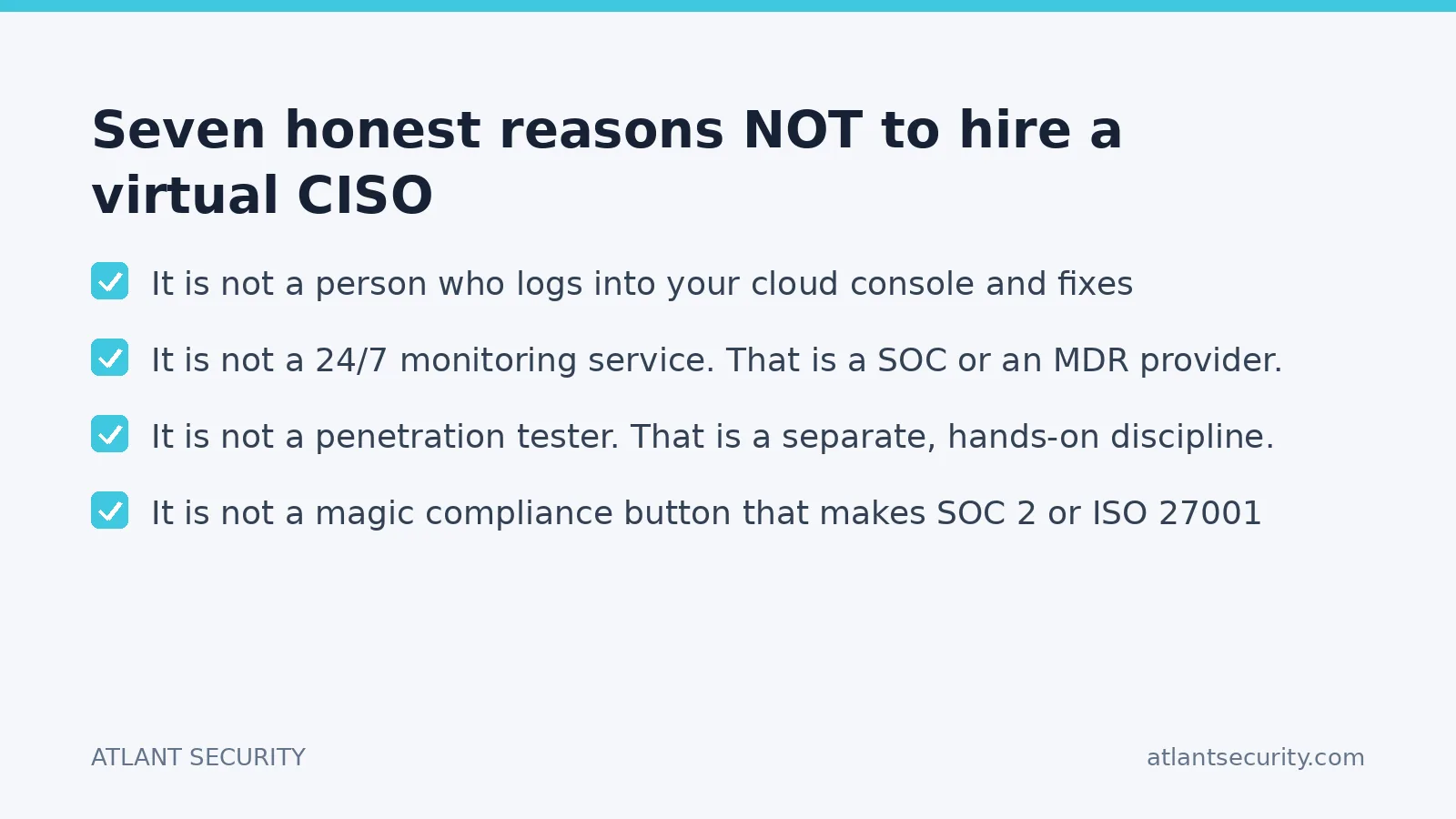
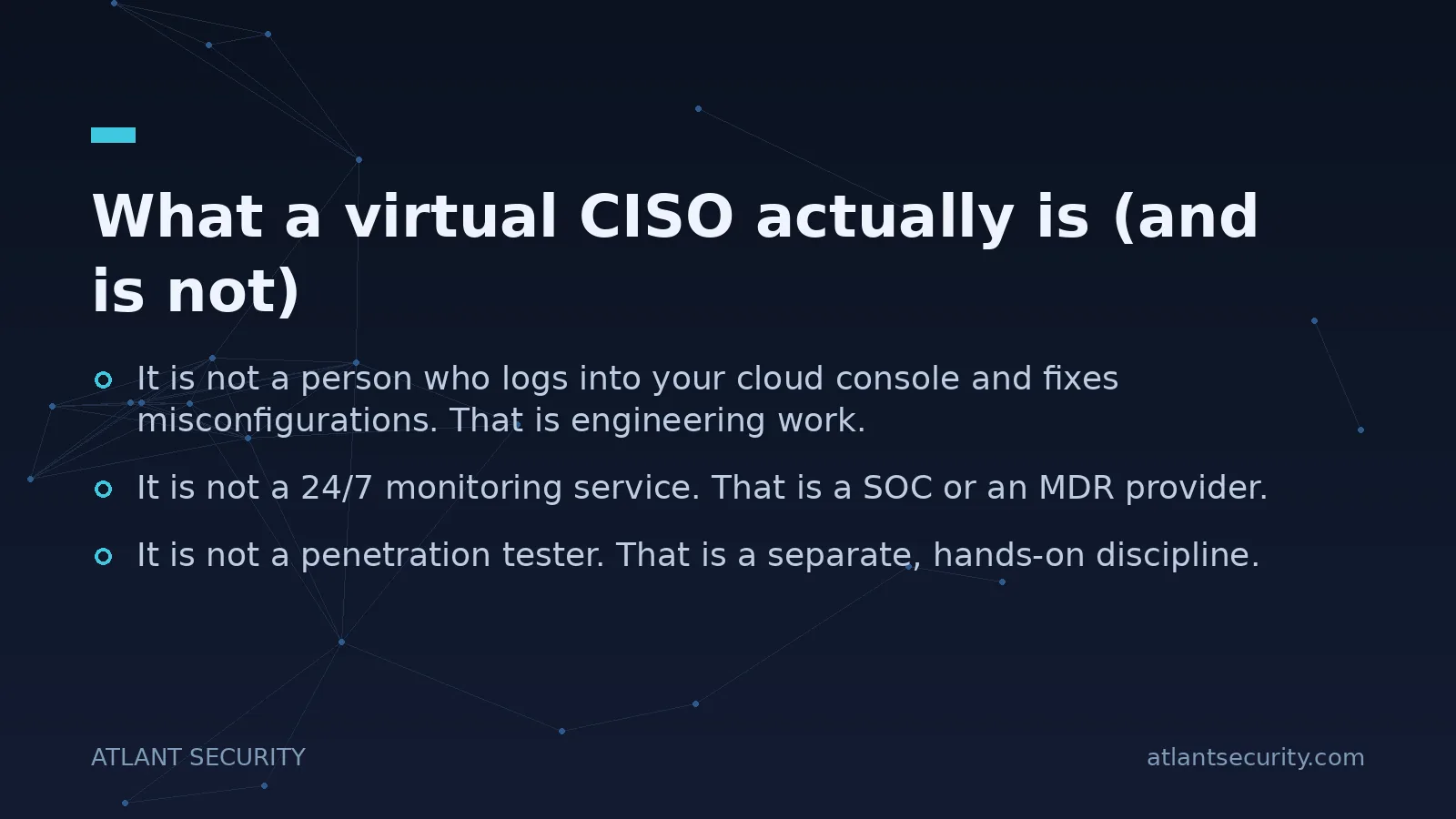
- It is not a person who logs into your cloud console and fixes misconfigurations. That is engineering work.
- It is not a 24/7 monitoring service. That is a SOC or an MDR provider.
- It is not a penetration tester. That is a separate, hands-on discipline.
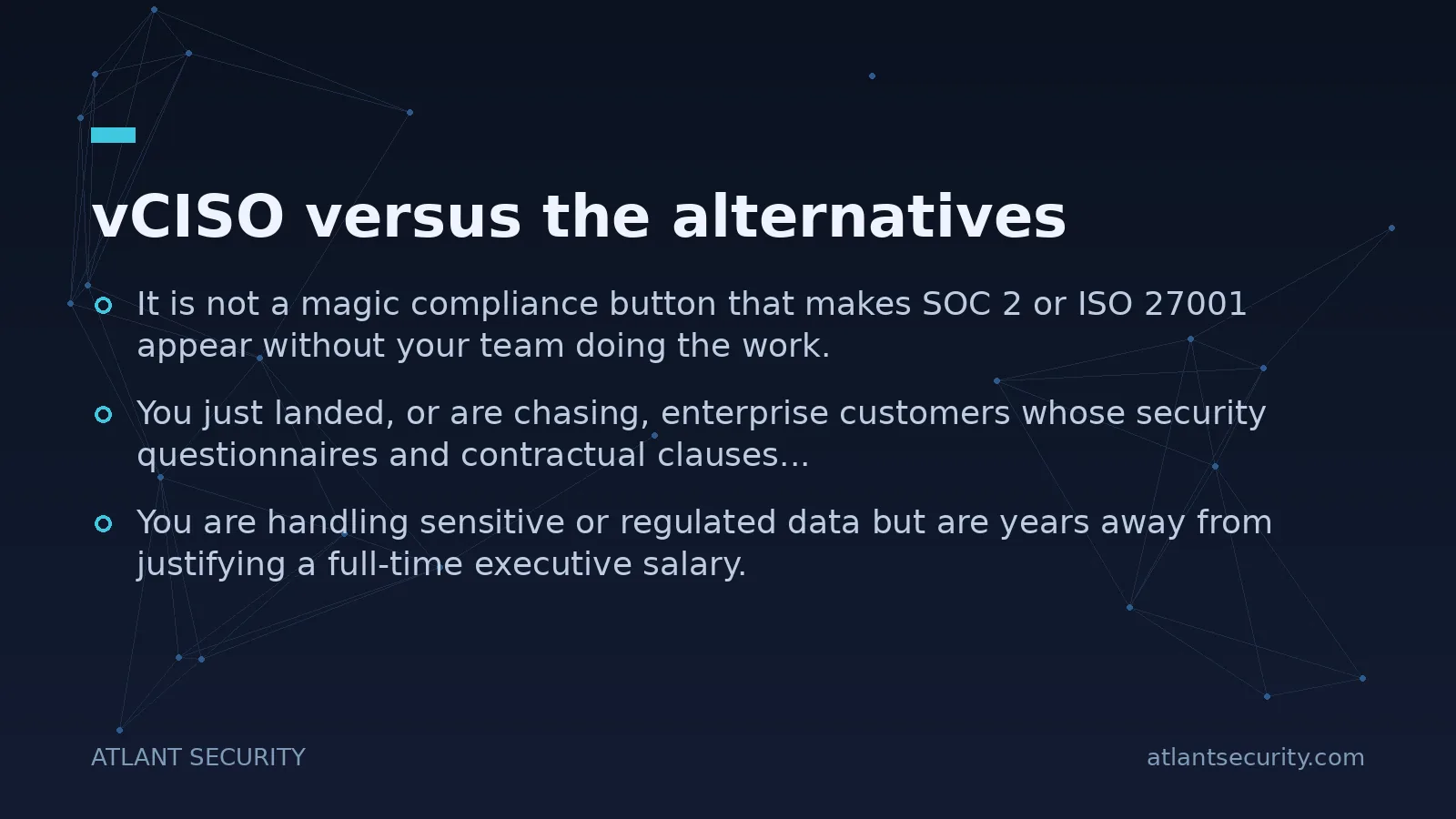
- It is not a magic compliance button that makes SOC 2 or ISO 27001 appear without your team doing the work.
Half of the disappointing vCISO engagements I have seen went wrong because the buyer expected one of the four things above and bought a strategy-and-governance service instead. So before we talk about reasons not to hire a vCISO, understand that many "reasons not to" are really "I needed a different service."
Seven honest reasons NOT to hire a virtual CISO
1. You have fewer than about 15 people and no sensitive data yet
If you are a 10 person pre-revenue startup that has not signed an enterprise customer and does not process regulated data, a vCISO is premature. At that stage your security "program" is a short list of high-leverage basics: enforce multi-factor authentication everywhere, use a password manager, patch your laptops, lock down your cloud identity provider, and turn on backups. You do not need a fractional executive to tell you that. You need a good checklist and a disciplined founder. Spend the money on the actual fixes instead.
2. What you actually need is hands on the keyboard
If your real problem is "our AWS account is a mess and nobody has time to fix it," a strategist is the wrong hire. A vCISO will produce a prioritized plan, but someone still has to implement it. If you have no one to implement, you need a security engineer or a hands-on cloud security consulting engagement, not a governance role. Buy the outcome you need, not the title that sounds impressive.
3. You already have a capable in-house security leader
If you have a head of security or a strong, security-minded VP of engineering who owns risk decisions and has the bandwidth to run the program, a full-scope vCISO overlaps with them. In that case a better use of external help is a bounded, expert IT security audit or a penetration test to give your internal leader independent evidence and a second opinion, not a parallel decision-maker who muddies accountability.
4. You want a logo on a slide, not a working program
Some buyers want to tell customers "we have a CISO" while changing nothing internally. If that is the goal, do not waste anyone's time. A vCISO who lets you check that box without fixing anything is selling you liability, not security. When a breach or a serious audit happens, "we had a part-time consultant" is not a defense if the program never functioned. Either commit to running a real program or do not pretend to.
5. Your leadership will not give security any authority
A CISO, virtual or not, is only useful if the organization will act on their recommendations. I have walked away from engagements where the CEO wanted a security leader in name but overruled every decision that cost money or slowed a release. If your culture treats security as pure friction and no one above the vCISO will back a hard call, the engagement fails no matter how good the consultant is. Fix the mandate first.
6. You are buying a one-size-fits-all package
Be skeptical of any vCISO offer that is a fixed monthly retainer with the same deliverables for a fintech, a healthcare app, and a marketing agency. Good fractional security leadership is shaped by your specific threat model, data, customers, and regulatory exposure. If the pitch does not start with questions about what you do, who your customers are, and what you are trying to protect, it is a template. A template is not leadership.
7. The commitment is too small to matter
A "vCISO" package of two hours a month is a subscription, not a security program. Real fractional leadership needs enough time to understand your environment, run risk reviews, prepare for audits, and respond when something goes wrong. If the price looks suspiciously cheap, check the hours. Below a certain threshold you are paying for the comfort of a title with none of the substance.
When a virtual CISO IS the right call
To be fair to the model, here is when a fractional CISO earns its cost many times over:
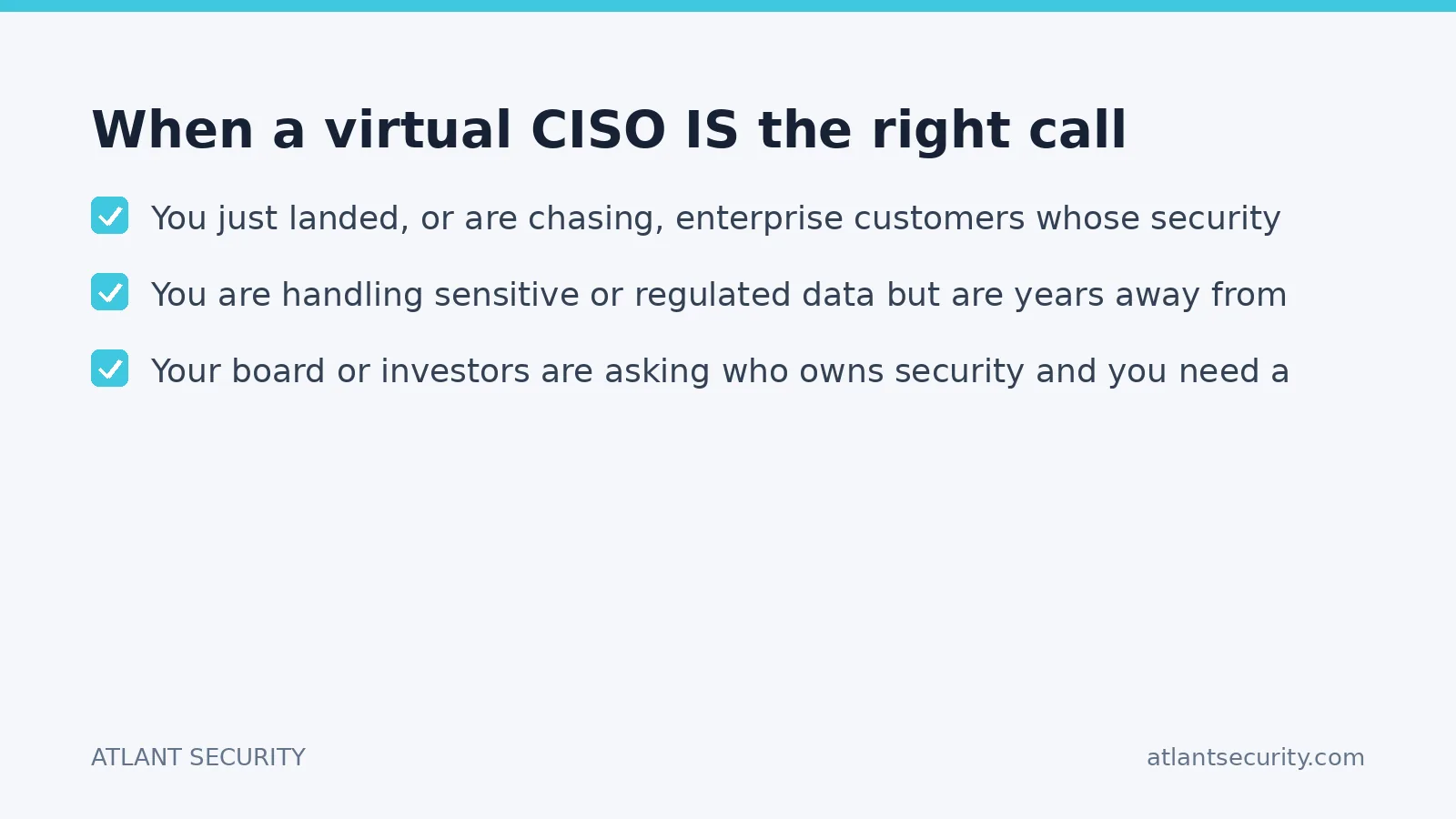
- You just landed, or are chasing, enterprise customers whose security questionnaires and contractual clauses now gate your revenue.
- You need SOC 2, ISO 27001, HIPAA, or PCI and need someone to own the program end to end, from scoping to auditor management. This is exactly where a SOC 2 readiness engagement plus fractional leadership pays off.
- You are handling sensitive or regulated data but are years away from justifying a full-time executive salary.
- You are in a high-scrutiny sector such as fintech, where a fintech virtual CISO brings both the technical depth and the regulatory fluency your board and investors expect.
- Your board or investors are asking who owns security and you need a credible, accountable answer without a permanent six-figure hire.
vCISO versus the alternatives
| Option | Best when | Watch out for |
|---|---|---|
| Full-time CISO | 100+ staff, regulated, security is core to the product | 250k to 400k salary; hard to hire; often overkill early |
| Virtual / fractional CISO | Strategy, compliance, risk ownership without a full-time cost | Needs a real mandate and enough hours to matter |
| Security engineer | You have a plan and need hands to implement it | Executes, but usually will not set strategy or face the board |
| Point-in-time audit or pentest | You need independent evidence or to find gaps | Snapshot only; someone must own the follow-through |
| Do nothing yet | Tiny team, no sensitive data, no customer pressure | Revisit the moment you sign an enterprise deal or touch regulated data |
How to hire one without getting burned
If you decide a vCISO is right, protect yourself:
- Insist on talking to the person who will actually do the work, not a salesperson. You are buying judgment, so evaluate the judgment directly.
- Ask how they scope. A good answer starts with your business and threat model, not their package tiers.
- Clarify the hours and what is out of scope. Know exactly what "engineering," "monitoring," and "testing" are handled separately.
- Define the mandate in writing. What can the vCISO decide, and what needs sign-off? Ambiguity here kills engagements.
- Start small. A scoped assessment or a 90-day trial tells you more than a glossy proposal ever will.
If you are still not sure whether you need a fractional executive, a full-time hire, or just a focused audit, that is a normal place to be. A short, no-pressure conversation with an experienced part-time CISO will usually clarify it in 30 minutes.
Frequently Asked Questions
What does a virtual CISO cost compared to a full-time one?
A full-time CISO typically costs 250,000 to 400,000 US dollars a year in total compensation. A virtual CISO is a fraction of that because you pay only for the days you use. The exact figure depends on the hours and scope, which is precisely why you should scrutinize any package that looks unusually cheap: the low price often means too few hours to run a real program.
Can a small startup skip having any CISO at all?
Yes, until you cannot. If you have no sensitive data, no enterprise customers, and no regulatory exposure, you can run on disciplined basics: MFA everywhere, a password manager, patched devices, hardened cloud identity, and backups. The moment you sign an enterprise deal, touch regulated data, or take on investors who ask who owns security, revisit the decision.
Is a virtual CISO the same as a managed security service?
No. A managed service or SOC handles monitoring, detection, and response. A virtual CISO handles strategy, governance, risk decisions, compliance, and executive-level assurance. They complement each other. Many companies need both, and confusing the two is the most common reason a vCISO engagement disappoints.
Will a virtual CISO get us through SOC 2 or ISO 27001?
A good one will own the program, design the controls, prepare your evidence, and manage the auditor relationship. What they will not do is implement every technical control for you or make the work disappear. Pairing fractional leadership with a structured SOC 2 readiness effort is the realistic path to passing on the first attempt.
How quickly can a virtual CISO add value?
A capable fractional CISO should give you a clear risk picture and a prioritized plan within the first few weeks, because that is exactly the kind of senior judgment you are renting. If a month goes by with only generic templates and no decisions, you hired the wrong provider or gave them no mandate.
Not sure whether you need a vCISO at all? That is the right question to ask before spending a dollar. Atlant Security will tell you honestly, based on 200+ assessments across 14 countries, whether a fractional CISO, a full-time hire, or a focused audit fits your situation. Book a no-pressure discovery call and we will point you to the cheapest option that actually solves your problem, even if it is not us.
