

A cybersecurity audit is not a scan and it is not a certificate. It is an independent, structured examination of whether your defenses actually do what you believe they do. After running well over two hundred assessments across 14 countries, I can tell you the single most consistent finding is not some exotic zero-day. It is the gap between what leadership assumes is protected and what is genuinely protected. An audit exists to close that gap before an attacker exploits it.
Every organization now operates on a wider attack surface than it did three years ago. Cloud adoption, remote work, an ever-growing stack of SaaS applications, and third-party integrations have quietly expanded the ways in - often faster than internal security has kept pace. A cybersecurity audit gives leadership something they rarely have otherwise: facts instead of assumptions about where their real risk sits.

Why Every Organization Needs a Cybersecurity Audit
Cyber threats do not discriminate by industry. Healthcare, finance, manufacturing, SaaS, logistics, and professional services all face the same fundamental problem: their systems hold something worth stealing or disrupting, and their defenses were built incrementally by busy people who rarely had time to step back and check the whole picture.
Without an audit, organizations manage security on assumptions. They assume backups work, that access was revoked when someone left, that the cloud is configured the way the documentation says, that the incident response plan would function under pressure. Every one of those assumptions is a place I have found reality diverging from belief. A proper audit turns that fog into a concrete, prioritized list. Specifically, a good audit helps you:
- Identify technical vulnerabilities before they are exploited
- Validate that the security controls you paid for actually work
- Reduce regulatory exposure and the penalties that follow non-compliance
- Improve your readiness to detect and respond to an incident
- Strengthen governance so security decisions are owned, not orphaned
The result is that security becomes measurable and manageable rather than a source of vague, permanent anxiety.
What a Cybersecurity Audit Actually Covers
A modern audit goes far beyond a vulnerability scan. Scanning tells you which software is out of date; it tells you almost nothing about whether an attacker who phishes one employee can move laterally to your crown-jewel data. A real audit evaluates security across three dimensions - technology, people, and process - because attackers exploit all three.
In practice, the scope typically includes:
- Network and cloud environments - configuration, segmentation, exposure of internet-facing services
- Identity and access management - who can access what, whether privileges match roles, and how authentication is enforced
- Endpoint protection - coverage, monitoring, and whether alerts actually reach someone who acts on them
- Data protection - where sensitive data lives, how it is encrypted, and who can reach it
- Vendor and supply-chain risk - the third parties with access to your systems and data
- Security policies and incident response readiness - whether the documented plans would survive contact with a real event
The objective is to evaluate security holistically rather than in isolated technical silos, because that is how it fails in the real world - at the seams between systems that each looked fine on their own.
Cybersecurity Audit Services That Deliver Real Risk Reduction
For the buyer's view of the market, the five kinds of information security audit services, who performs each and what they cost, see our dedicated guide.
Not all audits are equal. The weak ones produce a 200-page tool export, hand it over, and disappear. Nobody reads it, nothing changes, and the exercise becomes a compliance checkbox. Effective audits focus on outcomes: reducing operational risk, strengthening controls, and improving security maturity in a way the business can act on.
A strong audit program delivers:
- A clear organizational risk profile leadership can understand at a glance
- A prioritized remediation roadmap - what to fix first, and why
- Executive-level reporting suitable for the board, not just the server room
- Compliance alignment mapped to the frameworks that apply to you
- Measurable benchmarks so you can prove improvement over time
That prioritization is where the value lives. Every organization has more findings than budget. The job of the audit is to tell you which handful of fixes buys the most risk reduction, so limited resources go where they matter. This is the same discipline behind a thorough IT security audit.
Understanding the Cybersecurity Audit Process
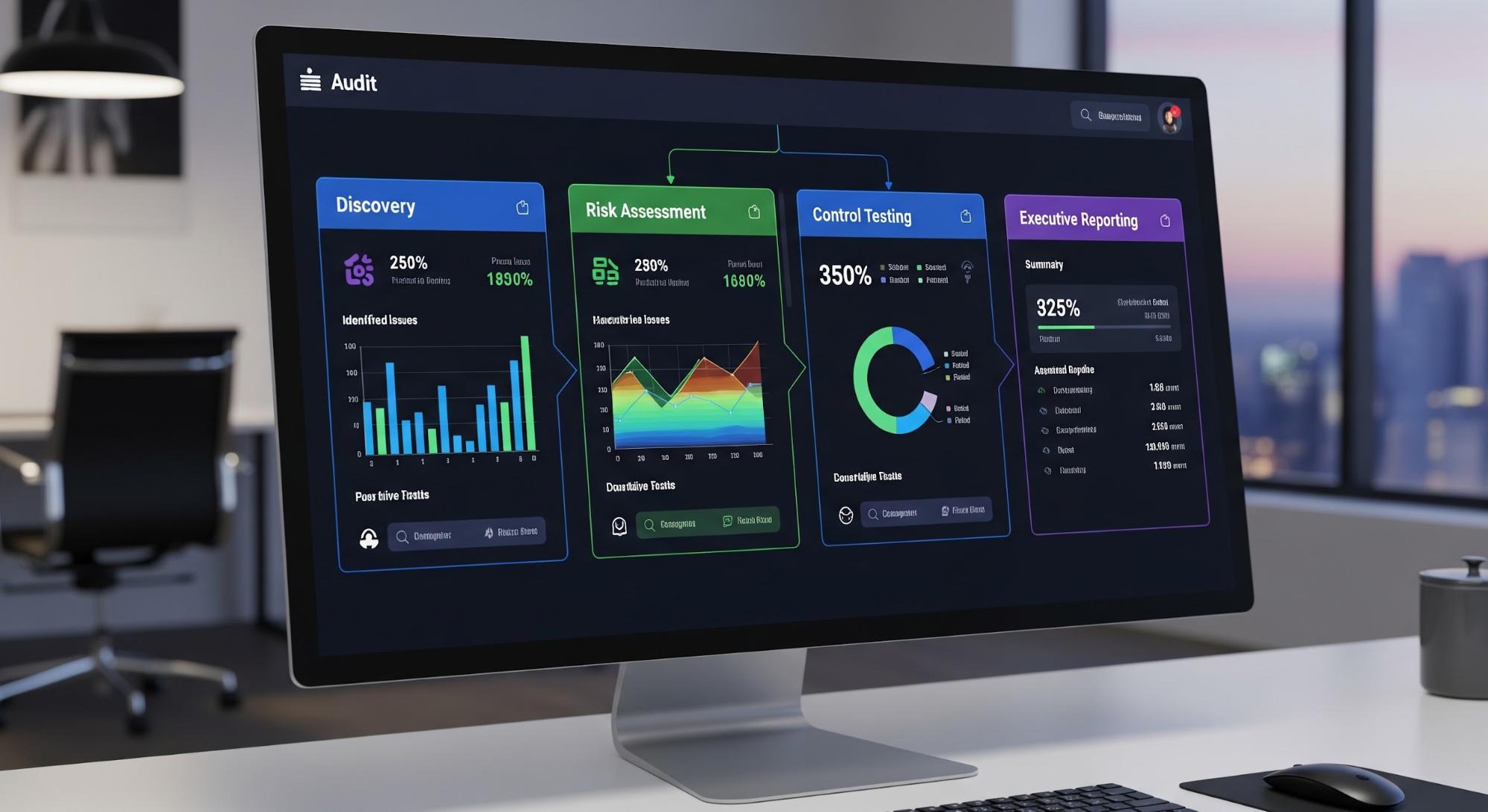
A credible audit follows a structured methodology so the findings are consistent, evidence-based, and relevant to the business rather than a random collection of whatever the tooling happened to flag. A typical engagement moves through these phases:
- Discovery and scoping - agreeing what is in scope, what matters most, and what "good" looks like for this specific organization
- Risk assessment and threat modeling - understanding which threats are realistic given your industry and setup
- Control testing - actually verifying that controls work, not just that they exist on paper
- Gap analysis - comparing current state against the standard you are being held to
- Compliance mapping - aligning findings to SOC 2, ISO 27001, HIPAA, PCI DSS, or NIS2 as relevant
- Executive reporting - translating technical findings into business decisions with a clear roadmap
That structure is what ensures the findings translate into real-world improvements rather than a report that gets filed and forgotten.
Common Gaps a Cybersecurity Audit Uncovers
Organizations almost always rate their own security higher than an independent test does. That is not incompetence; it is the natural blind spot of being too close to your own systems. The gaps I find most consistently are:
The economics of this changed recently. Pentestas runs the same OWASP Top 10, API, cloud and network checks a human tester works through, chains the findings into proof-of-concept evidence, and returns results in five to ten days with retesting included once you have fixed things. That turns testing after every release from an aspiration into a line item.
- Excessive user privileges - accounts with far more access than the job requires, often accumulated over years
- Weak authentication - missing or inconsistently enforced multi-factor authentication, especially on legacy and administrative access
- Unmonitored endpoints - devices generating alerts nobody sees, or with no monitoring at all
- Misconfigured cloud environments - storage or services exposed more broadly than anyone intended
- Incomplete incident response plans - documents that have never been tested and would not survive a real event
- Outdated security policies - written for an environment that no longer exists
None of these are exotic. All of them meaningfully increase both the likelihood and the impact of a breach, and all of them are fixable once you know they are there.
IT Audit Services and Security Assurance
Traditional IT audits were built around availability and integrity - is the system up, is the data accurate. Those questions still matter, but modern environments demand deeper security validation. It is no longer enough to confirm a system runs; you need to confirm it cannot be trivially compromised.
IT audit services focused on cybersecurity assurance evaluate how your technology controls line up against the current threat landscape and regulatory expectations. The goal is to ensure your security investments actually reduce risk rather than adding complexity that introduces new risk. It is entirely possible to spend heavily on tools and end up less secure because nobody has the capacity to run them properly. An audit catches that.
Auditing for Security in Regulated Industries
Highly regulated sectors carry a heavier burden. When you handle payment data, health records, or critical infrastructure, an audit must address regulatory compliance, data protection mandates, vendor risk, operational resilience, and incident readiness together. Financial services, healthcare, and SaaS organizations face scrutiny that demands audit programs built specifically for regulatory confidence.
If you are working toward a specific standard, aligning the audit to it directly is far more efficient than auditing generically and then translating. That is the logic behind targeted SOC 2 readiness, HIPAA compliance, and PCI DSS engagements - the audit and the compliance goal reinforce each other instead of running as separate projects.

The Most Common Audit Failures in Financial Services
The financial sector concentrates risk: high transaction volume, sensitive data, and intense regulatory pressure. Across engagements in this space, the audit failures that recur most often are:
- Weak identity governance - unclear ownership of who can access sensitive systems and stale access that was never revoked
- Inadequate vendor risk management - third parties with deep access and shallow oversight
- Incomplete incident response testing - plans that exist but have never been exercised under realistic conditions
- Legacy system vulnerabilities - critical business functions running on software that can no longer be properly secured
- Limited monitoring visibility - gaps where an attacker could operate undetected long enough to do real damage
Addressing these is less about buying more tools and more about governance, ownership, and testing - the unglamorous work that determines whether an incident is contained or catastrophic.
How Cybersecurity Audits Improve Business Resilience
The deeper value of a security audit is the shift it enables: from reactive defense, where you deal with problems after they surface, to proactive risk management, where you find and close gaps before they are used against you. Organizations that audit regularly get faster threat detection, lower incident impact, a stronger regulatory posture, and the customer trust that comes from being able to demonstrate real diligence.
Audits as a Long-Term Strategy, Not a One-Time Event
A single audit is a snapshot. Security environments change constantly - new systems, new staff, new vendors, new attacker techniques - so a snapshot goes stale quickly. Regular audits let you track security maturity over time, validate that controls still work, adapt to emerging threats, and support ongoing compliance. That is what turns auditing from a grudging obligation into a genuine strategic asset. For most organizations, an annual audit with lighter reviews after any major change is a sensible cadence.

From the publisher
Ready to book a cybersecurity audit rather than read about one?
Everything above describes what a good audit looks like. This is what ours is, so you can hold it against the standard this article just set.
- Every domain above, on your real environment, in 14 days from kickoff.
- Findings ranked by what an attacker can actually reach, not by scanner severity.
- Mapped to SOC 2, ISO 27001, NIST 800-171, CMMC and HIPAA at once, so one audit answers whichever framework your customer is asking about.
- Gaps closed with your engineers, not handed over as a list of recommendations.
- Fixed price, published. You read the report before you pay a cent.
Start with the cybersecurity audit, or if a customer has named a framework, go straight to SOC 2 readiness.
Working With Atlant Security
Atlant Security provides executive-level cybersecurity audits for organizations that need strategic security leadership without carrying the cost of a full-time CISO. That means independent audit expertise, board-ready reporting, alignment to the regulations that apply to you, practical remediation guidance you can actually implement, and - where it helps - ongoing virtual CISO leadership to keep the improvements on track after the audit ends.
Our audits are built for real operations, not for a filing cabinet. If your organization needs clarity about where its risk truly sits and a defensible plan to reduce it, contact Atlant Security to scope an audit around your specific environment.
Frequently Asked Questions
What is the difference between a cybersecurity audit and a penetration test?
An audit is a broad examination of your entire security posture - technology, people, and process - against a standard. A penetration test is a focused, adversarial exercise that attempts to actually break in through specific paths. They complement each other: the audit tells you where the weaknesses are across the whole organization, and the pen test proves how exploitable particular ones really are.
How long does a cybersecurity audit take?
It depends entirely on scope and organizational size. A focused audit of a small environment can take a couple of weeks; a comprehensive audit of a mid-sized regulated business, covering cloud, identity, endpoints, and compliance mapping, typically runs several weeks. Scoping up front is what keeps the timeline honest.
How often should we run a cybersecurity audit?
At least annually for most organizations, and additionally after any significant change - a cloud migration, a merger, a major new system, or a serious incident anywhere in your industry. Between full audits, lighter reviews and continuous vulnerability assessment keep the picture current.
Will an audit disrupt our operations?
A well-run audit is designed to be non-disruptive. Most of the work is examination, testing against copies or non-production paths where possible, and interviews. Anything that could affect live systems is scheduled and agreed in advance. Disruption is a sign of a poorly scoped engagement, not an inherent cost.
We are a small business. Do we really need a full audit?
You need an audit proportionate to your risk, not a bank-sized program. Smaller organizations benefit enormously from a focused audit that identifies the handful of gaps most likely to end the business. Our cybersecurity services for small business are scoped exactly for that reality.
