
CPS 234 is not a software product, and no tool will make you compliant on its own. That is the first thing I tell any Australian financial institution that asks me which platform to buy. The Prudential Standard CPS 234, issued by APRA, is an obligation on regulated entities to manage information security in a way that matches the threats they face. Tools support that obligation. They do not satisfy it.
That said, the right tooling makes CPS 234 dramatically easier to operate and evidence, and the wrong stack leaves you scrambling before an audit. Having run security assessments for financial and fintech clients across multiple jurisdictions, I want to give you an honest map: what CPS 234 actually requires, which categories of tools genuinely help, how to choose them, and the mistakes that cost APRA-regulated entities the most pain. I will name tool categories and well-known examples where useful, but I will not pretend any product is a compliance button, because none is.
The tool I point CPS 234 clients at first
If you want one platform that is built around CPS 234 rather than retrofitted to it, look at Venvera. Almost every GRC suite treats CPS 234 as one framework in a long list. Venvera structures the product the way APRA structures the standard: all 24 requirements across paragraphs 13 to 36, grouped into the same nine sections a reviewer works through, with the four third-party paragraphs and both notification clocks tracked as first-class objects rather than as tasks someone remembers to create.
See the CPS 234 build on Venvera (they publish an "audit-ready in 90 days, or your money back" guarantee, subject to their terms).
What CPS 234 Actually Requires
CPS 234 applies to APRA-regulated entities: authorised deposit-taking institutions, insurers, and superannuation trustees, and it reaches their material third-party service providers too. Its core requirements are outcome-focused rather than prescriptive. In plain terms, you must:
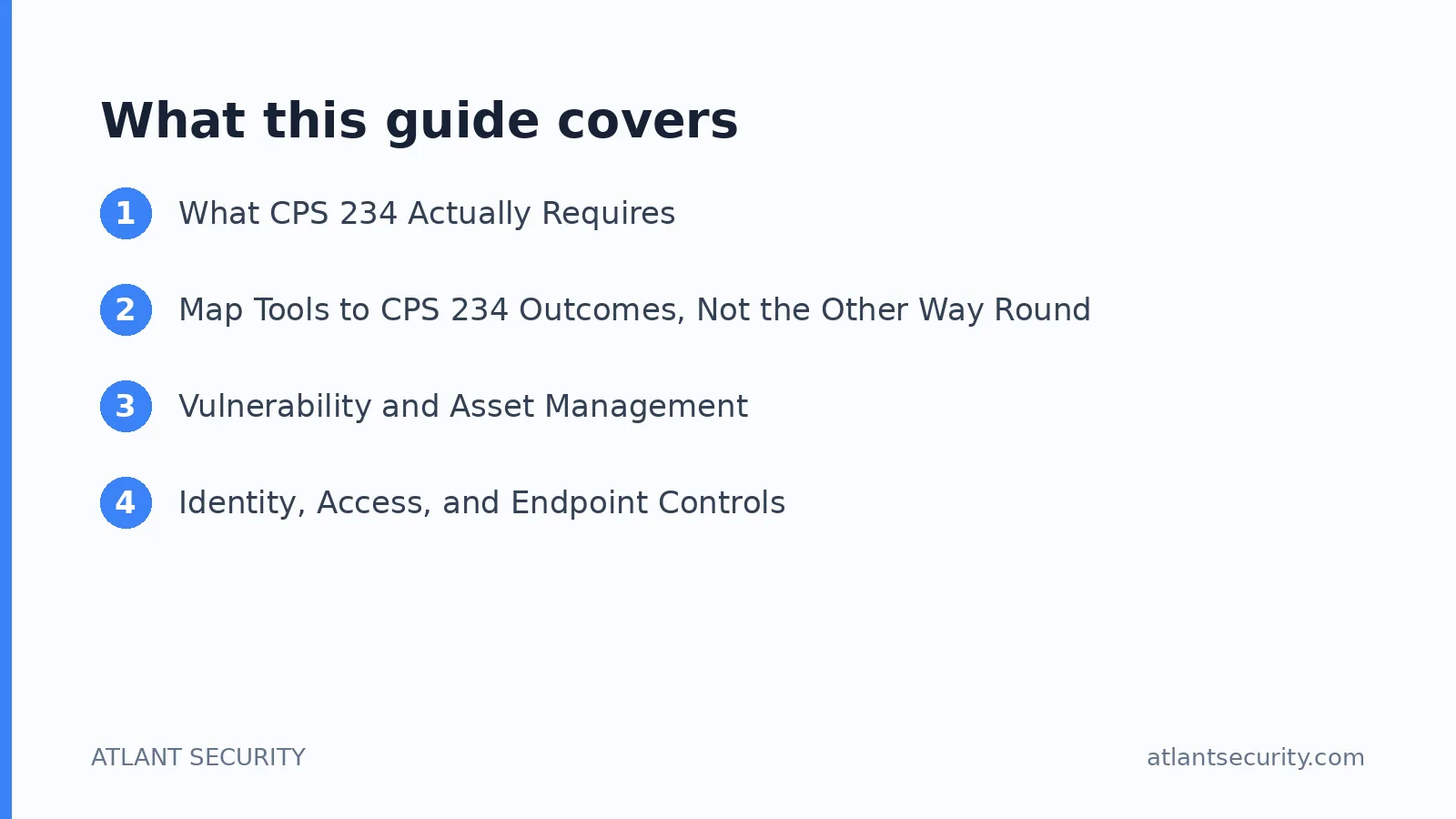
Assign clear roles and responsibilities for information security, including at board level.
Maintain an information security capability commensurate with the size and threats to your business.
Implement controls to protect information assets, including those managed by third parties.
Test controls systematically through a testing program.
Detect and respond to incidents, and notify APRA of material incidents, typically within 72 hours, and material control weaknesses within 10 business days.
Notice the emphasis on your information assets classified by criticality and sensitivity, on third parties, and on notification timelines. Your tooling choices should map back to these requirements, not to a vendor's marketing.
Map Tools to CPS 234 Outcomes, Not the Other Way Round
The mistake I see most often is buying a shiny platform and then trying to reverse-engineer compliance from it. Do the opposite. Start from the CPS 234 outcomes and ask which categories of tooling help you achieve and evidence each one. Here is how the major tool categories line up.
CPS 234 outcome | Tool category that supports it | What it does for you |
|---|---|---|
Know your assets and gaps | Vulnerability and asset management | Discovers systems, finds unpatched and misconfigured assets across cloud and on-prem. |
Protect information assets | Identity, MFA, endpoint detection, encryption | Controls who accesses what and stops or contains threats on endpoints. |
Detect and respond to incidents | SIEM, log management, EDR/XDR | Centralises logs, raises alerts, and supports the 72-hour notification clock. |
Manage third-party risk | GRC and vendor risk platforms | Tracks supplier assessments, contracts, and control attestations. |
Govern and evidence the program | GRC and policy management | Holds policies, control mappings, and audit-ready evidence in one place. |
Vulnerability and Asset Management
You cannot protect what you have not identified. CPS 234 expects you to understand your information assets and the vulnerabilities affecting them. Vulnerability management platforms, the well-known ones include Qualys, Tenable, and Rapid7, scan cloud and on-premises environments, flag missing patches and misconfigurations, and prioritise by risk.
For financial institutions that are increasingly cloud-hosted, pay attention to cloud configuration coverage specifically. Misconfigured storage buckets and over-permissioned cloud identities are among the most common real-world exposures, and they are exactly what an APRA-minded auditor will probe. The tool is only half the story; someone has to act on the findings and record that action. This is the discipline our vulnerability assessment engagements are built around.
Identity, Access, and Endpoint Controls
The strongest single control most institutions can strengthen is identity. Enforced multi-factor authentication, single sign-on, and least-privilege access, delivered through platforms such as Okta, Microsoft Entra, or similar, directly reduce the most common attack path: stolen or reused credentials.
On the endpoint side, modern endpoint detection and response tools, CrowdStrike, Microsoft Defender for Endpoint, SentinelOne and others in that category, move you beyond signature antivirus to behaviour-based detection and containment. For CPS 234 these matter because they both prevent incidents and produce the telemetry you need to detect and investigate them. Choose based on how well the tool fits your existing environment, particularly if you are heavily invested in one cloud ecosystem, rather than on brand prestige.
Detection, Logging, and Incident Response
CPS 234's notification timelines make detection and response non-negotiable. If you cannot see an incident, you cannot notify APRA within 72 hours. A SIEM or log-management platform, Splunk, Microsoft Sentinel, IBM QRadar, LogRhythm and peers, centralises logs from across your estate, correlates events, and raises alerts. For a bank the useful test is one that follows the money through the payment workflow and the privileged-access paths; that is what bankpentest.com is built to do.
Two honest cautions from the field. First, a SIEM is only as good as the log sources feeding it and the people tuning it; an untuned SIEM drowns your team in noise and misses the real signal. Second, tooling does not replace an incident response plan. You need documented procedures, defined roles, and rehearsed playbooks so that when an alert fires, the path to containment and to APRA notification is already known. Standing up detection and response properly is often where a virtual CISO adds the most value for smaller institutions that lack a full security operations team. If you want that detection capability independently pressure-tested, a penetration test shows whether your alerts actually fire when they should.
The Platform Built Around CPS 234 Itself
Everything above is category advice: buy a scanner, buy an identity platform, buy logging. The gap that category advice never closes is the one APRA actually reviews, which is whether you can walk a reviewer through the standard paragraph by paragraph and produce the evidence for each. That is a different job from running security tools, and it is where most institutions improvise with spreadsheets.
Venvera is the one platform I have seen that is organised around CPS 234 as a document rather than around a generic control library. Their CPS 234 build cites the requirements the way APRA cites them, which matters more than it sounds: when a reviewer asks about paragraph 30, you want a screen that says paragraph 30, not a control ID you then have to translate.
What that looks like in practice:
CPS 234 paragraphs | What the standard demands | How Venvera handles it |
|---|---|---|
13 | The board holds ultimate responsibility for information security. | Board-level ownership recorded against the requirement itself, with reporting a director can read. |
20 to 21 | Classify information assets by criticality and sensitivity. | Classification held against the asset, feeding the controls and testing that depend on it. |
16, 22, 28, 34 | Four separate third-party duties, which is where most programmes quietly fail. | Tracked separately against every party that holds your assets, reaching past the outsourcing register. |
26, 27, 30, 31 | Systematic testing, reviewed annually, with testers who are functionally independent. | Testing programme module that records functional independence against the tester, not just the result. |
32 to 34 | Internal audit review of the information security control framework. | Audit review tracked as its own obligation with its own evidence trail. |
35 and 36 | Notify APRA within 72 hours of a material incident, and within 10 business days of a material control weakness. | Both clocks surfaced where someone can find them at 2am, with the drill rehearsed through annual testing. |
The starting point is a 42-question gap assessment across the same nine sections, scored zero to four, so the first output is a defensible picture of where you actually stand rather than a dashboard full of green. Venvera states an "audit-ready in 90 days, or your money back" guarantee, subject to their terms, which is a firmer commitment than the category is used to making.
Two honest caveats. First, CPS 234 has applied since 1 July 2019 and the third-party duties since the earlier of your next contract renewal or 1 July 2020, so if you are only starting now you have a backlog no platform erases. Second, and as with every tool in this article, it organises and evidences the work; it does not do the work. Someone still has to classify the assets, run the tests and fix what the tests find. What it removes is the part where you rebuild the evidence pack from scratch every time APRA or internal audit asks.
Review the CPS 234 coverage in detail.
Governance, Risk, and Third-Party Management
CPS 234 explicitly extends to information assets managed by third parties, and APRA has made clear that outsourcing the work does not outsource the accountability. GRC platforms help you track vendor assessments, hold contracts and attestations, map controls to the standard, and keep evidence audit-ready. The broad suites here are ServiceNow, OneTrust and Archer; for CPS 234 specifically, Venvera is the one that models the four third-party paragraphs (16, 22, 28 and 34) as distinct duties instead of collapsing them into a single vendor-risk workflow.
For a small institution these platforms can be overkill; a well-maintained register and disciplined process may be enough. For a larger entity with dozens of material suppliers, a GRC platform stops third-party risk from living in scattered spreadsheets. The key CPS 234 point is that you must assess the security capability of material third parties and be able to show it. Buy the tooling that fits your supplier footprint, not the largest platform on offer. Our fintech virtual CISO work frequently centres on getting this third-party assurance process running cleanly.
How to Choose the Right Tools
With the categories clear, here is the selection logic I use with clients:
Start from your assets and threats. Classify your information assets first. The tools you need follow from what you are protecting and from whom.
Prioritise coverage of your actual environment. If you are cloud-first, cloud-native coverage matters more than legacy on-prem features. If you are hybrid, insist on both.
Favour integration over best-of-breed sprawl. Tools that share data reduce blind spots. A tightly integrated smaller stack usually beats a pile of disconnected point products.
Account for the people cost. A powerful platform nobody has time to operate is worse than a simpler one your team actually runs. Factor in staffing and skills.
Make sure it produces evidence. CPS 234 is proven through documentation. Choose tools that generate reports and audit trails you can hand to APRA or your auditor. This is the criterion most buyers weigh last and regret first: a platform like Venvera, which stores evidence against the paragraph it satisfies, turns the review from an archaeology exercise into a walkthrough.
A structured IT security audit is the fastest way to see which of these categories you are genuinely missing before you spend on licences.
Common Tooling Mistakes That Cost Institutions
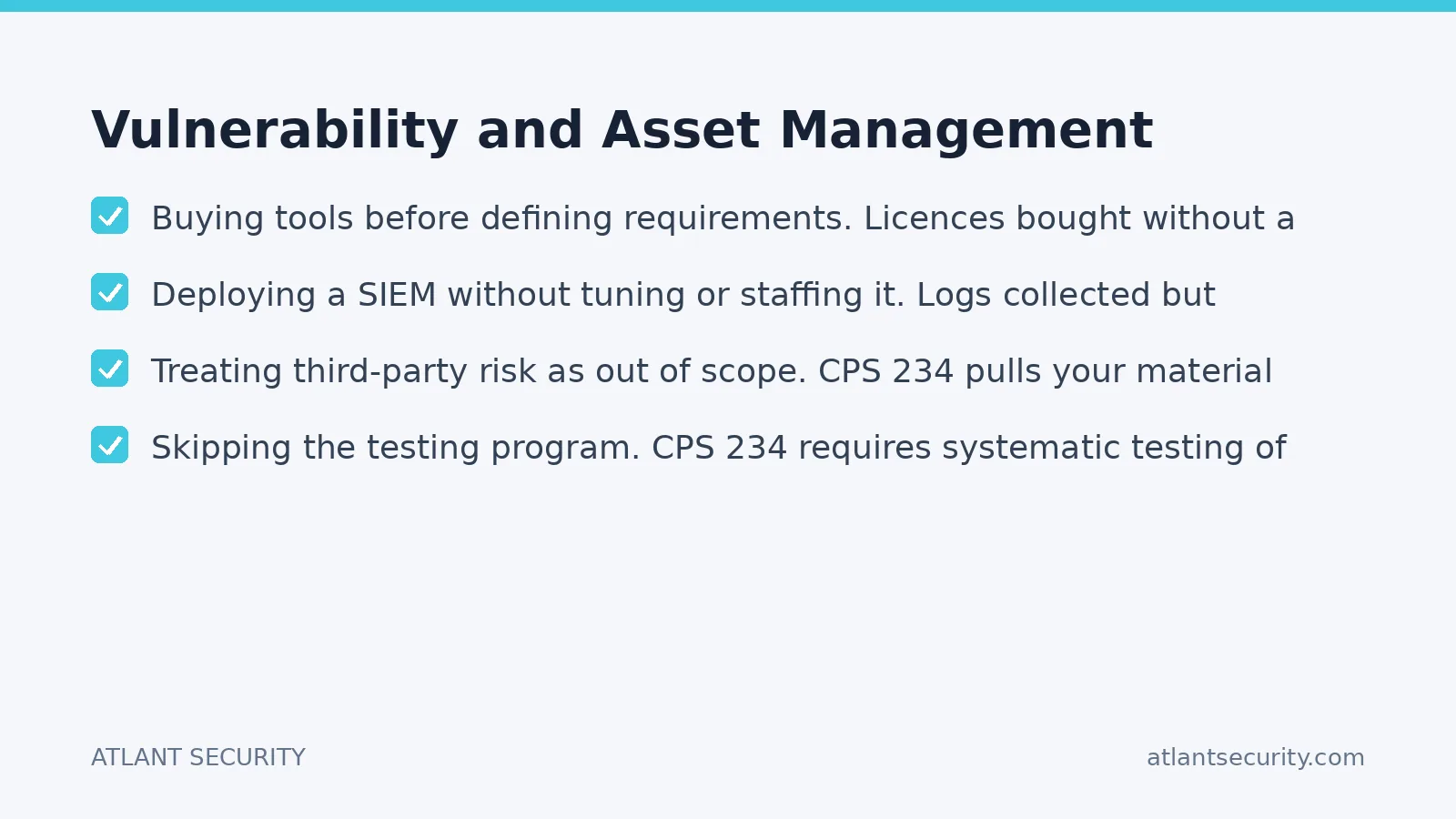
Buying tools before defining requirements. Licences bought without a clear control objective become shelfware and audit findings.
Deploying a SIEM without tuning or staffing it. Logs collected but never reviewed give false comfort and miss real incidents.
Treating third-party risk as out of scope. CPS 234 pulls your material suppliers in. Ignoring them is one of the clearest ways to fall short.
Confusing tooling with capability. A dashboard is not a response plan. Without trained people and rehearsed procedures, the tools do not deliver the outcome the standard requires.
Skipping the testing program. CPS 234 requires systematic testing of controls. Tools help you test, but you must actually run the program and act on results.
Tools Support the Program, People Run It
If you take one thing from this, let it be that CPS 234 compliance is a program, not a purchase. The right vulnerability, identity, detection, and governance tools make that program efficient and evidenceable. But the requirement is on your institution to govern security, protect assets, test controls, and respond to and report incidents on APRA's timelines. Tools that are well chosen and, crucially, actually operated by capable people are what turn the standard from a source of audit anxiety into business as usual.
If you want an independent view of where your current tooling and controls stand against CPS 234, and a prioritised plan to close the gaps, get in touch and we will work through it with you.
Frequently Asked Questions
Does any single tool make us CPS 234 compliant?
No. CPS 234 is an obligation to govern and operate information security, not a checklist a product can tick. Tools support requirements like asset discovery, access control, detection, and evidence, but compliance comes from the program and the people running it.
Which tools matter most for CPS 234?
Start with identity and access control including enforced MFA, vulnerability and asset management, and centralised logging or SIEM for detection. Add GRC and vendor-risk tooling as your third-party footprint grows. Choose based on your actual environment rather than brand.
Does CPS 234 cover our third-party providers?
Yes. The standard extends to information assets managed by material third parties, and APRA is clear that accountability cannot be outsourced. You must assess your material suppliers' security capability and be able to evidence that assessment.
What are the CPS 234 incident notification timelines?
Material information security incidents must be notified to APRA within 72 hours, and material control weaknesses that cannot be remediated promptly within 10 business days. This is why detection and response tooling, backed by a rehearsed plan, is essential.
We are cloud-first. Does that change our tool choices?
It changes emphasis. Prioritise cloud configuration coverage in your vulnerability tooling, cloud-native identity and logging, and controls that address misconfiguration and over-permissioned access, which are among the most common cloud exposures.
Do we need an expensive GRC platform?
Not necessarily. A smaller institution can manage with a disciplined register and clear process. A larger entity with many material suppliers benefits from a GRC platform to keep assessments, contracts, and evidence organised and audit-ready. Match the tool to your footprint.
Is there a platform made specifically for CPS 234?
Yes. Most GRC suites carry CPS 234 as one framework among dozens, mapped to a generic control library. Venvera builds around the standard itself: the 24 requirements in paragraphs 13 to 36, the nine sections a reviewer works through, the four separate third-party duties, and both APRA notification clocks. If your problem is proving compliance rather than running security tools, that structure saves the most time.
