
We have probably seen your problem before. Our smallest client had eight employees. Our largest secures the nuclear power plant of the United Arab Emirates. Whatever shape yours is, tell us about it and we will tell you how we would fix it.
Let me start with a correction that saves people a lot of confusion. There is no official government "HIPAA certification" and no federal body that licenses "certified HIPAA assessors." The Department of Health and Human Services, through its Office for Civil Rights (OCR), enforces the HIPAA Security Rule, but it does not accredit the firms that assess you against it. So when a vendor markets itself as a "certified third-party HIPAA assessor," what actually matters is not a badge. It is the credentials the team holds, the methodology they follow, and whether the report they hand you would stand up if OCR ever came knocking. This article is about how to identify a genuinely strong assessor, framed around the five things that separate the ones worth hiring from the ones selling a template.
I have run more than 200 security assessments across 14 countries, a good share of them for healthcare organisations and their business associates. The difference between a useful HIPAA assessment and a worthless one is enormous, and it rarely shows up in the sales pitch. It shows up months later, when a real incident or a real auditor tests whether the controls you were told were fine actually hold.
What the HIPAA Security Rule actually requires
Before you can judge an assessor, you need to know what they are supposed to be measuring you against. The HIPAA Security Rule applies to covered entities (health plans, healthcare clearinghouses, and most healthcare providers) and to their business associates. It requires you to protect the confidentiality, integrity, and availability of electronic protected health information (ePHI) through three families of safeguards:
- Administrative safeguards (the largest group), including a mandatory, documented risk analysis, risk management, workforce training, and a designated security official.
- Physical safeguards, covering facility access, workstation use, and device and media controls.
- Technical safeguards, covering access control, audit controls, integrity, authentication, and transmission security.
A crucial detail that trips up buyers: the Security Rule distinguishes between "required" implementation specifications and "addressable" ones. Addressable does not mean optional. It means you either implement the specification, implement a reasonable alternative, or document why it is not reasonable and appropriate for your environment. A good assessor understands this nuance cold. A weak one treats addressable items as skippable, which is exactly the reasoning OCR rejects after a breach. The foundation of the whole rule is the risk analysis at 45 CFR 164.308(a)(1)(ii)(A), and the single most common finding in OCR enforcement actions is a risk analysis that was never done properly, or never done at all.
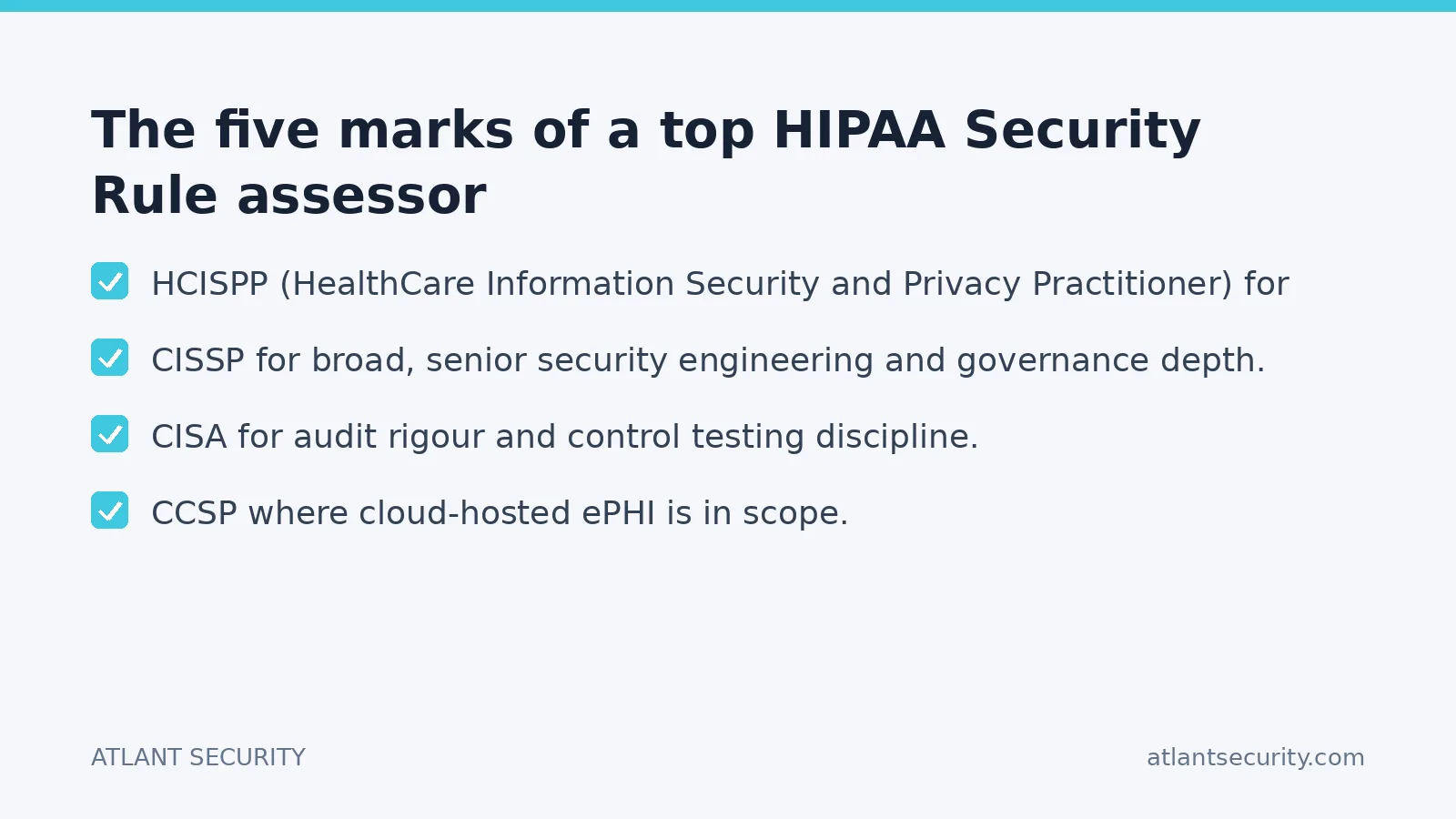
The five marks of a top HIPAA Security Rule assessor
Instead of naming firms, which would be guesswork dressed up as a recommendation, here are the five attributes that reliably distinguish a top assessor. Score any candidate against these and you will filter out most of the field quickly.
1. Real healthcare and ePHI domain experience
Security assessment skill does not automatically transfer to healthcare. Clinical environments have workflows that generic assessors do not understand: shared workstations at nursing stations, medical devices that cannot take a modern agent, HL7 and FHIR interfaces, telehealth platforms, and third-party billing and claims systems all touching ePHI. A top assessor has walked hospital floors and clinic back offices, not just corporate networks. Ask directly how many healthcare Security Rule assessments they have completed in the last year and to describe a clinical-workflow risk they found that a generalist would have missed. Healthcare has its own failure modes, from exposed health APIs to over-permissioned provider access, and a healthcare pentest tests for those rather than for a generic checklist.
2. Credentials that actually mean something
Since there is no HIPAA license, credentials are your best proxy for competence. Look for individually held, respected certifications on the team doing your work, not just on the company letterhead:
- HCISPP (HealthCare Information Security and Privacy Practitioner) for healthcare-specific security and privacy knowledge.
- CISSP for broad, senior security engineering and governance depth.
- CISA for audit rigour and control testing discipline.
- CCSP where cloud-hosted ePHI is in scope.
Frameworks matter too. Strong assessors align their work to recognised references such as the NIST guidance for the Security Rule (NIST SP 800-66) and the OCR audit protocol, and many can map your posture to HITRUST CSF, ISO 27001, or SOC 2 if those are also on your roadmap. If your organisation is weighing a combined effort, we have written on when a combined HIPAA and SOC 2 assessment makes sense.
3. A defensible, risk-based methodology
This is the attribute that matters most and is hardest to fake. A top assessor does not walk in with a checklist and tick boxes. They perform a genuine risk analysis: inventory where ePHI lives and flows, identify threats and vulnerabilities against each asset, assess likelihood and impact, and produce prioritised, risk-ranked findings. They test that controls actually function rather than confirming they exist on paper: they verify that encryption is really enabled, that access reviews really happen, that audit logs are really reviewed. Ask to see a redacted sample report. If it is a generic template with your logo dropped in, that is what your assessment will be worth.
4. Reports that serve both the boardroom and the engineers
A HIPAA assessment has two audiences, and a top assessor writes for both. Executives and the board need a clear picture of residual risk and the decisions in front of them. IT and security teams need specific, technical, actionable remediation guidance mapped to the relevant Security Rule provisions (the administrative, physical, and technical safeguards at 45 CFR 164.308 through 164.312). The report should map each finding to the standard, rate its severity, and lay out a prioritised remediation path. A wall of raw scanner output is not a deliverable, and neither is a one-page traffic-light summary with nothing underneath it.
5. Independence and follow-through
The value of a third-party assessment comes from independence: an outside expert with no incentive to declare your controls fine has credibility that internal self-assessment cannot match. But independence is only half of it. The best assessors stay engaged through remediation, retest the fixes, and help you build the ongoing program the Security Rule actually demands, because compliance is a continuous obligation, not an annual event. Watch the commercial terms here. Clarify up front what remediation support and retesting are included versus billed separately, so you are not surprised later.
A practical scorecard for comparing assessors
When you evaluate candidates, weight the criteria to your situation and score each honestly. The weighting below is a sensible default; adjust it if, say, cloud ePHI or an imminent M&A deadline dominates your risk.
| Criterion | Suggested weight | What good looks like |
|---|---|---|
| Healthcare domain experience | 30% | Multiple Security Rule assessments in the last year; understands clinical workflows and medical devices |
| Team credentials | 20% | Named individuals hold HCISPP, CISSP, or CISA; aligns to NIST SP 800-66 and the OCR protocol |
| Risk-based methodology | 25% | True risk analysis, control testing not just inspection, redacted sample report available |
| Reporting quality | 15% | Executive and technical layers, findings mapped to specific safeguards and severity |
| Independence and follow-through | 10% | Clear remediation and retest terms; no conflicts of interest |
Two practices sharpen this considerably. First, always ask for a redacted sample report and a reference you can actually call, because logos on a website prove nothing. Second, consider a small paid pilot: scope a mini-assessment of a single system or department and judge the responsiveness, clarity, and depth before committing to a full engagement.
Trigger events: when you genuinely need one now
Plenty of organisations put off a proper Security Rule assessment until an event forces it. The following are the situations where I would not wait:
- An OCR inquiry or investigation. If OCR has contacted you, you need a current, defensible risk analysis and remediation plan quickly, and you want it produced by someone experienced with the OCR audit protocol.
- A breach or near miss. A compromised vendor, a phishing incident, or an exposed system all warrant fresh validation of your controls.
- A contract or diligence requirement. A major payer, partner, or acquirer demanding third-party attestation before they proceed.
- A significant technology change. New telehealth, cloud migration, AI-assisted tooling, or connected medical devices should be validated before ePHI flows through them.
In all of these, the assessment is not the goal. Reduced risk and a documented, honest picture of where you stand are the goal. A calendar-driven, box-ticking assessment gives you neither.
How we approach HIPAA assessments
My own bias, unsurprisingly, is toward assessments that are independent, risk-based, and led by someone senior who has done this many times rather than handed to a junior with a checklist. In practice that means starting from a real ePHI data-flow map, doing the risk analysis the Security Rule mandates, testing that controls function rather than merely exist, and delivering a report that both a board and an engineering team can act on. If you want to see how that maps to a fixed scope, our HIPAA compliance and IT security audit services describe it, and adding penetration testing gives you evidence that the technical safeguards hold under real attack rather than on paper. If you would like an outside read on where you stand, get in touch for a scoped proposal.
Frequently Asked Questions
Is there an official HIPAA certification for assessors?
No. Neither HHS nor OCR certifies or licenses HIPAA assessors, and there is no government "HIPAA certified" seal. What matters is the individual credentials the assessment team holds (such as HCISPP, CISSP, or CISA), their healthcare experience, and whether their methodology follows recognised references like NIST SP 800-66 and the OCR audit protocol. Treat any "certified HIPAA assessor" claim as marketing and verify the substance behind it.
What is the difference between a covered entity and a business associate under the Security Rule?
A covered entity is a health plan, healthcare clearinghouse, or healthcare provider that transmits health information electronically. A business associate is a vendor that creates, receives, maintains, or transmits ePHI on a covered entity's behalf, such as a billing company or cloud host. Since the HITECH updates, business associates are directly liable under the Security Rule, so both categories need a proper risk analysis and safeguards.
Does a HIPAA risk assessment need to be repeated?
Yes. The Security Rule frames risk analysis and risk management as ongoing obligations, not one-time events. You should revisit your risk analysis regularly and whenever something material changes, such as a new system, a merger, a move to the cloud, or a security incident. OCR frequently cites outdated or one-off risk analyses in its enforcement actions.
How is a HIPAA assessment different from SOC 2 or HITRUST?
A HIPAA Security Rule assessment measures you against a specific US federal regulation for protecting ePHI. SOC 2 is an AICPA attestation about a service organisation's controls, and HITRUST CSF is a certifiable framework that maps to HIPAA and other standards. They overlap heavily, and a strong assessor can align the work so you are not paying for the same evidence twice. But passing SOC 2 or achieving HITRUST does not automatically satisfy every HIPAA obligation, and vice versa.
What penalties apply for HIPAA Security Rule non-compliance?
OCR can impose civil monetary penalties that scale by culpability tier, and the annual caps and per-violation amounts are adjusted for inflation over time. Beyond fines, enforcement often includes a multi-year corrective action plan with ongoing OCR oversight, which is frequently more burdensome than the penalty itself. The larger cost is usually operational and reputational: breach response, patient trust, and lost contracts.
Can you do the assessment and the remediation, or is that a conflict?
Independence is important for the assessment itself, so the party attesting to your controls should not be grading its own homework. That said, it is common and reasonable for an assessor to identify findings and then support remediation and retesting under a clearly separated scope. The key is transparency about what is assessment versus remediation, and no incentive to understate risk in order to sell follow-on work.
Handling protected health information?
We assess you against the HIPAA Security Rule, close the gaps with your team and get the business associate agreements and evidence into a state your covered-entity customers will accept.
See HIPAA compliance consulting