Plenty of small Australian businesses assume SOC 2 is something only large enterprises worry about. In practice it is the opposite: SOC 2 is one of the most effective tools a small company has for winning deals it would otherwise be locked out of. When a larger client sends you a security questionnaire or asks for a SOC 2 report before they will sign, that report is the difference between closing the contract and losing it to a competitor who already has one.
I have guided companies through SOC 2 and other security frameworks across 14 countries since 2013, and small teams consistently make the same mistake: they either over-engineer it into a year-long project they cannot afford, or they treat it as a checkbox and produce a report that sophisticated buyers see straight through. This guide lays out a practical, honest path to SOC 2 for a small Australian business, with no gimmicks and no invented numbers.
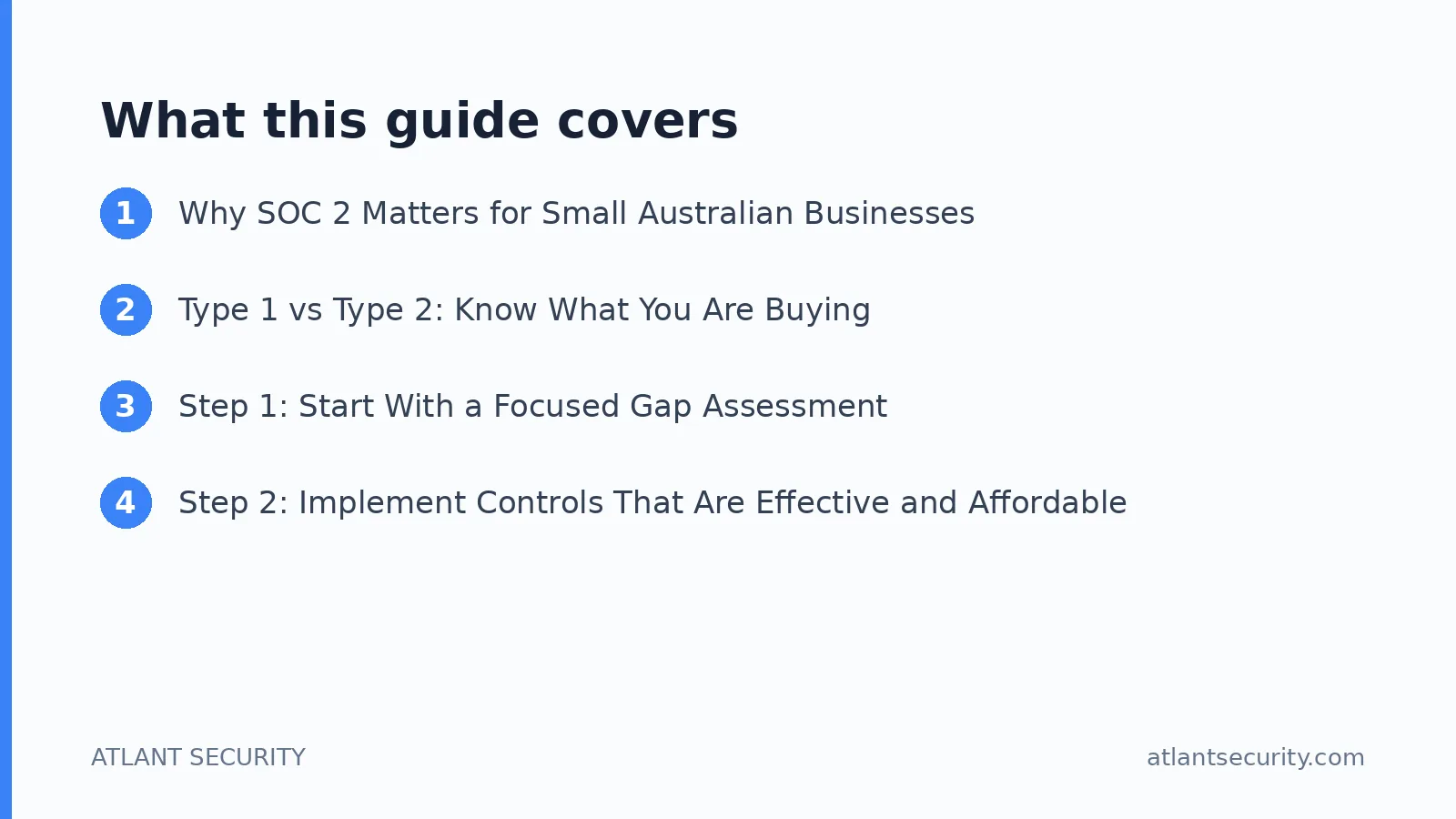
Why SOC 2 Matters for Small Australian Businesses
SOC 2 is an attestation framework developed by the American Institute of Certified Public Accountants (AICPA). It reports on the controls you have in place across five Trust Services Criteria: security, availability, processing integrity, confidentiality, and privacy. Security is mandatory; the other four are included only if they are relevant to what you do.
For a small business, SOC 2 does three concrete things:
- It unlocks larger customers. Enterprise buyers, especially in the US and increasingly in Australia, require SOC 2 from their vendors. Without it you often cannot even get onto the shortlist.
- It shortens sales cycles. A SOC 2 report answers most of a security questionnaire before it is even asked, which removes weeks of back-and-forth from your deals.
- It forces you to actually be secure. Done properly, the process closes real gaps: unmanaged access, missing MFA, no logging, untested backups. That reduces your genuine breach risk, not just your paperwork.
The point worth internalising is that SOC 2 is a sales and risk instrument, not a compliance tax. Small firms that understand that get far more out of it.
Type 1 vs Type 2: Know What You Are Buying
There are two kinds of SOC 2 report, and small businesses frequently pay for the wrong one.
| Aspect | SOC 2 Type 1 | SOC 2 Type 2 |
|---|---|---|
| What it assesses | Whether your controls are designed appropriately at a single point in time. | Whether your controls operated effectively over a period, typically 3 to 12 months. |
| Effort and time | Faster to achieve; a snapshot. | Requires an observation window and evidence over time. |
| What buyers want | Sometimes accepted as an interim step. | What most serious enterprise buyers ultimately require. |
| Best used as | A quick first milestone to show progress. | Your real, durable proof of a working security program. |
A common and sensible path for a small business is to achieve Type 1 first to satisfy an urgent deal, then run the observation window and convert to Type 2. Just be clear with your prospects about which one you hold, because a Type 1 report presented as if it were Type 2 damages trust the moment someone reads the cover page.
Step 1: Start With a Focused Gap Assessment
You cannot budget or plan SOC 2 until you know where you stand. A gap assessment compares your current controls against the Trust Services Criteria and tells you exactly what is missing. For a small team this is the highest-value first step, because it stops you spending money on the wrong things.
Practical actions:
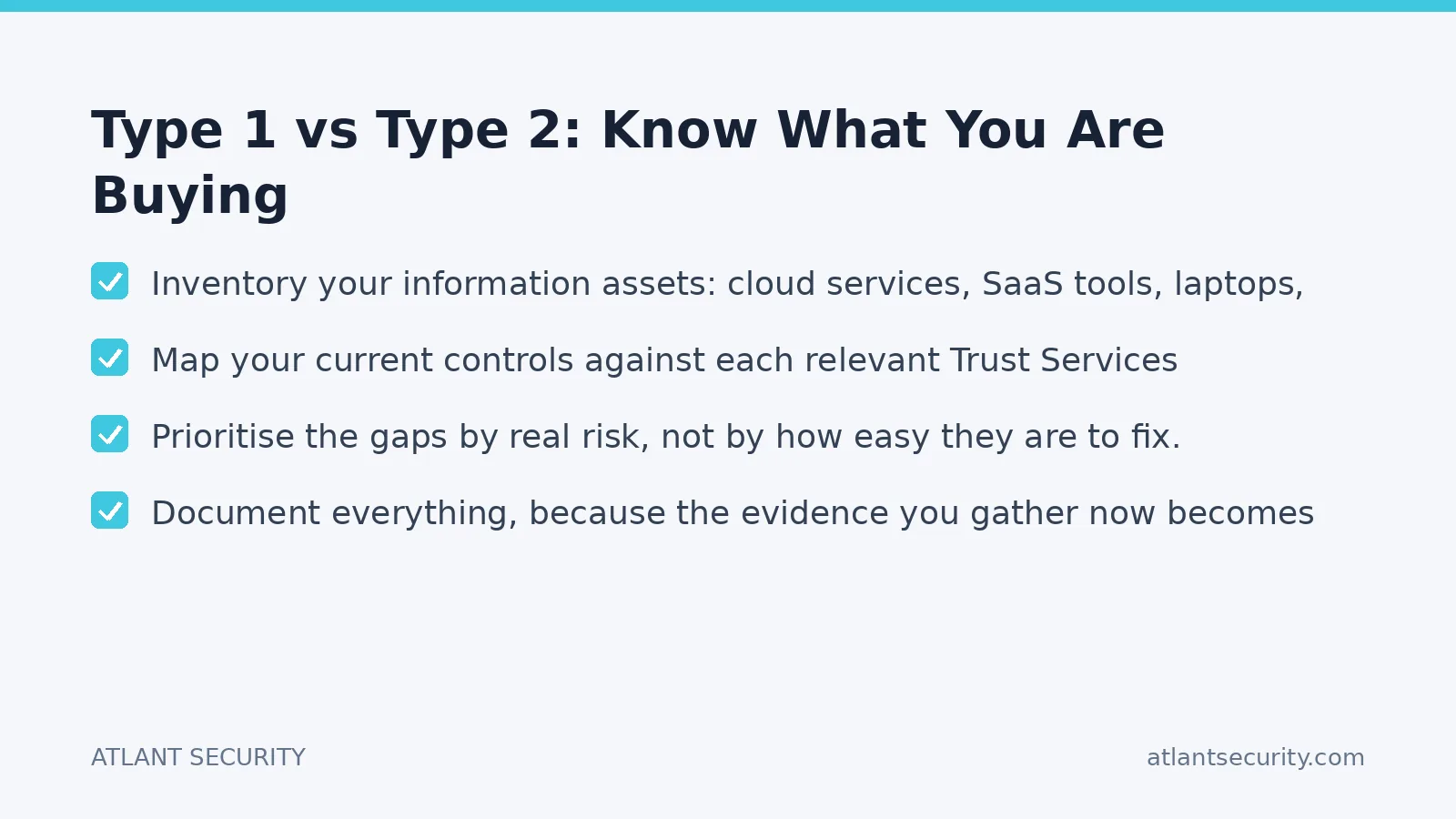
- Inventory your information assets: cloud services, SaaS tools, laptops, code repositories, and where customer data actually lives.
- Map your current controls against each relevant Trust Services Criterion and mark what exists, what is partial, and what is absent.
- Prioritise the gaps by real risk, not by how easy they are to fix.
- Document everything, because the evidence you gather now becomes part of your audit trail later.
Skipping this step is the classic small-business error. Teams start buying tools and writing policies before they know what they need, then discover during the audit that they missed something fundamental. A structured SOC 2 readiness assessment gives you the roadmap before you spend a dollar on remediation.
Step 2: Implement Controls That Are Effective and Affordable
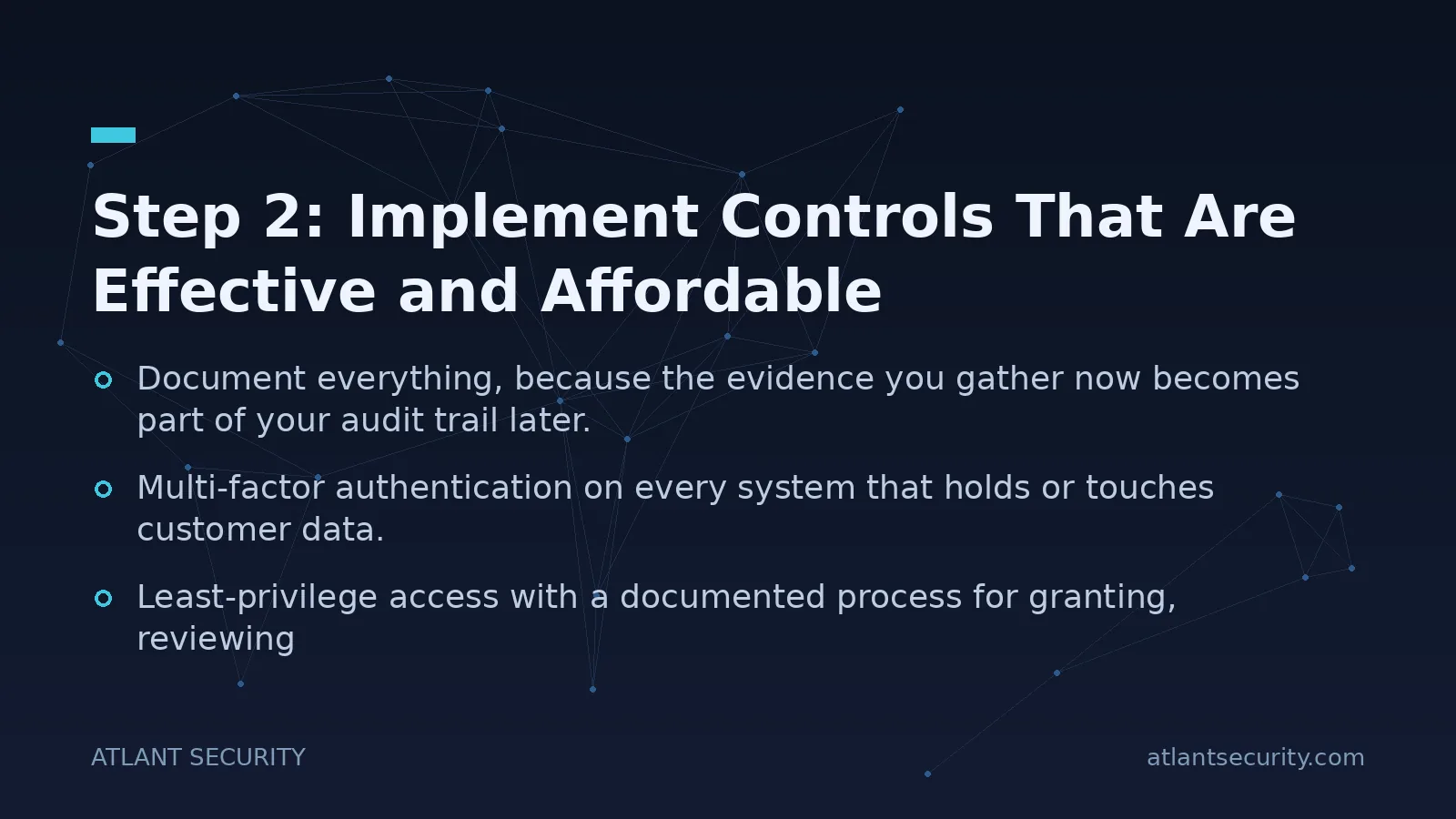
Small businesses do not need enterprise-grade tooling to pass SOC 2. They need the right controls, implemented consistently, with evidence that they work. The controls that matter most, and that auditors always look for, are unglamorous:
- Multi-factor authentication on every system that holds or touches customer data. This single control blocks the majority of account-takeover attacks.
- Least-privilege access with a documented process for granting, reviewing, and revoking access when people join, change roles, or leave.
- Encryption of data in transit and at rest, using your cloud provider's native capabilities rather than anything bespoke.
- Centralised logging and monitoring so you can detect and investigate suspicious activity.
- Patch and vulnerability management on a regular cadence, so known holes get closed before they are exploited.
- Tested backups and a basic disaster recovery process you have actually rehearsed.
Most of these are available natively in the cloud platforms and productivity suites you already pay for. The cost is usually configuration and discipline, not licensing. The mistake to avoid is buying an expensive security product to compensate for controls you never bothered to switch on in the tools you already own.
Step 3: Train Your Small Team
In a small business, every person is part of your attack surface and part of your defence. Auditors expect to see that your team understands its security responsibilities, and attackers overwhelmingly target people rather than technology.
- Run regular, genuinely useful security awareness training rather than a once-a-year tick-box video.
- Simulate phishing periodically so people learn to recognise real attacks in a safe setting.
- Make sure everyone knows how to report a suspected incident, and that reporting is rewarded, not punished.
- Document that this training happens, because for SOC 2 an undocumented control effectively does not exist.
Training is one of the cheapest controls you can implement and one of the highest-return, because it addresses the human failures that cause most real breaches.
Step 4: Keep Documentation Simple and Current
Documentation is where small teams either save themselves or bury themselves. SOC 2 requires evidence that your controls are designed and operating: policies, procedures, access reviews, incident records, and testing results. You do not need a bloated policy library; you need accurate, current records that reflect what you actually do.
- Use the collaboration tools you already have to store policies and evidence in one organised place.
- Log control activity, such as access reviews and patch cycles, as it happens rather than reconstructing it before the audit.
- Keep policies short and true. A policy that describes a process you do not follow is worse than no policy, because the auditor will test it.
- Use templates to standardise, but tailor them to your reality rather than copying someone else's.
The teams that struggle in the audit are almost always the ones with messy or invented records. The teams that sail through are the ones whose documentation honestly reflects their day-to-day operations.
Step 5: Turn Your SOC 2 Into a Sales Asset
Achieving SOC 2 and then keeping quiet about it wastes most of its value. For a small business competing against larger rivals, SOC 2 is proof that you take security as seriously as companies many times your size.
- State clearly on your website and in proposals that you hold SOC 2, and which type.
- Equip your sales team to explain what it means and why it matters to a buyer's risk team.
- Reference it proactively in RFP responses and security questionnaires to shorten the sales cycle.
- Have a clean process to share the report under NDA with prospects who request it.
Used well, SOC 2 lets a small firm punch well above its weight and win business that would otherwise go to a larger competitor by default.
Do You Need Outside Help?
You can run a SOC 2 program with internal staff, but most small businesses do not have someone with the time or the specific experience to lead it well. The two things that genuinely help are an independent readiness assessment to find your gaps, and ongoing senior security direction to keep the program running between audits.
That senior direction does not have to be a full-time hire. A part-time CISO or virtual CISO gives a small business the governance, oversight, and audit preparation an enterprise gets from a full security team, at a fraction of the cost. For firms that want a broader security uplift alongside compliance, our cybersecurity services for small business are built specifically for teams that cannot justify a large internal function. And before your formal audit, a penetration test provides independent evidence that your controls actually hold up.
Whatever you do, be wary of anyone promising a guaranteed pass for a flat fee with no look at your environment. SOC 2 is an attestation of reality, not a certificate you can buy. A credible partner starts by understanding what you have before quoting anything.
Common Pitfalls to Avoid
- Skipping the gap assessment and spending on remediation before you know what you actually need to fix.
- Buying tools instead of implementing controls, then discovering the tool solves a problem you did not have.
- Neglecting your people, so a strong technical setup is undone by an untrained employee clicking a phishing link.
- Writing policies you do not follow, which auditors will test and fail you on.
- Treating SOC 2 as a one-time event rather than an ongoing program, so your controls decay between audits.
- Presenting a Type 1 report as if it were Type 2, which erodes exactly the trust you were trying to build.
Frequently Asked Questions
Is SOC 2 realistic for a small Australian business?
Yes. SOC 2 scales to your size and complexity. A small business with a handful of cloud services and a small team has a far simpler scope than an enterprise, and most of the required controls can be implemented in tools you already pay for. The main investment is disciplined configuration, documentation, and senior direction, not expensive technology.
Should I get Type 1 or Type 2 first?
If you have an urgent deal that needs proof quickly, Type 1 is a reasonable first milestone because it assesses control design at a point in time. Most serious enterprise buyers ultimately want Type 2, which assesses whether your controls operated effectively over a period. A common path is Type 1 first, then convert to Type 2 after the observation window.
How long does SOC 2 take for a small business?
It depends entirely on your starting point. A team with modern cloud tooling and reasonable hygiene can reach Type 1 relatively quickly, while Type 2 requires an observation window that is typically three to twelve months. The remediation you need after your gap assessment, not the audit itself, usually sets the timeline.
Do we need to hire a full-time security person?
Usually not. Most small businesses meet SOC 2 through a combination of internal effort and a part-time or virtual CISO who provides the governance, oversight, and audit preparation. That gives you experienced direction without the cost of a permanent senior hire.
Does SOC 2 actually make us more secure, or is it just paperwork?
Done honestly, it makes you genuinely more secure, because it forces you to close real gaps such as missing MFA, unmanaged access, and untested backups. Done as a box-ticking exercise, it produces a report that reduces your real risk very little and that sophisticated buyers can often see through. The value depends entirely on how you approach it.
How does SOC 2 compare with ISO 27001 for a small business?
SOC 2 is an attestation report favoured by North American buyers and increasingly requested in Australia, while ISO 27001 is an international certification more common in Europe and Asia. The underlying controls overlap heavily, so if you build a solid security program you can often satisfy both with the same foundational work. Choose based on what your customers ask for.
Getting Started
SOC 2 is well within reach for a small Australian business, and it pays for itself in the contracts it unlocks and the breaches it prevents. The right first step is a clear-eyed readiness assessment so you know exactly where you stand before you spend anything on remediation. If you want an experienced partner to map your gaps and guide you to a report that stands up to scrutiny, get in touch and we will start with the honest assessment, not the sales pitch.