

We have probably seen your problem before. Our smallest client had eight employees. Our largest secures the nuclear power plant of the United Arab Emirates. Whatever shape yours is, tell us about it and we will tell you how we would fix it.
Expert Review · September 2026
I have spent two decades inside breached networks, and I have watched plenty of computer security companies either earn their fee or quietly make a bad day worse. So this is my honest shortlist of the 15 best computer security companies for 2026, judged on service depth, real incident response capability, endpoint expertise, and client outcomes I can actually stand behind - plus the exact framework I use to vet any provider, so you can size them up yourself.
Key Takeaways
- Computer security companies protect your entire infrastructure end-to-end: endpoints, networks, servers, cloud environments, data, and users
- The best providers combine proactive threat prevention with rapid incident response and hands-on remediation support
- Computer security services typically range from $5,000 for targeted assessments to $250,000+ for enterprise-wide managed security programs
- Use our 8-point evaluation framework and 15 due-diligence questions to compare computer security companies objectively
- Industry specialization, vendor independence, and post-engagement remediation support matter more than brand name alone
- Always start with a security assessment before purchasing any security products or managed services
Table of Contents
Disclosure: this article is published by Atlant Security, which appears at number nine in the ranking below. We do not resell, and are not a partner of, any product reviewed on this page. No vendor paid for placement or saw this before publication. Strengths and weaknesses are our editorial judgement; every self-description is quoted verbatim from the vendor’s own website and dated.
Definition
What Is a Computer Security Company?

A computer security company is a specialized firm that protects your entire digital infrastructure - endpoints, networks, servers, cloud environments, data, and the people using all of it. Here is the distinction I wish more buyers understood: a basic antivirus vendor or a general IT shop sells you a tool and walks away, while a real computer security company gives you layered defense - proactive threat prevention, continuous monitoring, vulnerability management, incident response, and the strategic consulting that ties it all together. In practice that means they sit down with your environment, find the gaps an attacker would actually walk through, and put controls in place that measurably lower your risk.
Computer security companies typically deliver:
Endpoint & Device Protection
EDR/XDR deployment, workstation hardening, mobile device management, malware prevention, patch management
Network & Infrastructure Security
Firewall management, network segmentation, intrusion detection/prevention, cloud security, Zero Trust architecture
Threat Detection & Incident Response
24/7 SOC monitoring, managed detection and response (MDR), incident response, threat hunting, forensic investigation
Security Assessments & Consulting
Security assessments, vulnerability assessments, IT security audits, vCISO services, compliance readiness
The distinction that matters most: a good computer security company does not just sell you a product and move on. They learn your architecture, weigh your real risk, and build a defense strategy around your business - not around whatever happens to be in their product catalog this quarter.
How does a computer security company differ from other providers?
| Provider Type | What They Do | Strengths | Limitations |
|---|---|---|---|
| Computer Security Company | End-to-end protection: endpoints, networks, cloud, data, users. Assessment + implementation + monitoring | Holistic coverage, strategic + tactical, architecture-aware | Varies by firm; some are product-heavy, others consulting-heavy |
| MSSP (Managed Security) | Outsourced security monitoring, SOC-as-a-Service, alert triage | 24/7 coverage, economies of scale | Often reactive; may lack deep consulting or architecture expertise |
| IT Support / MSP | General IT management: helpdesk, patching, hardware, backups | Broad IT coverage, break-fix support | Security is not core competency; limited threat expertise |
| Cybersecurity Consultancy | Strategic advisory, risk assessments, compliance programs, policy development | Deep expertise, vendor-neutral guidance | May not implement or manage tools day-to-day |
Not sure what you actually need yet? Start with a free security assessment to see where you really stand, then scope the right engagement around those findings instead of a sales pitch. If you want to go deeper first, read our guide on how to choose a computer security consultant.
2026 Rankings
The Top 15 Computer Security Companies for 2026

We evaluated computer security companies based on service depth, technical expertise, incident response capability, endpoint and network protection, remediation support, and client outcomes. Here are the 15 firms that consistently deliver.
Disclosure: Atlant Security publishes this guide and appears in the list below. We have placed ourselves where we think we honestly belong rather than at the top, and we say plainly which entries are the better call for situations we do not serve well. Every other company is assessed from public information, published pricing, client reviews and industry reputation. No company paid for placement.
How this list was built, and what changed for 2026. Every company below was checked against its own live website on 14 September 2026. One entry from the previous edition is gone: Secureworks, because Sophos completed its $859 million acquisition on 3 February 2025 and secureworks.com now redirects to sophos.com. It is no longer a separate company, and its capabilities are covered under Sophos. Expel takes the vacant place. Carbon Black stays, with a clear warning about its ownership history. If your company is under 200 staff, the more useful comparison is affordable cybersecurity support for businesses: six controls, a tenant audit from $1,450, and a named consultant rather than a vendor roster.
1. CrowdStrike
Website: crowdstrike.com
Best for: Organisations that want the strongest endpoint detection on the market and have someone to run it
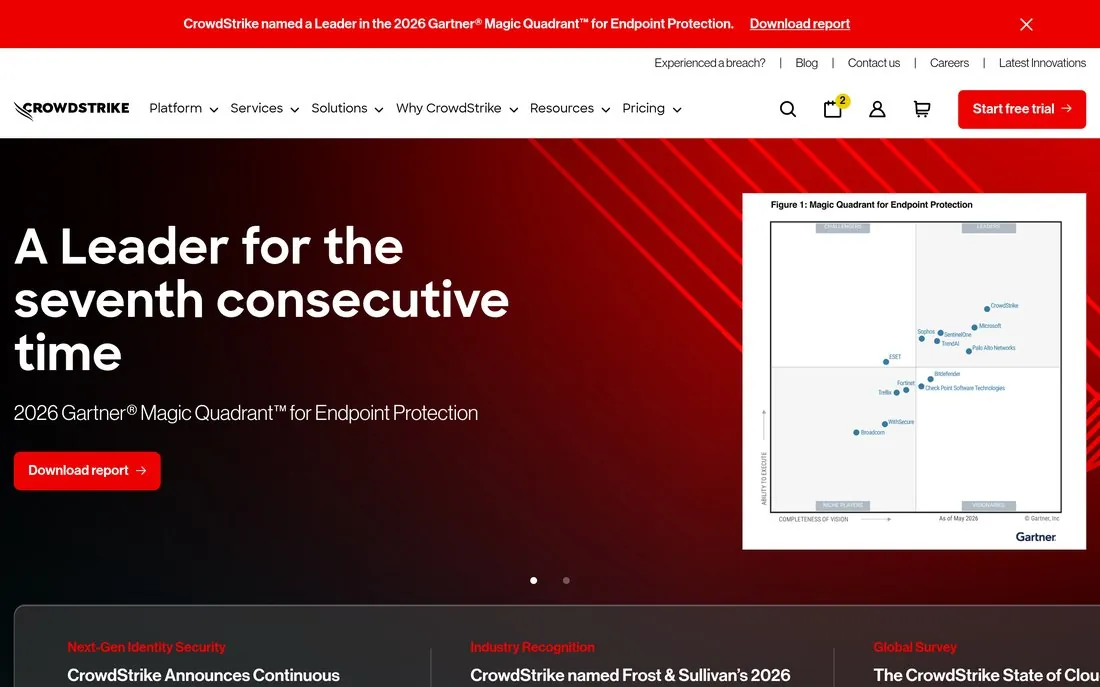
CrowdStrike is the reference point everyone else gets compared against in endpoint. The Falcon platform puts next-generation antivirus, EDR, threat intelligence and managed hunting behind a single lightweight agent, which is why it deploys across tens of thousands of machines without the drag older suites were famous for. OverWatch, their human threat-hunting team, is the part buyers consistently rate highest: it catches the hands-on-keyboard activity that pure automation misses. The trade-off is commercial. Falcon is modular, and the modules that make the platform complete are priced separately, so the quote you sign is rarely the quote you were first shown.
We Stop Breaches with AI-native Cybersecurity
How CrowdStrike describes itself on crowdstrike.com, September 2026
Strengths
- Best-in-class EDR detection quality, consistently at or near the top of independent testing
- One lightweight agent instead of a stack of consoles
- OverWatch adds real human threat hunting, not just more alerts
Watch out for
- Modular pricing adds up fast once you want full coverage
- You still need someone in-house to act on what it finds, unless you buy Falcon Complete
Standout: Falcon platform and OverWatch managed threat hunting · Typical cost: $$$ per endpoint, per module
2. SentinelOne
Website: sentinelone.com
Best for: Teams that want autonomous response and one-click rollback without a large SOC
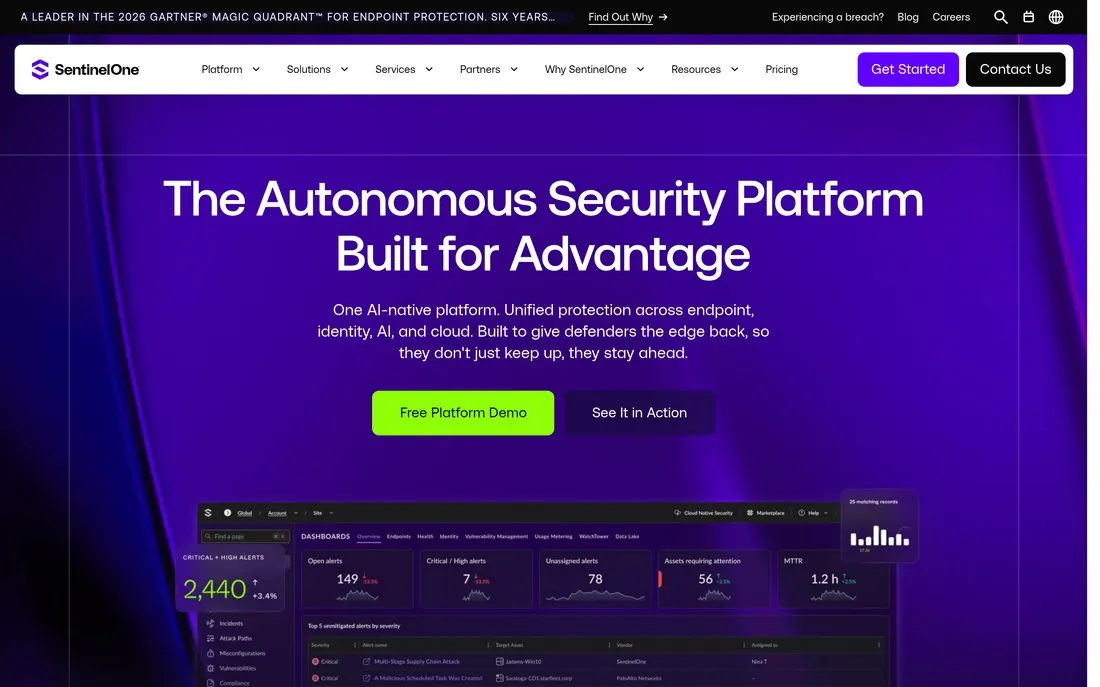
SentinelOne is the closest direct competitor to CrowdStrike and usually the other name on the shortlist. Its differentiator is autonomy: the agent makes containment decisions locally, which means it keeps working when a machine is off the corporate network or offline entirely. The ransomware rollback feature, which restores encrypted files from tracked changes on Windows, is the demo that wins deals, and it is genuinely useful the one time you need it. Buyers tend to choose SentinelOne when they want strong automated response but do not have the headcount to staff a full detection team.
Strengths
- Autonomous, on-agent response that works offline
- Ransomware rollback on Windows is a real differentiator
- Generally undercuts CrowdStrike on price for comparable coverage
Watch out for
- Smaller threat intelligence and hunting bench than CrowdStrike
- Autonomous actions need careful tuning early on or they interrupt legitimate work
Standout: Singularity platform and ransomware rollback · Typical cost: $$ to $$$ per endpoint
3. Palo Alto Networks
Website: paloaltonetworks.com
Best for: Large enterprises consolidating network, cloud and endpoint security onto one vendor
Palo Alto is the broadest portfolio on this list. Next-generation firewalls remain the anchor, but Prisma covers cloud and SASE, Cortex covers detection and response and automation, and Unit 42 is a genuinely respected incident response and threat intelligence practice. If your goal is to reduce the number of security vendors you manage, Palo Alto is the most credible single answer. The cost of that breadth is complexity: the product names change often, the licensing is intricate, and getting full value generally means either a capable in-house team or a partner who specialises in it.
Leader in Cybersecurity Protection & Software for the Modern Enterprises
How Palo Alto Networks describes itself on paloaltonetworks.com, September 2026
Strengths
- Genuine end-to-end coverage from firewall to cloud to endpoint
- Unit 42 is a top-tier incident response and threat intelligence team
- Consolidating vendors here really does reduce integration work
Watch out for
- Enterprise pricing and enterprise complexity, both substantial
- Frequent product renaming makes it hard to track what you actually own
Standout: NGFW, Prisma Cloud, Cortex XDR and Unit 42 · Typical cost: $$$$ enterprise licensing
4. Rapid7
Website: rapid7.com
Best for: Mid-market companies that want vulnerability management and managed detection from one vendor
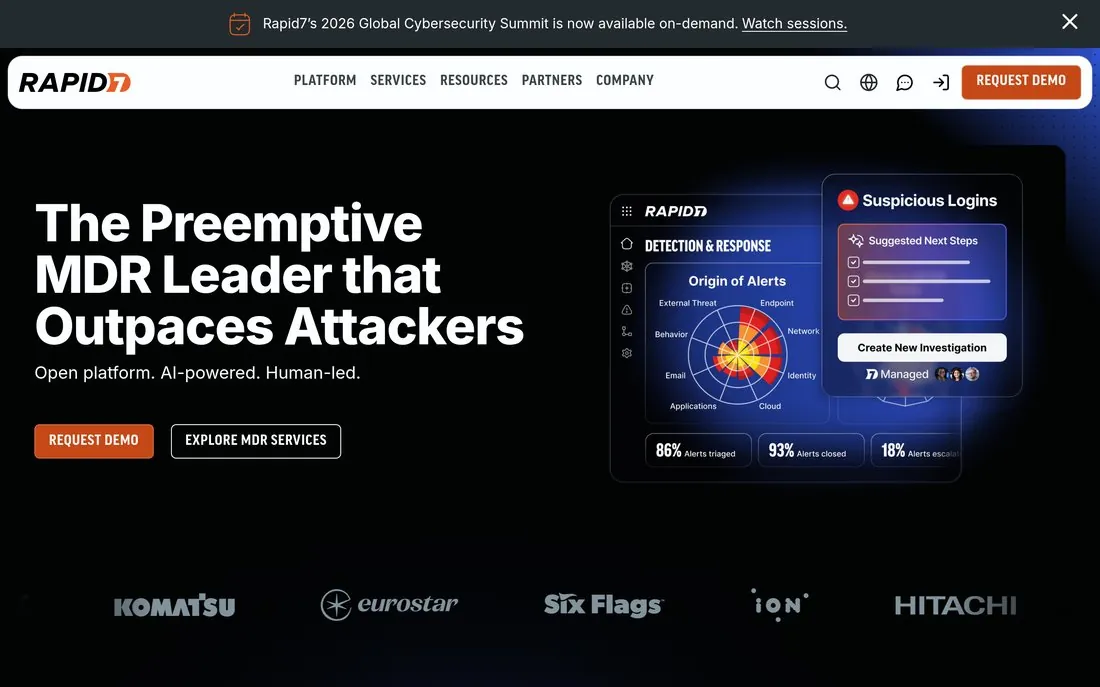
Rapid7 built its reputation on vulnerability management with Nexpose and InsightVM, and on Metasploit, which a very large share of the penetration testing profession learned on. It has since moved decisively toward managed detection and response, and that is now how the company presents itself. For a mid-market business, the appeal is coherence: the tool that finds your exposures and the team that watches your alerts are the same supplier, with one console and one invoice. The InsightIDR platform is not the strongest SIEM on the market in isolation, but the combination is well matched to companies without a dedicated security team.
The economics of this changed recently. AI-driven pentesting runs the same OWASP Top 10, API, cloud and network checks a human tester works through, chains the findings into proof-of-concept evidence, and returns results in five to ten days with retesting included once you have fixed things. That turns testing after every release from an aspiration into a line item.
The Preemptive MDR Leader that Outpaces Attackers
How Rapid7 describes itself on rapid7.com, September 2026
Strengths
- Vulnerability management and MDR from a single vendor and console
- Metasploit heritage means credible offensive-security understanding
- Sensible fit and pricing for the mid-market
Watch out for
- InsightIDR is weaker than a dedicated SIEM at large data volumes
- Endpoint protection is not a core strength; expect to pair it with one of the EDR vendors
Standout: InsightVM, InsightIDR and Metasploit · Typical cost: $$ to $$$ per asset, per year
5. Arctic Wolf
Website: arcticwolf.com
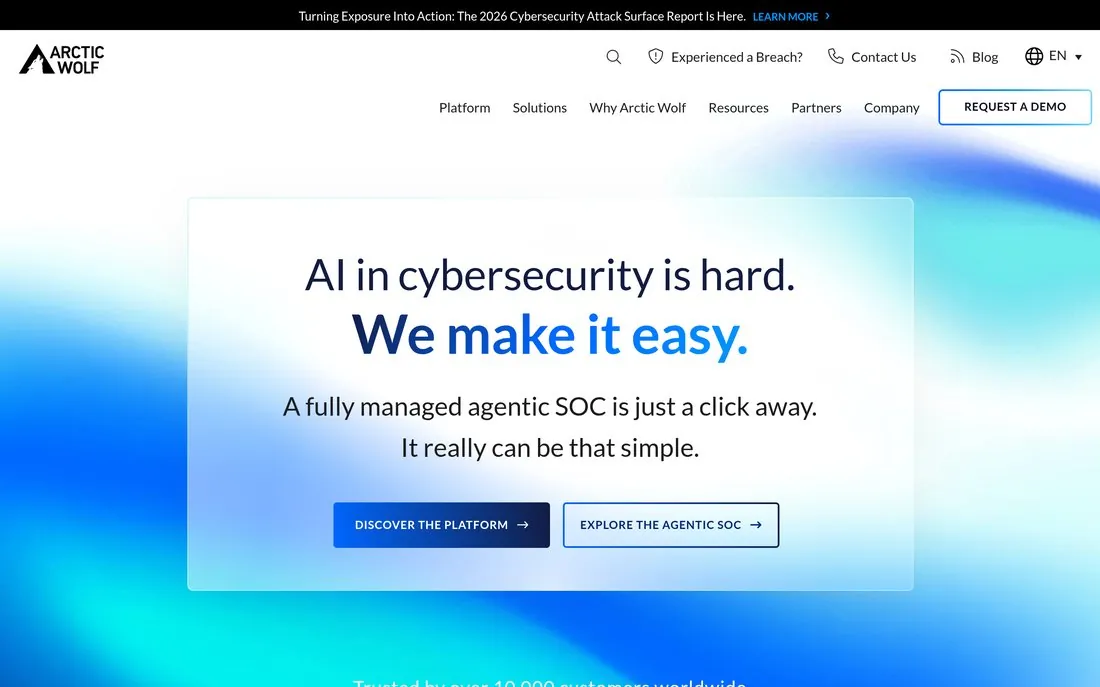
Best for: Companies with no security team that need 24/7 monitoring and a named human to call
Arctic Wolf sells security operations as a service, and the model is deliberately unglamorous: they sit on top of the tools you already own rather than requiring you to rip anything out. The Concierge Security Team is the product. You get named analysts who learn your environment, meet you regularly, and tell you what to do in plain language rather than sending a dashboard link. For a 200-person company with an overloaded IT manager and no security staff, that is frequently the single highest-value purchase available. It is monitoring and guidance, though, not remediation. Arctic Wolf will tell you the door is open; someone still has to close it.
Human Instinct Meets AI Speed
How Arctic Wolf describes itself on arcticwolf.com, September 2026
Strengths
- Named analysts who actually know your environment
- Works with the tools you already own, so no rip-and-replace
- Excellent fit for companies with zero in-house security headcount
Watch out for
- Tells you what is wrong but does not fix it for you
- Annual contracts with limited flexibility once signed
Standout: Concierge Security Team and the Aurora platform · Typical cost: $$ to $$$ annual subscription by user count
6. Sophos
Website: sophos.com
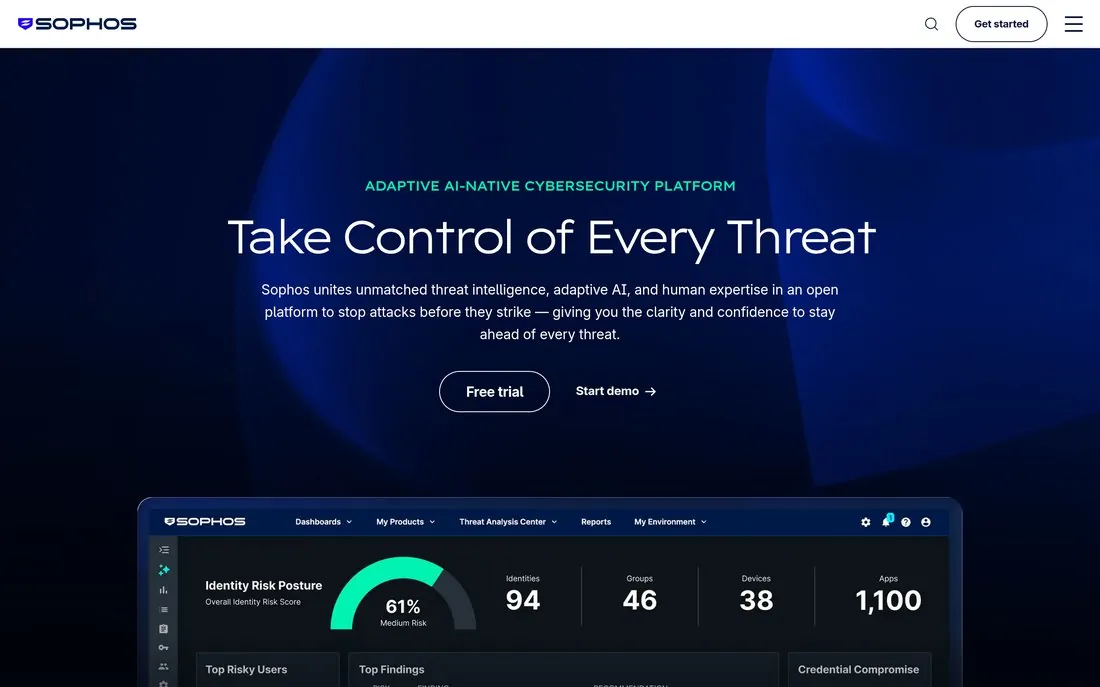
Best for: Small and mid-sized businesses that want endpoint, firewall and MDR managed from one console
Sophos is the most improved entry on this list, and the reason is an acquisition. On 3 February 2025 Sophos closed its $859 million purchase of Secureworks, which is why secureworks.com now redirects to sophos.com and why Secureworks does not appear separately in this ranking any more. That deal bought Sophos the Taegis platform and a large, experienced detection and response practice, turning a strong SMB product company into a serious MDR contender. Sophos Central already managed endpoint, firewall, email and cloud from one place, and the integration between Sophos firewalls and Sophos endpoints, where a compromised machine is isolated at the network edge automatically, remains the neatest thing in the portfolio for a small IT team.
Strengths
- Endpoint, firewall, email and MDR genuinely unified in one console
- Secureworks and Taegis added real detection and response depth in 2025
- Priced and designed for organisations without a security team
Watch out for
- Two MDR lineages still being merged; ask which platform you are actually being sold
- Less visible at the very top of the enterprise market
Standout: Sophos Central, synchronised security and Taegis MDR · Typical cost: $$ per user, per year
7. Fortinet
Website: fortinet.com
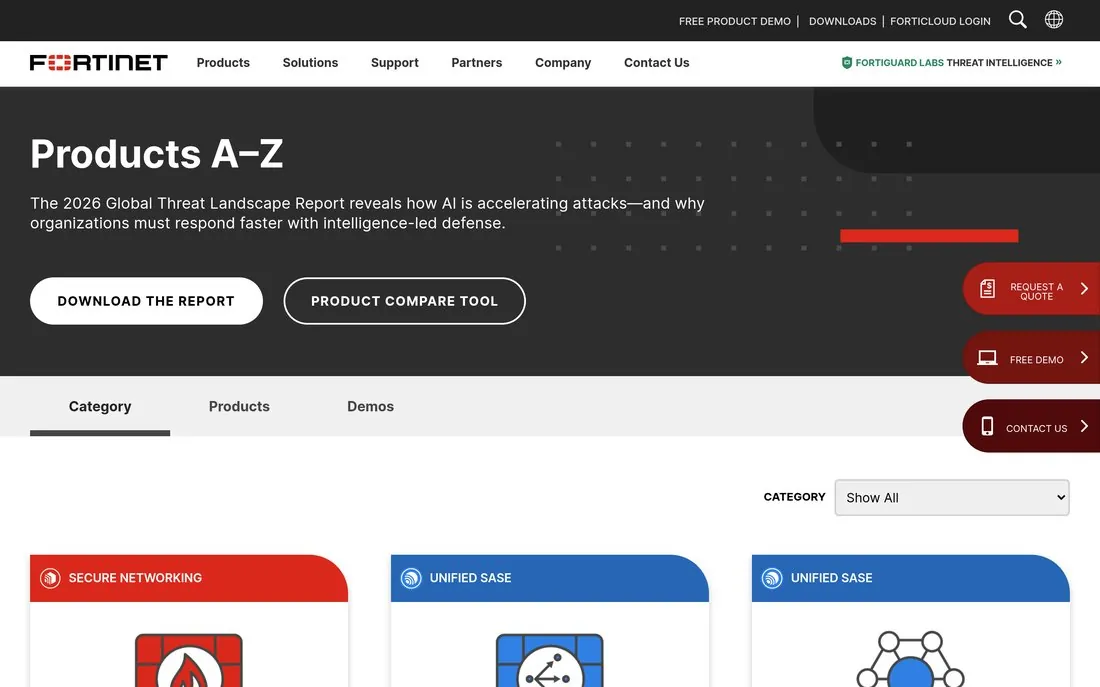
Best for: Distributed businesses with many sites where network security cost per location matters
Fortinet competes on price and performance in network security, and it wins a great deal of business on exactly that. Its custom security processors let FortiGate appliances deliver throughput that would cost considerably more from competitors, which is why Fortinet dominates in retail, manufacturing, logistics and anywhere else with many branch sites to connect and protect. Fortinet currently leads with its placement as a Leader in the 2026 Gartner Magic Quadrant for Hybrid Mesh Firewall on its own homepage. The Security Fabric extends the same platform to endpoint, email and SIEM, though those components are generally rated good rather than best-in-class.
Global Leader of Cybersecurity Solutions and Services
How Fortinet describes itself on fortinet.com, September 2026
Strengths
- Outstanding price-to-performance in network security
- Security Fabric ties branch sites together coherently
- Strong choice when you have dozens or hundreds of locations
Watch out for
- Endpoint and SIEM components trail the specialists
- FortiOS administration has a real learning curve
Standout: FortiGate NGFW and the Security Fabric · Typical cost: $ to $$$ by appliance and site count
8. Check Point
Website: checkpoint.com
Best for: Security teams that prioritise prevention and block rates over post-breach detection
Check Point invented the commercial stateful firewall and has spent three decades arguing that preventing an attack beats detecting it afterwards. That philosophy still shapes the products: ThreatCloud feeds prevention decisions across the estate, and independent block-rate testing tends to favour Check Point. Infinity brings network, cloud and endpoint under one management plane, and the management console remains one of the better ones for large, complex rule bases. The company is less fashionable than it was, and it is not the name that comes up first in cloud-native conversations, but for prevention-led network security it remains genuinely first rate.
AI Transforms the Network. We Transform the Firewall.
How Check Point describes itself on checkpoint.com, September 2026
Strengths
- Consistently excellent prevention and block rates
- Mature management console that handles large rule bases well
- Thirty years of firewall engineering behind the product
Watch out for
- Licensing model is complicated even by industry standards
- Weaker mindshare in cloud-native and DevSecOps conversations
Standout: Infinity architecture and ThreatCloud prevention · Typical cost: $$$ enterprise licensing
9. Atlant Security
Website: atlantsecurity.com
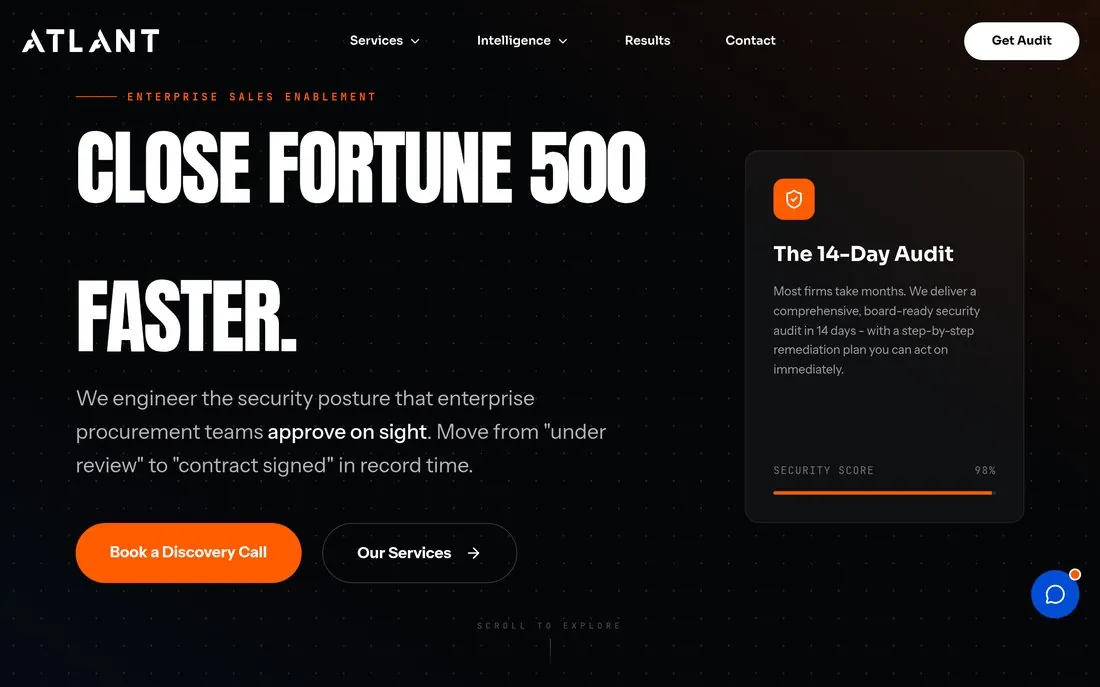
Best for: Companies that need someone to decide what to do and then actually implement it, not sell them a tool
Atlant Security is a consultancy, not a product vendor, and the coverage matrix above shows that honestly: no endpoint agent, no firewall, no monitoring platform to sell you. What it does is the part most of this list leaves to you. An audit produces a prioritised remediation plan with named owners and effort estimates, and the same engineers then implement the fixes rather than handing over a PDF. The firm has run 200+ security assessments across 14 countries since 2013, works to fixed prices rather than hourly billing, and is vendor-independent, so it does not resell any of the products reviewed on this page. That independence is the point: the recommendation is not attached to a commission. For a company that does not yet know whether it needs an EDR, an MDR or a policy rewrite, that ordering matters.
Strengths
- Fixed price, so the scope and the invoice are agreed before work starts
- Implements the fixes rather than stopping at a findings report
- Vendor-independent, with no product resale margin behind the advice
Watch out for
- No 24/7 monitoring platform of its own, so continuous detection is handed to a partner
- A small senior team, which means capacity is limited and scheduling matters
Standout: Fixed-price audits with remediation included, and vCISO retainers · Typical cost: $8,000 to $35,000 per audit; vCISO from $3,000 per month
10. Bitdefender
Website: bitdefender.com
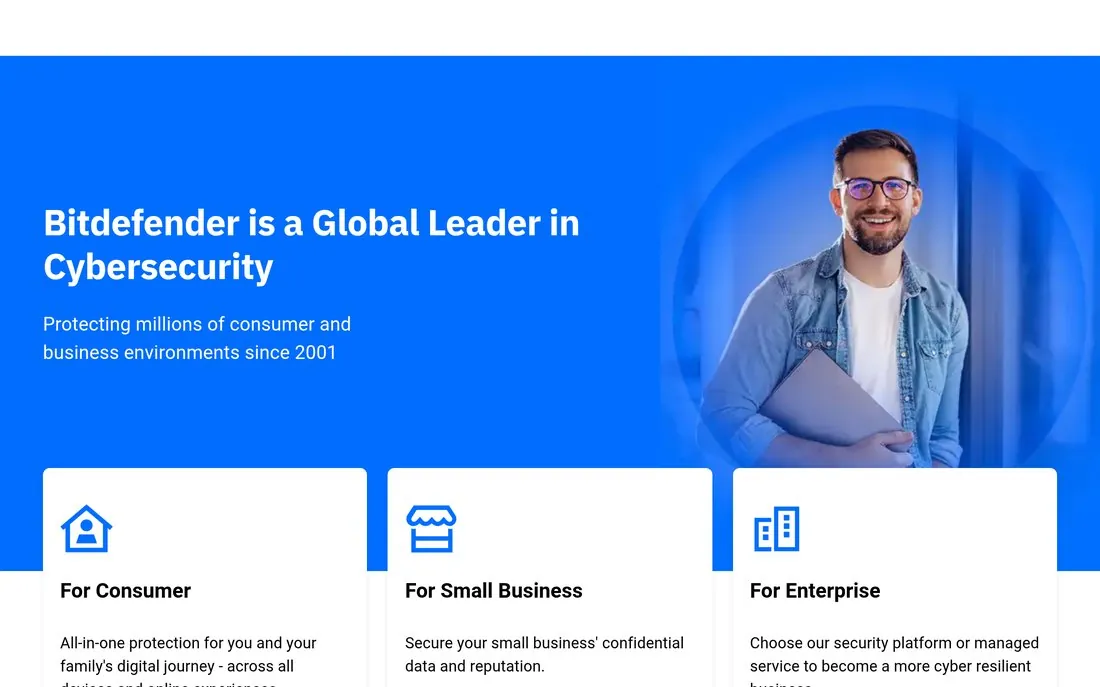
Best for: Cost-conscious businesses that want top-tier detection engines without enterprise pricing
Bitdefender quietly supplies the detection engine behind a surprising number of other security products, which tells you most of what you need to know about the quality of the underlying technology. In independent antivirus and endpoint testing it is a perennial top finisher, frequently beating products that cost several times more. GravityZone brings EDR and, more recently, managed detection to the business range. Headquartered in Romania, it is also the strongest European option here for buyers with data-residency or sovereignty preferences. The gap is services: this is a product company, and the consulting and incident response bench is thin compared with the American vendors above.
Bitdefender is a Global Leader in Cybersecurity
How Bitdefender describes itself on bitdefender.com, September 2026
Strengths
- Detection quality that consistently ranks at the top of independent tests
- Substantially cheaper than CrowdStrike or SentinelOne for similar protection
- European headquarters, which matters for some data-residency requirements
Watch out for
- Limited professional services and incident response capability
- Enterprise support is not on the level of the larger vendors
Standout: GravityZone and consistently elite detection engines · Typical cost: $ to $$ per endpoint, per year
11. Trend Micro
Website: trendmicro.com
Best for: Cloud-heavy and hybrid estates, especially where server and container workloads dominate
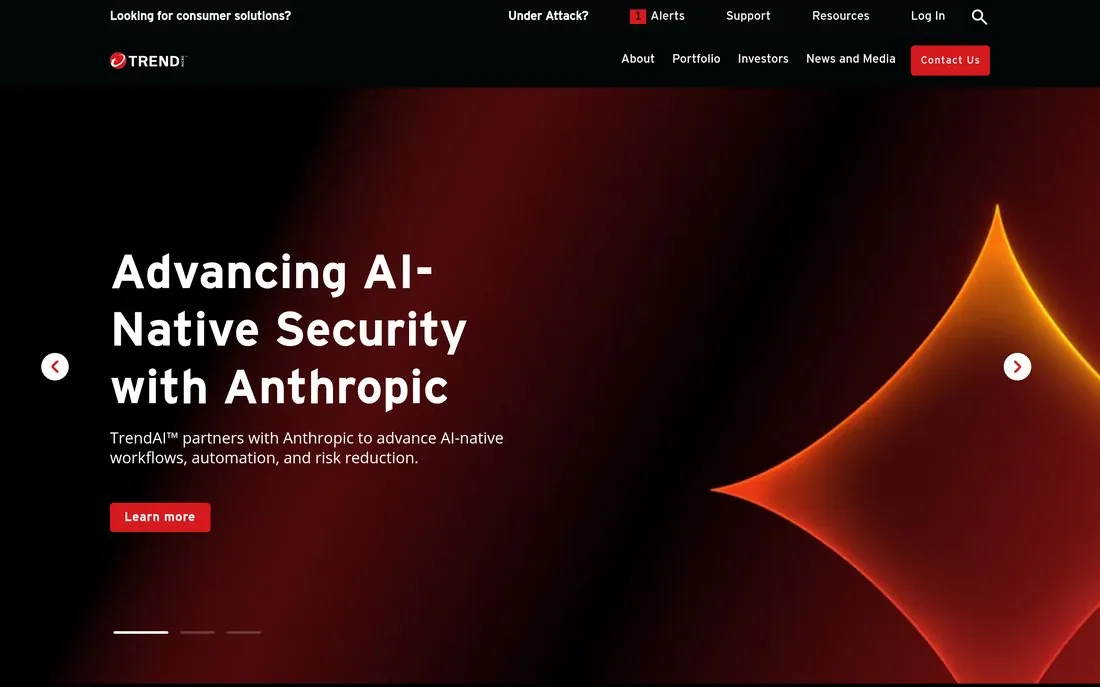
Trend Micro has been in this industry since 1988 and has aged better than most of its contemporaries, largely because it moved early and seriously into cloud workload protection. Cloud One and the Vision One platform are strong where it counts for a modern estate: servers, containers, Kubernetes and hybrid infrastructure that spans a data centre and two clouds. The Zero Day Initiative, which Trend Micro runs, is also one of the largest vulnerability bounty programmes in the world and feeds real research back into the products. On pure endpoint against CrowdStrike or SentinelOne it is competitive rather than leading; on server and cloud workloads it is frequently the better engineered choice.
Global Enterprise AI Cybersecurity Platform
How Trend Micro describes itself on trendmicro.com, September 2026
Strengths
- Excellent server, container and hybrid cloud workload protection
- Zero Day Initiative gives it genuine original vulnerability research
- Nearly four decades of continuity and a stable roadmap
Watch out for
- Endpoint protection is good but not class-leading
- The platform sprawls, and product boundaries are not always obvious
Standout: Vision One, Cloud One and the Zero Day Initiative · Typical cost: $$ to $$$ by workload
12. Carbon Black (Broadcom)
Website: carbonblack.com
Best for: Organisations already committed to Broadcom or Symantec that want deep endpoint telemetry
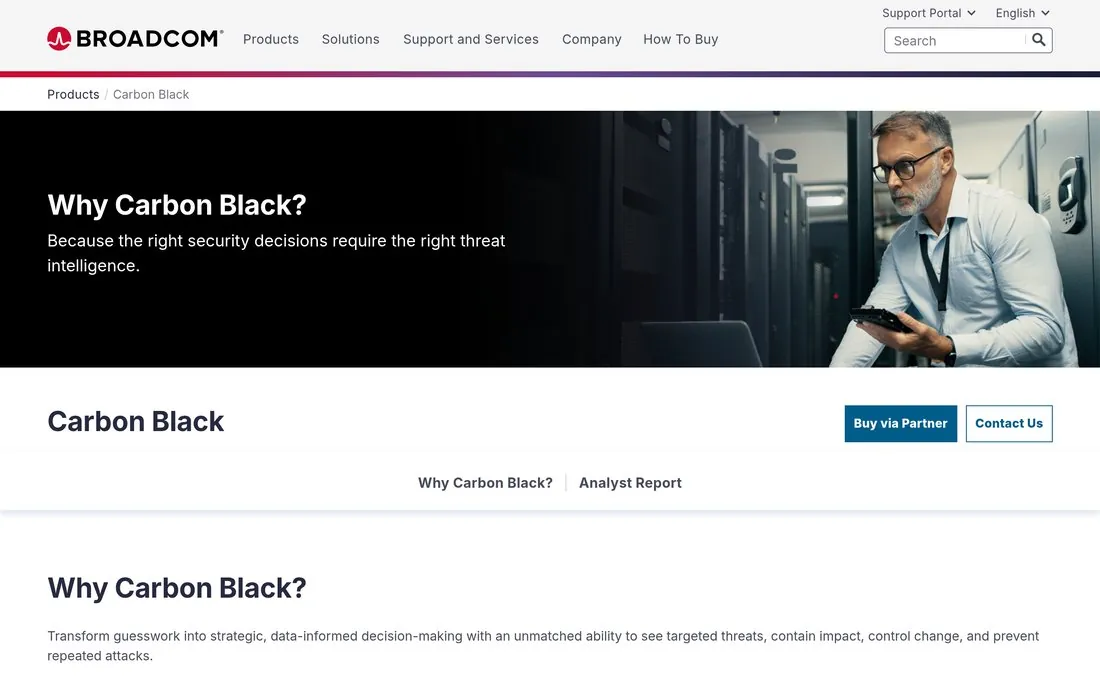
Carbon Black earned its reputation on recording everything: unusually deep endpoint telemetry and the ability to reconstruct exactly what a process did, which threat hunters and incident responders valued highly. Its ownership history is the cautionary tale of this entire article. VMware bought it in October 2019 for $2.1 billion, Broadcom bought VMware in November 2023 for $69 billion, and in March 2024 Broadcom merged the Carbon Black assets with Symantec to form its Enterprise Security Group. Today carbonblack.com simply redirects to a Broadcom product page. The technology is still capable, but this is now a business unit inside a very large conglomerate, and buyers consistently report that support and roadmap clarity have suffered. Ask hard questions about both before signing.
Why Carbon Black?
How Carbon Black (Broadcom) describes itself on carbonblack.com, September 2026
Strengths
- Exceptionally deep endpoint telemetry for threat hunting and forensics
- Makes sense if you are already standardised on Broadcom or Symantec
Watch out for
- Three owners in six years, and the brand no longer has its own website
- Widely reported decline in support quality and roadmap transparency since the Broadcom acquisition
- No longer a serious contender for a greenfield endpoint purchase
Standout: Deep process-level endpoint telemetry · Typical cost: $$ to $$$, bundled into Broadcom agreements
13. Mandiant (Google Cloud)
Website: mandiant.com
Best for: Organisations in the middle of a serious breach, or preparing for a nation-state threat model
When a major breach becomes public, Mandiant is very often the name in the press release. Google completed its $5.4 billion acquisition on 12 September 2022 and, unusually for a deal that size, kept the brand intact as a Google Cloud subsidiary; mandiant.com now resolves to a Google Cloud page. What you buy from Mandiant is people and intelligence rather than a product: incident response, threat intelligence, red teaming and adversary emulation performed by people who spend their working lives inside real nation-state intrusions. It is the most expensive option on this list by a wide margin and it is not a day-to-day security programme. Buy an incident response retainer before you need it, because rates and availability during an active incident are a different conversation entirely.
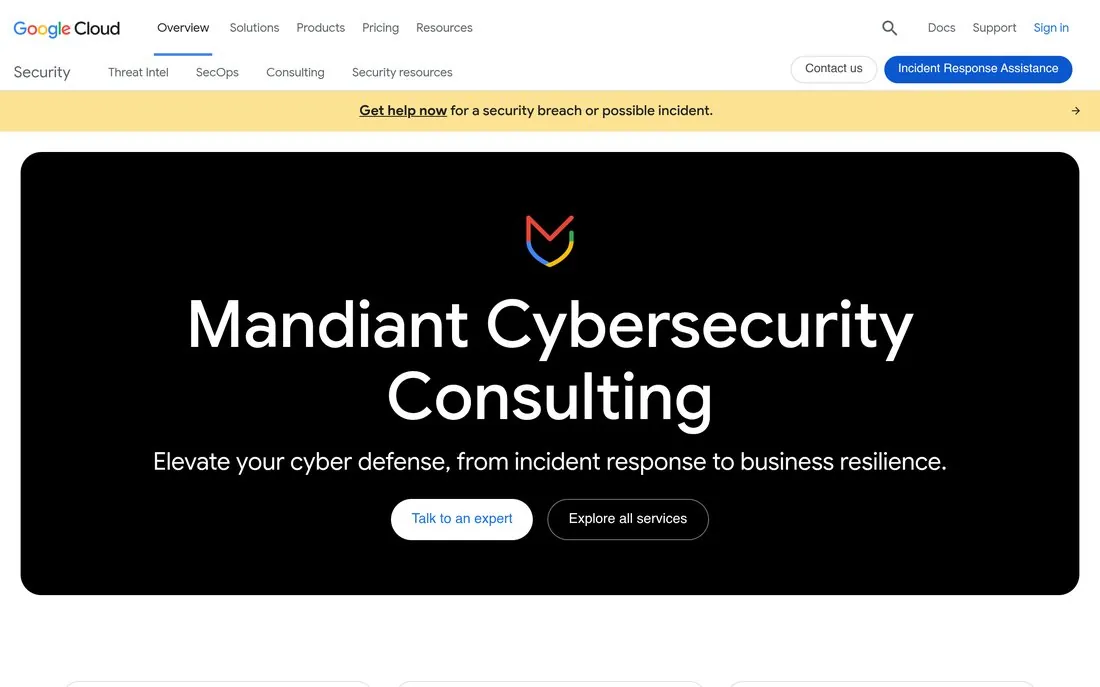
Mandiant Cybersecurity Consulting
How Mandiant (Google Cloud) describes itself on mandiant.com, September 2026
Strengths
- The most respected incident response practice in the industry
- Threat intelligence drawn from genuine frontline nation-state investigations
- Google Cloud backing gives it scale and staying power
Watch out for
- Premium pricing that puts it out of reach for most mid-market budgets
- Consulting and IR only; there is no product here to run day to day
Standout: Incident response, threat intelligence and red teaming · Typical cost: $$$$ project and retainer based
14. Expel
Website: expel.com
Best for: Teams that want MDR but refuse to give up visibility into why an analyst made a decision
Expel is the transparency argument in managed detection made into a company. Most MDR providers operate as a black box: an alert goes in, a verdict comes out, and the reasoning stays with the vendor. Expel deliberately exposes the work, showing customers the investigative steps and the decision path behind each conclusion, which makes it the natural choice for a security team that wants leverage rather than replacement. Like Arctic Wolf it works on top of the tools you already own rather than requiring its own agent, and it has been notably early in publishing about how it applies automation to triage. It is a service, not a platform, and it is priced as one.
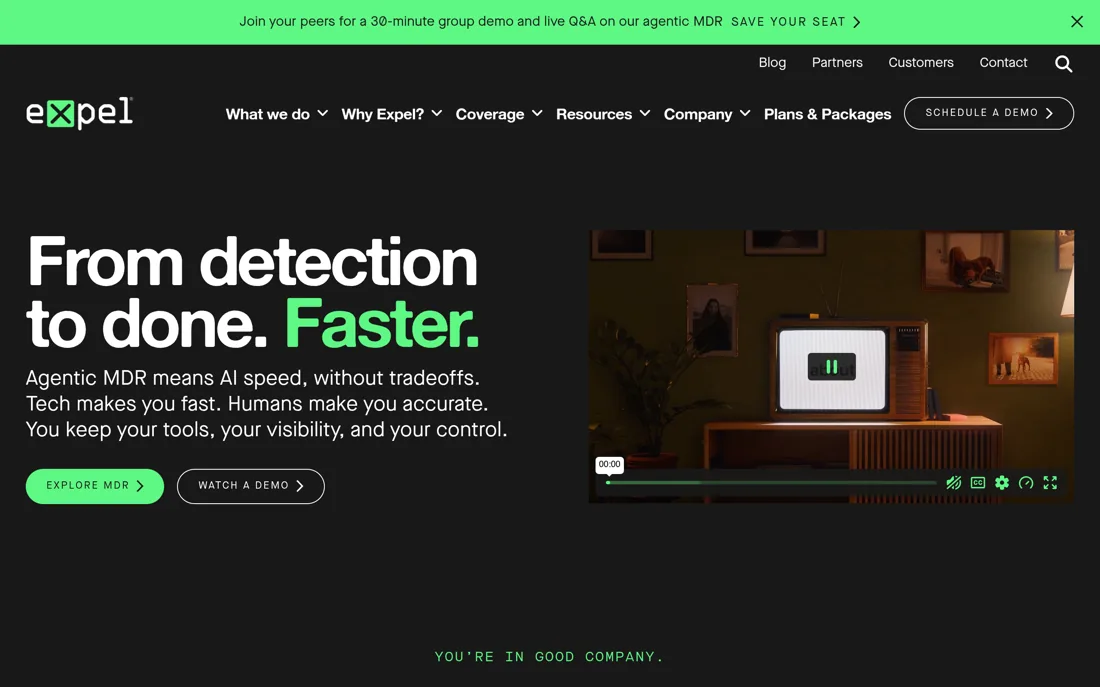
From detection to done. Faster.
How Expel describes itself on expel.com, September 2026
Strengths
- Shows its investigative reasoning instead of returning a black-box verdict
- Sits on top of your existing tools, so no rip-and-replace
- Strong fit for an existing small security team that needs 24/7 cover
Watch out for
- Costs more than the budget end of the MDR market
- No product of its own, so coverage depends on the quality of your existing tooling
Standout: Transparent analyst workflow and Workbench · Typical cost: $$$ annual subscription
15. Huntress
Website: huntress.com
Best for: Small businesses and the IT providers that serve them, at a price that actually fits
Huntress built its business on a observation the rest of the industry was slow to act on: attackers establish persistence on small-business networks and nobody is looking. It started by hunting footholds specifically, then added managed EDR, Microsoft 365 identity protection and security awareness training. The human element is the differentiator at this price point, because a real analyst reviews detections and writes the remediation steps in language an IT generalist can follow. It is deliberately not an enterprise platform and does not pretend to be. For a fifty-person company or the managed service provider looking after thirty of them, it is arguably the best value on this entire list.
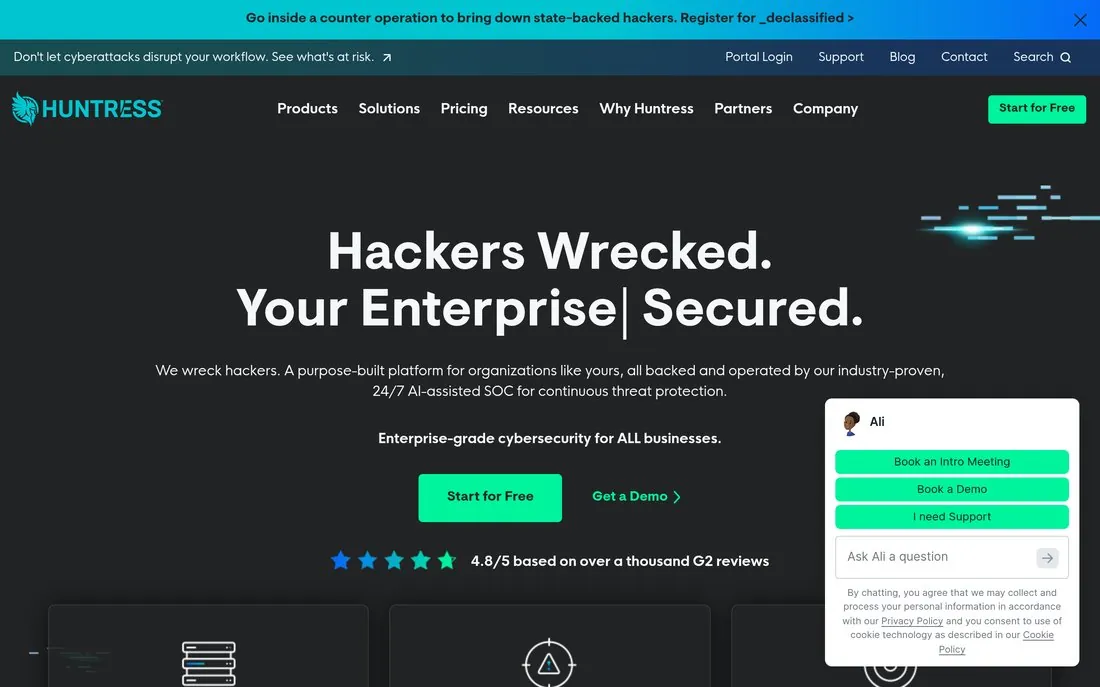
Wrecking Hackers 24/7
How Huntress describes itself on huntress.com, September 2026
Strengths
- Genuine 24/7 human analyst review at small-business pricing
- Remediation instructions written for IT generalists, not security specialists
- Excellent Microsoft 365 identity coverage, where most SMB compromises now start
Watch out for
- Not built for enterprise scale or complexity
- Narrower coverage than a full platform; it is a layer, not the whole programme
Standout: Managed EDR and Microsoft 365 identity threat detection · Typical cost: $ per endpoint, per month
Quick Reference
Computer Security Companies: Side-by-Side Comparison
| Company | Best For | Primary Focus | Key Strength | Remediation | Size Fit |
|---|---|---|---|---|---|
| Atlant Security | SMBs & SaaS | Consulting + Assessment | Vendor-neutral, hands-on | ✓ Included | SMB - Mid |
| CrowdStrike | Endpoint / EDR | Cloud-native EDR/XDR | OverWatch threat hunting | ✓ Platform | Mid - Enterprise |
| SentinelOne | Autonomous EDR | AI-driven endpoint | Automated response & rollback | ✓ Automated | SMB - Enterprise |
| Palo Alto Networks | Enterprise Platform | Network + Cloud + Endpoint | Unit 42, vendor consolidation | Consulting | Mid - Enterprise |
| Rapid7 | Vuln Mgmt + MDR | Detection + Vulnerability | Metasploit, InsightVM | ✓ Platform | SMB - Enterprise |
| Arctic Wolf | Outsourced SOC | Concierge Security Ops | Dedicated CST per client | ✓ Managed | SMB - Mid |
| Sophos | SMB Protection | Endpoint + Firewall sync | Adaptive security ecosystem | ✓ MDR | SMB - Mid |
| Fortinet | Network Security | Security Fabric platform | ASIC performance, value | FortiGuard | SMB - Enterprise |
| Check Point | Prevention-First | Unified Infinity platform | ThreatCloud AI engine | Advisory | Mid - Enterprise |
| Bitdefender | Best-Value EPP | GravityZone endpoint | Top independent test scores | ✓ MDR | SMB - Enterprise |
| Mandiant (Google) | Incident Response | IR + Threat Intel | Frontline breach expertise | ✓ Full IR | Mid - Enterprise |
| Huntress | SMB / MSP | Managed EDR for SMBs | Human-powered SOC, affordable | ✓ Managed | SMB |
Table shows a representative subset. For detailed pricing, see the pricing section below.
Who Actually Owns Your Security Vendor?
This is the question almost nobody asks during a procurement process, and it is the one that most often explains why a product that demoed brilliantly is disappointing eighteen months later. This market has consolidated hard, and a meaningful share of the products on any 2026 shortlist are now business units inside much larger companies that bought them for reasons having little to do with your use case.
Carbon Black is the clearest example. It was an excellent independent endpoint company, then VMware bought it in October 2019 for $2.1 billion, then Broadcom bought VMware in November 2023 for $69 billion, and in March 2024 Broadcom folded the Carbon Black assets into the Symantec Enterprise Security Group. The technology did not get worse overnight, but the roadmap stopped being about Carbon Black customers and the brand lost its own website: carbonblack.com now redirects to a Broadcom product page. Secureworks went the same way in February 2025, and Mandiant was absorbed by Google Cloud in September 2022, though in that case the brand and the practice survived largely intact.
None of this makes an acquired product a bad purchase. Sophos is demonstrably stronger for having bought Secureworks, and Mandiant under Google has more resources than it had as a public company. The point is to ask three specific questions before you sign: who owns the roadmap for this product today, what happens to my support tier once the integration completes, and what is the renewal price in year three rather than the discounted year-one figure. A vendor that answers those three cleanly is a safer bet than one with a marginally better detection rate.
Evaluation Framework
How to Choose a Computer Security Company: The 8-Point Framework
Use this framework to objectively score and compare computer security companies. Rate each provider on a 1-5 scale for each criterion. A provider scoring below 30 out of 40 should raise questions.
| # | Criterion | What to Look For | Red Flag |
|---|---|---|---|
| 1 | Methodology & Approach | Documented security methodology. Do they assess before recommending? Architecture-first vs. product-first thinking | Jumps straight to product recommendations without understanding your environment |
| 2 | Service Scope | Covers endpoints, networks, cloud, identity, and data. Can deliver assessment, implementation, and monitoring | Only sells one product category and tries to make every problem fit their solution |
| 3 | Industry Expertise | Track record in your industry with knowledge of relevant threats, regulations, and compliance requirements | No references or case studies in your sector |
| 4 | Team Seniority | Senior engineers with certifications (CISSP, OSCP, CISM) doing the actual work, not just selling | Senior people sell the deal, then juniors deliver. Bait-and-switch staffing |
| 5 | Pricing Model | Clear, scoped pricing. Fixed-price or transparent per-endpoint/per-seat models with no surprise overages | Vague pricing, open-ended T&M billing, hidden fees for essential features |
| 6 | Remediation Support | Help fixing the issues they find, not just listing them. Hands-on implementation and verification | Hands you a report and disappears. Remediation is a separate, expensive engagement |
| 7 | Reporting Quality | Actionable findings with business context, risk ratings, and prioritized remediation. Executive summaries for leadership | Generic reports with scanner output pasted in, no business context or prioritization |
| 8 | References & Track Record | Willingness to provide client references, case studies, and measurable outcome data | Refuses references, no case studies, claims everything is “confidential” |
Scoring Guide
35-40: Excellent fit - strong across all dimensions. 28-34: Good fit - minor gaps that may be acceptable. 20-27: Proceed with caution - significant gaps in key areas. Below 20: Not recommended - too many critical weaknesses.
Pricing Guide
Computer Security Company Pricing Guide for 2026
Computer security pricing varies significantly based on service type, company size, and scope. Here’s what the market looks like:
| Service Type | Small Business (1-50) | Mid-Market (50-500) | Enterprise (500+) |
|---|---|---|---|
| Security Assessment / Audit | $5,000 - $15,000 | $15,000 - $50,000 | $50,000 - $150,000+ |
| Managed EDR / Endpoint Protection | $3 - $12 /endpoint/mo | $5 - $18 /endpoint/mo | Custom (volume pricing) |
| Managed Detection & Response (MDR) | $2,000 - $8,000/mo | $5,000 - $25,000/mo | $15,000 - $75,000+/mo |
| Penetration Testing | $5,000 - $15,000 | $10,000 - $40,000 | $25,000 - $100,000+ |
| Incident Response Retainer | $2,000 - $5,000/mo | $5,000 - $15,000/mo | $10,000 - $50,000+/mo |
| vCISO Services | $3,000 - $8,000/mo | $8,000 - $20,000/mo | $15,000 - $30,000+/mo |
What Drives the Price Up?
- Number of endpoints, locations, and cloud environments in scope
- 24/7 monitoring and response requirements vs. business-hours coverage
- Manual penetration testing vs. automated-only scanning
- Compliance requirements (SOC 2, HIPAA, PCI DSS, CMMC) adding audit scope
- Incident response retainer hours and guaranteed response SLAs
- Executive and board-level reporting requirements
For detailed cost benchmarks, read our guide on how much cybersecurity assessments cost. Atlant Security offers a free initial security assessment to help you understand your baseline before committing to a larger engagement.
Due Diligence
15 Questions to Ask Before Hiring a Computer Security Company
These questions separate serious computer security companies from firms selling you products you don’t need. Ask all of them. A quality provider will answer every one directly.
1. Do you assess before you recommend?
A good computer security company evaluates your environment first. If they prescribe solutions before understanding your architecture, they’re selling, not consulting.
2. Who will actually do the work?
Understand their seniority, certifications (CISSP, OSCP, CISM), and whether the people on the sales call are the people delivering the engagement.
3. Are you vendor-neutral?
Do they earn commissions on product sales? A vendor-neutral provider recommends the best tools for your needs, not the ones that pay them the most.
4. What does your assessment cover?
Endpoints, network, cloud, identity, data, policies? Get a detailed scope. What’s tested, what’s excluded, and what triggers scope changes?
5. Do you provide remediation support?
Finding problems is half the job. Do they help you fix vulnerabilities, implement controls, and verify the fixes work?
6. What is your incident response capability?
Can they respond to a breach? What’s their SLA? Do they offer retainer-based IR or only ad-hoc engagement?
7. Can I see a sample report or deliverable?
Evaluates report quality, depth of findings, and whether they provide actionable remediation steps with business context.
8. How do you handle our sensitive data?
The provider will access your systems. What are their data handling, NDA, and internal security practices?
9. What’s the timeline from kickoff to delivery?
Get specific milestones. Vague timelines signal capacity problems or poor project management.
10. Can I speak with recent clients?
Refusal is a major red flag. Ask references about quality of work, timeline accuracy, and communication.
11. How do you prioritize findings?
CVSS scores alone aren’t enough. Do they factor in business context, exploitability, and actual impact on your operations?
12. What compliance frameworks do you support?
SOC 2, ISO 27001, HIPAA, PCI DSS, CMMC, NIST-ensure they have experience with frameworks relevant to your industry.
13. Do you carry professional liability insurance?
Protects your organization if the provider causes a system outage or misses a critical vulnerability during testing.
14. How do you measure success?
What KPIs or metrics do they track? Risk reduction over time, mean time to detect/respond, vulnerability closure rate?
15. What happens after the engagement ends?
Is there ongoing support? Periodic reassessment? Knowledge transfer? Or is it a one-and-done report?
Frequently Asked Questions
Computer Security Services: What a Provider Actually Delivers
"Computer security services" covers everything from installing antivirus to running a 24/7 security operations centre. When you compare computer security companies, ask which of these six services are included, which are extra, and who is accountable for each.
- Endpoint protection and response. The agent on every laptop and server, plus someone watching what it reports. Sold by CrowdStrike, SentinelOne, Sophos, Bitdefender and Huntress; monitored by Arctic Wolf, Secureworks and the MDR arms of the vendors.
- Network and perimeter security. Firewalls, secure access and DNS filtering from Fortinet, Palo Alto Networks and Check Point.
- Vulnerability management and testing. Continuous scanning from Rapid7 and Trend Micro, and manual penetration testing that finds what scanners miss.
- Security audits and compliance. An independent IT security audit, then SOC 2, ISO 27001 or HIPAA readiness.
- Incident response. Containment, forensics and recovery when something goes wrong; Mandiant at the top end, Atlant Security for companies under 2,000 staff.
- Security leadership. A virtual CISO who owns the programme and the vendors above.
Computer Security Solutions vs Computer Security Services
The words get used interchangeably in marketing copy, and the distinction costs companies real money. A solution is a thing you buy and then own the problem of running: a firewall, an EDR agent, a backup platform, an email gateway. A service is an outcome somebody else is accountable for: a monitored SOC, an audit that ends with a fixed plan, a vCISO who owns your roadmap. Solutions have licence costs. Services have accountability. If you are buying the service kind, our managed security services site lists what that accountability has to cover: ownership of each platform, onboarding, monitoring coverage and who may act on an alert.
The service side of that distinction has its own guide: what a managed security service provider is, including how MSSPs price and 35 providers compared.
The failure pattern is buying solutions when you needed services. A company with no security staff buys a well-reviewed EDR platform, deploys it, and then nobody logs into the console. Eleven months later the renewal arrives and the honest answer to “what did this catch?” is that nobody knows. The tool was never the missing piece. The missing piece was a person whose job was to read what the tool said. That is why the MDR market exists, and why it has grown faster than the product market it sits on top of.
The reverse mistake is rarer but more expensive: buying services to compensate for genuinely missing infrastructure. No amount of monitoring fixes an estate with no multi-factor authentication, unpatched internet-facing servers and shared administrator passwords. A good provider will tell you to fix those first and will decline to sell you monitoring until you have. If a supplier quotes an MDR subscription without asking what your identity and patching baseline looks like, that tells you what kind of company they are.
Practical rule: buy the assessment first. It is the cheapest line item on the pricing ladder, it is the only purchase that tells you which of the other two you actually need, and a good one pays for itself by preventing a six-figure licence commitment to the wrong category. Our fixed-price IT security audit exists precisely to answer that question before you spend.
Computer Security Companies Near Me: Local vs Remote
“Computer security companies near me” is one of the most common searches in this market, and the honest answer in 2026 is that proximity matters for less than most buyers assume, but it does not matter for nothing.
Almost all of the work is remote now. Configuration review, cloud posture assessment, identity hardening, policy work, detection engineering and incident response are all done over a screen share and an API connection. The best consultant for your Microsoft 365 tenant is the one who has hardened four hundred of them, not the one whose office is twenty minutes away. Restricting a shortlist to a single metro area usually means trading expertise for a drive time you will use twice.
Location does still matter in four specific cases. Physical assessments, including badge cloning, server room access and social engineering at the front desk, need somebody in the building. OT and industrial environments often require on-site work because the equipment is not reachable any other way. Data residency and legal jurisdiction can force a choice: a European company handling EU personal data has a defensible reason to prefer an EU-based supplier, which is part of why Bitdefender appears on this list. And time zone overlap matters enormously for incident response, though that argues for a compatible working day rather than a nearby postcode.
A reasonable approach: search nationally for expertise, then filter for a supplier whose working hours overlap yours by at least four hours, who can put someone on a plane if an incident requires it, and who is contractually in a jurisdiction your legal team is comfortable with. Atlant Security works remotely with clients across 14 countries and travels on site when the engagement genuinely needs it.
Computer Security Consultant vs Computer Security Company
An independent consultant is one person. A company is a team with process, cover and a balance sheet. Both are legitimate purchases, and they fail in different ways.
The individual consultant gives you exactly the person you evaluated. There is no bait and switch, no junior being trained on your estate, and rates are typically lower because there is no overhead to carry. For a bounded piece of expert work, a cloud architecture review, a threat model, a board presentation, an independent second opinion on a vendor selection, this is frequently the better value. The risks are equally clear: one person gets sick, takes holidays, and cannot cover an incident at 3am. They may also carry no professional indemnity insurance, which matters more than it sounds if the advice turns out to be wrong.
A company gives you continuity, a named escalation path, insurance, and the ability to put more than one skill set on a problem. It also gives you the thing buyers complain about most: the senior engineer who sold the work is not always the engineer who does it. That is why the scorecard above weights “named senior engineer” at fifteen per cent. Ask, in writing, who will be on your engagement and what share of their time you are buying.
The useful middle ground is a small senior firm: enough people for cover and insurance, few enough that the person who scoped the work is the person who does it. That is the model Atlant Security runs, and it is worth asking any shortlisted supplier directly which of the three they are. Our guide to hiring a computer security consultant goes into the scoping detail further.
FAQ: Computer Security Companies
What does a computer security company do?
A computer security company protects your digital infrastructure-endpoints, networks, servers, cloud environments, and data-from cyber threats. Services range from security assessments and vulnerability assessments to managed detection and response, incident response, endpoint protection deployment, and strategic consulting via vCISO services.
How much does it cost to hire a computer security company?
Costs vary widely. A one-time security assessment may cost $5,000-$50,000 depending on scope. Managed endpoint protection runs $3-$18 per endpoint per month. Managed detection and response (MDR) ranges from $2,000 to $75,000+ per month depending on company size. See our pricing guide for detailed benchmarks.
What is the difference between a computer security company and an MSSP?
A computer security company is a broad category that includes firms offering assessment, consulting, implementation, and managed services. An MSSP (Managed Security Service Provider) specifically focuses on outsourced monitoring and management of security technologies. Many computer security companies offer MSSP-like managed services alongside consulting, but not all MSSPs provide the strategic consulting and architecture expertise that a full-service computer security company does.
Should I buy security tools first or hire a consultant?
Always hire a consultant first. A security assessment reveals what you actually need before you spend money. Many companies waste thousands on tools that don’t address their real vulnerabilities because they bought based on marketing rather than their actual architecture and risk profile.
What certifications should a computer security company have?
Look for individual certifications like CISSP, OSCP, CISM, CEH, and CISA on the team doing the actual work. At the company level, look for ISO 27001 certification, SOC 2 compliance, and relevant vendor certifications. More importantly, ask for case studies and real-world outcomes-certifications indicate knowledge, but results indicate capability.
Do small businesses need a computer security company?
Yes. Small businesses are disproportionately targeted because they typically have weaker defenses. A computer security company helps small businesses identify critical vulnerabilities and focus limited budgets on controls that matter most. Many providers like Atlant Security and Huntress offer services specifically scaled for small business needs and budgets.
What is the difference between computer security and cybersecurity?
The terms are largely interchangeable in modern usage. Computer security traditionally focused on protecting individual systems and endpoints, while cybersecurity encompasses the broader landscape including networks, cloud infrastructure, data, identity, and organizational processes. Today, most “computer security companies” provide the full spectrum of cybersecurity services.
How often should we engage a computer security company?
At minimum, conduct a comprehensive security audit annually. You should also engage after major infrastructure changes (cloud migrations, mergers, new applications), before pursuing compliance certifications, and immediately after any security incident. Many organizations maintain ongoing relationships through managed services, vCISO retainers, or quarterly assessments.
Need a Computer Security Partner That Goes Beyond Products?
Atlant Security delivers comprehensive computer security consulting with remediation built in. We don’t just find problems-we fix them. Vendor-neutral, architecture-first. Start with a free security assessment to see where you stand.
Author: Alexander Sverdlov, CISSP, Founder and Principal Security Consultant
This article is for informational purposes only. While Atlant Security is a computer security provider and is included in this list, all companies are evaluated based on publicly available information and industry reputation. Organizations should conduct their own due diligence when selecting a security partner. Company details reflect publicly available information at time of publication and may have changed.
Related services from Atlant Security: IT Security Audit, Virtual CISO, All Services. Book a discovery call to discuss your specific situation.
This comparison is deliberately short. For the long version, the cybersecurity company directory filters by category, location and credentials.
