
SOC 2 is one of the most requested security attestations I run into during sales-driven security work, and it is also one of the most misunderstood. Founders hear "we need SOC 2" from a prospect, panic, and start buying tools before anyone has defined what data they hold, where it lives, or what they are actually promising customers. That order of operations is backwards, and it is why so many first attempts drag on for a year and still surface findings.
I have led SOC 2 readiness work for SaaS and fintech teams as part of more than 200 security assessments since 2013. This guide lays out the best practices that actually move you toward a clean report: how the framework is structured, the controls auditors expect to see evidence for, and the sequence that gets you there without wasting money. No sales theatre, just the work.
What SOC 2 Actually Is
SOC 2 (System and Organization Controls 2) is an attestation framework maintained by the American Institute of Certified Public Accountants (AICPA). A licensed CPA firm examines your controls against the Trust Services Criteria and issues a report describing what they found. It is not a pass/fail certificate like ISO 27001, and there is no "SOC 2 certified" stamp. There is an opinion, and there may be exceptions noted in it.
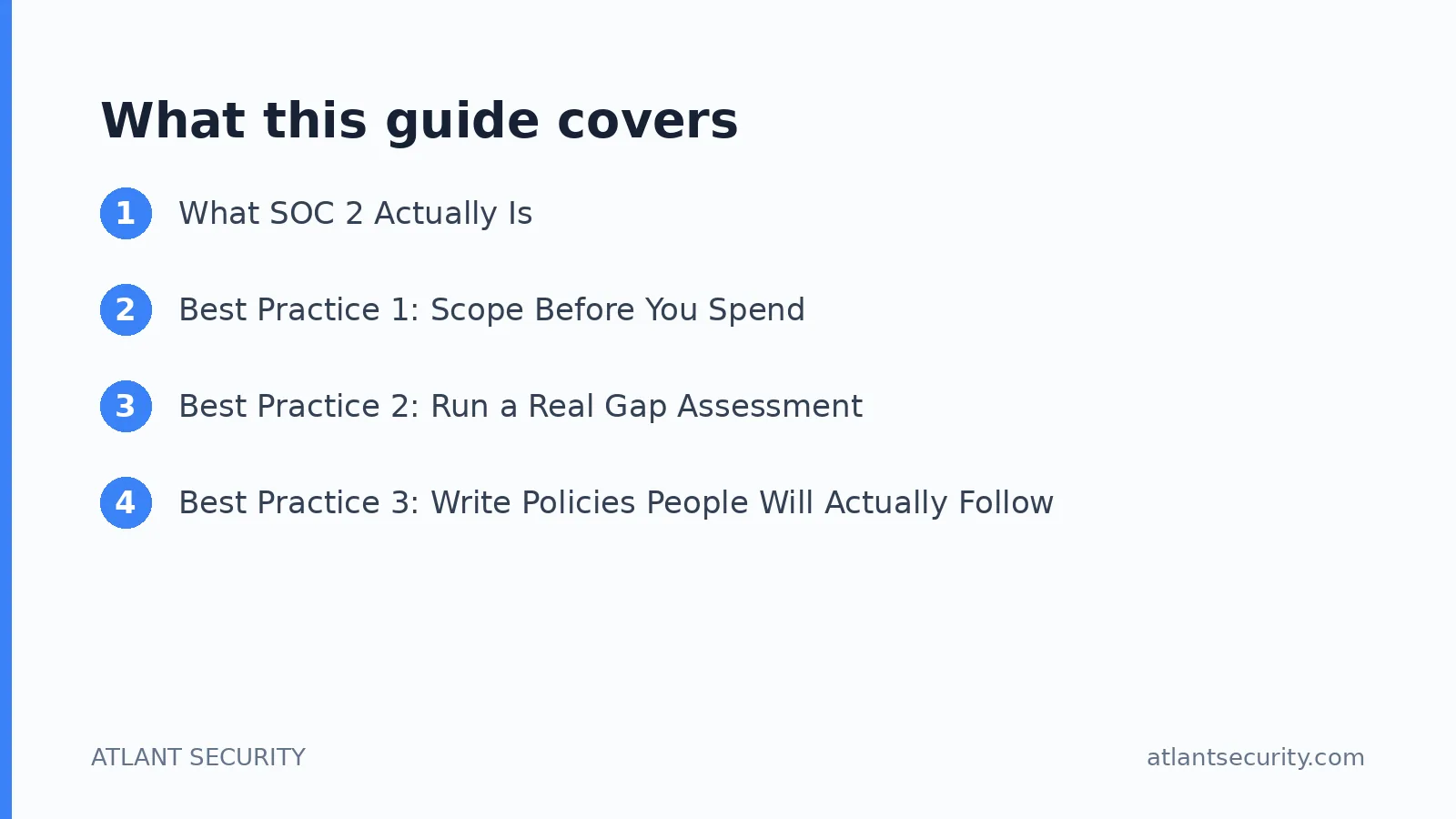
The Trust Services Criteria cover five categories:
- Security (the common criteria, mandatory in every report): protection against unauthorized access.
- Availability: the system is up and reachable as committed.
- Processing Integrity: processing is complete, valid, accurate, and timely.
- Confidentiality: information designated confidential is protected.
- Privacy: personal information is handled per your privacy notice.
Only Security is required. You add the others based on what you promise customers. A pure infrastructure product with an uptime SLA usually adds Availability; a company processing regulated personal data may add Confidentiality and Privacy. Do not scope in criteria you cannot support with evidence, because every criterion you claim is something the auditor will test.
Type I versus Type II
A Type I report describes your controls at a single point in time. A Type II report tests whether those controls operated effectively over a period, usually three to twelve months. Enterprise buyers almost always want Type II. A common, sensible path is to get a Type I to prove design, then run a Type II observation window of six months. If a large deal is already on the table, ask the prospect which report they will accept before you spend anything.
Best Practice 1: Scope Before You Spend
The single most expensive mistake in SOC 2 is over-scoping. Every system in scope adds evidence collection, monitoring, and audit hours. Draw a clear boundary around the systems that store, process, or transmit customer data, and the infrastructure that supports them. Everything outside that boundary should be explicitly out of scope and documented as such.
Practical steps:
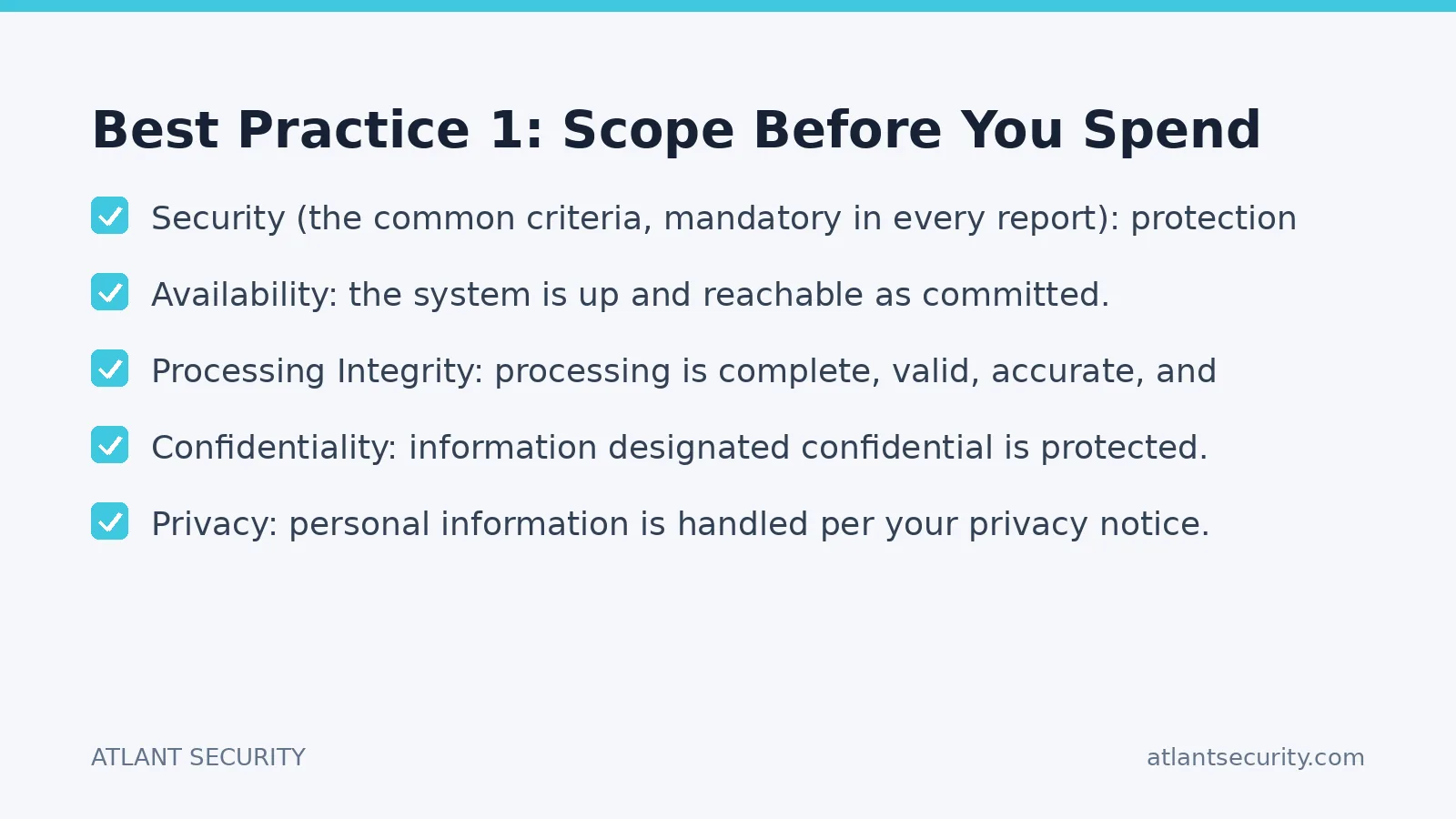
- Inventory every system that touches customer data, including third-party subprocessors.
- Decide which Trust Services Criteria apply based on your customer commitments, not on what sounds impressive.
- Document the system description: what the service does, its boundaries, and the components involved. The auditor relies on this heavily.
- Confirm the report type your buyers require before committing to a timeline.
If you are unsure how to draw the boundary, a structured SOC 2 readiness engagement will define scope for you before any money goes to tooling or an auditor.
Best Practice 2: Run a Real Gap Assessment
Before you touch a compliance automation platform, map your current controls against the criteria you have scoped. A gap assessment tells you what already exists, what needs formalizing, and what is genuinely missing. Most teams discover that they are doing plenty of the right things but have no documentation or evidence to prove it, which is what SOC 2 is really testing.
A useful gap assessment produces a prioritized remediation list: control area, current state, required state, owner, and target date. Focus first on the controls that are both high risk and completely absent, such as missing multi-factor authentication on administrative accounts or no formal access review process.
This is also where a technical security audit earns its keep, because an auditor will test whether controls actually work, not just whether a policy says they should. Finding a broken control yourself is far cheaper than having it appear as an exception in your report.
Best Practice 3: Write Policies People Will Actually Follow
SOC 2 requires a set of documented policies: information security, access control, change management, incident response, vendor management, risk assessment, and business continuity, among others. The trap here is downloading generic templates that describe controls you do not operate. Auditors test against what your policies claim, so a policy promising quarterly access reviews you never perform creates an exception you would not otherwise have had.
Write policies that match reality, then improve reality where it falls short. Assign a named owner to each policy. Get leadership to formally approve them, because board-level or executive ownership of the security program is itself a criterion auditors look for.
Best Practice 4: Implement the Controls Auditors Test
Across SOC 2 engagements, the same technical controls come up again and again. These are the ones worth getting right early:
- Multi-factor authentication on all user and administrative access, especially to cloud consoles, source control, and production systems.
- Least-privilege access with documented onboarding and offboarding. Terminated accounts must be disabled promptly, and you need evidence of it.
- Encryption of data in transit (TLS) and at rest, using your cloud provider's managed keys where reasonable.
- Change management: code changes go through review and approval before reaching production, with an audit trail.
- Logging and monitoring: security-relevant events are collected, retained, and reviewed, with alerting on suspicious activity.
- Vulnerability management: regular scanning and a defined remediation timeline by severity.
- Endpoint protection on company devices that access production or customer data.
You do not need enterprise-priced tooling to satisfy these. Native cloud controls, a reputable password manager, an SSO provider, and disciplined process cover most of it for a small team. If your product runs in AWS, Azure, or Google Cloud, a cloud security review will tell you which native controls already give you the evidence and which gaps need closing.
Best Practice 5: Train People and Manage Vendors
Security awareness training is a control, and auditors will ask for completion records. Run it at onboarding and at least annually, and keep the evidence. Phishing simulations are useful but not strictly required; consistent, documented training is.
Vendor management is frequently neglected and frequently flagged. You are responsible for the security of the subprocessors that handle your customers' data. Maintain a vendor inventory, collect their SOC 2 reports or equivalent assurances, and review critical vendors on a schedule. If a subprocessor cannot show you any security evidence, that is a risk you need to record and manage.
Best Practice 6: Prepare for the Observation Window
For a Type II report, the auditor tests whether your controls operated consistently across the observation period. This is where readiness and reality diverge. A control that worked the week before the audit but was skipped for two months in the middle produces an exception. The best practice is boringly simple: operate your controls consistently and capture evidence as you go, rather than reconstructing it under pressure.
Set recurring calendar reminders for the periodic controls: quarterly access reviews, periodic vulnerability scans, annual policy reviews, incident response tabletop exercises. Store evidence in one organized place. When the auditor requests a sample, you want to hand it over in minutes, not spend a week hunting for screenshots.
SOC 2 Readiness Timeline at a Glance
| Phase | Typical Duration | Main Output |
|---|---|---|
| Scoping and criteria selection | 1 to 2 weeks | System boundary and Trust Services Criteria in scope |
| Gap assessment | 2 to 4 weeks | Prioritized remediation plan |
| Remediation and policy work | 1 to 3 months | Controls implemented, policies approved |
| Type I examination | 2 to 4 weeks | Point-in-time report on control design |
| Type II observation window | 3 to 12 months | Consistent evidence of operating controls |
| Type II examination | 3 to 6 weeks | Report on operating effectiveness |
End to end, a well-run first SOC 2 Type II typically takes six to twelve months. Teams that already run mature engineering practices move through the front half quickly; the observation window is the part you cannot compress.
Common Mistakes That Cause Exceptions
- Over-scoping: claiming criteria you cannot support, which multiplies testing and findings.
- Policy and practice mismatch: documents that describe controls nobody actually runs.
- Inconsistent operation: controls that lapse during the observation window.
- Weak offboarding: departed employees whose access lingers, a favorite audit finding.
- Evidence chaos: no central, organized store, so audit season becomes a scramble.
- Ignoring vendors: no inventory and no review of subprocessors handling customer data.
Every one of these is avoidable with planning. None of them require a large budget. They require discipline and an honest picture of your current state, which is exactly what a good readiness process delivers.
Where a vCISO Fits
Most companies pursuing their first SOC 2 do not have a full-time security leader, and hiring one purely to run an attestation is hard to justify. This is where a virtual CISO makes sense: senior ownership of the program without a permanent executive salary. A vCISO scopes the report correctly, runs the gap assessment, owns the remediation plan, and manages the relationship with the auditor, so your engineering team is not pulled off product work to reinvent a process they have never run.
If you are staffing this yourself, that is fine too. The best practices above hold regardless of who executes them. The point is that SOC 2 is a project with a clear method, not a mystery you throw tools at.
Frequently Asked Questions
How long does SOC 2 take to achieve?
A first Type II report usually takes six to twelve months end to end. Scoping and remediation can move fast if your engineering practices are already solid, but the Type II observation window (commonly three to six months) is a fixed cost of time you cannot shortcut. A Type I, which tests design at a point in time, can be done in a couple of months.
What is the difference between SOC 2 Type I and Type II?
Type I describes whether your controls are designed appropriately at a single moment. Type II tests whether those controls actually operated effectively across a period, typically three to twelve months. Enterprise buyers almost always want Type II because it demonstrates sustained operation, not just good intentions on audit day.
Do I need all five Trust Services Criteria?
No. Only Security (the common criteria) is mandatory. You add Availability, Processing Integrity, Confidentiality, or Privacy based on the commitments you make to customers. Scoping in criteria you cannot support with evidence only increases testing and the chance of exceptions.
Is SOC 2 the same as ISO 27001?
No. SOC 2 is a US attestation report issued by a CPA firm, common in North American markets. ISO 27001 is an international certification of an information security management system. They share many underlying controls, so if you need both, plan them together to reuse evidence. If your buyers are US-based, start with SOC 2; if they are international, consider ISO 27001 readiness.
Can a small company realistically pass SOC 2?
Yes, and many do with lean teams. SOC 2 does not require expensive tooling; it requires clearly scoped controls, honest policies, and consistent evidence. Small teams often succeed faster than large ones because their systems are simpler and their scope is naturally tighter.
What causes most SOC 2 exceptions?
The frequent culprits are controls that lapsed during the observation window, access that was not removed when an employee left, and policies that describe practices the company never actually performed. All three come down to consistency and honest documentation rather than any technical shortfall.
Planning your first SOC 2? Atlant Security runs SOC 2 readiness end to end, led personally by a former Microsoft security consultant with 200+ assessments across 14 countries. We scope it correctly, close the gaps, and get you audit-ready without wasted spend. See our SOC 2 readiness service or book a strategy call for a fixed-price proposal.
