
Most Australian companies I meet do not chase SOC 2 because they love audits. They chase it because a deal is stuck. An enterprise buyer, usually in the United States, sent over a security questionnaire and then asked the one question that stops the sale: "Can you share your SOC 2 report?" If the answer is no, procurement quietly moves the shortlist along without you.
I have run more than 200 security assessments across 14 countries since 2013, and SOC 2 comes up in almost every SaaS, fintech, and B2B tech engagement. This article is not a set of glossy testimonials. It is an honest look at how SOC 2 actually creates commercial value, what a realistic program looks like, and the patterns I see separating the companies that win enterprise contracts from the ones that stall. No invented client names, no fabricated deal sizes, just the mechanics.
What SOC 2 Actually Is (and Is Not)
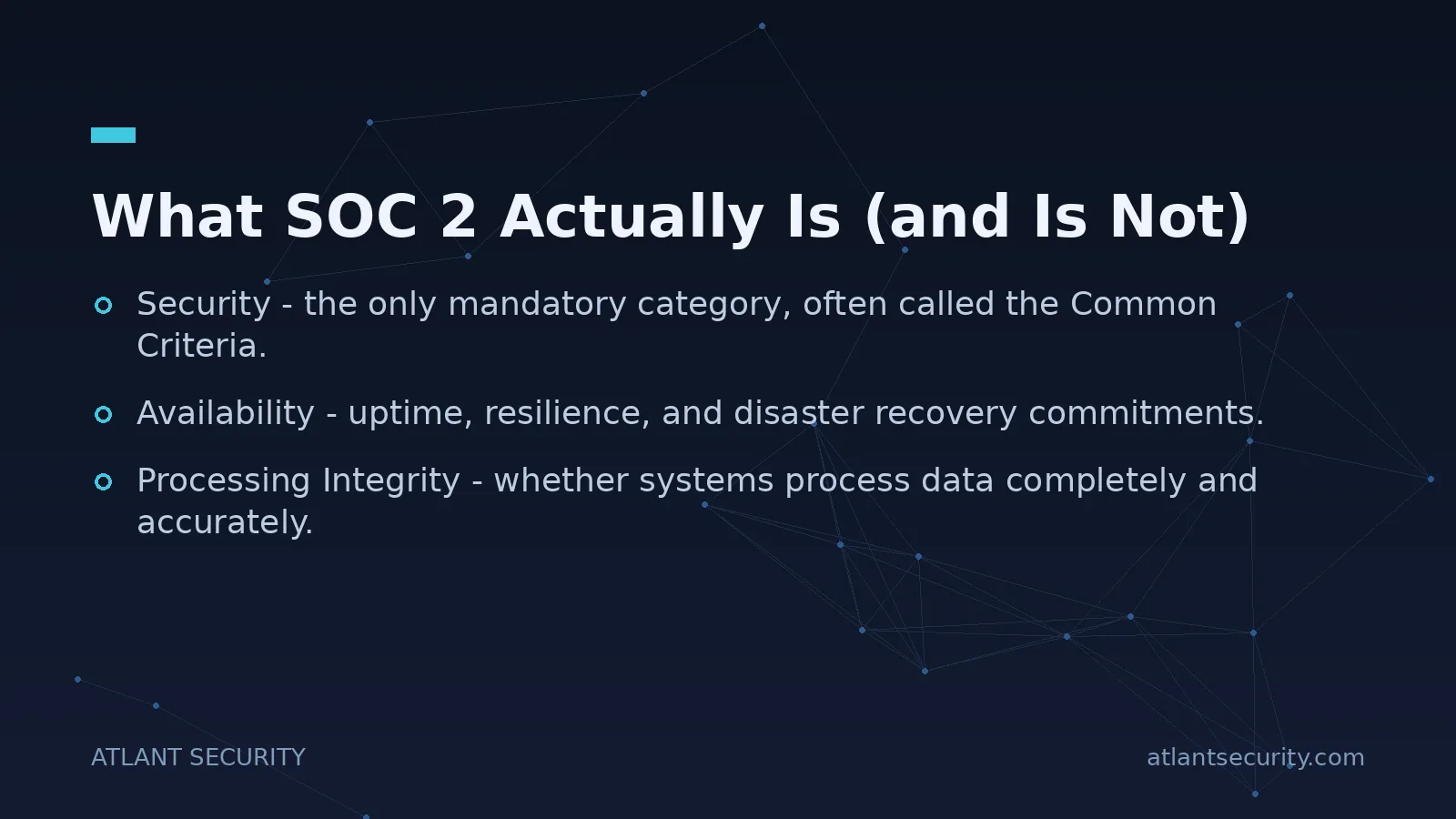
SOC 2 is an attestation report produced by a licensed CPA firm against the AICPA Trust Services Criteria. It evaluates the design and, in the case of Type II, the operating effectiveness of your controls across up to five categories:
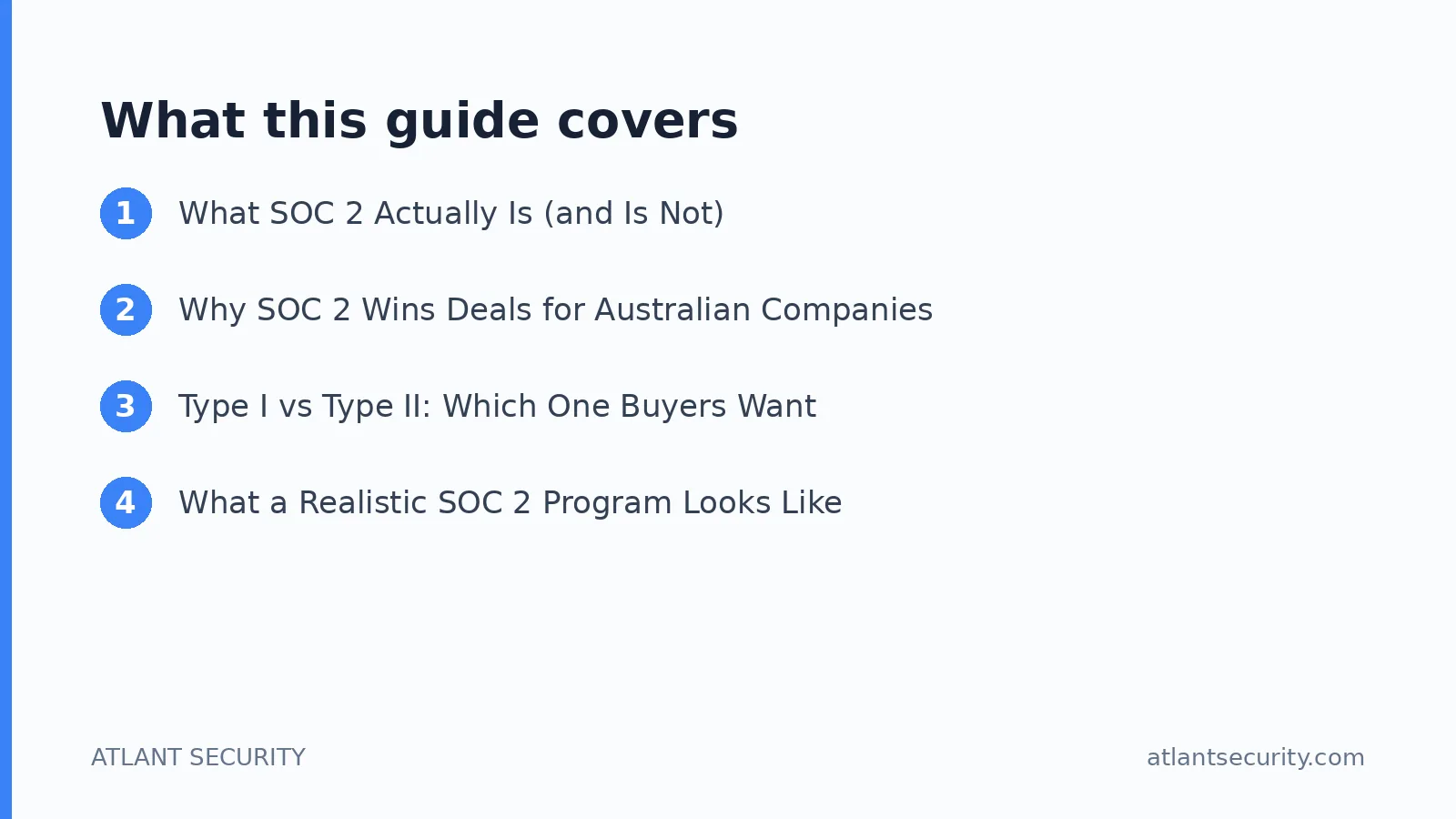
Security - the only mandatory category, often called the Common Criteria.
Availability - uptime, resilience, and disaster recovery commitments.
Processing Integrity - whether systems process data completely and accurately.
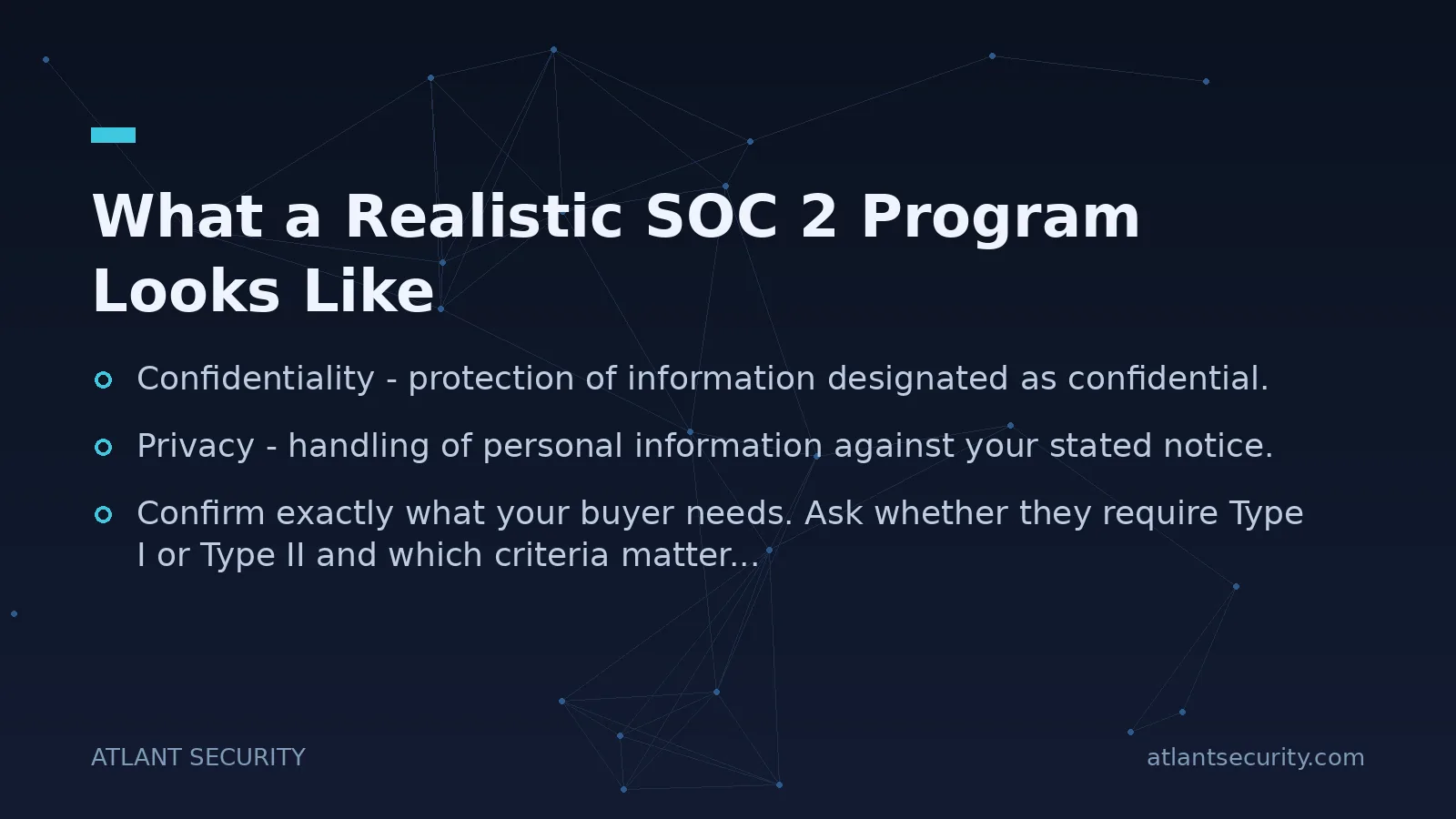
Confidentiality - protection of information designated as confidential.
Privacy - handling of personal information against your stated notice.
A few things SOC 2 is not. It is not a government regulation, and no Australian regulator issues it. It is not a certification with a pass or fail stamp like ISO 27001; instead an auditor issues an opinion and lists any exceptions. And it is not a substitute for actually being secure. A clean report on a badly run environment is a liability waiting to surface. The value comes from the controls being real.
Why SOC 2 Wins Deals for Australian Companies
Australian SaaS and fintech firms sell into a global market, and their largest prospects are frequently North American enterprises with mature vendor risk programs. Those buyers cannot audit every supplier themselves, so they lean on SOC 2 as a shorthand for "this vendor has been independently reviewed." Here is where I consistently see it move the needle.
It shortens the security review, not just passes it
Without a report, every enterprise deal drags you through a bespoke questionnaire, a security architecture call, and sometimes a customer-run penetration test. A SOC 2 Type II report answers most of those questions up front. The practical benefit is speed: deals that would take months of back-and-forth close in weeks because the buyer's security team signs off faster.
It removes you from the "too risky" pile
Many procurement policies simply forbid onboarding a vendor that handles customer data without an attestation on file. In those accounts the absence of SOC 2 is not a negotiation point, it is a hard gate. Having the report keeps you in the running at all.
It signals operational maturity to investors
During due diligence, investors read a SOC 2 report as evidence that a company runs disciplined engineering and access practices. It rarely closes a funding round on its own, but its absence raises questions you would rather not answer mid-diligence.
Commercial lever | What SOC 2 changes |
|---|---|
Enterprise sales cycle | Replaces repeated bespoke reviews with one shareable report, compressing time to close. |
Vendor onboarding gates | Satisfies "no attestation, no contract" procurement policies. |
Renewals and expansion | Annual reports reassure existing customers and support upsell into regulated teams. |
Fundraising and M&A | Reduces diligence friction and signals security maturity. |
Incident resilience | Forces you to build monitoring, access control, and response that actually reduce risk. |
Type I vs Type II: Which One Buyers Want
This trips up nearly every first-timer, so let me be blunt about it.
Type I assesses whether your controls are suitably designed at a single point in time. You can get it quickly, and it is a reasonable interim milestone.
Type II assesses whether those controls operated effectively over a period, usually three to twelve months. This is the report enterprise buyers actually trust, because it proves the controls run day to day rather than existing on paper for a single afternoon.
My standard advice: if you need something on file fast to keep a deal alive, get Type I, but treat it as a stepping stone. Begin your Type II observation window immediately after. A serious buyer will eventually ask for Type II. Plan for it from the start rather than doing the work twice. If you are early in the journey, our SOC 2 readiness process is designed to get your controls right before the clock on a Type II window ever starts.
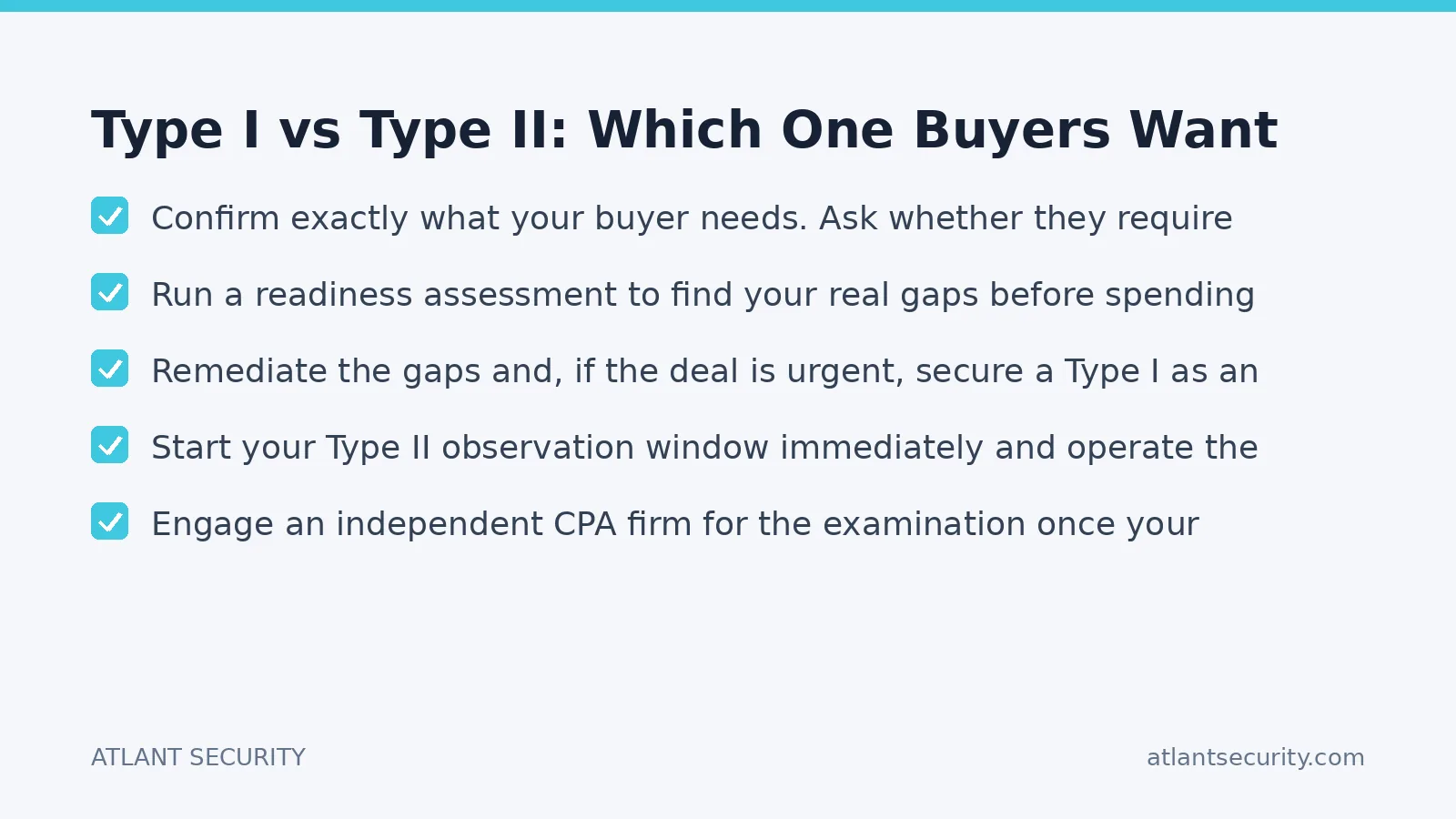
What a Realistic SOC 2 Program Looks Like
The companies that get through SOC 2 without drama treat it as an operational project with clear phases, not a last-minute scramble. Here is the sequence I recommend.
1. Scope the report
Decide which Trust Services Criteria apply. Almost everyone starts with Security only. Add Availability if you make uptime commitments, Confidentiality if customers designate data as confidential, and Privacy if you handle personal information in ways that matter to buyers. Wider scope means more evidence and more cost, so scope to what your market actually asks for.
2. Run a readiness assessment
Before an auditor ever looks at you, map your current controls against the criteria and find the gaps. This is where most of the real work lives: access control, change management, vulnerability management, logging and monitoring, vendor management, and incident response. A readiness assessment turns "we think we are fine" into a concrete remediation list.
3. Remediate the gaps
Typical fixes I see across Australian SaaS teams include enforcing multi-factor authentication everywhere, formalising employee onboarding and offboarding, introducing a documented change-management process, centralising logs, and standing up continuous vulnerability scanning. None of this is exotic. It is disciplined engineering hygiene written down and enforced.
4. Operate through the observation window
For Type II, your controls need to run and produce evidence over the whole period. This is why automation matters: tickets, access reviews, and alerts should generate their own audit trail so you are not manufacturing evidence the week before the auditor arrives.
5. Complete the audit
A licensed CPA firm performs the examination and issues the report. Note the separation of duties here: a consultancy like ours prepares you and can act as your virtual CISO, but the audit opinion must come from an independent CPA firm. Any consultant who offers to both prepare you and issue the SOC 2 opinion is a red flag.
Tooling: Useful, but Not the Point
You will hear a lot about identity providers, endpoint detection platforms, SIEM tools, and compliance-automation software. These are genuinely helpful. Single sign-on with enforced MFA, endpoint protection, centralised logging, and a compliance platform that continuously collects evidence all reduce manual effort and lower the chance of a control quietly failing.
But tools do not pass an audit, controls do. I have seen companies buy an expensive stack and still fail because nobody owned the process behind it. Buy tools to support controls you have actually decided to operate, not as a substitute for the decision. If your environment is largely cloud-hosted, aligning tooling with the underlying platform's security model matters more than the brand on the invoice, which is exactly the sort of thing our cloud security consulting work focuses on.
Common Ways SOC 2 Programs Go Wrong
The failures I see are almost always process failures, not technology failures.
Starting with the auditor instead of readiness. Engaging a CPA firm before your controls exist just means paying to be told what you already suspected.
Over-scoping. Chasing all five criteria when buyers only ask for Security inflates cost and timeline for no commercial gain.
Treating it as a one-off. SOC 2 is annual. Controls that lapse after the report is issued create a worse position than never having started, because now the gap is documented.
Manufacturing evidence. Backfilling access reviews and tickets the week before an audit is obvious to an experienced auditor and undermines the report's credibility.
No internal owner. Without someone accountable, controls drift. This is precisely the gap a part-time CISO fills for companies not ready to hire a full-time security leader.
How SOC 2 Fits Alongside Other Frameworks
Australian companies often ask whether they need SOC 2, ISO 27001, or both. It depends on your buyers. North American enterprises tend to ask for SOC 2. European and increasingly Asia-Pacific buyers often ask for ISO 27001, which is a certifiable standard with strong international recognition. The good news is that the underlying controls overlap heavily, so building for one gets you most of the way to the other. If your market spans both regions, plan the control set once and map it to both. Our ISO 27001 readiness engagements are frequently run in parallel with SOC 2 for exactly this reason.
A Practical Path Forward
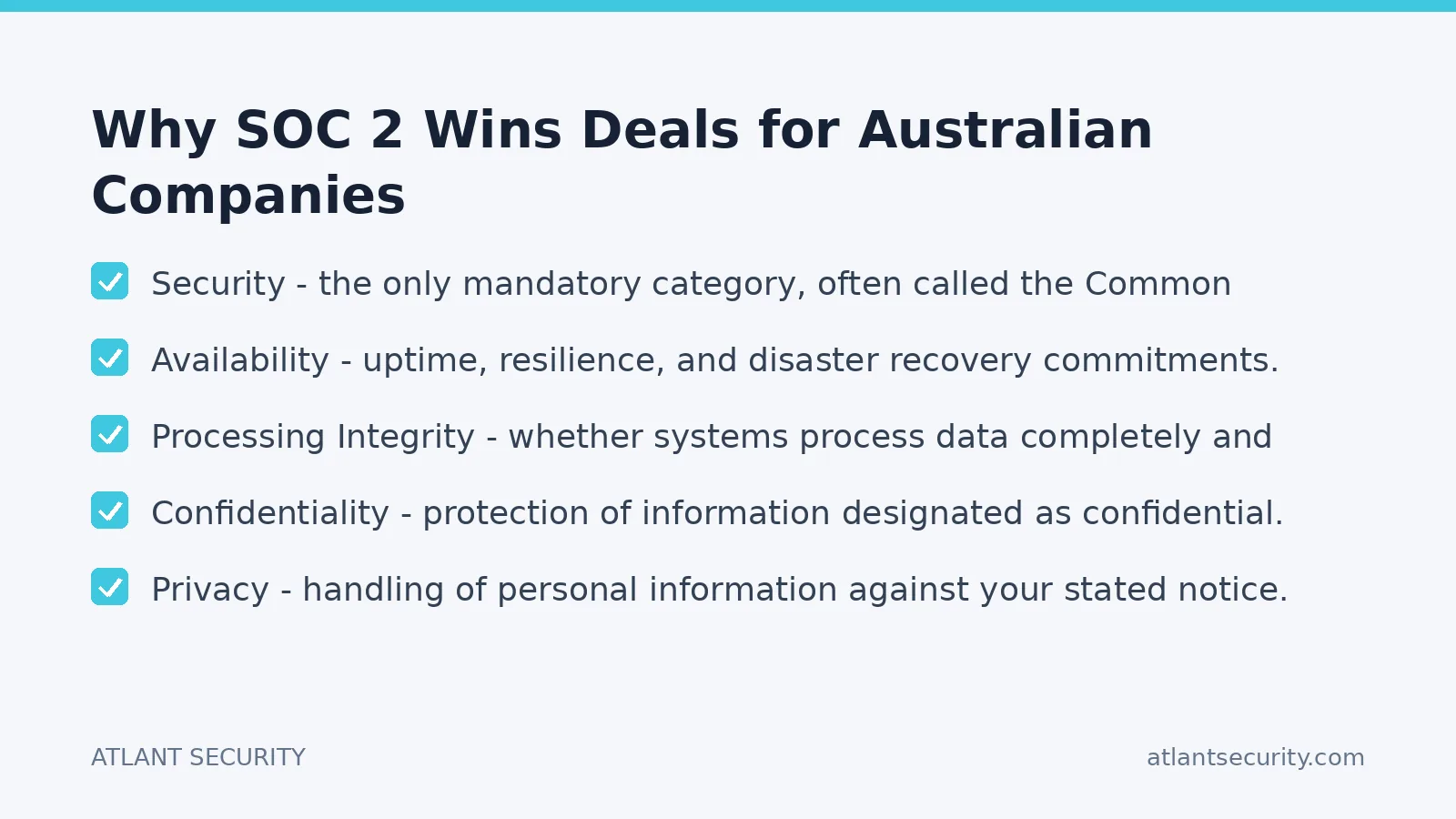
If you are an Australian founder or CTO with an enterprise deal blocked on SOC 2, here is what I would do in order:
Confirm exactly what your buyer needs. Ask whether they require Type I or Type II and which criteria matter to them.
Run a readiness assessment to find your real gaps before spending money on an audit.
Remediate the gaps and, if the deal is urgent, secure a Type I as an interim proof point.
Start your Type II observation window immediately and operate the controls for real.
Engage an independent CPA firm for the examination once your evidence is genuinely accumulating.
Done this way, SOC 2 stops being a tax on your time and becomes what it should be: proof that you run a business a serious customer can trust with their data. If you want a straight assessment of where you stand and the fastest honest route to a report, get in touch and we will map it out with you.
Frequently Asked Questions
How long does SOC 2 take for an Australian company?
A Type I can be achievable within a couple of months once controls are in place. A Type II depends on your observation window, commonly three to twelve months, plus the readiness and remediation work beforehand. Most first-timers should plan for a six to twelve month journey end to end.
Do we need SOC 2 if we already have ISO 27001?
Not automatically. It depends on what your buyers ask for. North American enterprises usually request SOC 2 specifically. Because the controls overlap heavily, having ISO 27001 puts you in a strong position to add SOC 2 with less incremental effort.
Can one firm both prepare us and issue the SOC 2 report?
No. The audit opinion must come from an independent licensed CPA firm. A consultancy can run your readiness, remediation, and ongoing virtual CISO work, but it cannot also issue the attestation. Keeping those roles separate is what makes the report credible.
Is SOC 2 a legal requirement in Australia?
No. It is a voluntary, market-driven attestation, not a regulation. No Australian regulator mandates it. Companies pursue it because customers, especially overseas enterprises, require it before signing.
What happens if the auditor finds exceptions?
SOC 2 is not pass or fail. The auditor documents any exceptions in the report, along with management's response. A small number of well-explained exceptions is normal and usually acceptable to buyers. The goal is an honest report, not a flawless one.
How much does SOC 2 cost?
Costs vary widely with scope, environment complexity, and how much remediation you need. Budget separately for readiness and remediation, the independent audit fee, and any tooling. The largest variable is almost always the internal engineering work to close control gaps, not the audit itself.
