
Most UK SaaS founders treat NCSC Cyber Essentials as a box to tick when a customer asks for it, then forget about it until renewal. That is a missed opportunity. Handled properly, Cyber Essentials is one of the cheapest, fastest ways to shorten your enterprise and public sector sales cycles, and it forces you to fix the basic misconfigurations that cause the majority of the breaches I see in my assessment work. Handled badly, it becomes a certificate on the wall that does not reflect how your systems are actually configured, which is worse than not having it at all.
I have run security assessments for companies selling into regulated buyers across 14 countries since 2013, and the pattern in the UK is consistent: buyers, especially government and healthcare buyers, use Cyber Essentials as a filter. If you have it, you clear the first gate. If you do not, you are often excluded before anyone reads your proposal. This article explains what the scheme actually requires, how to use it to grow, and where it stops being enough.
What NCSC Cyber Essentials Actually Is
Cyber Essentials is a UK government backed certification scheme created by the National Cyber Security Centre (NCSC) and delivered through IASME, the scheme's partner. It is deliberately narrow. It does not try to be ISO 27001. It focuses on five technical control areas that, when implemented correctly, block the large majority of commodity internet attacks: opportunistic scanning, credential stuffing, unpatched software exploitation, and malware.
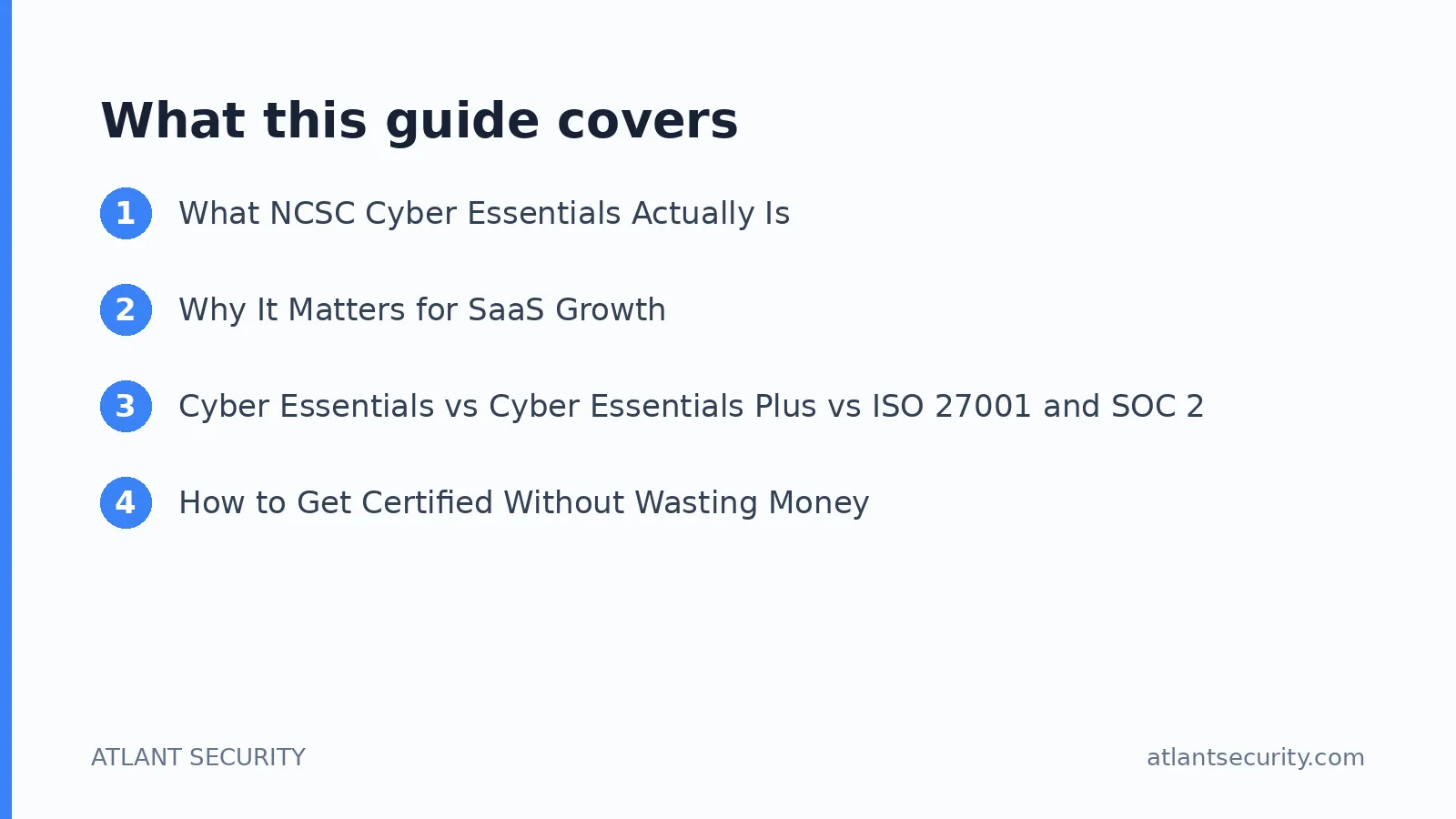
There are two levels:
- Cyber Essentials is a self assessment questionnaire. You answer questions about your configuration and a senior person signs it off. It is verified by an assessor but relies on your honest answers.
- Cyber Essentials Plus covers the same five controls but adds a hands on technical audit by a qualified assessor: vulnerability scans, a sample of your endpoints, and verification that your answers match reality. This is the version serious buyers increasingly ask for.
The Five Control Areas
| Control | What it means in practice |
|---|---|
| Firewalls | Boundary and host firewalls configured to deny by default, with documented and approved exceptions. No admin interfaces exposed to the internet. |
| Secure configuration | Removing default accounts and passwords, disabling unused services, and hardening cloud and endpoint baselines rather than shipping vendor defaults. |
| User access control | Least privilege, individual named accounts, prompt removal of leavers, separate accounts for administrative work, and multi factor authentication on cloud services. |
| Malware protection | Anti malware on endpoints, application allow listing, or sandboxing, kept current. |
| Security update management | Supported software only, with high and critical severity patches applied within the scheme's required window, typically 14 days. |
For a SaaS company, the tricky part is usually scope. Your production cloud environment, your corporate laptops, your identity provider, and any bring your own device that touches company data all fall in. Getting the scope boundary right is where most first attempts stumble.
Why It Matters for SaaS Growth
The commercial case for Cyber Essentials is not abstract. It shows up in three concrete places.
1. Public Sector Procurement
UK central government contracts that involve handling certain personal or sensitive information require suppliers to hold Cyber Essentials. If you want to sell through frameworks associated with the Crown Commercial Service, or work with NHS or Ministry of Defence supply chains, the certification is frequently a stated prerequisite rather than a nice to have. Without it, you do not get to compete. With it, you meet the baseline and the conversation moves on to your actual product.
Be honest with yourself about which frameworks and buyers you are genuinely targeting. Certification opens the door to bid; it does not win the bid for you. Anyone who promises that a certificate alone lands multi million pound contracts is selling you a fantasy.
2. Enterprise Vendor Security Reviews
Even outside government, mid market and enterprise buyers run vendor security assessments before they sign. Cyber Essentials gives their procurement and security teams a recognised, standardised answer to a chunk of their questionnaire. It will not replace a SOC 2 report or ISO 27001 certificate for the largest buyers, but for many UK deals it is enough to clear the initial risk screen and keep your sales cycle short.
3. It Forces You to Fix Real Weaknesses
This is the part people undersell. In assessment after assessment, the issues that actually get companies breached are mundane: an exposed admin panel, a former contractor whose access was never removed, a server running an unsupported operating system, MFA that was never enforced on the admin console. The five Cyber Essentials controls map almost exactly onto those root causes. Achieving the certificate honestly means you have closed the doors attackers use most often.
Cyber Essentials vs Cyber Essentials Plus vs ISO 27001 and SOC 2
Founders constantly ask me which one they need. The honest answer is that they solve different problems and often stack.
| Scheme | Assurance level | Best for |
|---|---|---|
| Cyber Essentials | Self assessed, verified | Meeting a baseline requirement quickly and cheaply; UK public sector entry |
| Cyber Essentials Plus | Independently tested | Buyers who want proof the controls actually work; stronger differentiator |
| ISO 27001 | Full management system audit | International enterprise buyers; a broad, auditable security program |
| SOC 2 | Independent auditor attestation | US buyers and B2B SaaS deals where SOC 2 is the expected standard |
A sensible path for a UK SaaS company is to start with Cyber Essentials, move to Cyber Essentials Plus once you have the basics stable, and then pursue ISO 27001 or SOC 2 when your target buyers demand the deeper assurance. The good news is that the technical work you do for Cyber Essentials is not wasted; it directly supports the more demanding frameworks later. If you are unsure which to prioritise, a short IT security audit against your actual buyer requirements will save you from certifying the wrong thing first.
How to Get Certified Without Wasting Money
The scheme itself is inexpensive relative to the deals it unlocks. The cost that hurts is remediation you did not plan for, and re assessment after a failed attempt. Here is the approach I recommend.
- Define scope deliberately. Decide whether you are certifying the whole organisation or a defined subset. A whole organisation certificate is far more valuable to buyers, so avoid the temptation to scope out your messiest systems just to pass.
- Run a gap check first. Before you submit anything, compare your real configuration against the five controls. The common failures are unenforced MFA, unsupported software still in production, missing host firewalls, and stale privileged accounts. A quick vulnerability assessment surfaces most of these fast.
- Fix, then document. Remediate the gaps, then capture evidence: screenshots of MFA enforcement, patch policy, access review records, firewall rule sets. This evidence is also what you will need again for Cyber Essentials Plus and later frameworks.
- Attempt Cyber Essentials Plus with clean systems. The Plus audit includes vulnerability scanning and endpoint checks. If your patching and configuration are genuinely in order, it is straightforward. If they are not, the assessor will find it, which is the point.
- Treat renewal as continuous, not annual. Certification lapses in a year. Patching, access removal, and configuration drift happen daily. Build the controls into your operations so renewal is a formality rather than a scramble.
Where Cyber Essentials Stops Being Enough
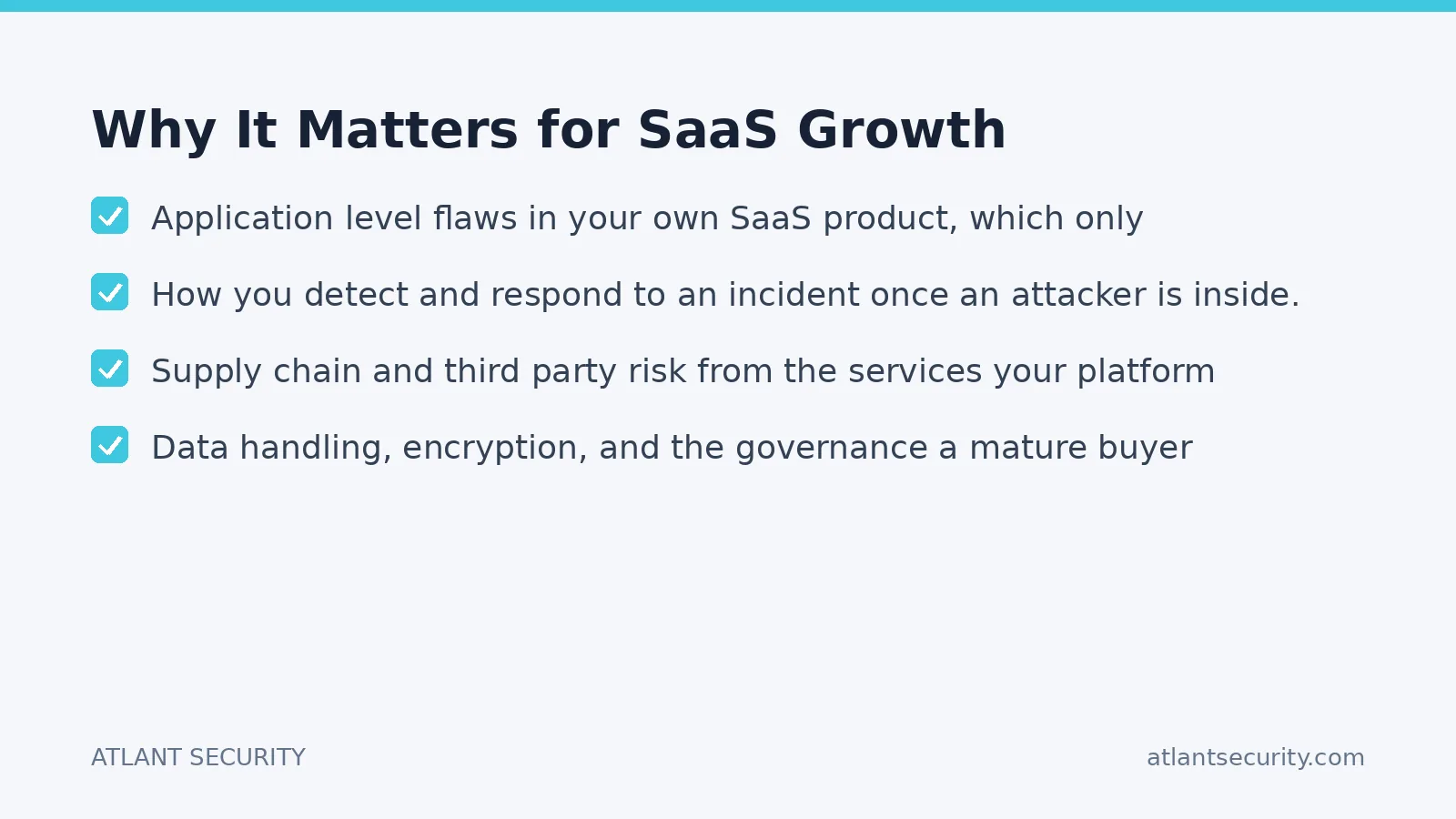
I would be doing you a disservice if I let you believe the certificate makes you secure. It does not. It raises you above the commodity attack floor, which is genuinely valuable, but it says nothing about:
- Application level flaws in your own SaaS product, which only penetration testing will find.
- How you detect and respond to an incident once an attacker is inside.
- Supply chain and third party risk from the services your platform depends on.
- Data handling, encryption, and the governance a mature buyer expects.
If security is becoming a recurring blocker in your sales cycle, or you are heading toward ISO 27001 or SOC 2, the most efficient move is usually to bring in part time senior security leadership rather than hiring a full team you do not yet need. That is exactly what our virtual CISO services exist for: owning the roadmap from Cyber Essentials through to the frameworks your largest buyers require, and making sure the controls hold up under real scrutiny.
A Realistic Timeline
For a small to mid sized SaaS company with reasonably modern cloud infrastructure, self assessed Cyber Essentials is achievable in a few weeks, most of which is remediation rather than paperwork. Cyber Essentials Plus adds the assessor's schedule and any additional fixes the technical audit surfaces. Companies that struggle are almost always the ones that treat it as a documentation exercise instead of fixing the underlying configuration first. Fix the systems, and the certificate follows.
Frequently Asked Questions
Is Cyber Essentials mandatory for UK SaaS companies?
Not universally. It becomes effectively mandatory when you sell to buyers who require it, which includes many UK central government contracts and a growing number of enterprise procurement processes. If your target market includes public sector or security conscious enterprises, treat it as a practical requirement.
What is the difference between Cyber Essentials and Cyber Essentials Plus?
Both cover the same five controls. Cyber Essentials is a verified self assessment based on your own answers. Cyber Essentials Plus adds an independent technical audit, including vulnerability scanning and endpoint checks, so it provides much stronger assurance and is the version demanding buyers increasingly ask for.
How long does Cyber Essentials certification last?
Certification is valid for twelve months and must be renewed annually. Because patching, access changes, and configuration drift happen continuously, the controls need to be maintained year round rather than reassembled at renewal time.
Does Cyber Essentials replace ISO 27001 or SOC 2?
No. Cyber Essentials establishes a technical baseline. ISO 27001 and SOC 2 assess a broader, independently audited security program and are what larger international and US buyers typically expect. Cyber Essentials is a strong first step, and the work you do for it supports those frameworks later.
Will Cyber Essentials make my SaaS product secure?
It removes the most common commodity attack routes, but it does not test your application code, your incident response, or your supply chain. You still need penetration testing of your product and ongoing security management to be genuinely secure. The certificate is a floor, not a ceiling.
Can a very small startup get certified?
Yes. The scheme applies to organisations of any size, and small teams with modern cloud setups often certify quickly because there is less legacy configuration to fix. Scope it to your whole organisation where possible so the certificate carries maximum weight with buyers.
If you want Cyber Essentials or Cyber Essentials Plus done properly, with the underlying weaknesses actually fixed rather than papered over, and a roadmap toward the frameworks your buyers will ask for next, get in touch with Atlant Security. We will tell you honestly what you need and what you can skip.
