
For a US SaaS company, SOC 2 Type II is usually the moment security stops being an internal concern and becomes a sales requirement. Enterprise buyers ask for the report during procurement, and without it the deal stalls in the security review. I have spent more than a decade running security assessments for software companies, and the same misunderstanding comes up again and again: teams treat SOC 2 as paperwork they can generate quickly, then discover that Type II specifically requires their controls to operate consistently over a period of months. That is why the consultant you pick matters. The wrong one sells you tooling and a rushed audit; the right one builds controls that actually hold and produces a report an enterprise security team will accept without pushback.
Type I Versus Type II, and Why It Changes Everything
SOC 2 comes in two flavours and the difference drives your whole timeline. A Type I report attests that your controls are suitably designed at a single point in time. A Type II report attests that those controls operated effectively over a review period, commonly three to twelve months. Enterprise buyers almost always want Type II, because a snapshot proves nothing about whether you run the control day after day.
This is the crux of consultant selection. Anyone can help you write a policy. The hard part is standing up controls that generate evidence continuously over the observation window, so that when the auditor samples your access reviews or your change tickets across six months, the evidence is actually there. A consultant who only knows how to prepare for a point-in-time assessment will leave you exposed when the Type II window opens.
What a SOC 2 Type II Report Actually Covers
SOC 2 is built on the AICPA Trust Services Criteria. Security, the common criteria, is mandatory. Availability, processing integrity, confidentiality, and privacy are optional and included only if they are relevant to what you promise customers. A good consultant helps you scope this deliberately rather than including every category and multiplying your evidence burden for no commercial reason.
Underneath the criteria sit the controls your auditor will test: access management, change management, risk assessment, vendor management, incident response, monitoring, and encryption among them. If you want the full picture of how readiness works before an audit firm gets involved, our SOC 2 readiness guidance walks through the path from gap assessment to audit-ready.
What Separates a Strong SOC 2 Consultant
Consultants in this space range from genuine security engineers to resellers who wrap a compliance automation platform in a service fee. Here is how I would tell them apart.
| What to Look For | Strong Consultant | Weak Consultant |
|---|---|---|
| Security depth | Engineers who understand your architecture | Checklist administrators |
| Type II focus | Builds controls that generate evidence over months | Preps for a point-in-time snapshot |
| Independence from tooling | Recommends what you need | Sells one platform to everyone |
| Cloud fluency | Hands-on with AWS, Azure, or GCP controls | Generic policy templates only |
| Auditor relationship | Clarifies the line between prep and audit | Blurs the line, risking independence |
One important note on the audit itself: the firm that issues your SOC 2 report must be an independent CPA firm, and it cannot be the same party that built your controls. A good readiness consultant knows exactly where that line sits and works alongside the auditor rather than compromising their independence. Be wary of anyone who claims they can both prepare you and issue the report.
The Realistic Path to a SOC 2 Type II Report
When I take a SaaS company through this, the work breaks into clear phases. A consultant who cannot articulate these phases does not understand the process.
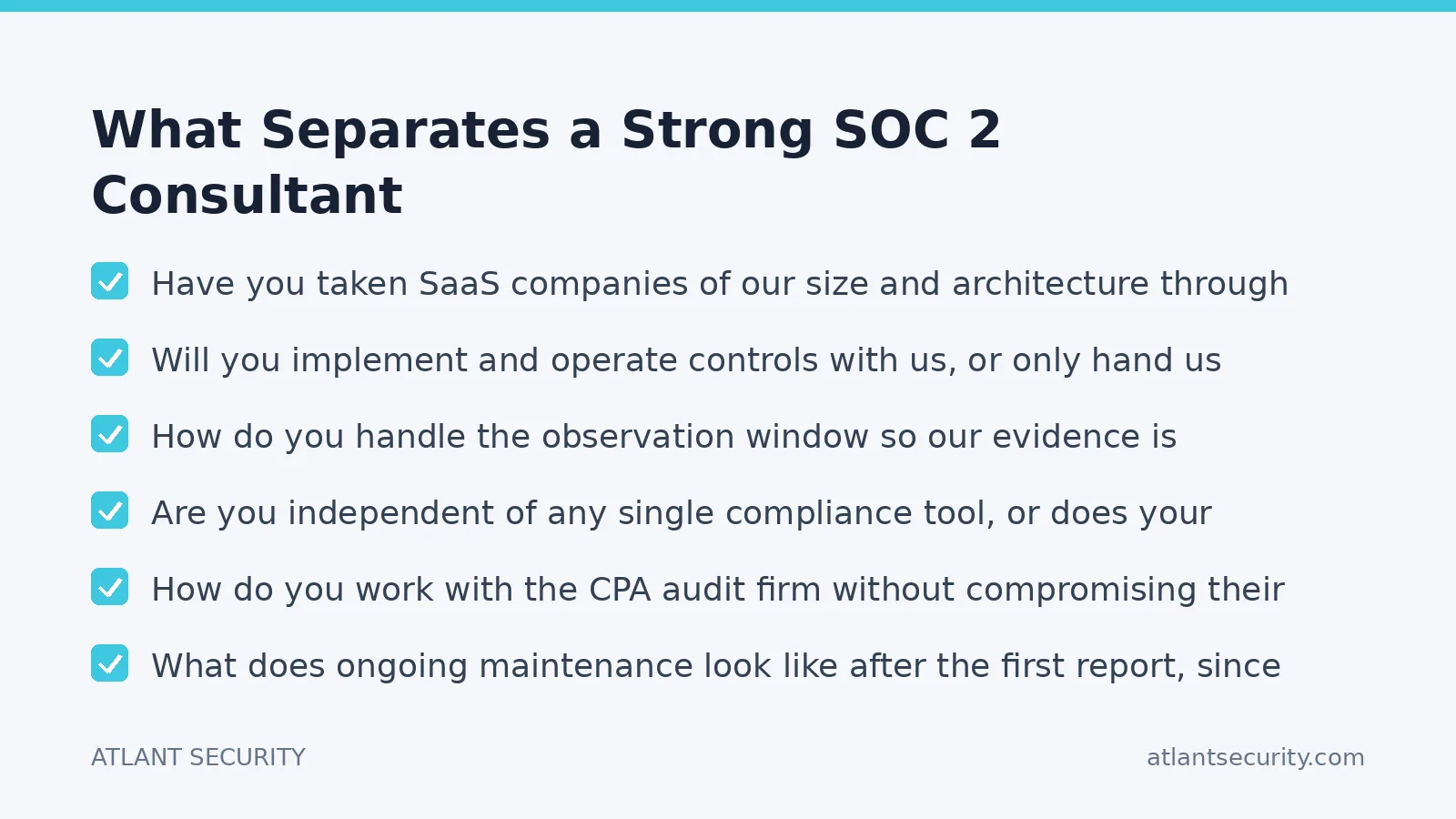
- Scoping. Decide which Trust Services Criteria apply and define the systems in scope. Getting this wrong inflates cost and effort for no benefit.
- Gap assessment. Compare current controls against the criteria and produce a prioritised remediation plan. This is where an honest consultant tells you the uncomfortable truths early.
- Remediation. Implement or fix the controls: access reviews, change management, logging and monitoring, vendor risk, incident response, and encryption. This is real engineering work, not documentation.
- Evidence and observation. Run the controls through the Type II observation window so they generate the evidence the auditor will sample.
- Audit. The independent CPA firm tests the controls and issues the report.
The remediation phase is where most of the value and most of the risk sits. Access management and change management are the areas I most often find broken in SaaS companies: shared admin accounts, no formal access reviews, and production changes that bypass any approval trail. These are exactly the controls a Type II auditor scrutinises. Getting them right often benefits from dedicated cloud security consulting, because in a modern SaaS platform most of these controls live in your cloud configuration.
Where Penetration Testing Fits
SOC 2 does not mandate a penetration test by name, but the risk assessment and monitoring criteria effectively expect you to identify and manage vulnerabilities, and most auditors and enterprise customers ask about testing. A regular penetration test gives you the evidence that you actively find and fix weaknesses, and it surfaces the exploitable issues a compliance checklist never will. I treat it as part of a credible SOC 2 programme, not an optional extra.
When You Need a Virtual CISO Instead of Just a Consultant
Many SaaS companies pursuing SOC 2 do not have a full-time security leader, yet enterprise customers increasingly want to see one. This is where a virtual CISO earns its keep. Rather than a one-off readiness project, you get ongoing security leadership that owns the control environment, keeps it running through the observation window, and represents your security posture to customers during procurement. For a growing SaaS business, that continuity is often what turns SOC 2 from a stressful annual scramble into a maintained state.
Questions to Ask Before You Sign
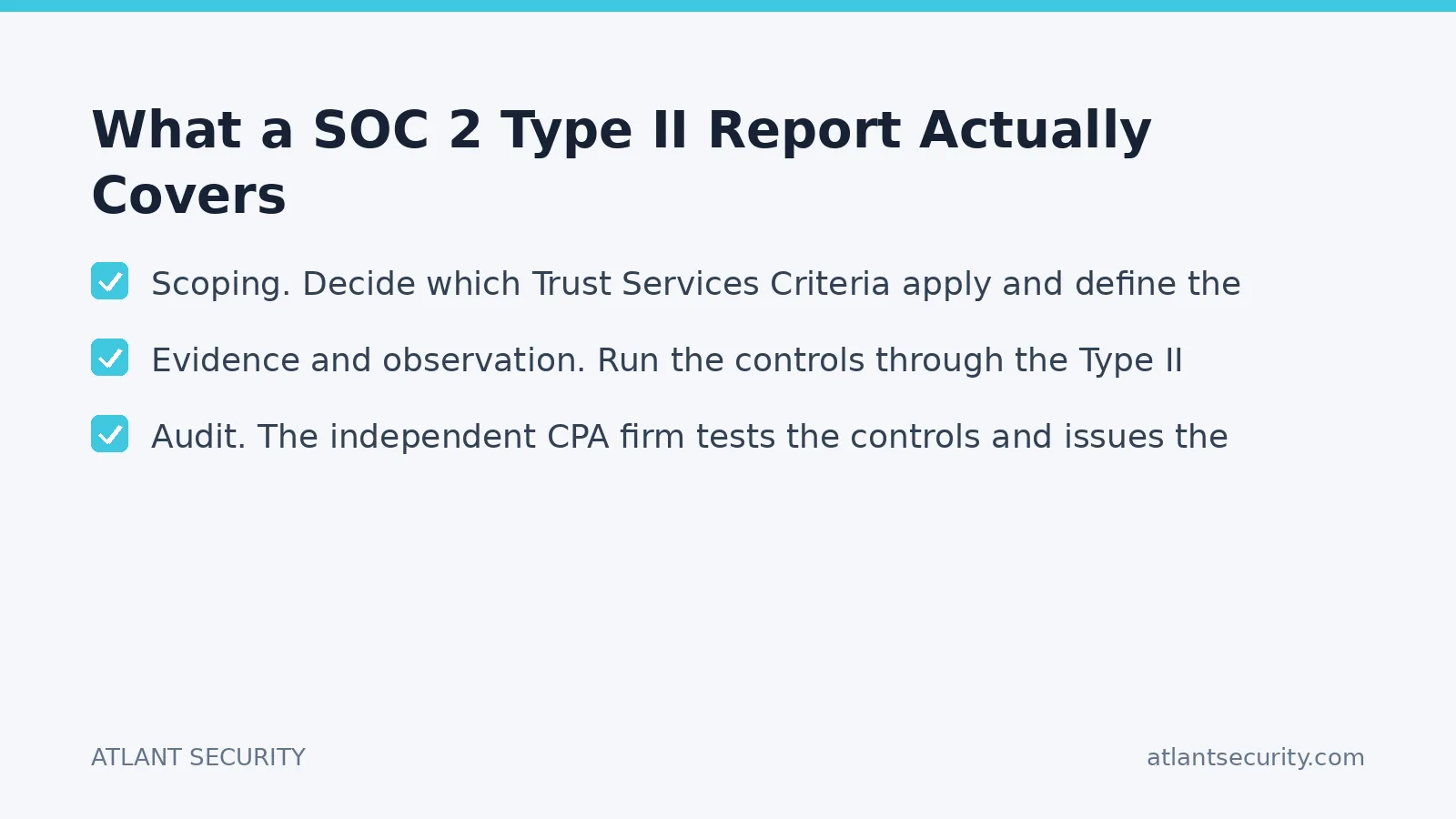
- Have you taken SaaS companies of our size and architecture through a Type II specifically, not just Type I?
- Will you implement and operate controls with us, or only hand us policy templates?
- How do you handle the observation window so our evidence is complete when the auditor samples it?
- Are you independent of any single compliance tool, or does your service assume we buy a specific platform?
- How do you work with the CPA audit firm without compromising their independence?
- What does ongoing maintenance look like after the first report, since SOC 2 renews annually?
The answers separate a partner who understands security from a vendor who sells a process. If a consultant cannot explain how they keep your controls operating between audits, they are setting you up to repeat the entire scramble next year.
Common Mistakes That Delay a SOC 2 Report
- Over-scoping. Including every Trust Services Criteria when only security and one other are relevant multiplies the evidence burden.
- Starting the observation window before controls are real. If the control was not operating, the evidence will not be there when the auditor samples it.
- Treating it as documentation. Policies without operating controls fail Type II every time.
- Ignoring vendor risk. Your subprocessors are in scope; auditors and customers will ask about them.
- No plan for renewal. SOC 2 Type II is annual. A consultant who leaves after the first report leaves you to rebuild the muscle each cycle.
Avoiding these is mostly about starting with an honest gap assessment and sequencing the work so controls are genuinely operating before the clock starts. If you want that assessment done by someone who has taken SaaS companies through it repeatedly, get in touch and we can scope your path to a Type II report.
Frequently Asked Questions
How long does SOC 2 Type II take?
Plan for the readiness and remediation work first, which commonly runs a couple of months depending on how mature your controls already are, followed by the observation window itself. Type II observation periods are typically three to twelve months. Many companies choose an initial three-month window to get a report faster, then move to a longer window in subsequent years.
What is the difference between SOC 2 Type I and Type II?
Type I attests that your controls are suitably designed at a single point in time. Type II attests that those controls operated effectively across a review period. Enterprise buyers almost always want Type II because it demonstrates the controls actually run, not just that they exist on paper. Our SOC 2 service page explains how we approach both.
Do we need a penetration test for SOC 2?
SOC 2 does not name penetration testing as a required control, but the risk assessment and monitoring criteria expect you to identify and manage vulnerabilities, and most auditors and enterprise customers ask whether you test. A regular penetration test is the practical way to satisfy that expectation and to find exploitable issues a checklist misses.
If you want this more often than once a year without a retainer, Pentestas is the route: AI-driven testing across web, API, cloud, network and mobile, with results back in five to ten days.
Can the same firm prepare us and issue the SOC 2 report?
No. The SOC 2 report must be issued by an independent CPA firm that did not build your controls. A readiness consultant helps you get ready and works alongside the auditor, but they cannot also be the auditor without breaking the independence the report depends on.
Which Trust Services Criteria should we include?
Security, the common criteria, is always required. Include availability, processing integrity, confidentiality, or privacy only if they are relevant to the commitments you make to customers. Scoping deliberately keeps your evidence burden proportionate rather than inflating cost for categories that do not apply.
What happens after the first SOC 2 report?
SOC 2 Type II renews annually, so your controls need to keep operating continuously between reports. This is where ongoing security leadership, such as a virtual CISO arrangement, keeps the programme maintained rather than rebuilt from scratch each year.
