Singapore's Cybersecurity Code of Practice, usually shortened to CCoP, is one of the more demanding compliance regimes in the region, and it is frequently misunderstood by the companies it touches. I have run security assessments across 14 countries since 2013, and the questions I hear from Singapore technology teams are almost always the same: does this even apply to us, what does it actually require, and how do we choose someone to help without overpaying for work we do not need. This guide answers those questions honestly and explains what to look for in a CCoP consultant, without the inflated promises that pollute most articles on the subject.
What CCoP actually is
The CCoP is issued by the Cyber Security Agency of Singapore (CSA) under the Cybersecurity Act. Its full name is the Cybersecurity Code of Practice for Critical Information Infrastructure. That last part is the key: the Code is a mandatory set of requirements imposed on owners of Critical Information Infrastructure (CII), the systems whose disruption would have a debilitating effect on essential services in Singapore. CSA has designated CII across sectors such as energy, water, banking and finance, healthcare, transport, infocomm, media, government, and security and emergency services.
The current edition raised the bar considerably over earlier versions, with stronger expectations around securing operational technology, cloud environments, and the supply chain, alongside faster incident reporting and more rigorous governance. For a CII owner, compliance is not optional and is subject to CSA oversight.
Does CCoP apply to your SaaS company?
This is where a lot of marketing content is misleading. The CCoP binds designated CII owners, not every SaaS company operating in Singapore. Most software vendors are affected in one of two ways:
- As a vendor or service provider to a CII owner. If your platform supports a designated CII system, that CII owner is obligated to manage supply chain risk, and they will push CCoP-aligned requirements down to you contractually. You feel the Code through your customer's obligations even though you are not directly regulated by it.
- As a designated party yourself. If your system is itself designated as CII, you are directly bound.
If neither applies, CCoP may still be a useful benchmark, but you should not let a consultant frame it as a legal obligation you are breaching. Being precise about your actual position is the first thing a competent advisor does. A good starting point is a scoping conversation and an IT security audit that establishes where you genuinely stand before anyone sells you a remediation program.
What CCoP compliance involves
While the Code is detailed, the obligations cluster into recognizable domains. Any consultant worth hiring should be able to work fluently across all of them:
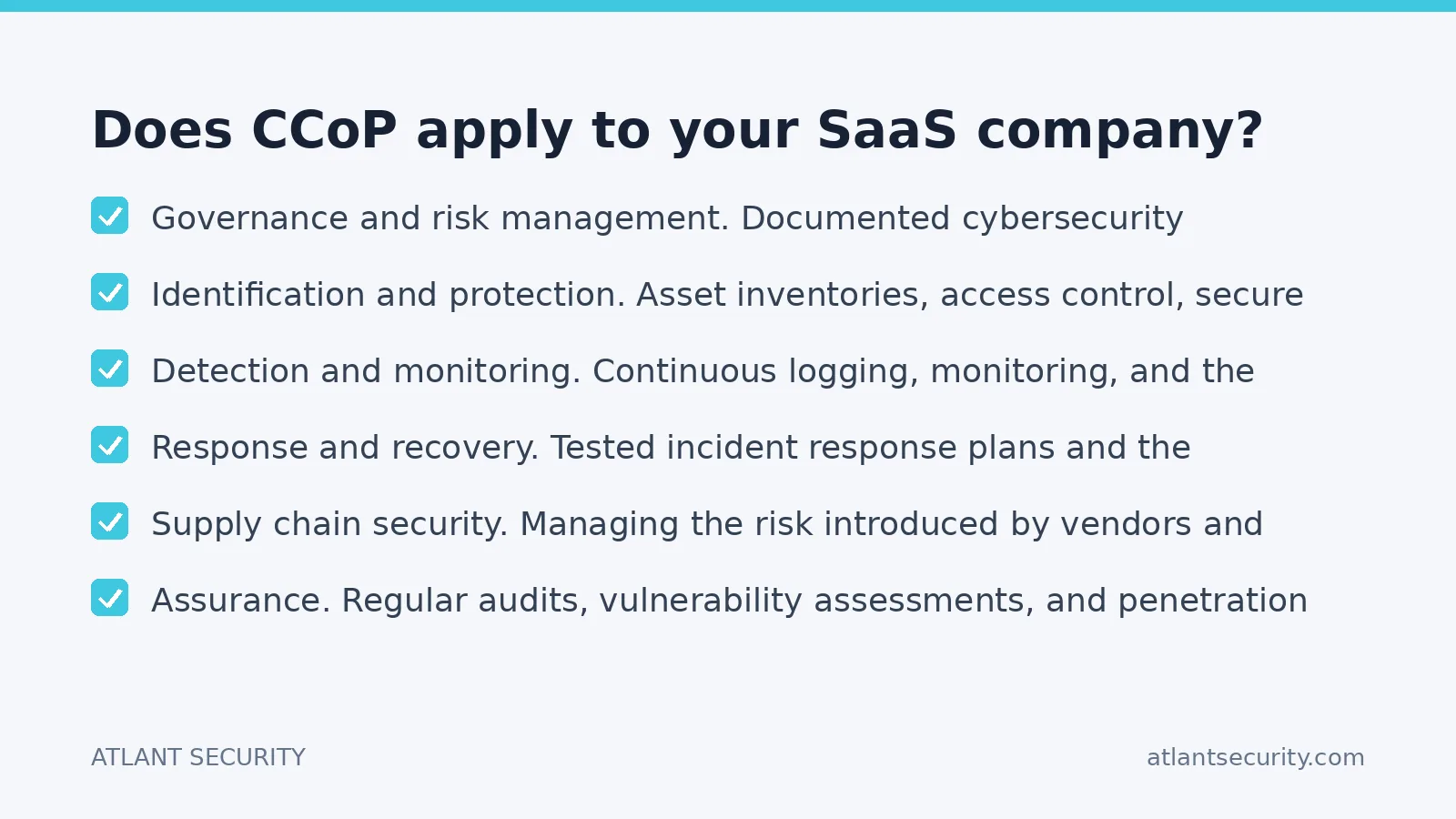
- Governance and risk management. Documented cybersecurity governance, accountable ownership, and regular risk assessments of the in-scope systems.
- Identification and protection. Asset inventories, access control, secure configuration, and hardening of both IT and, where relevant, operational technology.
- Detection and monitoring. Continuous logging, monitoring, and the ability to detect anomalies across the environment.
- Response and recovery. Tested incident response plans and the mandatory reporting of incidents to CSA within the required timeframes.
- Supply chain security. Managing the risk introduced by vendors and service providers, which is exactly the mechanism that pulls SaaS companies into scope.
- Assurance. Regular audits, vulnerability assessments, and penetration testing to demonstrate that controls work.
How to choose a CCoP consultant
The market is full of firms that will happily sell a CCoP engagement. Choosing well is about matching real expertise to your actual position. Here is what I would insist on.
Confirm they scope before they sell
A credible consultant establishes whether and how CCoP applies to you before quoting a program. If the first conversation is a pitch rather than an assessment of your exposure, that is a warning sign. You do not want to pay for CII-grade remediation if you are a downstream vendor who mainly needs to satisfy a customer's supply chain requirements.
Check for genuine technical depth
CCoP is not a paperwork exercise. It expects working controls, and in some sectors it reaches into operational technology and cloud security. Ask the consultant to explain how they would harden a specific part of your environment, how they approach monitoring, and how they validate controls with testing. Vague answers about frameworks and best practices signal a reseller rather than a practitioner. Our own approach pairs advisory with hands-on penetration testing and vulnerability assessment, because a control you have not tested is a control you cannot trust.
Ask about incident reporting and governance, not just tooling
Much of CCoP is governance and response. A consultant who only talks about products to buy is missing half the Code. You want someone who can stand up your risk management process, write incident response plans your team will actually follow, and prepare you for CSA's reporting expectations.
The economics of this changed recently. AI-run penetration testing runs the same OWASP Top 10, API, cloud and network checks a human tester works through, chains the findings into proof-of-concept evidence, and returns results in five to ten days with retesting included once you have fixed things. That turns testing after every release from an aspiration into a line item.
Look for ongoing capability, not a one-off report
CCoP compliance is a continuous obligation, not a certificate you earn once. The right partner helps you build a program you can sustain. For many Singapore companies without a full-time security leader, a Virtual CISO arrangement provides that ongoing senior oversight at a fraction of the cost of a permanent hire.
| What to look for | Why it matters | Red flag |
|---|---|---|
| Scopes your exposure first | Avoids paying for controls you do not need | Pitches a program before assessing you |
| Hands-on technical work | CCoP demands working, tested controls | Talks only in frameworks and slideware |
| Governance and incident response depth | Half the Code is process, not products | Recommends only tools to purchase |
| Ongoing support model | Compliance is continuous, not one-off | Delivers a report and disappears |
| Independent testing capability | Assurance requires validation | Never verifies its own control claims |
How CCoP fits with your other obligations
Singapore companies rarely face CCoP in isolation. If you handle personal data, the Personal Data Protection Act (PDPA) applies in parallel. Financial sector companies also contend with the Monetary Authority of Singapore's Technology Risk Management guidelines. And if you sell internationally, buyers will likely ask for globally recognized attestations regardless of your CCoP position. The controls overlap heavily, which is the opportunity: build once, satisfy several. Many of our Singapore clients pair CCoP-aligned work with ISO 27001 and SOC 2, because a single well-designed control set can carry all three with the right mapping. Doing this deliberately avoids running three disconnected projects that duplicate effort and budget.
Common mistakes companies make with CCoP
Over the years I have seen the same avoidable errors repeat, and most of them cost money without buying real security:
- Assuming it applies when it does not, or vice versa. Some companies pay for a full CII-grade program they are not obligated to run, while others ignore requirements that are quietly flowing to them through a customer contract. Both come from skipping the scoping step.
- Buying tools instead of building a program. A stack of security products does not satisfy CCoP on its own. The Code expects governance, documented processes, tested response plans, and evidence, none of which come out of a box.
- Treating operational technology like ordinary IT. In sectors with OT, the current Code sets specific expectations. Applying generic IT controls to industrial systems misses the point and can introduce new risk.
- Ignoring incident reporting readiness. CCoP sets expectations for reporting incidents to CSA within defined timeframes. A team that has never rehearsed this will fumble it under real pressure.
- One-and-done thinking. Compliance lapses the moment controls stop operating. Without an ongoing owner, a clean assessment quietly decays into an exposed one.
Every one of these traces back to underestimating the governance and continuity side of the Code while overestimating what a purchase or a single project can deliver. The antidote is senior input early and a program you can actually sustain.
A sensible path forward
- Establish your actual position. Are you a CII owner, a vendor to one, or neither? This determines everything that follows.
- Run a gap assessment against the relevant CCoP domains and any customer requirements flowing down to you.
- Prioritize remediation by risk, focusing first on the controls that protect the most sensitive systems and the ones your customers contractually require.
- Implement governance and response, not just technology. Risk management, incident response, and reporting readiness are core.
- Validate with testing. Penetration tests and vulnerability assessments turn claimed controls into demonstrated ones.
- Operate continuously. Stand up the monitoring and review cadence that keeps you compliant between assessments.
Frequently asked questions
Does the CCoP apply to every company in Singapore?
No. The Cybersecurity Code of Practice binds designated owners of Critical Information Infrastructure under the Cybersecurity Act. Most SaaS companies are affected indirectly, as vendors to CII owners who pass supply chain requirements down to them, rather than being directly regulated. A consultant should confirm your actual position before selling you a program.
Who issues and enforces the CCoP?
The Cyber Security Agency of Singapore (CSA) issues the Code under the Cybersecurity Act and oversees compliance by designated CII owners, including expectations around incident reporting and regular assurance activities.
We are a vendor to a CII owner. What do we need to do?
You will typically receive CCoP-aligned requirements through your contract, because the CII owner must manage supply chain risk. Focus on the specific controls your customer requires, back them with real technical hardening and testing, and be able to evidence them. A gap assessment against those requirements is the efficient starting point.
How is CCoP different from ISO 27001 or SOC 2?
CCoP is a sector-specific, mandatory Singapore regime for critical infrastructure, issued by CSA. ISO 27001 and SOC 2 are voluntary, internationally recognized frameworks driven by customer demand. The underlying controls overlap substantially, so a well-designed program can address all three, but they are governed and assessed differently.
Do we need a full-time security team for CCoP compliance?
Not necessarily. Many companies meet their obligations with a combination of internal owners and external expertise. A Virtual CISO arrangement provides senior, ongoing oversight without the cost of a permanent hire, which suits organizations that need continuity but not a full in-house function yet.
Where to start
Before you engage anyone on a large CCoP program, get an honest read on whether and how the Code applies to you, and where your real gaps are. That single step prevents both under-compliance and paying for work you do not need. If you want a clear-eyed assessment and a practical path to compliance, get in touch. We help Singapore companies meet CCoP-aligned requirements and build security programs that hold up under scrutiny, through our audit, penetration testing, and Virtual CISO services.