SOC 2 Type 2 is the report your enterprise customers actually want, and it is also the one most SaaS companies underestimate. Type 1 asks whether your controls are designed properly at a single point in time. Type 2 asks whether they actually operated, consistently, over a period of months. That difference is where the real work lives, and it is where most first-time efforts run into trouble.
I have guided SaaS teams through this from both sides: helping them prepare, and later seeing which shortcuts cause pain during fieldwork. Below are the challenges that come up again and again for US SaaS companies pursuing SOC 2 Type 2, and what to do about each. If you are still weighing Type 1 versus Type 2, our SOC 2 readiness guidance is the right starting point.
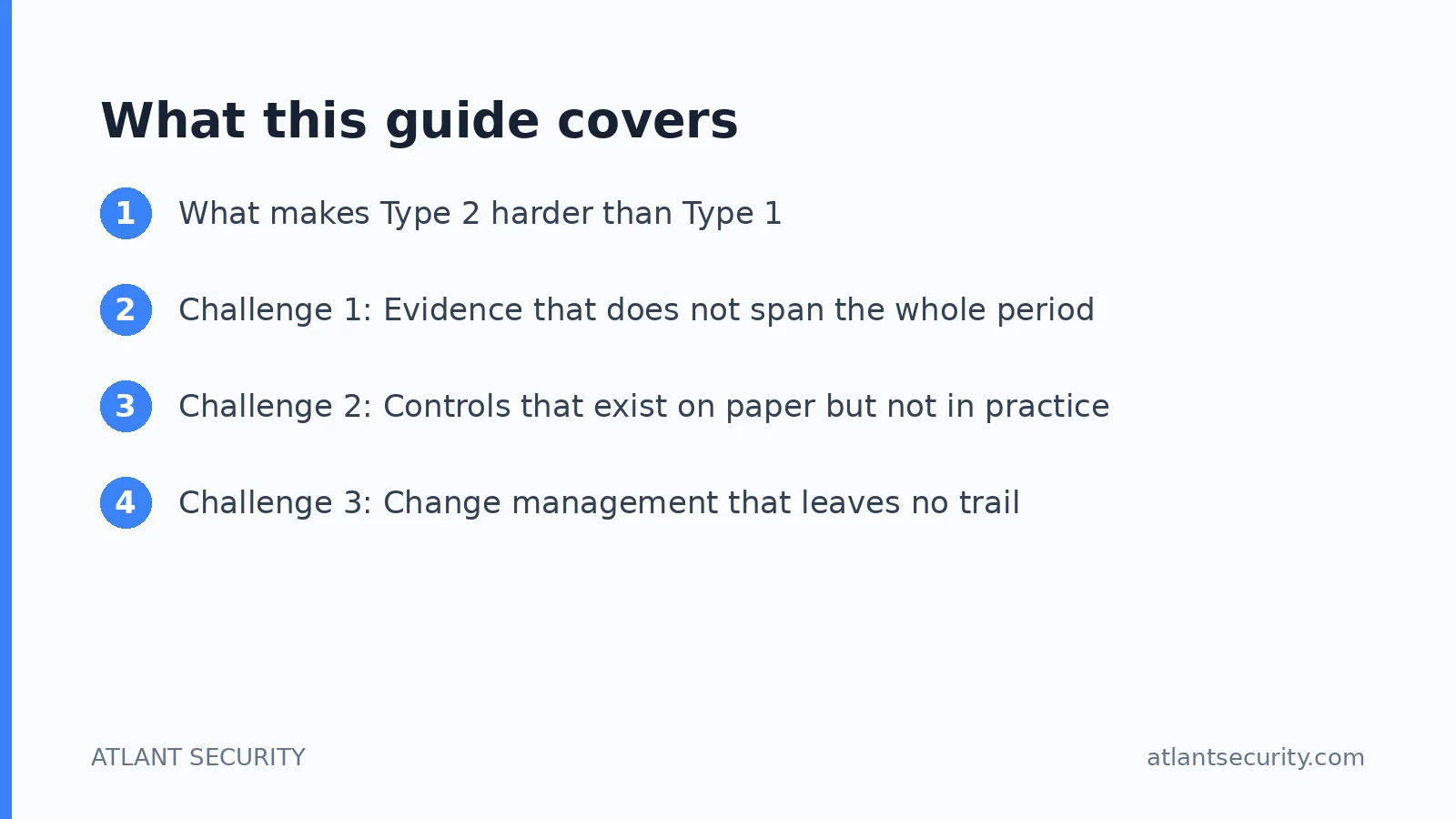
What makes Type 2 harder than Type 1
A Type 1 report is a snapshot. An auditor confirms that your controls are suitably designed on a given date, and you can often reach that point quickly. A Type 2 report covers an observation window, commonly three to twelve months, during which the auditor samples evidence to confirm that each control ran as described the entire time. You cannot fake a period of operation retroactively. If your access reviews did not happen in month two, no amount of last-minute effort recovers that sample.
That single fact drives almost every challenge below. Type 2 rewards teams that build controls into how they already work and punishes teams that treat compliance as a project with an end date.
Challenge 1: Evidence that does not span the whole period
The most common Type 2 failure is gaps in evidence. A control that ran in month one and month six but has nothing in between produces an exception. Auditors sample across the period, and missing samples are treated as the control not operating.
What to do:
- Turn on comprehensive logging before the observation window starts, not partway through. Cloud audit logs, access logs, and change history should be capturing from day one.
- Automate recurring controls so evidence is generated on schedule rather than when someone remembers. Access reviews, backup checks, and vulnerability scans are the usual offenders.
- Store evidence in one organized location, tagged to the control it supports, so retrieval during fieldwork is trivial.
Challenge 2: Controls that exist on paper but not in practice
Policies are easy to write and hard to live by. Many teams document an elegant control set, then operate nothing like it. The auditor tests operation, not intention, so the gap between the written policy and daily reality becomes a list of exceptions.
Before your window opens, walk each control and ask: does this actually happen, on this cadence, with a record? If the answer is no, either change the practice or change the policy so the two match. A control you cannot sustain is worse than no control, because you have now promised something the evidence will contradict.
Challenge 3: Change management that leaves no trail
Fast-moving SaaS teams ship constantly, and SOC 2 wants to see that changes to production are reviewed, approved, and traceable. The challenge is doing this without grinding engineering to a halt. Teams that bolt on a heavyweight approval process end up bypassing it under deadline pressure, which produces exceptions.
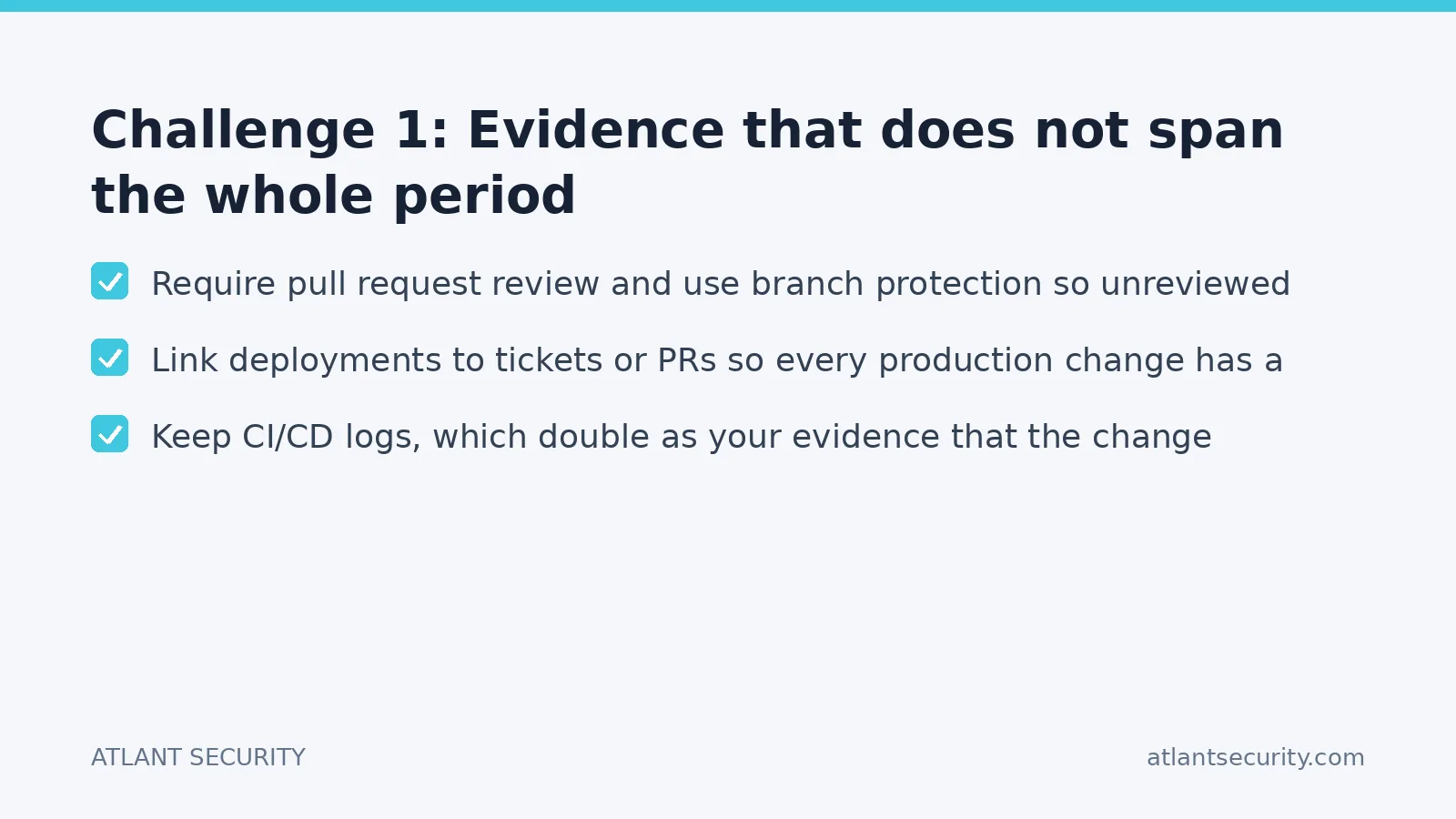
The sustainable approach is to make your existing tooling the control:
- Require pull request review and use branch protection so unreviewed code cannot reach production.
- Link deployments to tickets or PRs so every production change has a traceable origin.
- Keep CI/CD logs, which double as your evidence that the change process ran on every deploy.
When the control is the workflow engineers already follow, evidence collects itself and drift stays low.
Challenge 4: Access reviews that slip
User access reviews are one of the most frequently sampled controls and one of the most frequently missed. The requirement is simple: on a defined cadence, someone reviews who has access to what and removes what is no longer needed. The failure is equally simple: the review is scheduled quarterly, month five arrives, and nobody ran the second quarter.
Make access reviews a calendared, owned task with a recorded outcome. Centralize identity through single sign-on so the review has one place to look rather than a dozen separate consoles. Capture the evidence: who reviewed, when, what changed. An Active Directory security assessment or an identity review can also expose the stale access that would otherwise surface as an audit exception.
Challenge 5: Vendor and subservice management
Your SaaS runs on other people's infrastructure, and SOC 2 expects you to manage that dependency. Auditors look for a current vendor inventory, evidence that you reviewed the assurance your critical vendors provide, and confirmation that you perform the complementary user entity controls their reports assume. Teams routinely leave this until fieldwork and then cannot produce reviewed vendor reports.
Keep a live inventory of vendors that touch customer data, collect and actually read their SOC 2 or ISO 27001 evidence, and diarize an annual re-review. This is the same discipline as vendor risk in your risk assessment, and doing it once serves both.
Challenge 6: Configuration drift over the audit period
You can pass the design phase with a clean environment and still fail operation because the environment drifted. A public storage bucket that appears in month four, an over-permissive security group added during an incident, an MFA exception granted "temporarily" - each becomes an exception if it lands in a sample.
Continuous monitoring is the answer. Use cloud posture tooling to detect misconfigurations as they happen, alert on them, and remediate quickly with a record of the fix. For teams on AWS, Azure, or GCP, structured cloud security consulting keeps drift under control across the whole window rather than surfacing it at fieldwork.
Challenge 7: Under-resourcing the effort
SOC 2 Type 2 is not a task you assign to one engineer as a side project. It touches engineering, IT, HR, and leadership, and it runs for months. The teams that struggle are the ones that never gave it a clear owner or budget. The teams that succeed treat it as a program with an accountable leader, even if that leader is fractional.
Many SaaS companies do not have a full-time security executive and do not need one yet. A virtual CISO gives you that leadership and the day-to-day drive to keep controls operating across the audit period, without the cost of a full-time hire.
Challenge 8: Incident response you cannot evidence
SOC 2 expects a defined incident response process and, crucially, evidence that it works. The trap is subtle: many teams have a capable engineering culture that handles incidents well in practice but leaves no record an auditor can sample. If you resolved a production issue at 2am over a chat thread and never logged it against your incident process, from the auditor's perspective the control did not operate.
Make the process lightweight enough that people actually follow it. A simple, mandatory step of opening an incident ticket, recording severity, actions taken, and resolution is usually enough. If you ran a tabletop exercise or a post-incident review during the period, keep the notes. These are exactly the artifacts a sampler looks for, and they double as genuinely useful operational hygiene. A penetration test during the window also produces a natural, well-documented event you can point to as evidence that detection and response work.
Documentation is the foundation, not an afterthought
Underneath every control is a policy that describes it, and auditors read those policies against what your evidence shows. Thin, generic, or contradictory policies create friction throughout fieldwork because the examiner has to reconcile what you wrote against what you did. The fix is not more documentation; it is accurate documentation. Write policies that describe how you actually operate, keep them versioned, and have them reviewed and approved on a cadence you can evidence. When policy and practice agree, the auditor's job (and yours) gets far simpler. Keeping the evidence together across the observation window is the hard part; Venvera's SOC 2 build is built around exactly that.
Type 1 versus Type 2 at a glance
| Dimension | SOC 2 Type 1 | SOC 2 Type 2 |
|---|---|---|
| What it tests | Control design at a point in time | Control operation over a period |
| Typical timeline | Weeks once controls are in place | Three to twelve month observation window |
| Evidence needed | Controls exist and are designed well | Controls ran consistently throughout |
| Hardest part | Getting controls documented | Sustaining them without gaps |
| What buyers prefer | Accepted as interim proof | The report enterprises really want |
How to set yourself up to pass
The pattern across every challenge above is the same: build controls into how you already operate, start evidence collection before the window opens, and give the program a real owner. Concretely:
- Run a readiness assessment first so you fix gaps before the clock starts, not during it.
- Instrument logging and automate recurring controls before day one of the observation window.
- Make change management and access reviews part of existing workflows, not separate chores.
- Keep a live vendor inventory and monitor configuration continuously.
- Assign an accountable owner, full-time or fractional, to keep it all running.
If you want a candid picture of where you stand before committing to a Type 2 window, an IT security audit or a focused readiness review will tell you which controls will actually hold up under sampling.
Frequently Asked Questions
How long does a SOC 2 Type 2 observation period need to be?
Typically between three and twelve months. Many companies choose a three-month window for their first Type 2 to get a report to market faster, then move to a twelve-month cycle. The right length depends on customer expectations and how mature your controls already are.
Should we do Type 1 before Type 2?
Often, yes. A Type 1 report confirms your control design and gives you something to show enterprise buyers while the Type 2 window runs. It is not mandatory, but it de-risks the larger effort and provides interim proof to procurement teams.
What causes the most exceptions in a Type 2 audit?
Gaps in evidence across the period. A control that ran at the start and end but has nothing in the middle is treated as not operating. Missed access reviews, unlogged changes, and configuration drift are the usual sources.
Can a small SaaS company realistically pass SOC 2 Type 2?
Yes. Small teams often pass more cleanly than large ones because their environment is simpler and their controls are easier to keep consistent. The deciding factor is discipline and ownership, not headcount. A fractional security leader can supply both.
Do we need to automate everything?
No, but automate the recurring controls that are easy to forget: access reviews, backups, vulnerability scans, and evidence collection. Automation is not about tooling for its own sake; it is about removing the human memory failures that create evidence gaps.
Plan the work before the clock starts
SOC 2 Type 2 is very achievable for a SaaS company that prepares properly and treats controls as part of daily operations rather than a one-off scramble. The companies that struggle are the ones that start the observation window before they are ready. If you want help scoping the effort, closing gaps, and keeping controls operating cleanly through the audit period, reach out and we will map a realistic path to a clean report.