

Every risk assessment I have ever run stalls in the same place: not on the math, not on the tooling, but on language. The board hears "risk" and pictures one thing. The IT lead hears it and pictures another. The auditor means something more specific than either. After 200-plus security assessments across 14 countries, I can tell you that most bad risk decisions are not caused by bad analysis. They are caused by two people using the same word to mean two different things and never noticing.
This guide is the glossary I wish every client had read before we sat down together. It is not a dictionary dump. It walks the terms in the order they actually appear when you assess risk, and it explains why the distinctions matter in practice, not just on paper. If you are a founder, an IT manager, a compliance owner, or a board member who has to sign off on a security budget, this is the vocabulary that lets you challenge the numbers instead of nodding along to them.
Why terminology is the real bottleneck
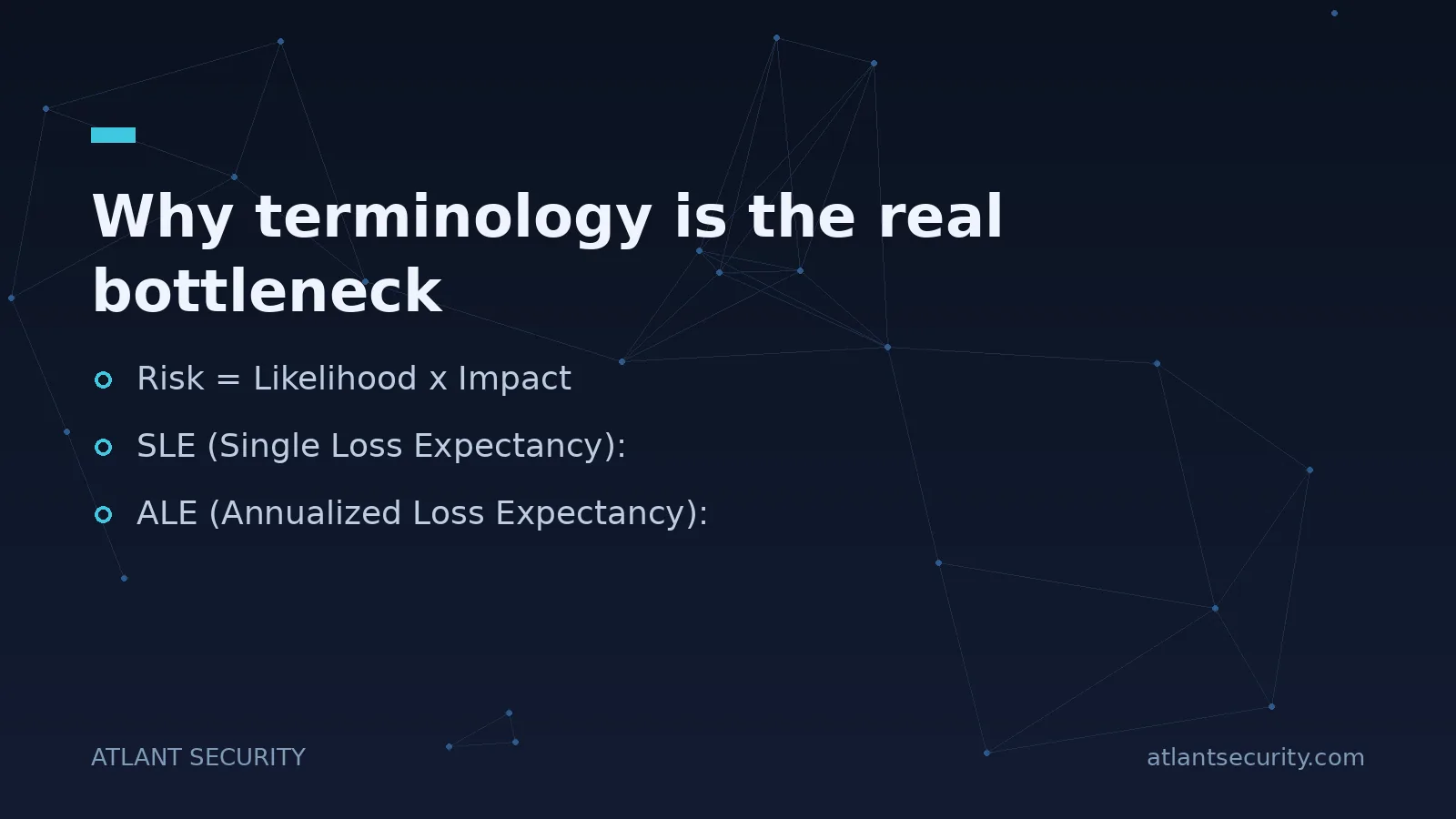
A risk assessment is, at bottom, a structured argument: here is what could go wrong, here is how likely it is, here is what it would cost us, and here is what we should do about it. If the words carrying that argument are fuzzy, the whole thing collapses into vibes. I have watched a company spend heavily mitigating a "critical risk" that, once we pinned down the terms, turned out to be a low-likelihood event with trivial impact. The label was doing the work that analysis should have done.
Get the vocabulary right and three things happen. Meetings get shorter because people stop talking past each other. Prioritization gets honest because you can compare items on the same scale. And your reports survive contact with an auditor, because regulators and frameworks such as ISO 27001 and SOC 2 use these terms precisely and expect you to as well.
The core building blocks
Start here. Almost every other term in risk management is built from these five.
- Asset: Anything of value you are trying to protect. Customer data, a payment system, source code, a domain name, even the reputation attached to your brand. If losing it would hurt, it is an asset. The mistake I see most often is a company that inventories servers but forgets that the customer database living on them is the asset that actually matters.
- Threat: A potential cause of harm. A ransomware crew, a disgruntled employee, a flood in the data center, a careless contractor. A threat is the actor or event, not the weakness it exploits.
- Vulnerability: A weakness that a threat can use. An unpatched server, a reused password, a misconfigured cloud bucket, a staff member who has never been trained to spot phishing. Threats without vulnerabilities cause no damage. Vulnerabilities without threats sit harmlessly. Risk lives where the two meet.
- Likelihood: How probable it is that a given threat exploits a given vulnerability within a defined timeframe. Usually expressed as a qualitative band (low, medium, high) or a probability if you have the data.
- Impact: The magnitude of harm if it happens. Financial loss, downtime, regulatory fines, legal exposure, lost customers. Impact is what makes a risk worth caring about.
The one-line formula that ties them together: Risk = Likelihood x Impact, where likelihood is a function of the threat meeting a vulnerability. Everything else in this guide is a refinement of that sentence.
Threat, vulnerability, and risk: the distinction that decides your budget
These three get blurred constantly, and the blur costs money. Here is the clean version.
A threat is largely outside your control. You cannot stop ransomware groups from existing or stop it from raining. A vulnerability is almost entirely inside your control. You can patch, configure, train, and segment. Risk is the product of the two, and it is where you decide to spend.
This matters because you cannot reduce a threat, but you can reduce a vulnerability, and reducing the vulnerability is what lowers the risk. When a vendor tries to sell you a product to "stop the threat," translate it: which specific vulnerability does this close, and how much does that move the risk? If they cannot answer, you are buying a feeling. A proper vulnerability assessment exists precisely to map the weaknesses you can actually act on, rather than the threats you cannot.
Inherent risk, residual risk, and controls
This trio is where risk assessments earn their keep, and where most homegrown spreadsheets go wrong.
- Control: A safeguard that reduces likelihood or impact. Controls come in three flavors. Preventive controls stop an event (multi-factor authentication, firewalls). Detective controls catch it in progress (logging, intrusion detection). Corrective controls limit the damage and restore operations (backups, incident response plans).
- Inherent risk: The level of risk before any controls are applied. The raw exposure. What would happen if you did nothing.
- Residual risk: The level of risk that remains after your controls are in place. This is the number that actually matters, because it is the risk you are living with right now.
The gap between inherent and residual risk is the value your controls deliver. When a board asks "what does our security spend buy us," the honest answer is the size of that gap. And residual risk is never zero. Anyone who tells you they eliminated a risk is either misusing the word or selling something.
What to do with a risk once you have measured it
Every identified risk gets one of four treatments. These are the standard risk-response options, and a mature program can name which one applies to each item on its register.
| Response | What it means | Typical example |
|---|---|---|
| Mitigate (reduce) | Apply controls to lower likelihood or impact. | Patch systems, enforce MFA, segment the network. |
| Transfer (share) | Move some of the financial burden to a third party. | Buy cyber insurance, use a managed provider with liability terms. |
| Avoid | Stop the activity that creates the risk. | Retire a legacy system, drop a feature that stores sensitive data. |
| Accept | Decide the residual risk is tolerable and document the decision. | A low-impact risk where the fix costs more than the exposure. |
Acceptance is a legitimate, professional choice, not a failure. But it must be a documented, named decision made by someone with the authority to own the consequences. That brings us to the next term.
Risk appetite, risk tolerance, and the risk register
- Risk appetite: The amount and type of risk an organization is willing to pursue in order to meet its objectives. This is a leadership statement, not a technical one. A high-growth fintech has a different appetite than a hospital.
- Risk tolerance: The acceptable variation around that appetite for a specific risk. Tighter than appetite, and usually expressed with thresholds. "We tolerate up to four hours of downtime for the marketing site, zero for the payments API."
- Risk register: The living document where every identified risk is recorded with its likelihood, impact, owner, chosen response, and status. If your risk assessment produces a slide deck but not a register, you produced awareness, not management.
- Risk owner: The named individual accountable for a specific risk. Not the person who fixes it, the person answerable for whether it gets fixed. Unassigned risks are the ones that rot.
Qualitative versus quantitative assessment
How you score risk shapes how much you can trust the results.
Qualitative assessment uses descriptive bands: low, medium, high, or a color grid. It is fast, requires no historical data, and is perfect for getting a first pass across a whole environment. Its weakness is that "high" means whatever the person filling in the cell felt that day.
Quantitative assessment puts numbers on it. Two terms you will meet here:
- SLE (Single Loss Expectancy): The financial loss from a single occurrence of the risk. Asset value multiplied by the exposure factor (the percentage of the asset lost in one event).
- ALE (Annualized Loss Expectancy): The expected yearly cost. SLE multiplied by the ARO (Annualized Rate of Occurrence, how many times per year you expect it). ALE is the number you compare against the annual cost of a control to see whether the control is worth buying.
In practice, most organizations run qualitative for breadth and switch to quantitative for the handful of top risks where a real budget decision hangs on the answer. You do not need to quantify everything. You need to quantify what you are about to spend serious money on.
Terms that get misused most often
A few clarifications that resolve most of the confusion I see in client conversations:
- Threat versus risk: Ransomware is a threat. "A meaningful chance that ransomware encrypts our unbacked-up file server, costing us a week of downtime" is a risk. If you cannot attach a likelihood and an impact, you are naming a threat, not a risk.
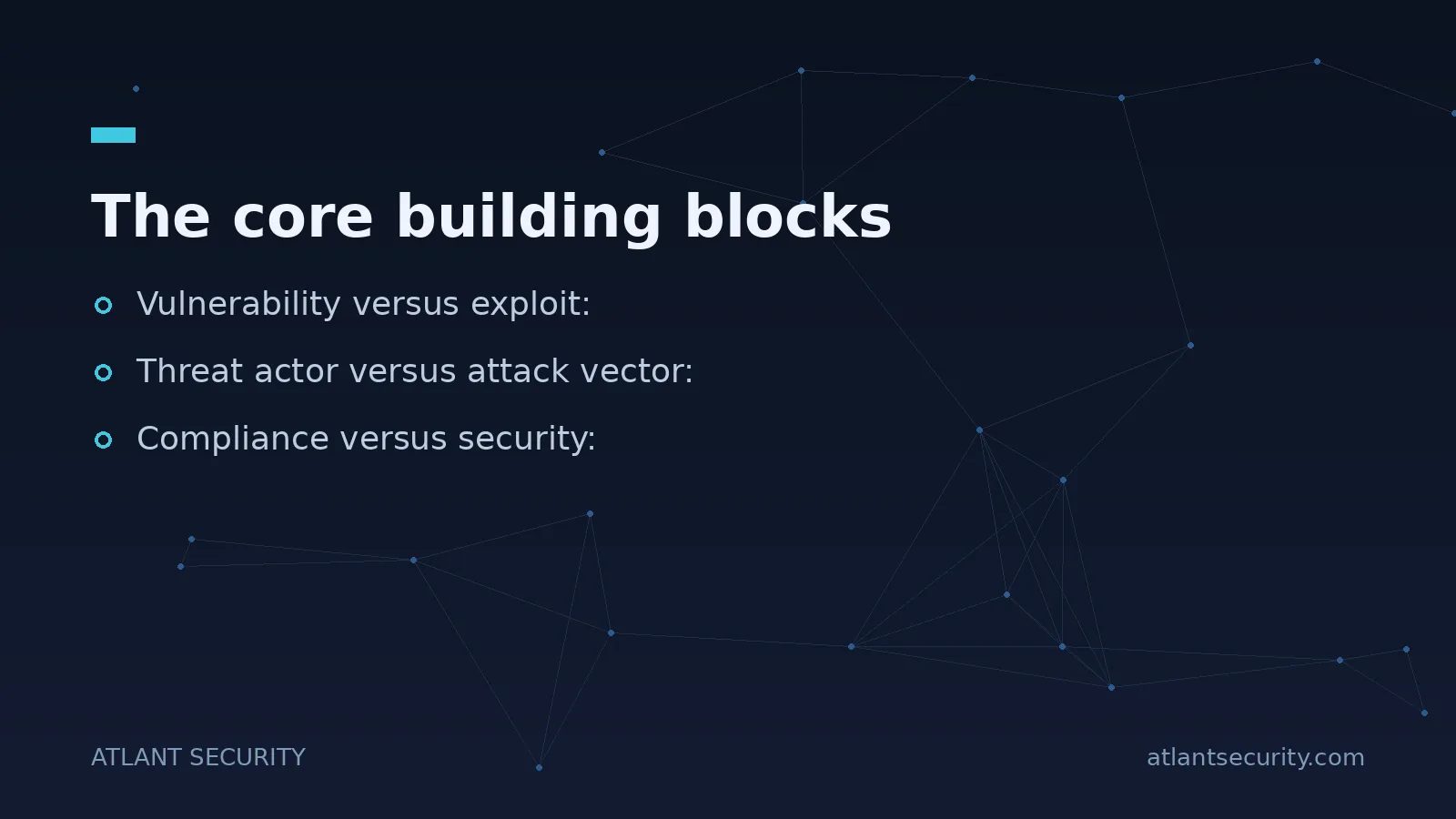
- Vulnerability versus exploit: A vulnerability is the open window. An exploit is the specific technique someone uses to climb through it.
- Incident versus breach: An incident is any event that threatens security. A breach is a confirmed incident where data was actually accessed or exfiltrated. Every breach is an incident; not every incident is a breach. Regulators care intensely about the difference.
- Threat actor versus attack vector: The actor is who or what (a criminal group, an insider). The vector is the path they use (a phishing email, an exposed API).
- Compliance versus security: Compliance means you meet a defined standard. Security means you are actually hard to compromise. They overlap, but passing an audit is not the same as being safe, and I have seen fully compliant companies breached the same quarter.
Putting the vocabulary to work
Terminology only earns its keep when it changes what you do. Here is the sequence a competent assessment follows, using the words above in order: inventory your assets, identify credible threats to each, find the vulnerabilities those threats could exploit, estimate likelihood and impact to get inherent risk, apply controls, recalculate to get residual risk, compare that against your risk appetite, choose a response for each item, assign a risk owner, and record everything in the risk register. Then review it on a schedule, because every one of those inputs changes over time.
If that sequence sounds like a lot to run internally, it is, and the language above is the easy part. Turning it into defensible scores and a remediation plan is the work. A structured IT security audit gives you the assets, vulnerabilities, and residual-risk picture in one pass, and if you are pursuing a certification, aligning the whole exercise with ISO 27001 readiness or SOC 2 means your terminology and your evidence already speak the auditor's language. When you would rather have someone own the risk register and the leadership conversation for you, that is exactly what a virtual CISO does.
Frequently Asked Questions
What is the difference between a threat and a risk?
A threat is a potential cause of harm, such as a ransomware group or a natural disaster. A risk is the combination of that threat exploiting a specific weakness, expressed with a likelihood and an impact. "Ransomware exists" is a threat. "There is a meaningful chance ransomware encrypts our unprotected servers and costs us a week of downtime" is a risk. If you cannot attach likelihood and impact, you have named a threat, not a risk.
What is residual risk and why does it matter more than inherent risk?
Inherent risk is your exposure before any controls. Residual risk is what remains after your controls are in place, and it is the risk you are actually living with today. It matters more because it reflects reality. Residual risk is also never zero, so any claim that a risk has been fully eliminated is a misuse of the term.
Should I use qualitative or quantitative risk assessment?
Use both. Qualitative scoring (low, medium, high) is fast and lets you cover the whole environment quickly. Quantitative scoring, using figures such as Single Loss Expectancy and Annualized Loss Expectancy, is worth the extra effort for the handful of top risks where a real budget decision depends on the number. Quantify what you are about to spend serious money on, not everything.
What belongs in a risk register?
Each entry should record the risk description, the affected asset, the likelihood and impact scores, the resulting risk rating, the chosen response (mitigate, transfer, avoid, or accept), the named risk owner, and the current status. A register without owners and statuses is a snapshot, not a management tool.
What are the four ways to respond to a risk?
Mitigate (apply controls to reduce it), transfer (share the financial burden through insurance or a third party), avoid (stop the activity that creates it), and accept (formally decide the residual risk is tolerable). Acceptance is a legitimate choice as long as it is documented and made by someone with the authority to own the outcome.
Is compliance the same as being secure?
No. Compliance means you meet the requirements of a defined standard at a point in time. Security means you are genuinely difficult to compromise. The two overlap, and good frameworks push you toward real security, but passing an audit is not proof that you are safe. Treat compliance as a floor, not a finish line.
Ready to turn this vocabulary into a real assessment? Atlant Security runs the full sequence for you, from asset inventory to a prioritized risk register. Explore our IT security audit or book a discovery call to discuss your environment.
