

Most companies do not have a cyber risk problem. They have a cyber risk visibility problem. In more than a decade running security assessments for organizations across 14 countries, the pattern is almost always the same: the business is spending money on security tools, the IT team is busy, everyone assumes the important things are covered, and nobody can actually tell you which risks would hurt the most if they went wrong tomorrow. That gap between activity and clarity is exactly what cyber risk management is supposed to close.
Cyber risk management is the discipline of identifying what could go wrong with your systems and data, deciding how bad each of those scenarios would be, and choosing deliberately what to fix, what to insure, what to transfer, and what to live with. Done well, it turns security from a bottomless spending pit into a set of defensible business decisions. Done badly - or not at all - it leaves you reacting to whichever incident happens to reach you first, usually at the worst possible moment.
This article walks through how I approach cyber risk management in practice: the core process, the elements that separate a real program from a binder full of policies nobody reads, and a concrete way to get started even if you are a small team with no dedicated security staff.
What Cyber Risk Management Actually Means
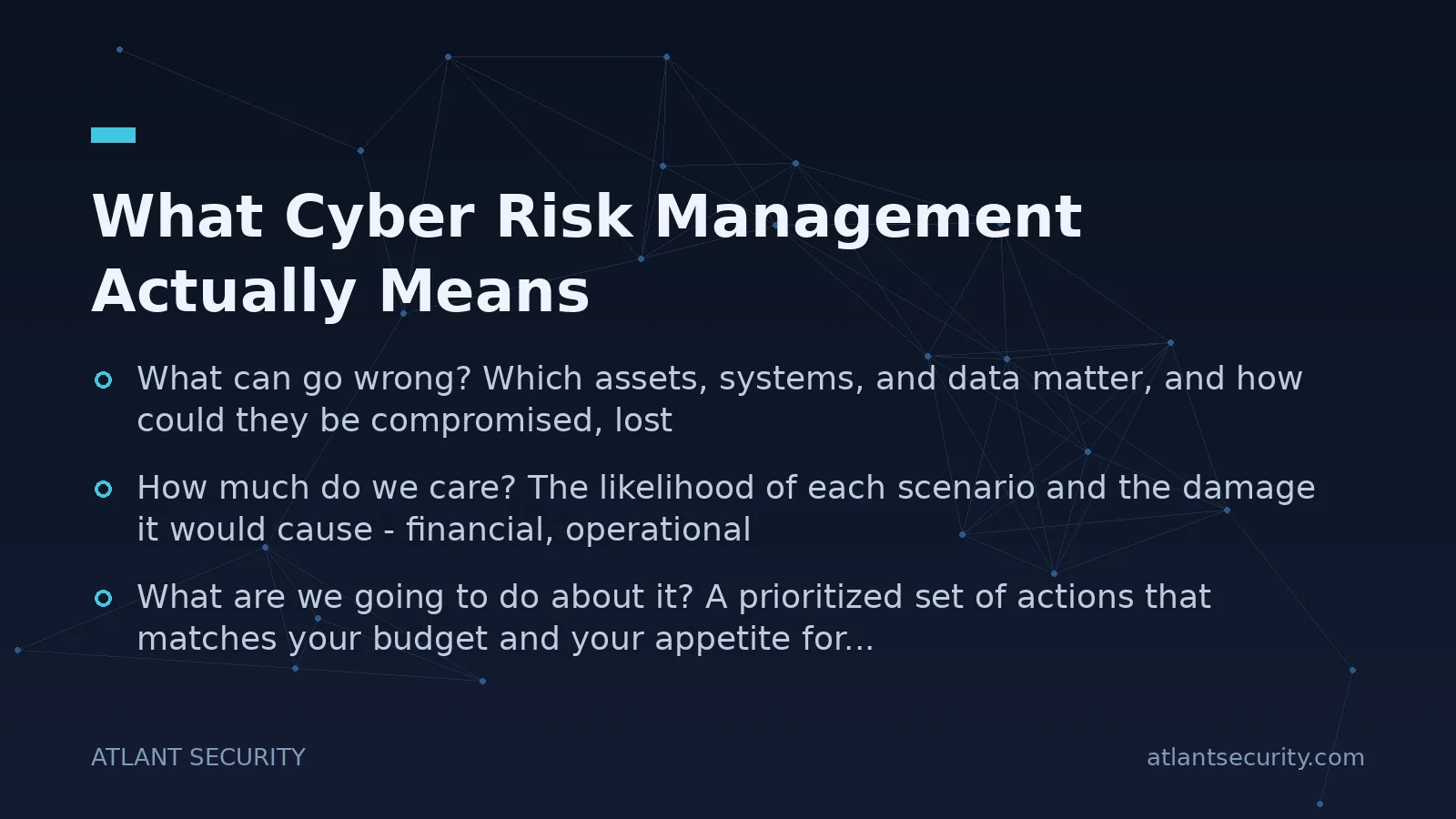
Strip away the jargon and cyber risk management answers three questions for leadership:
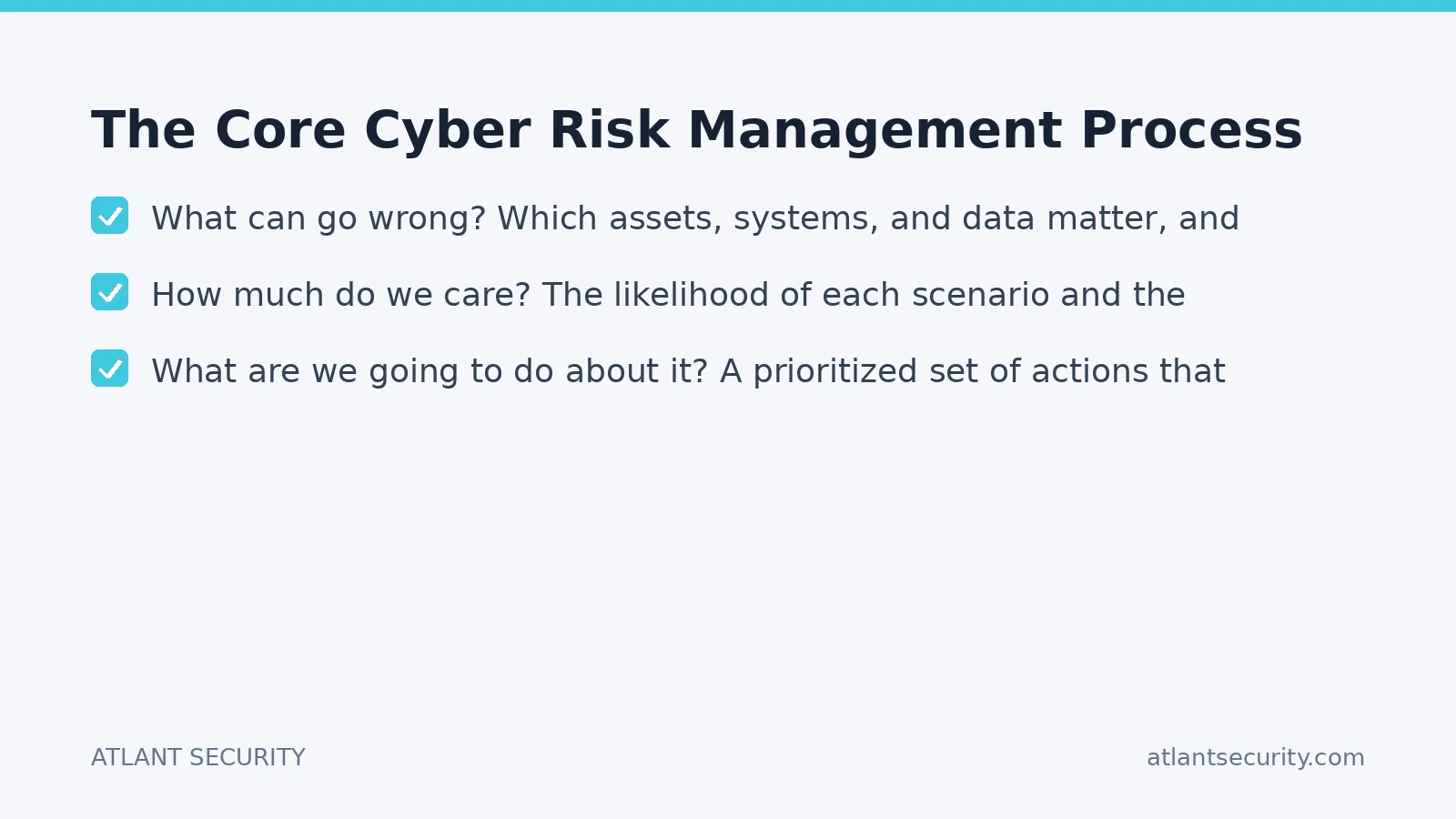
- What can go wrong? Which assets, systems, and data matter, and how could they be compromised, lost, or disrupted.
- How much do we care? The likelihood of each scenario and the damage it would cause - financial, operational, legal, and reputational.
- What are we going to do about it? A prioritized set of actions that matches your budget and your appetite for risk.
The word that matters most there is prioritized. You will never eliminate every risk, and trying to do so bankrupts the security budget on low-value controls while the genuinely dangerous gaps stay open. Risk management is the mechanism that forces those trade-offs into the open, where the business - not the firewall vendor - decides them.
The Core Cyber Risk Management Process
Every credible framework, whether it is NIST, ISO 27005, or FAIR, describes the same underlying loop. The labels differ; the substance does not.
1. Identify the risks
You cannot protect what you have not inventoried. Start with an honest asset inventory: servers, cloud accounts, SaaS applications, endpoints, identities, and above all the data those systems hold. In practice this is where most programs already fall down, because the unofficial systems - the marketing team's third-party tool, the developer's personal cloud account, the finance spreadsheet with everything in it - are exactly the ones that get breached.
For each meaningful asset, ask what threats apply: ransomware, business email compromise, credential theft, insider misuse, misconfiguration, supply-chain compromise, or simple availability loss. Threat identification does not require a crystal ball. It requires looking at what has actually happened to organizations like yours.
2. Assess and prioritize
Once you have a list of plausible risks, score each on two axes: likelihood and impact. You can do this qualitatively (high, medium, low) or quantitatively (estimated annual loss ranges), and for most small and mid-sized businesses a well-argued qualitative scale is enough to start. The output is a ranked list where the top items are the ones that are both plausible and expensive if they happen.
This step is where discipline pays off. It is tempting to rate everything "high" and everything as "urgent." A risk register where everything is critical is useless. The value comes from being able to say, with a straight face, that this handful of risks matters far more than the rest.
3. Treat the risk
For every prioritized risk you have four honest options, and mature organizations use all four:
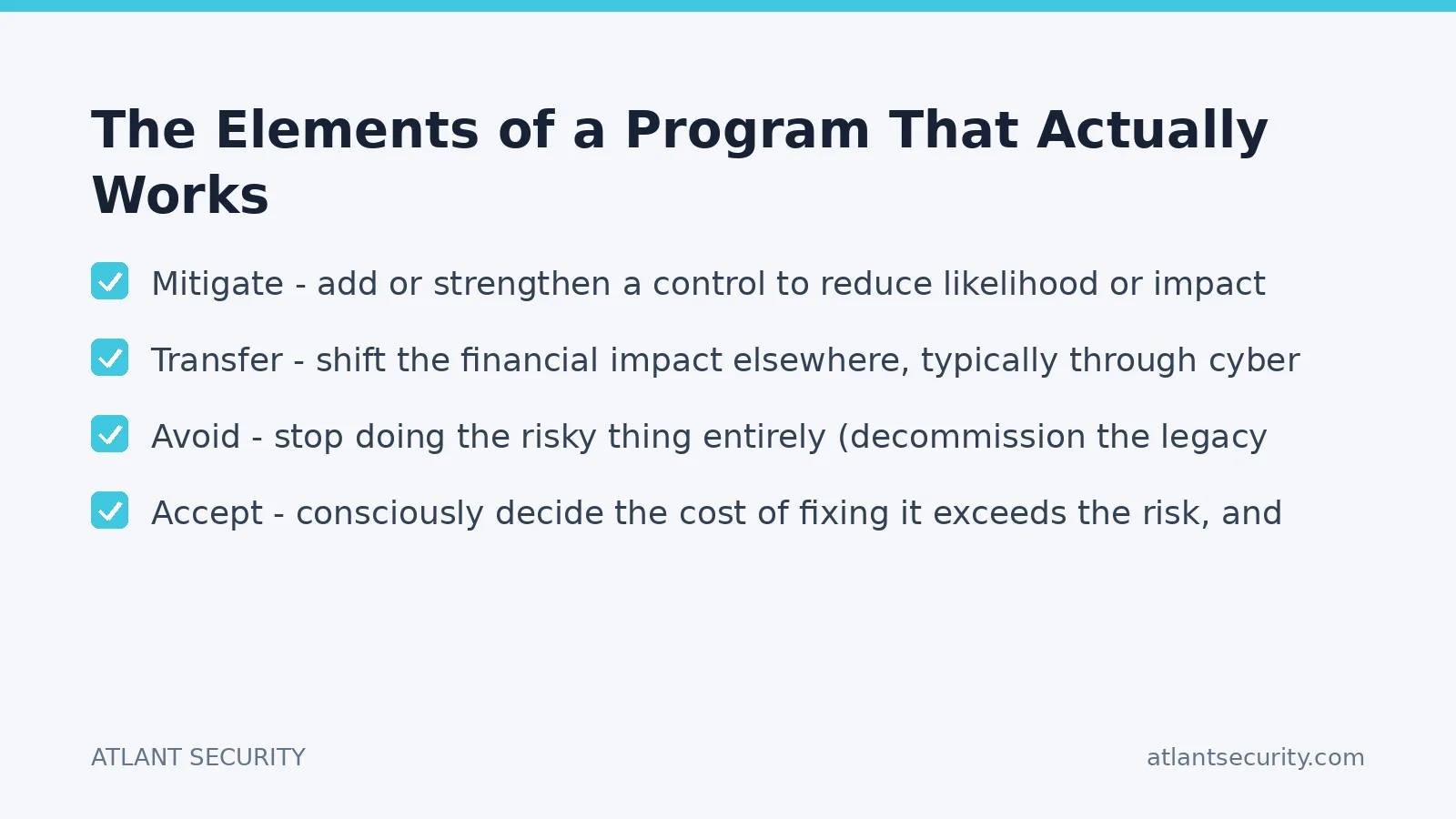
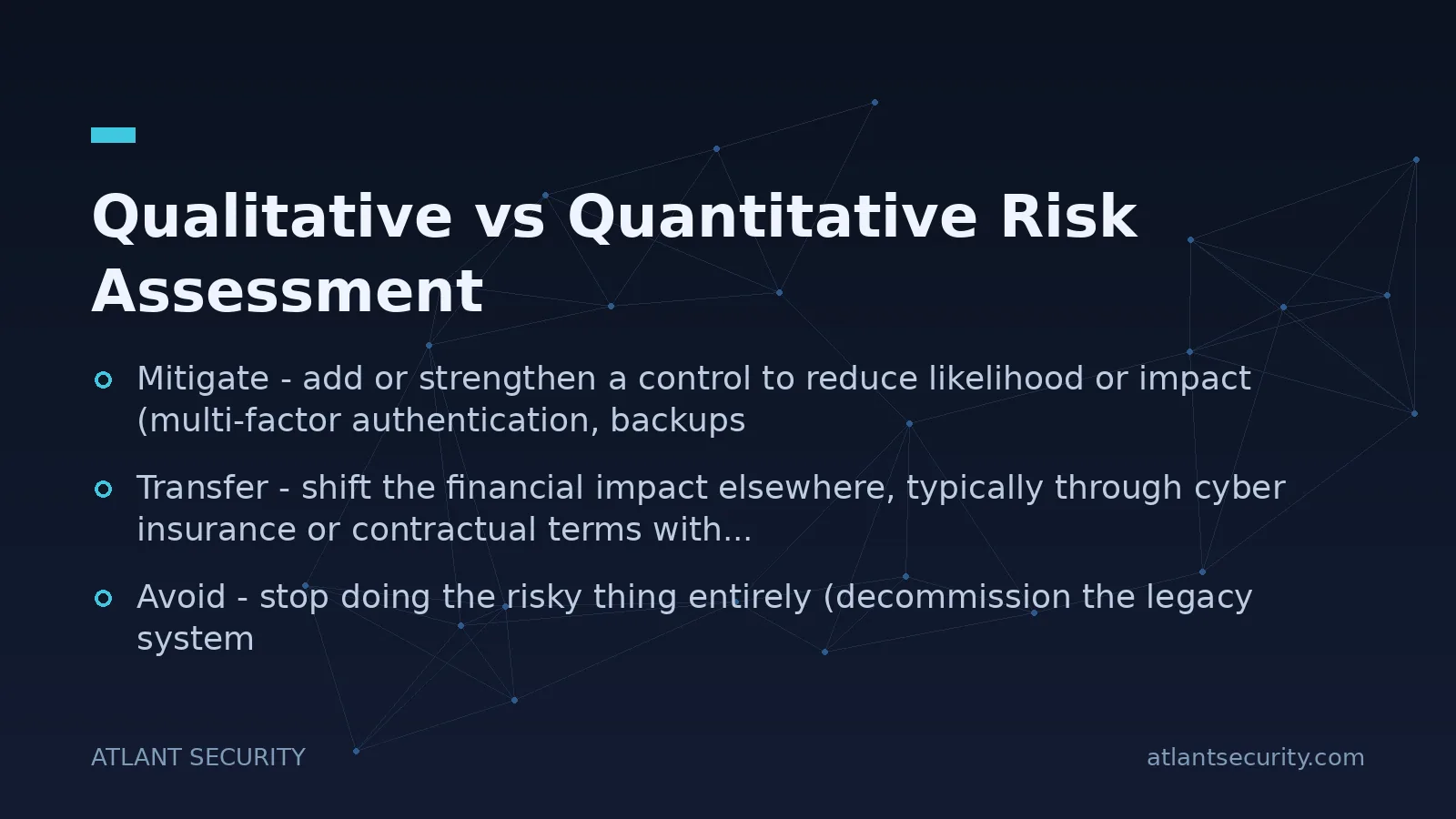
- Mitigate - add or strengthen a control to reduce likelihood or impact (multi-factor authentication, backups, network segmentation, patching).
- Transfer - shift the financial impact elsewhere, typically through cyber insurance or contractual terms with a vendor.
- Avoid - stop doing the risky thing entirely (decommission the legacy system, drop the data you do not need to hold).
- Accept - consciously decide the cost of fixing it exceeds the risk, and document that decision so it was a choice rather than an oversight.
4. Monitor and review
Risk is not static. New systems appear, vendors change, attackers develop new techniques, and controls decay. A risk register reviewed once a year and then forgotten is a compliance artifact, not a management tool. The organizations that stay ahead treat the register as a living document, revisiting it when anything material changes and validating that the controls they counted on still work. This is precisely what a recurring IT security audit is designed to confirm.
The Elements of a Program That Actually Works
A process on paper is easy. What makes cyber risk management effective in the real world is a small number of supporting elements that most organizations skip.
Governance and ownership
Someone must own cyber risk, and that someone should sit close to the business, not buried three layers down in IT. Roles, responsibilities, and escalation paths need to be explicit. In smaller companies without a full-time security leader, this is exactly the gap a virtual CISO fills - providing the executive-level ownership that turns technical findings into board-level decisions.
Asset inventory and classification
You cannot prioritize risk without knowing which assets are crown jewels and which are replaceable. Classify data by sensitivity and systems by criticality. This single step redirects effort away from protecting everything equally and toward protecting what would actually hurt to lose.
Continuous threat and vulnerability assessment
Knowing your weaknesses in concrete terms beats guessing. Regular vulnerability assessment and, where the stakes justify it, penetration testing convert abstract worry into a specific, fixable list. There is a meaningful difference between "we might have exposure" and "this internet-facing server is missing a patch that is being actively exploited."
Incident response readiness
Risk management assumes some incidents will get through. A tested incident response plan - with named roles, communication paths, and offline backups you have actually restored from - is the difference between a bad week and an existential crisis. The plan you never test is the plan that fails you.
Reporting that leadership understands
The final element is translation. Executives and boards do not need packet captures; they need to know which risks are open, what it would cost to close them, and what the business is choosing to accept. Risk management that cannot communicate upward never gets funded.
Qualitative vs Quantitative Risk Assessment
One of the most common questions I get is which assessment method to use. Here is how the two compare in practice.
| Factor | Qualitative | Quantitative |
|---|---|---|
| Output | High / medium / low ratings | Estimated loss in currency |
| Speed | Fast to produce | Slower, data-hungry |
| Best for | Getting started, smaller teams | Budget justification, board decisions |
| Main weakness | Subjective, hard to compare | Depends on data you may not have |
My advice for most organizations: start qualitative to build the register and get moving, then apply quantitative analysis to the top handful of risks where you need to justify real spending. Perfect precision is not the goal; better decisions are.
How to Build Your Cyber Risk Management Strategy
If you are starting from close to zero, here is the sequence I recommend, in order.
- Assign ownership. Name the person accountable for cyber risk before anything else. Without an owner, the rest stalls.
- Build the inventory. List systems, cloud accounts, SaaS tools, and the data each holds. Accept that version one will be incomplete and improve it continuously.
- Run an honest assessment. Identify the plausible risks, score likelihood and impact, and produce a ranked register. Bring in outside eyes if internal ones are too close to the systems to see the gaps.
- Decide treatment for the top risks. Mitigate, transfer, avoid, or accept - and write the decision down for each.
- Close the highest-value gaps first. Multi-factor authentication, tested backups, patching, and least-privilege access resolve a disproportionate share of real-world risk for very little money.
- Review on a schedule and after every material change. Quarterly is a reasonable default for most mid-sized businesses; more often if you are growing fast or handling regulated data.
Notice how much of this costs time and attention rather than money. The organizations that manage cyber risk well are rarely the ones that spent the most. They are the ones that were deliberate.
Where Compliance Fits In
Frameworks like SOC 2, ISO 27001, HIPAA, PCI DSS, and NIS2 are, at heart, structured risk management with an external auditor checking your work. If you already run a genuine risk program, compliance becomes a matter of documenting what you do rather than inventing controls under deadline pressure. If you are pursuing certification, aligning your risk process to the relevant framework early saves enormous pain later - whether that is SOC 2 readiness, ISO 27001 readiness, or NIS2 compliance. Treat the framework as a byproduct of good risk management, not the goal itself, and both improve.
Frequently Asked Questions
What is the difference between cyber risk management and cybersecurity?
Cybersecurity is the set of controls and technologies that protect your systems. Cyber risk management is the decision-making layer above it that decides which controls are worth having, in what order, and why. Security answers "how do we defend this?" Risk management answers "what should we defend, and how much should we spend?"
How often should we review our cyber risk register?
At minimum quarterly for most organizations, and immediately whenever something material changes - a new system, a new vendor with access to your data, an acquisition, or a significant incident anywhere in your industry. A register reviewed once a year is a compliance artifact, not a live management tool.
Do small businesses really need formal risk management?
Yes, though it should be proportionate. A ten-person company does not need the apparatus of a bank, but it absolutely needs to know which three or four scenarios would put it out of business and what it is doing about them. The process scales down cleanly; skipping it does not.
Should we quantify risk in financial terms?
For your top handful of risks, yes - it is the language leadership uses to make budget decisions. For the long tail of lower risks, a qualitative rating is faster and good enough. Do not let the pursuit of perfect numbers delay obvious fixes.
Can we manage cyber risk without a full-time security leader?
Many organizations do, by combining internal ownership with periodic outside expertise. A fractional or part-time CISO can provide the governance and prioritization that the role requires without the cost of a full-time executive hire.
Turning Risk Into Decisions
Cyber risk management is not about achieving perfect security, because that does not exist. It is about replacing guesswork and anxiety with a clear, prioritized view of what could hurt you and a deliberate plan for each item. That clarity is what lets leadership fund the right things, ignore the noise, and sleep at night.
If you want an independent, experienced read on where your real exposure sits - and a prioritized roadmap you can actually act on - get in touch with Atlant Security. We have spent more than a decade turning vague security worry into concrete, defensible decisions, and we can do the same for your organization.
