
We have probably seen your problem before. Our smallest client had eight employees. Our largest secures the nuclear power plant of the United Arab Emirates. Whatever shape yours is, tell us about it and we will tell you how we would fix it.
A temporary CISO is exactly what it sounds like: an experienced security executive who steps into your organisation for a defined period rather than as a permanent hire. People call the same thing by different names, fractional CISO, virtual CISO, vCISO, interim CISO, but the core idea is consistent. You get senior security leadership when you need it, scoped to the problem in front of you, without committing to a six-figure permanent salary before you know what the role should look like.
I have filled this role for companies across more than a dozen countries, usually in one of two situations: a security leader left unexpectedly and there is a gap to cover, or a customer or regulator has demanded security maturity the company does not yet have in-house. In both cases the value of a temporary CISO is speed and depth, an experienced pair of hands that has done this before and does not need six months to find the light switches. This article lays out where that model works, where it does not, and how to decide if it fits your organisation.
What a Temporary CISO Actually Does
A temporary CISO delivers the substance of a full-time chief information security officer for as long as you need it. The work usually starts the same way regardless of the trigger: assess the current state, then build a plan.
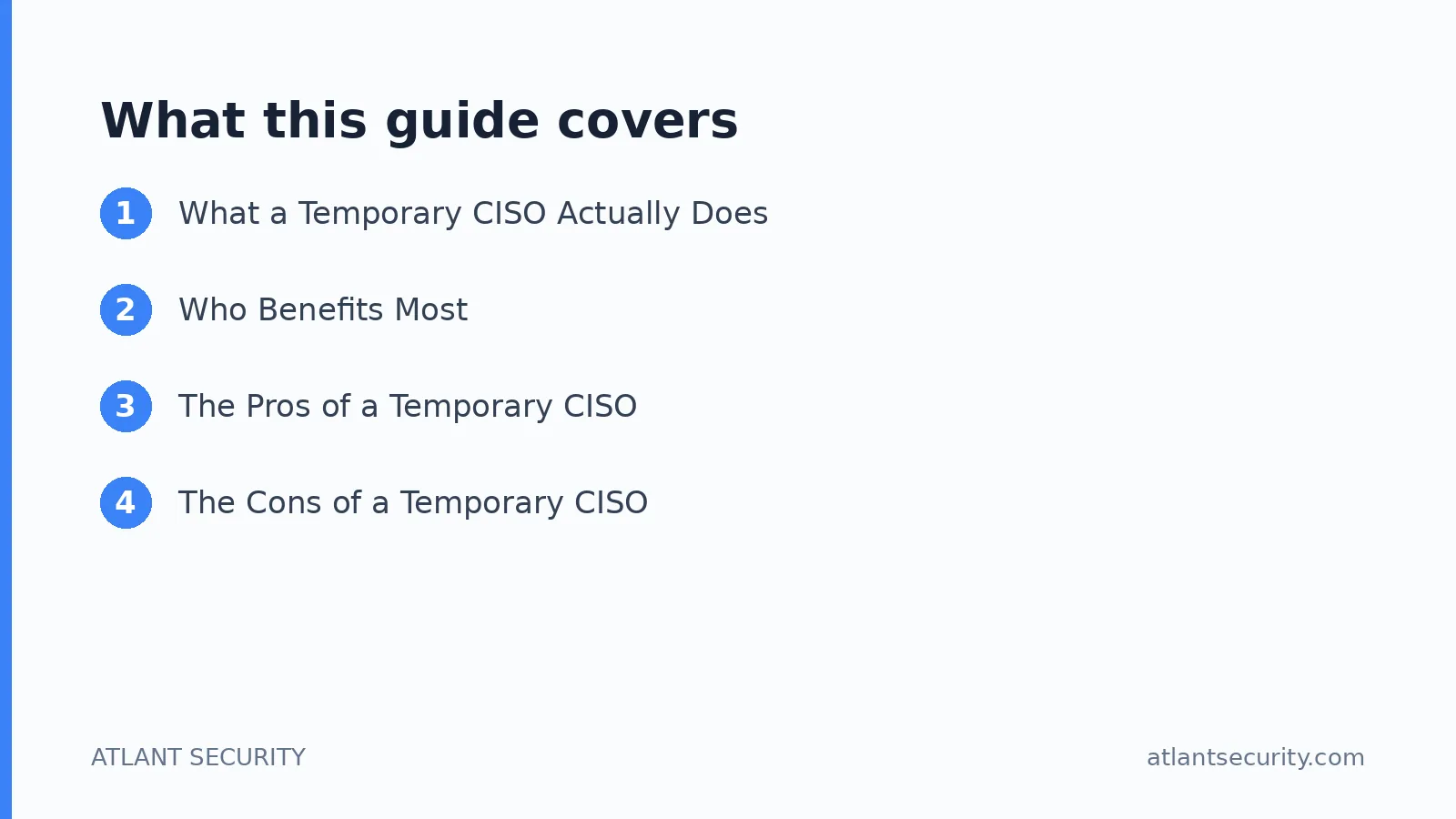
A typical engagement moves through these phases:
- Assessment: review the existing security posture, infrastructure, policies, and the risks specific to your business and industry.
- Prioritisation: translate findings into a ranked roadmap, so limited budget and time go to the controls that reduce the most risk.
- Execution oversight: drive implementation of the priority controls, working with your internal IT team or external providers.
- Governance: establish or tighten the policies, reporting, and decision-making that keep security running after the engagement ends.
- Stakeholder support: answer customer security questionnaires, support audits, and brief leadership or the board.
The plan should be tailored, not a generic template. A payments startup, a healthcare provider, and a manufacturing business face different threats and different obligations, and the roadmap should reflect that. If you want a sense of how this is delivered in practice, our virtual CISO service and part-time CISO options describe the typical scope.
Who Benefits Most
The temporary CISO model is not for everyone. It fits best when:
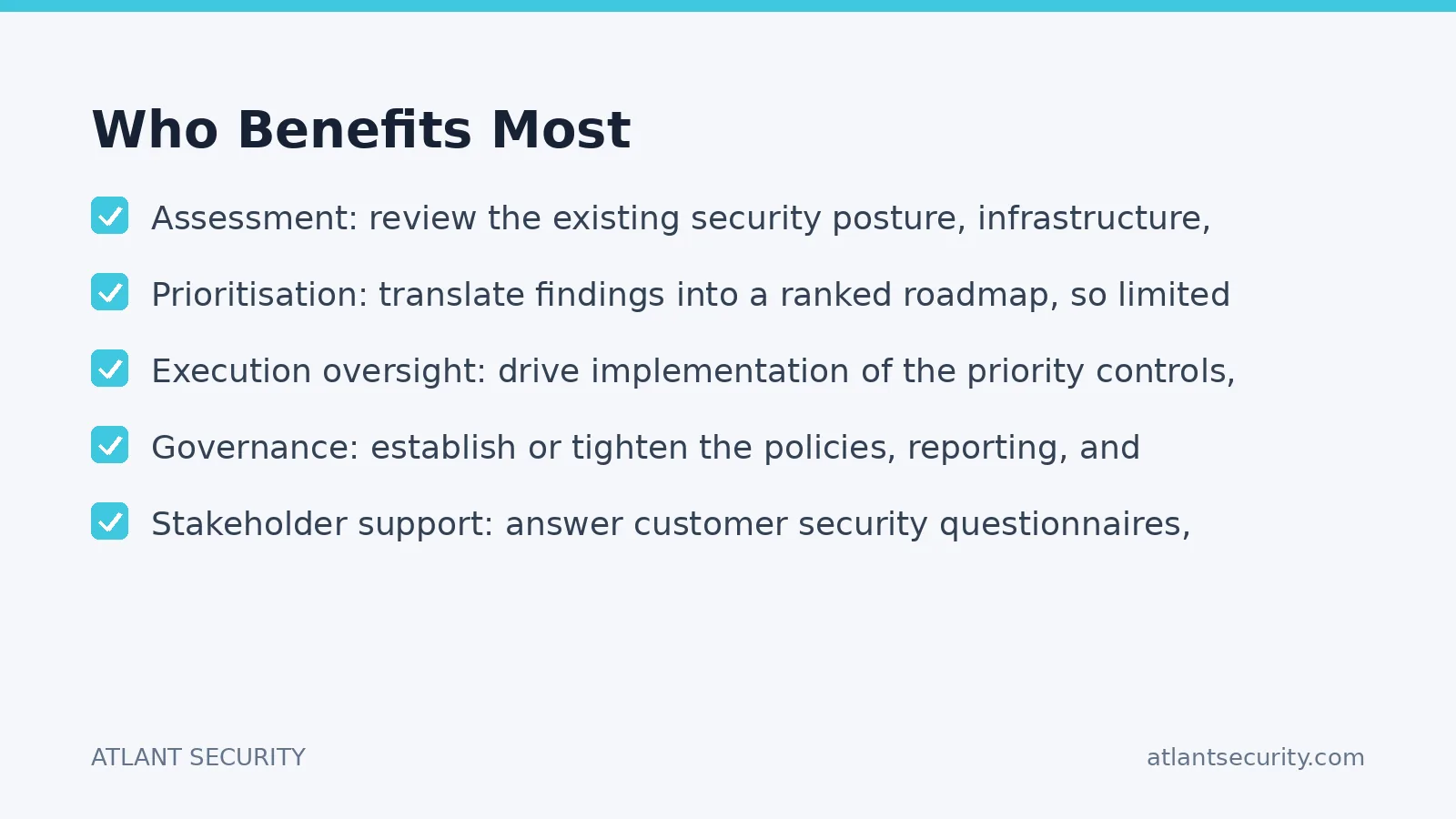
- You are a small or mid-sized company that needs security leadership but cannot justify a full-time executive yet.
- You are growing fast and enterprise customers have started asking hard security questions.
- Your security leader has left and you need continuity while you recruit a replacement.
- You are pursuing a compliance milestone such as SOC 2, ISO 27001, HIPAA, or PCI DSS and need someone to own the program.
- You are going through an event like a funding round, a merger, or an acquisition, where security due diligence suddenly matters.
If you are a very large enterprise with a complex, permanent security organisation, a temporary CISO is usually a bridge or a specialist supplement rather than the answer. The model shines where you need senior judgement without permanent overhead.
The Pros of a Temporary CISO
Flexibility and scalability
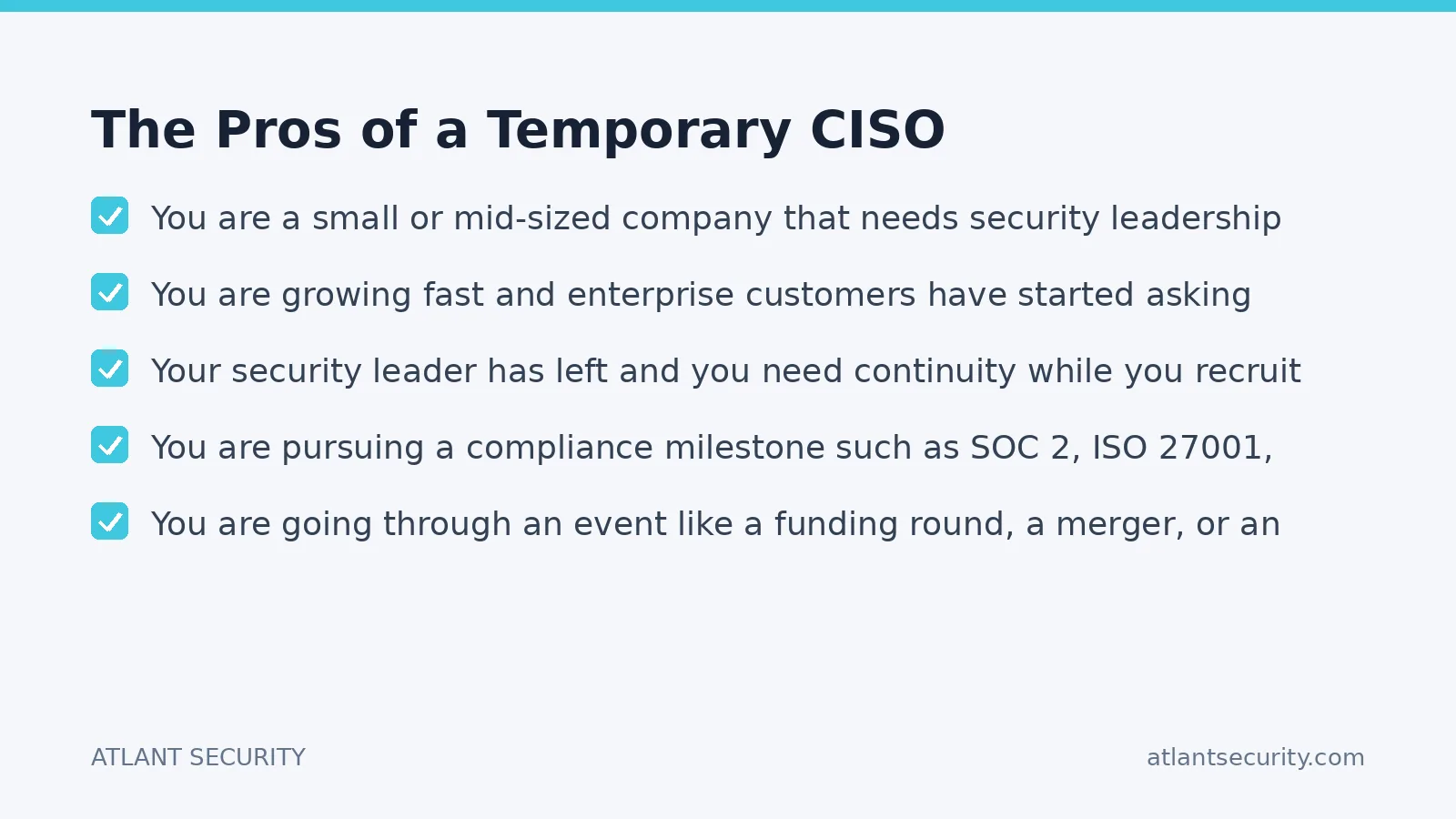
You engage the level of leadership the situation needs and adjust as it changes. A company navigating an acquisition might need intensive, high-level input for a few months, then a lighter ongoing cadence. You are not locked into a fixed salary regardless of workload.
Cost structure that matches value
A full-time CISO is a significant permanent cost once you add salary, benefits, and the recruiting fee to land them. A temporary or fractional CISO is engaged for defined time, so you pay for active work on your security, not for a headcount to keep busy between genuine priorities. For most companies that do not yet need a full-time security executive, this is simply a better match of spend to need.
Immediate, experienced expertise
A seasoned temporary CISO has run these programs before, often across many industries. That pattern recognition means they spot the real risks quickly and avoid the expensive detours a first-time security leader might take. There is no learning-the-role phase; the learning is about your specifics, which is faster.
Fast deployment
Recruiting a permanent CISO can take months. A temporary CISO can typically start within days or weeks, which matters when you are mid-audit, responding to a customer security demand, or covering a sudden departure.
Objective perspective
An external leader has no internal politics to protect and no history to defend. That independence often surfaces uncomfortable truths a long-tenured insider might soften, which is exactly what leadership needs to make good risk decisions.
The Cons of a Temporary CISO
This model is not a universal fix, and it is worth being honest about the trade-offs.
Continuity risk
The flexibility cuts both ways. When the engagement ends, the person leaves. Without deliberate handover, you can lose momentum and institutional knowledge. Mitigate this by insisting on documentation, knowledge transfer to internal staff, and a defined transition plan from the start.
Less cultural embedding
A temporary leader will not be as woven into your culture and team dynamics as someone who has been there for years. They bring expertise, but understanding internal relationships and unwritten norms takes time. For work that depends heavily on internal influence, factor this in.
Shared availability
A fractional CISO usually serves several clients. That is part of what makes the model affordable, but it means they are not sitting in your office full time. Agree response times and availability up front, and make sure there is a clear escalation path for genuine emergencies.
Bias toward near-term goals
Engagements scoped around an audit or an incident naturally focus on immediate and mid-term outcomes. If you need a leader to build and own a decade-long security strategy with deep organisational buy-in, a permanent hire may serve better once you reach that stage. A good temporary CISO builds the foundation that a future permanent leader inherits.
Temporary CISO Versus Full-Time CISO
| Factor | Temporary / Fractional CISO | Full-Time CISO |
|---|---|---|
| Time to start | Days to weeks | Months of recruiting |
| Cost model | Scoped engagement, pay for active work | Permanent salary, benefits, recruiting fee |
| Breadth of experience | Many industries and environments | Deep in one or two |
| Cultural embedding | Lighter | Deep over time |
| Best for | Gaps, growth, compliance pushes, transitions | Large, mature, permanent security orgs |
| Long-term continuity | Needs a handover plan | Built in |
How to Decide
Work through these questions honestly before you choose a model:
- Size and stage: Are you scaling quickly or handling sensitive or regulated data? The higher the stakes, the sooner you need senior ownership, but not necessarily permanent.
- Budget: What level of security leadership can you realistically fund without starving the rest of the program? A temporary CISO frees budget for the actual controls.
- Urgency: Do you need help now, or can you wait out a full recruiting cycle? Audits, customer demands, and departures rarely wait.
- Scope: Is this a defined project, such as reaching SOC 2, or an open-ended leadership role? Project-shaped needs suit a temporary model well.
- Internal team: Do you already have capable IT and security staff who need direction, or are you starting from scratch? A temporary CISO can lead a capable team effectively; building from nothing may eventually justify a permanent hire.
A common and sensible pattern is to bring in a temporary CISO to stabilise the program, reach the immediate milestone, and build the foundation, then transition to a permanent hire later once the role and requirements are clear. The temporary leader can even help you write the job description and interview candidates, because they now understand exactly what the role demands. For smaller organisations, our small business security services and a broader IT security audit are often where that engagement begins.
Frequently Asked Questions
What is the difference between a temporary CISO and a virtual CISO?
They largely overlap. Temporary or interim CISO emphasises the fixed-term nature, often covering a gap or a specific project. Virtual or fractional CISO emphasises the delivery model, part-time and typically remote, sometimes on an ongoing basis. In practice the same experienced person provides senior security leadership on a flexible arrangement rather than as a permanent employee.
How quickly can a temporary CISO start?
Usually within days to a couple of weeks, compared with the several months it often takes to recruit a permanent CISO. That speed is one of the main reasons companies choose the model when facing an audit deadline, a customer security demand, or the sudden departure of a security leader.
Is a temporary CISO cheaper than a full-time hire?
For most companies that do not yet need a full-time security executive, yes. You pay for scoped, active work rather than a permanent salary, benefits, and a recruiting fee. Just as important, you free up budget to spend on the actual security controls rather than concentrating it all in one headcount.
Will a temporary CISO understand our business?
An experienced one will get up to speed on your specifics quickly because they already know the role. They will not have the years of internal relationships a long-tenured insider has, so for work that depends on internal influence you should plan for that. The trade-off is objectivity and broad cross-industry experience.
Can a temporary CISO help us reach compliance?
Yes. Owning a compliance program such as SOC 2, ISO 27001, HIPAA, or PCI DSS is one of the most common reasons to engage one. They scope the requirements, run the gap assessment, drive remediation, and manage the auditor relationship, so your team is not pulled off its core work to learn a process from scratch.
What happens when the engagement ends?
With a proper handover, you keep the documentation, policies, and roadmap the temporary CISO built, and internal staff or an incoming permanent hire pick up from a stable foundation. Insist on knowledge transfer and a transition plan from day one so continuity is protected rather than lost when they leave.
Considering a temporary CISO? Atlant Security provides interim and fractional CISO leadership, delivered personally by a former Microsoft security consultant with 200+ assessments across 14 countries. We assess, prioritise, and lead your security program for as long as you need it. See our virtual CISO service or book a discovery call to talk through your situation.
Need someone to own this, not just advise on it?
A named virtual CISO takes the security programme, the compliance evidence and the board reporting, month to month, from $3,300 with a 30-day opt-out. The person you meet is the person who does the work.
See virtual CISO services