

We have probably seen your problem before. Our smallest client had eight employees. Our largest secures the nuclear power plant of the United Arab Emirates. Whatever shape yours is, tell us about it and we will tell you how we would fix it.
Most IT security audits fail before anyone runs a single scan. They fail in the planning, when the scope is vague, the objectives are borrowed from a template, and nobody agreed in advance what a successful outcome looks like. The result is a thick report full of findings that nobody prioritizes and nothing changes. I have seen organizations pay for the same audit three years running and stay exactly as exploitable, because the audit was treated as a deliverable to file rather than a process to drive improvement.
I am Alexander Sverdlov, founder of Atlant Security, CISSP, and a former Microsoft security consultant. Across more than 200 assessments in 14 countries, I have learned that the difference between a useful audit and an expensive one is almost entirely in how it is planned. This guide walks through the steps that make an IT security audit actually improve your security, not just document it.
What an IT Security Audit Actually Is
An IT security audit is a structured evaluation of how well your organization protects its information assets against the threats it realistically faces. Done well, it answers a simple question: if a competent attacker targeted us, where would they get in, and how bad would it be? A good audit produces a prioritized, honest list of gaps and a clear path to close them.
It is worth being clear about what an audit is not. It is not a single vulnerability scan. It is not a compliance checklist that proves you filled in the right boxes. And it is not a penetration test, though it may include one. An audit looks at technology, configuration, processes, and people together, because attackers exploit all of them. If you only need to confirm one specific exposure, a targeted penetration test or vulnerability assessment may be the better tool. If you want a full picture, you want an audit.
Step 1: Define Objectives That Mean Something
The most common planning mistake is starting with tools instead of objectives. Before anyone touches a scanner, you need to answer why you are doing this audit at all. The objectives shape everything that follows: scope, methodology, effort, and how you will judge success.
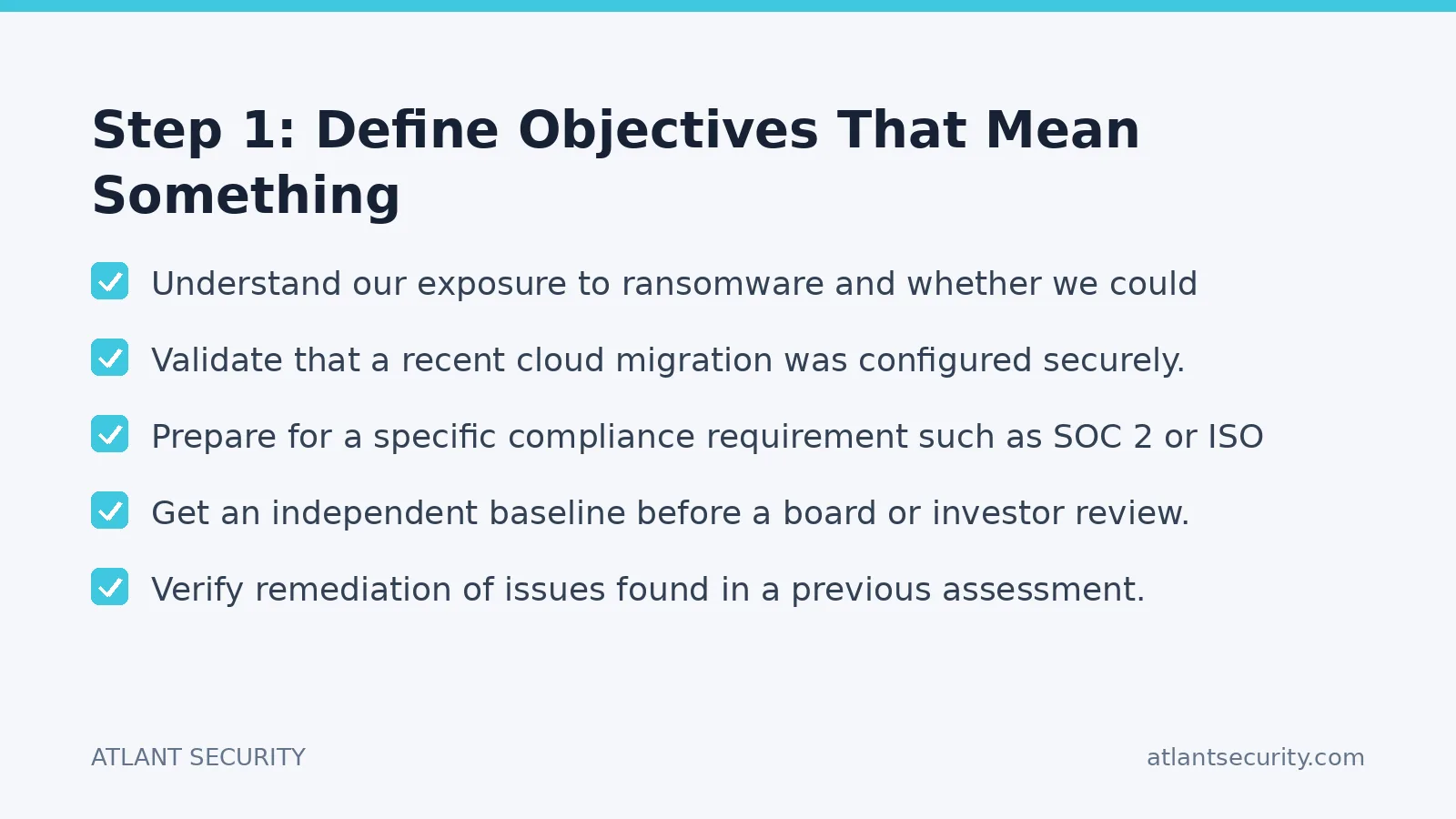
Concrete objectives sound like these:
- Understand our exposure to ransomware and whether we could recover from it.
- Validate that a recent cloud migration was configured securely.
- Prepare for a specific compliance requirement such as SOC 2 or ISO 27001.
- Get an independent baseline before a board or investor review.
- Verify remediation of issues found in a previous assessment.
Notice that "check our security" is not on that list. A vague objective produces a vague audit. Write down what a good outcome looks like and who needs to act on it, and the rest of the planning gets much easier.
Step 2: Assemble the Right Team
An audit needs a mix of skills. Someone who understands your business and its risk tolerance, someone who knows your technical environment, and someone with genuine security assessment experience. That last part matters. Reviewing your own configuration rarely finds the problems, because the people who built the system share the same blind spots that created the gaps.
This is the core argument for independent assessment. An outside assessor brings the attacker's perspective, has seen how other organizations get breached, and has no incentive to overlook an inconvenient finding. Internal teams are essential during the audit because they hold the context, but the assessment itself benefits enormously from fresh eyes. Our IT security audit engagements are designed to work alongside your internal team rather than around them.
Step 3: Define the Scope Precisely
Scope is where audits quietly succeed or fail. Too narrow, and you get false confidence because the thing that gets breached was out of scope. Too broad, and the effort is spread so thin that nothing is examined properly. The goal is a scope that matches your objectives and your risk.
A well-defined scope answers:
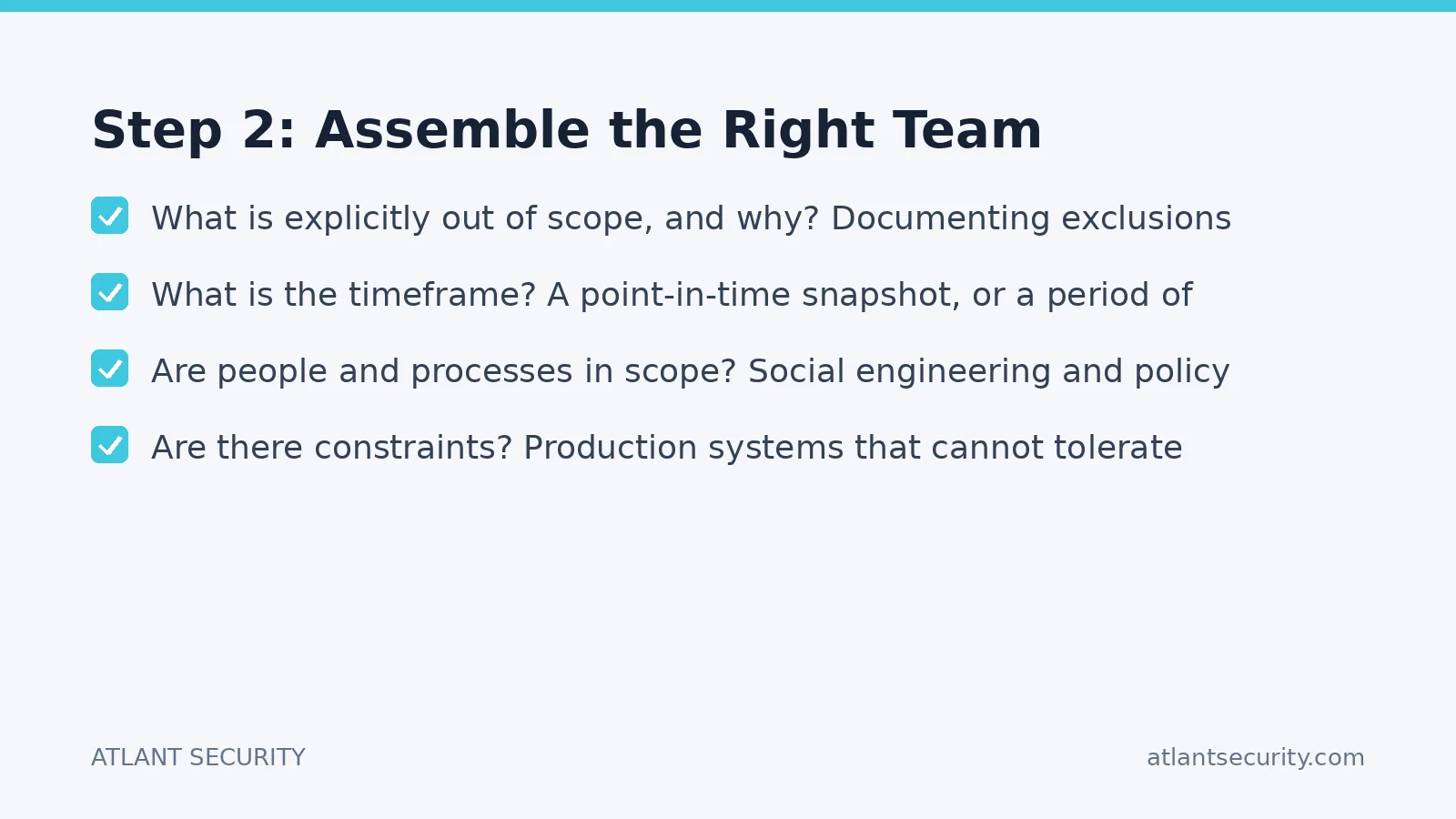
- What systems and networks are included? Cloud environments, on-premises infrastructure, endpoints, applications, and increasingly identity providers and SaaS platforms.
- What is explicitly out of scope, and why? Documenting exclusions prevents both false confidence and scope creep.
- What is the timeframe? A point-in-time snapshot, or a period of assessment.
- Are people and processes in scope? Social engineering and policy review often reveal more than technical scanning alone.
- Are there constraints? Production systems that cannot tolerate disruption, regulatory limits, or maintenance windows.
I generally advise clients to scope around their actual crown jewels rather than trying to boil the ocean. If a ransomware event or a data breach of one specific system would be catastrophic, that system and everything that can reach it belong at the center of the scope.
Step 4: Choose Methodologies and Tools to Match
Different objectives call for different techniques, and a serious audit combines several. The methodology should be driven by what you are trying to learn, not by whatever tool the assessor happens to own.
| Method | What It Reveals | Best For |
|---|---|---|
| Vulnerability assessment | Known, unpatched weaknesses at scale | Broad coverage of the environment |
| Penetration testing | How weaknesses chain into real compromise | Validating actual exploitability |
| Configuration review | Insecure settings and hardening gaps | Cloud, servers, and identity platforms |
| Access control review | Excess privilege and stale accounts | Identity and least-privilege checks |
| Policy and process review | Gaps between written and actual practice | Governance and compliance readiness |
A tool-only audit that just runs a scanner and exports the results is the low-value version of this work. The scanner output is a starting point, not the audit. The value comes from an experienced assessor interpreting the findings in the context of your environment and threat model.
Step 5: Conduct the Audit With Discipline
Execution is where planning pays off. With clear objectives, a defined scope, and the right methods, the audit becomes a systematic process rather than an open-ended fishing trip. During execution, keep a few things front of mind.

- Communicate continuously. The assessor and your internal team should stay in close contact so that unexpected findings and any operational concerns are handled immediately.
- Document as you go. Evidence gathered during the assessment is what makes findings defensible and remediation possible.
- Protect production. Agree in advance how sensitive systems are tested so the audit never becomes the incident.
- Follow the attack paths. The most valuable findings are usually not single vulnerabilities but chains that lead from a minor foothold to critical access.
Step 6: Document and Prioritize Findings
A report that lists five hundred findings ranked only by a generic severity score is nearly useless to a team with limited time. The job of the audit report is to tell you what to fix first, in your context. A finding that is technically medium severity but sits directly in the path to your most sensitive data may matter more than a high-severity issue on an isolated system.
A useful audit report includes what was assessed and how, the findings ranked by actual risk to your organization, clear and specific remediation guidance, and a realistic view of effort. It should be readable by both a technical team that has to fix things and a leadership team that has to fund the fixes. If the report only makes sense to the person who wrote it, it will not drive change.
Step 7: Remediate and Keep Going
The audit is not finished when the report is delivered. It is finished when the risks it identified are actually reduced. This is the step where most organizations fall down. The report gets filed, quarters pass, and the next audit finds the same issues. Closing the loop is what separates security theater from real improvement.
- Turn findings into an owned action plan. Each priority item needs an owner, a target date, and a way to verify it is done.
- Fix root causes, not just symptoms. A missing patch is a symptom. The absence of a patch process is the root cause worth fixing.
- Verify remediation. Re-test the important fixes rather than assuming they worked. "We think we fixed it" is not the same as confirmed.
- Treat security as continuous. A point-in-time audit is a snapshot. Environments change constantly, so pair periodic audits with ongoing scanning and reviews.
Organizations that need this discipline but lack a full-time security leader often bridge the gap with our virtual CISO services, which keep remediation moving between assessments rather than letting the report gather dust.
Common Planning Mistakes to Avoid
A few errors show up repeatedly and quietly ruin otherwise well-intentioned audits. Starting with tools instead of objectives. Scoping so broadly that nothing is examined deeply. Auditing your own work and inheriting your own blind spots. Accepting a raw scanner dump as an audit. And treating the final report as the finish line rather than the starting gun. Avoid these five and you are already ahead of most.
Frequently Asked Questions
How long does an IT security audit take?
It depends heavily on scope. A focused audit of a specific environment might take one to two weeks, while a comprehensive assessment of a larger organization can run several weeks or more. The planning conversation is what determines this. Once objectives and scope are clear, a realistic timeline follows naturally. Be wary of anyone who quotes a duration before understanding your environment.
What is the difference between an audit and a penetration test?
A penetration test simulates an attacker to prove whether specific weaknesses can actually be exploited. An audit is broader: it evaluates technology, configuration, processes, and people to assess your overall security posture, and it may include a penetration test as one component. If you want to know whether a particular system can be broken into, you want a pen test. If you want to understand your overall risk, you want an audit.
Worth knowing before you budget for this: the Pentestas AI pentesting platform changes the per-test cost enough that re-testing after each significant change stops being a once-a-year decision.
Should we use an internal team or an external firm?
Both have a role, but the assessment itself benefits from independence. Internal teams hold essential context and should be closely involved, yet they share the blind spots that produced the gaps in the first place. An external assessor brings the attacker's perspective, cross-industry experience, and no incentive to overlook uncomfortable findings. The strongest audits combine internal knowledge with outside eyes.
How often should we conduct an IT security audit?
At least annually for most organizations, and again after any major change such as a cloud migration, a merger, or a significant new system. Between full audits, continuous vulnerability scanning and access reviews catch new issues as they appear. Because environments change constantly, a single yearly snapshot on its own leaves long blind spots.
How do we prepare for an audit?
Clarify your objectives, gather an inventory of your systems and access, and identify the assets whose compromise would hurt most. You do not need to fix everything beforehand. The audit exists to find problems, so hiding or pre-cleaning issues only wastes the exercise. The most useful preparation is honesty about what you have and what you are worried about.
What should a good audit report contain?
It should describe what was assessed and how, present findings ranked by real risk to your organization rather than generic scores alone, provide specific and actionable remediation guidance, and be readable by both technical and executive audiences. Above all it should tell you clearly what to fix first. A report you cannot act on has failed regardless of how thorough it looks.
A well-planned IT security audit is one of the highest-return investments you can make in your security program, but only if it is scoped around real objectives and followed by real remediation. If you want to plan an audit that actually moves your security forward, book a discovery call and we will start with the questions that decide everything else.
Want to know where you actually stand?
A fixed-price IT security audit answers that in 14 days: 20 NIST 800-53 domains checked against your live environment, findings ranked by what an attacker can reach, and a remediation plan with named owners. You read the report before you pay.
See what the 14-day audit covers