
An IT security audit is not a compliance checkbox and it is not a vulnerability scan with a nicer cover page. It is a structured, evidence-based evaluation of how well your controls actually protect your data against the threats that matter to your business. After running more than 200 assessments across 14 countries since 2013, I can tell you the difference between an audit that changes anything and one that gathers dust comes down to scope, honesty, and what happens after the report lands. This guide walks through the fundamentals, the steps that matter, and the traps that make audits worthless.
Done right, an audit answers uncomfortable questions before an attacker does. Where is our sensitive data, and who can reach it? What would a phished employee actually be able to touch? Are our backups real, or do we just assume they are? An honest audit surfaces those answers while you still have time to act on them.
Why Your Business Needs Regular IT Audits
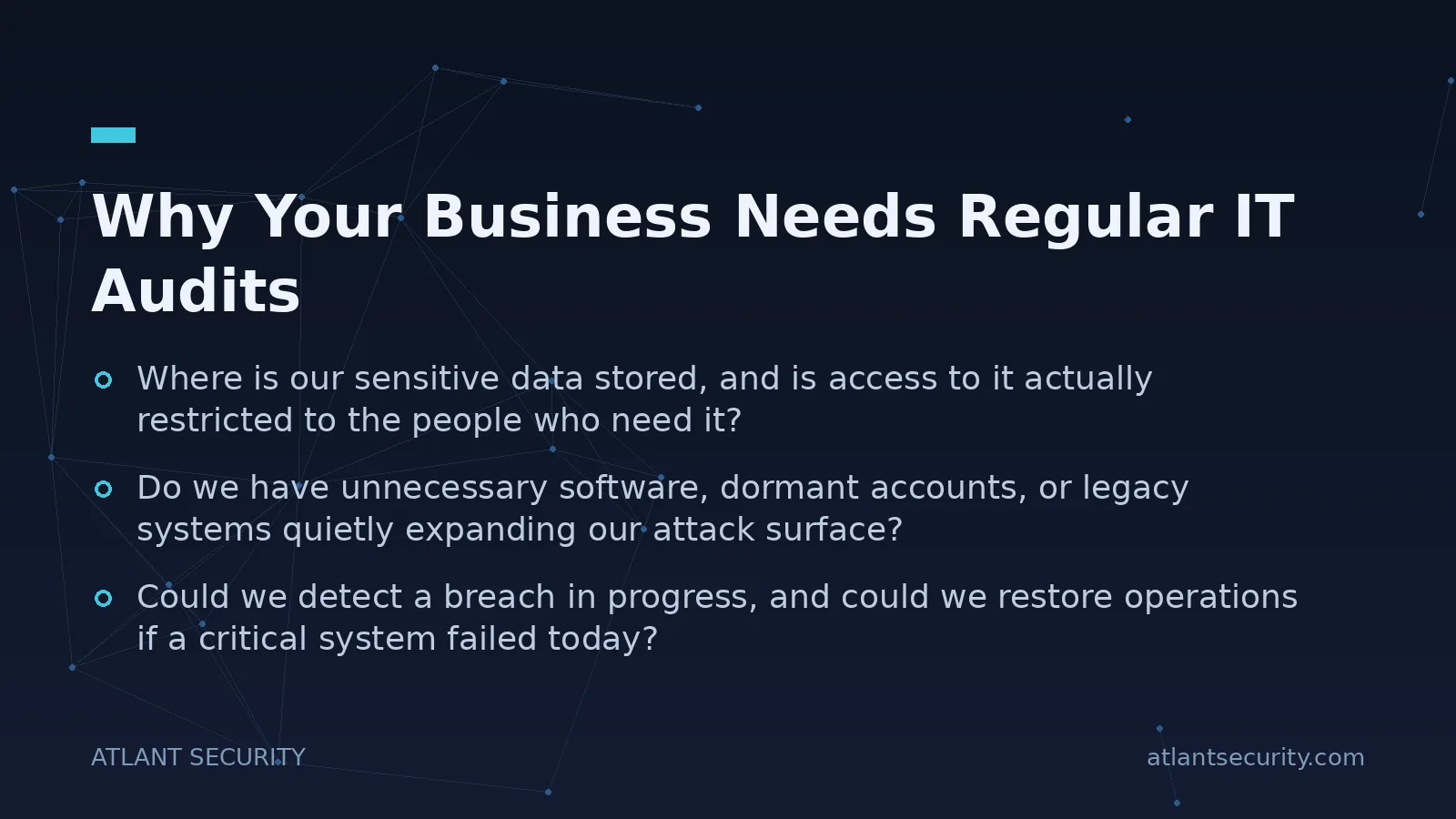
Environments drift. You add a SaaS tool here, a contractor there, a firewall exception "just for now" that never gets removed. Over a year, that drift accumulates into real exposure that nobody deliberately created. A periodic audit is how you catch the drift before it becomes an incident. A thorough review of your hardware, software, cloud services, networks, and data flows should answer questions like these:
- Where is our sensitive data stored, and is access to it actually restricted to the people who need it?
- Do we have unnecessary software, dormant accounts, or legacy systems quietly expanding our attack surface?
- Could we detect a breach in progress, and could we restore operations if a critical system failed today?
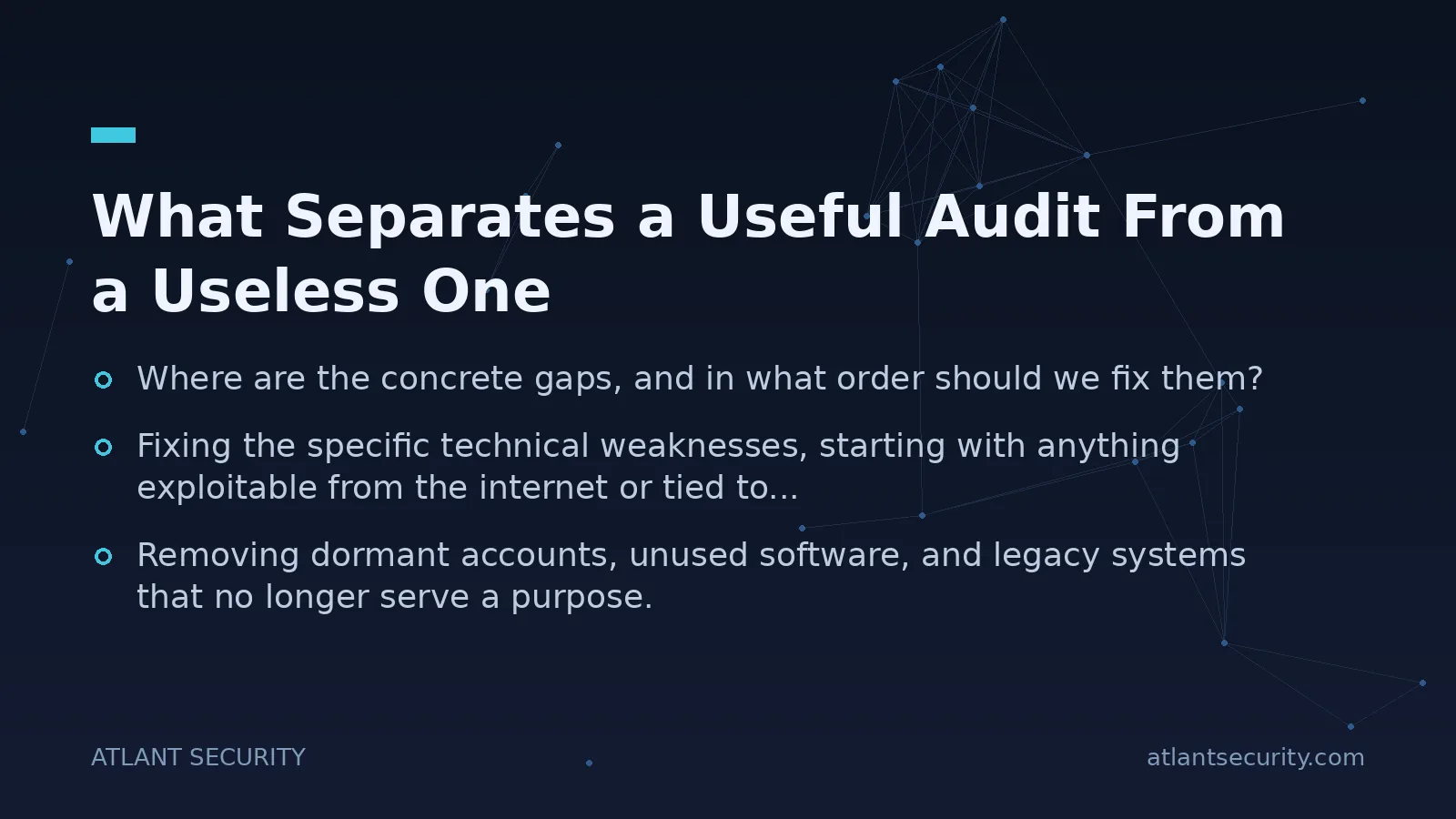
- Where are the concrete gaps, and in what order should we fix them?
There is also a compliance dimension. Frameworks and laws such as GDPR, HIPAA, PCI DSS, and ISO 27001 all expect you to periodically verify your controls. An audit tells you whether your information systems meet those requirements before a regulator or a customer's security questionnaire forces the issue. Compliance audits are often performed by certified external assessors, but internal reviews between formal audits keep you from being surprised.
Audit, Vulnerability Assessment, and Penetration Test: Not the Same Thing
People use these terms interchangeably, and that confusion leads to buying the wrong service. Here is how they differ.
| Activity | Question It Answers | Best For |
|---|---|---|
| IT Security Audit | Are our controls, policies, and processes adequate and followed? | Governance, compliance, whole-of-organization posture |
| Vulnerability Assessment | What known weaknesses exist in our systems? | Broad, regular technical coverage |
| Penetration Test | Can an attacker actually exploit those weaknesses to reach our data? | Proving real-world impact |
A mature program uses all three. The audit sets direction, a vulnerability assessment gives you continuous technical visibility, and a penetration test validates that the controls hold up against a determined attacker. If you only do one, the audit is the right place to start, because it tells you what the other two should focus on.
The Notable Steps in an IT Security Audit
A credible audit follows a repeatable process. Skipping steps is how you end up with a report that sounds thorough but misses the thing that gets you breached.
1. Establish Clear Objectives and Scope
Define what the audit is meant to accomplish and tie each objective to a real business concern. Are you preparing for a compliance certification, reassuring a major customer, investigating after a near-miss, or just establishing a baseline? Scope explicitly: which systems, which locations, which cloud tenants, which data. An audit with a vague scope produces vague findings. The single most common reason audits fail to deliver value is a scope that was never pinned down.
2. Prepare Thoroughly
Good preparation is most of the work. Set the timeline and methodology, and assign clear roles for the management team and the IT administrators who will support the review. Decide how you will handle logistics that carry operational risk, such as testing that might disrupt production or temporarily taking equipment offline. Agree in advance how findings will be classified and reported. Then write the plan down and share it, so every stakeholder is aligned before fieldwork begins. Surprises during an audit erode trust and slow everything down.
3. Carry Out the Fieldwork
Execute against the plan. This is where the real examination happens: reviewing network security, access control configurations, user permissions, and system hardening across file shares, database servers, and SaaS platforms like Microsoft 365. Verify identity and privileged access carefully, because that is where most real damage starts. Include a disaster recovery and backup review, and confirm that backups are not just scheduled but actually restorable and protected from ransomware. Where physical infrastructure matters, assess the data center against fire, flood, and power failure. Critically, interview people outside IT to gauge whether security policy is understood and followed in practice, not just written down.
4. Analyze and Report the Results
Produce a report that management and, where relevant, regulators can actually act on. It should describe each finding, the threat and vulnerability behind it, the business risk it represents, and a concrete recommendation to remediate. Prioritize ruthlessly. A report that lists 300 findings with no order of importance is a report that will be ignored. The best reports separate the handful of issues that could cause a serious breach from the long tail of hygiene items, so leadership knows what to fund first.
5. Remediate and Verify
The audit only creates value when you act on it. Turn the recommendations into an owned, deadlined remediation plan. Typical actions include:
- Fixing the specific technical weaknesses, starting with anything exploitable from the internet or tied to privileged access.
- Removing dormant accounts, unused software, and legacy systems that no longer serve a purpose.
- Tightening access controls and enforcing multifactor authentication and least privilege.
- Training staff to recognize phishing and to handle sensitive data correctly, since people remain the most exploited path in.
- Establishing a recurring cadence of vulnerability scanning and re-auditing so the environment does not drift back.
Then verify. Retest the fixed items to confirm the fix actually worked. I have seen "remediated" findings that were merely marked closed in a spreadsheet while the underlying hole stayed wide open.
What Separates a Useful Audit From a Useless One
Two audits of the same company can produce wildly different value. The useful one has these traits:
- Independence. The person auditing should not be the person who built and maintains the systems. Self-audits miss blind spots by design. An external or independent reviewer asks the questions insiders have learned to stop asking.
- Depth over checklist. Ticking boxes proves a control exists on paper. Testing whether it actually works proves it protects you. Good auditors do the latter.
- Business context. Findings ranked by real business risk, not by generic severity scores, let leadership make sound funding decisions.
- Actionable output. Recommendations specific enough that an engineer can implement them without a second consulting engagement.
- Follow-through. An audit with no remediation and no re-test is theater. The value is in what changes afterward.
For regulated organizations, an audit also feeds directly into certification efforts. The evidence and gap analysis from a solid IT security audit map closely onto what you need for SOC 2 or ISO 27001, so the work rarely goes to waste. If you lack the internal seniority to own the remediation program, a virtual CISO can drive it to completion rather than letting the report stall.
How Often Should You Audit?
For most organizations, a full IT security audit annually is a reasonable baseline, supported by more frequent vulnerability scanning and by targeted reviews whenever something material changes: a merger, a new core system, a shift to a new cloud platform, or a security incident. High-change or highly regulated environments audit more often. The right cadence is the one that catches drift before it becomes exposure.
Frequently Asked Questions
How long does an IT security audit take?
It depends entirely on scope and organization size. A focused audit of a small environment can take a couple of weeks from kickoff to report. A broad audit of a mid-sized company with multiple locations and cloud tenants can run several weeks to a couple of months, most of which is preparation, fieldwork, and verification rather than writing the report.
Should we use an internal team or an external auditor?
Internal reviews are useful for ongoing hygiene, but the formal audit benefits enormously from independence. An external auditor has no stake in defending the current setup and brings pattern recognition from many other environments. For compliance certifications, external assessment is usually required outright.
What is the difference between an audit and a penetration test?
An audit evaluates whether your controls, policies, and processes are adequate and actually followed across the organization. A penetration test simulates a real attacker to prove whether specific weaknesses can be exploited to reach your data. They complement each other, and mature programs use both.
A note on tooling, since it comes up every time: AI penetration testing sits between a vulnerability scanner and a manual engagement. It exploits rather than just flags, chains attacks, and produces remediation code, not a CVE list.
How much does an IT security audit cost?
Cost scales with scope, environment complexity, and depth. Beware of quotes that are suspiciously cheap, because they usually mean an automated scan dressed up as an audit. The real value is in expert analysis and prioritized, actionable recommendations, and that requires experienced human effort.
What happens after the audit?
You turn findings into an owned, deadlined remediation plan, fix the highest-risk issues first, and then re-test to confirm the fixes held. The audit is the diagnosis. The remediation and verification are where your risk actually goes down.
Does an audit guarantee we will not be breached?
No honest professional promises that. An audit substantially reduces your risk by finding and closing gaps before attackers do, and it improves your ability to detect and recover. Security is about lowering the odds and limiting the damage, not achieving an impossible guarantee.
If you want an audit that produces a prioritized, plain-English roadmap instead of a 200-page PDF nobody reads, book a discovery call. I will scope it around the risks that actually matter to your business, and if you are also thinking about a broader program, the small business cybersecurity approach is a good place to start.
