The phrase "IT security audit" makes most business owners think of a compliance checkbox: someone shows up with a clipboard, runs a scanner, and hands you a PDF you file away and never read. That version of an audit is worse than useless, because it gives you a false sense of security while your real problems sit untouched. A genuine security audit is different. It is a structured attempt to answer one honest question: if a competent attacker targeted you today, where would they get in, and how far would they get? Everything else - the frameworks, the reports, the recommendations - exists to answer that question well.
I have run over 200 security assessments across 14 countries since 2013, and the single most common thing I hear afterward is some version of "we had no idea." Not because the client was careless, but because you cannot see your own blind spots. The domain admin account nobody remembers creating, the backup that has silently failed for eight months, the firewall rule someone added "temporarily" in 2021 - these are invisible from the inside. An audit's job is to make them visible before an attacker does. This article explains what a real IT security audit involves, what it should deliver, and how to make sure yours is worth the money.
What an IT Security Audit Actually Is
An IT security audit is a systematic, evidence-based evaluation of how well your organization protects its systems and data. It looks at three things together: your technology (how systems are configured and defended), your processes (how you manage access, changes, backups, and incidents), and your people (whether the humans running the show understand and follow the rules). A good audit weaves these together, because weaknesses in one area almost always trace back to another. A missing patch is a technology finding, but the reason it is missing is usually a broken process.
It is worth being precise about terminology, because these words get used interchangeably and they should not be:
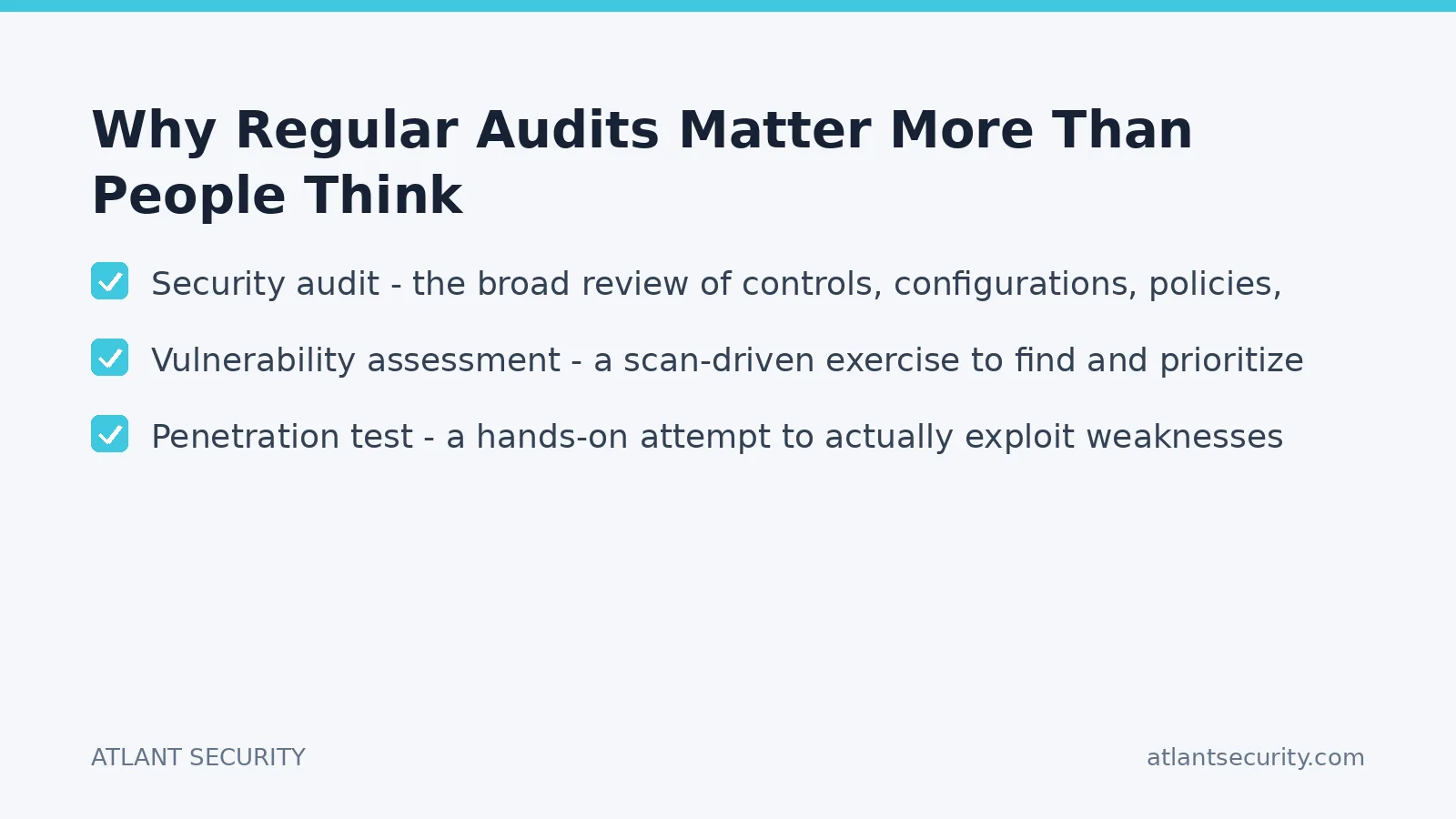
- Security audit - the broad review of controls, configurations, policies, and practices against a standard or a threat model. This is the umbrella.
- Vulnerability assessment - a scan-driven exercise to find and prioritize known weaknesses across your systems. Broad coverage, moderate depth.
- Penetration test - a hands-on attempt to actually exploit weaknesses and chain them together the way a real attacker would. Narrower scope, much greater depth.
- Compliance audit - verification that you meet the specific requirements of a standard such as SOC 2, ISO 27001, HIPAA, or PCI DSS. This checks conformance, not necessarily real-world resilience.
A comprehensive engagement usually combines several of these. Compliance and security overlap but are not the same thing. You can pass a compliance audit and still be trivially hackable, and you can be genuinely secure while failing a checkbox that does not apply to your risk. The goal is real resilience, with compliance as a byproduct rather than the destination.
Why Regular Audits Matter More Than People Think
Environments rot. The configuration that was locked down when it was deployed drifts over months of changes, exceptions, new hires, departed staff, and quick fixes that were never cleaned up. A security posture is not a state you reach; it is a state you maintain. Regular audits are how you catch drift before it becomes an incident. The concrete benefits are:
- Finding vulnerabilities while they are still cheap to fix. Remediating a weakness during a scheduled audit costs a fraction of remediating it during an active breach, and it does not come with legal, regulatory, and reputational damage attached.
- Demonstrating due diligence. Customers, partners, insurers, and regulators increasingly want proof that you take security seriously. A recent, credible audit is that proof, and it increasingly determines whether you win contracts at all.
- Meeting compliance obligations. Standards like SOC 2, ISO 27001, HIPAA, and PCI DSS require periodic assessment. Regular audits keep you continuously ready rather than scrambling before a deadline.
- Prioritizing spend. A good audit tells you where your money will actually reduce risk, so you stop buying tools that solve problems you do not have while ignoring the ones you do.
The Steps of a Real IT Security Audit
A serious audit follows a deliberate sequence. Skip steps and you get the clipboard version. Here is how a credible engagement runs.
1. Scoping and Objectives
Before anyone touches a system, you define what is being assessed and why. Which networks, applications, cloud environments, and business processes are in scope? What is driving the audit - a compliance deadline, a customer requirement, a recent scare, a merger? Clear objectives keep the audit focused on what matters to your business instead of producing a generic report that could apply to anyone.
2. Information Gathering and Documentation Review
The auditor reviews your existing material: network diagrams, asset inventories, policies, access lists, prior audit reports, and system configurations. This is where the gap between what you think you have and what you actually have starts to show. Documentation that does not match reality is itself a finding, and a common one.
3. Interviews With the People Who Run Things
Technology is only as good as the people operating it. Talking to administrators, developers, and key staff reveals how work actually gets done versus how the policy says it should. This is where you learn that the documented offboarding process is ignored, or that everyone shares one admin password because the proper way was too slow. These conversations surface risks no scanner will ever find.
4. Technical Assessment and Vulnerability Analysis
Now the hands-on work: examining configurations, reviewing identity and access management, checking patch levels, testing network segmentation, and running vulnerability assessment scans across systems and applications. The auditor is looking for the concrete weaknesses - exposed services, weak authentication, missing updates, over-privileged accounts, misconfigured cloud storage - that attackers exploit every day.
5. Penetration Testing
Where a vulnerability assessment finds weaknesses, a penetration test proves whether they are actually exploitable and how far they lead. This is the difference between "you have an open port" and "using that open port I reached your customer database in three steps." Real exploitation, done safely and with permission, is what separates a theoretical risk list from a demonstrated attack path. It is the step that most convinces leadership, because it turns abstractions into an undeniable story.
6. Reporting and Prioritized Recommendations
The deliverable is not a list of everything wrong; it is a prioritized roadmap. A good report ranks findings by real risk to your business, explains each in plain language, and gives specific, actionable remediation guidance. It should be readable by an executive at the summary level and precise enough for your engineers at the detail level. A report that just dumps raw scanner output onto your desk has failed at the one thing that gives an audit value.
How to Tell a Good Audit From a Bad One
Not all audits are equal, and the price tag tells you very little. Use these markers to judge quality before and after the engagement.
| Signal | A Real Audit | A Checkbox Audit |
|---|---|---|
| Method | Manual analysis plus tooling, tailored to you | Automated scan, generic template |
| Findings | Prioritized by business risk, with context | Raw severity list, no context |
| Scope | People, process, and technology together | Technology scan only |
| Report | Actionable roadmap, exec plus technical | Tool output exported to PDF |
| Follow-up | Retest and validation of fixes | None; you are on your own |
Best Practices for Getting Value From an Audit
The audit itself is only half the work. Whether it improves your security depends on what happens around it.
- Do not sanitize the environment first. The temptation to quietly fix known issues before the auditor arrives defeats the purpose. You want the audit to find the real state, not a rehearsed one. The findings you hide are the ones an attacker will exploit.
- Give the auditor honest access and honest answers. An audit constrained by defensiveness produces a flattering, useless report. The value is proportional to the candor.
- Insist on prioritization. A hundred findings with no ranking is paralysis. Demand a clear "fix these five things first" and a rationale for the order.
- Act on the report. An unactioned audit is money set on fire. Assign owners and deadlines to findings, and treat the report as a work plan, not an archive document.
- Retest after remediation. Fixing a finding and verifying the fix are different things. Validation closes the loop and confirms the change actually worked and did not introduce a new problem.
- Repeat on a cadence. One audit is a snapshot. Security is a moving target, so build audits into an annual or more frequent rhythm.
Who Should Run Your Audit
Internal teams know your environment intimately, which is valuable, but they carry two disadvantages: they share the same blind spots that created the gaps, and they find it hard to be objective about systems they built. An independent assessor brings fresh eyes, an attacker's perspective, and no incentive to protect anyone's prior decisions. For most organizations, the strongest approach pairs internal knowledge with external independence: your team provides context, the outside expert provides the objective evaluation. If you do not have a security leader to own the audit process and drive remediation, a virtual CISO or part-time CISO can fill that role without the cost of a full-time hire.
Whatever you choose, the point of an IT security audit is not the report. It is the decisions you make afterward. The organizations that get breached are rarely the ones that never audited; they are the ones that audited, filed the PDF, and did nothing. For a wider view of what these audits typically uncover, see my post on the most common IT security threats and how they are addressed.
Frequently Asked Questions
How often should we conduct an IT security audit?
At least annually for most organizations, and more often if you handle sensitive data, operate in a regulated industry, or change your environment frequently. You should also audit after any major change - a cloud migration, a merger, a significant new system, or a security incident. Between full audits, continuous vulnerability scanning helps catch new issues as they appear.
What is the difference between an audit and a penetration test?
An audit is the broad evaluation of your controls, configurations, processes, and policies. A penetration test is a focused, hands-on attempt to actually exploit weaknesses the way an attacker would. The audit tells you what is weak; the penetration test proves what is exploitable and how far it leads. They complement each other, and a thorough engagement includes both.
Worth knowing before you budget for this: Pentestas changes the per-test cost enough that re-testing after each significant change stops being a once-a-year decision.
How long does an IT security audit take?
It depends entirely on scope. A focused assessment of a small environment might take one to two weeks; a comprehensive audit of a larger organization with multiple systems, cloud environments, and compliance requirements can run several weeks. Scoping and clear objectives up front are what keep the timeline and cost predictable.
Will an audit disrupt our operations?
A well-run audit is designed to avoid disruption. Most activities - documentation review, interviews, configuration analysis, and scanning - have minimal operational impact. Testing that could affect production is scheduled and coordinated in advance, and sensitive or fragile systems are handled with extra care or tested in controlled windows. Disruption is a sign of a careless assessor, not an inherent part of auditing.
Does passing a compliance audit mean we are secure?
No. Compliance verifies that you meet a specific set of requirements, which is valuable but not the same as being resilient against a real attacker. You can pass a compliance audit and still have exploitable weaknesses that the standard did not cover. Treat compliance as a floor, not a ceiling, and pursue genuine security assessment alongside it.
The Bottom Line
A real IT security audit is an investment in seeing clearly. It replaces assumptions with evidence and gives you a prioritized plan to reduce the risks that actually threaten your business. The clipboard version wastes your money and lulls you into complacency; the real version is one of the highest-return security activities you can undertake. If you want an audit that finds what matters and hands you a plan you can act on, get in touch and let us scope one around your environment.