Most companies under about 500 employees need the judgment of a Chief Information Security Officer but cannot justify the cost of hiring one. A seasoned full-time CISO commands a senior executive salary plus equity, and for a company that is not yet a bank or a health system, that is a hard number to defend to a board. A virtual CISO solves that mismatch. You get the strategy, the accountability, and the outside perspective of an experienced security leader, on a fraction of the budget and without adding to headcount.
I am Alexander Sverdlov, founder of Atlant Security and a former Microsoft security consultant. Since 2013 I have run more than 200 security assessments across 14 countries, and a large share of my work is acting as the part-time security leadership for companies that are too small for a full-time CISO but too exposed to have no one steering security at all. This article explains what a virtual CISO actually does, where the model works, where it does not, and how to tell whether it is right for you.
What a Virtual CISO Actually Does
A virtual CISO, sometimes called a fractional or part-time CISO, is an experienced security executive who leads your security program on a retained, part-time basis instead of as a full-time employee. The role is about direction and accountability, not hands-on ticket work. In practice, a good virtual CISO will:
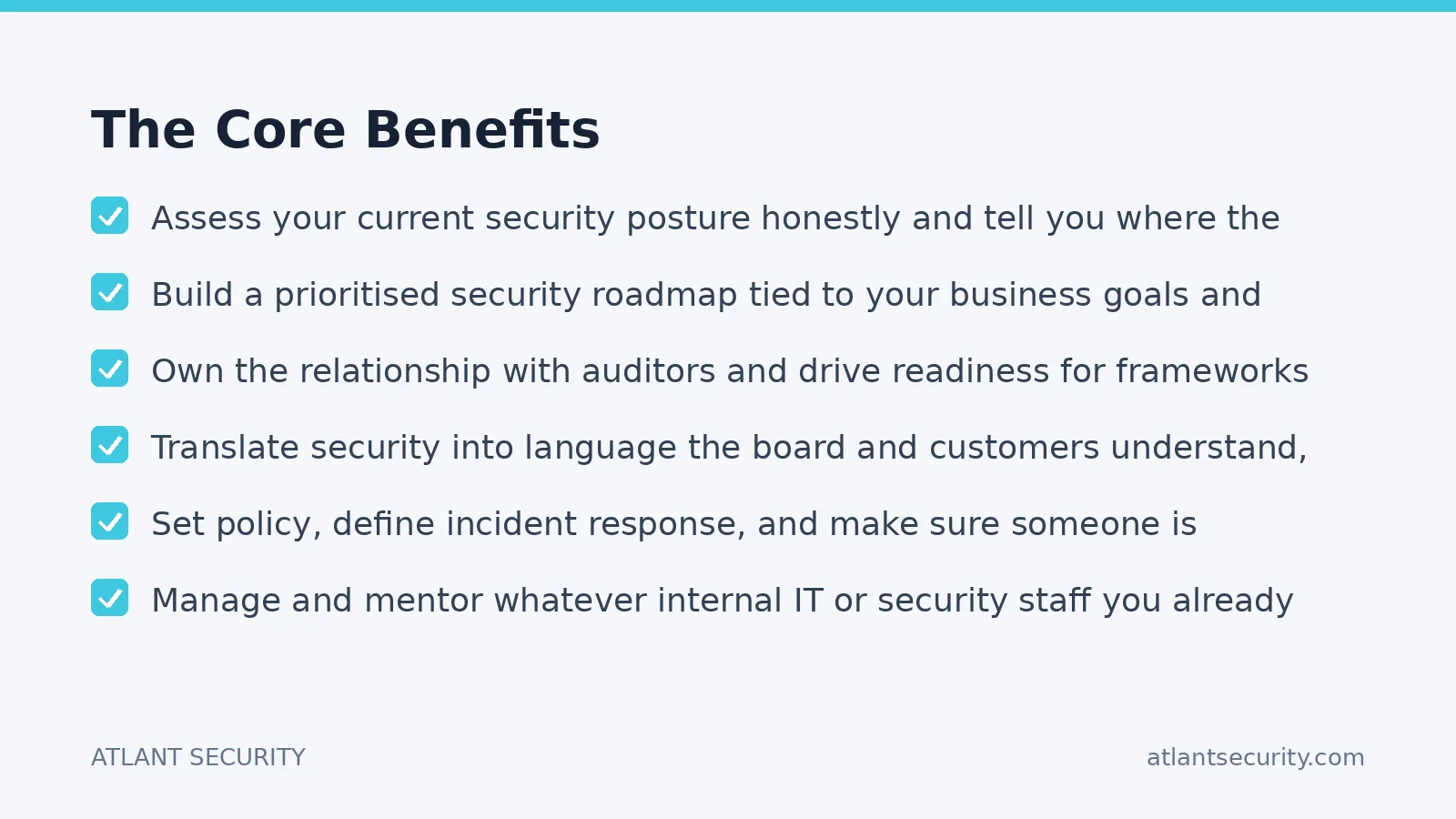
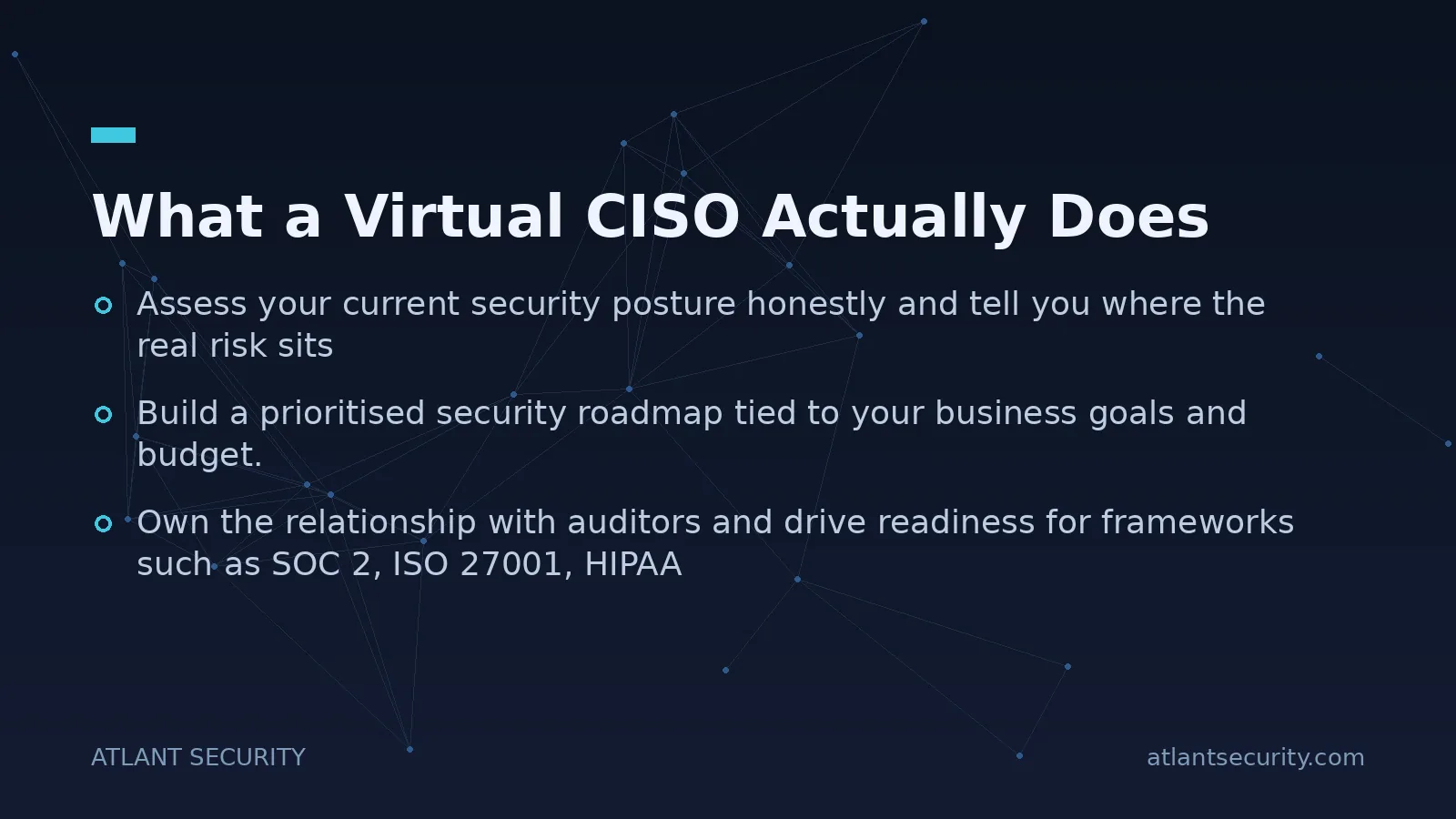
- Assess your current security posture honestly and tell you where the real risk sits, not where it is fashionable.
- Build a prioritised security roadmap tied to your business goals and budget.
- Own the relationship with auditors and drive readiness for frameworks such as SOC 2, ISO 27001, HIPAA, or PCI DSS.
- Translate security into language the board and customers understand, and represent your security posture in sales and vendor due-diligence conversations.
- Set policy, define incident response, and make sure someone is actually accountable when something goes wrong.
- Manage and mentor whatever internal IT or security staff you already have, so your existing team gets better rather than being replaced.
The distinction that matters: a virtual CISO leads, decides, and is accountable. That is different from a managed service that simply runs tools for you. You are buying senior judgment, not a dashboard.
The Core Benefits
1. Executive-level expertise at a fraction of the cost
The most obvious benefit is economic. A full-time CISO is one of the most expensive hires a company makes, and once you add benefits, equity, and the cost of a bad hire, the number climbs fast. A virtual CISO gives you the same calibre of judgment for the hours you actually need, which for most mid-sized companies is a few days a month rather than a full week.
2. Breadth of experience across many companies
A CISO who has only ever worked inside one or two organisations has seen a narrow slice of threats and solutions. Someone who leads security across a portfolio of companies sees attack patterns, tooling trade-offs, and audit outcomes constantly, and brings that pattern recognition to your problem. You benefit from lessons learned on someone else's budget.
3. Independence and objectivity
An internal executive has career incentives that can quietly bias security decisions. An outside security leader has no internal politics to protect and can tell the CEO an uncomfortable truth without worrying about next year's promotion. That independence is one of the most underrated benefits of the model.
4. Scalability
Security needs are not constant. Preparing for a SOC 2 audit, responding to a customer security questionnaire, integrating an acquisition, or recovering from an incident all spike the workload. A virtual CISO engagement flexes up and down without the pain of hiring and layoffs. You add intensity when you need it and dial it back when you do not.
5. Faster credibility with customers and partners
When an enterprise buyer sends a security questionnaire or asks who owns security at your company, "we have a CISO leading our program" is a far stronger answer than silence. A virtual CISO helps you present the controls you have actually built, in a form that enterprise procurement and B2B clients respect. In deals where security review is part of the buying process, that can be the difference between closing and stalling.
Virtual CISO vs Full-Time CISO vs Doing Nothing
| Dimension | Virtual CISO | Full-time CISO | No security leadership |
|---|---|---|---|
| Cost | Fraction of a full salary | Senior executive salary plus equity | Low until an incident |
| Breadth of experience | Very broad, many companies | Deep but narrow | None |
| Objectivity | High, external | Subject to internal politics | N/A |
| Availability | Scheduled plus incident support | Full-time | None |
| Best fit | SMBs, scale-ups, regulated startups | Large or highly regulated enterprises | No one, once you hold sensitive data |
Where the Virtual CISO Model Fits Best
The model is strongest for:
- Small and mid-sized businesses that hold sensitive customer data but cannot justify a full-time hire. Our small business cybersecurity services are built around exactly this.
- Scale-ups pursuing compliance such as SOC 2 or ISO 27001 for the first time, where someone needs to own the program end to end. A SOC 2 readiness engagement led by a virtual CISO is a common starting point.
- Regulated startups, particularly in fintech and health, where a fintech virtual CISO brings sector-specific regulatory experience.
- Companies with IT but no security leadership, where a capable IT team is doing its best without anyone setting security strategy or owning risk decisions.
Honest Limitations of the Model
I would rather set expectations correctly than oversell. A virtual CISO is not the right answer in every case, and the model has real trade-offs:
- Reduced day-to-day presence. A part-time leader is not in the building every day. That works when responsibilities and escalation paths are clearly defined, and struggles when an organisation relies heavily on informal, in-person coordination.
- It is leadership, not hands-on operations. A virtual CISO sets direction and holds accountability, but you still need people or a service to do the hands-on work such as patching, monitoring, and tuning. The best engagements pair a virtual CISO with a capable internal or outsourced delivery team.
- Very large or heavily regulated enterprises with round-the-clock security operations usually need a full-time CISO and a dedicated team. The virtual model is a fit up to a certain scale, not beyond it.
A good provider will tell you when you have outgrown the model and need to hire internally. If someone insists the fractional model fits every company at every size, be skeptical.
How to Get Value From a Virtual CISO Engagement
To get the most out of the arrangement:
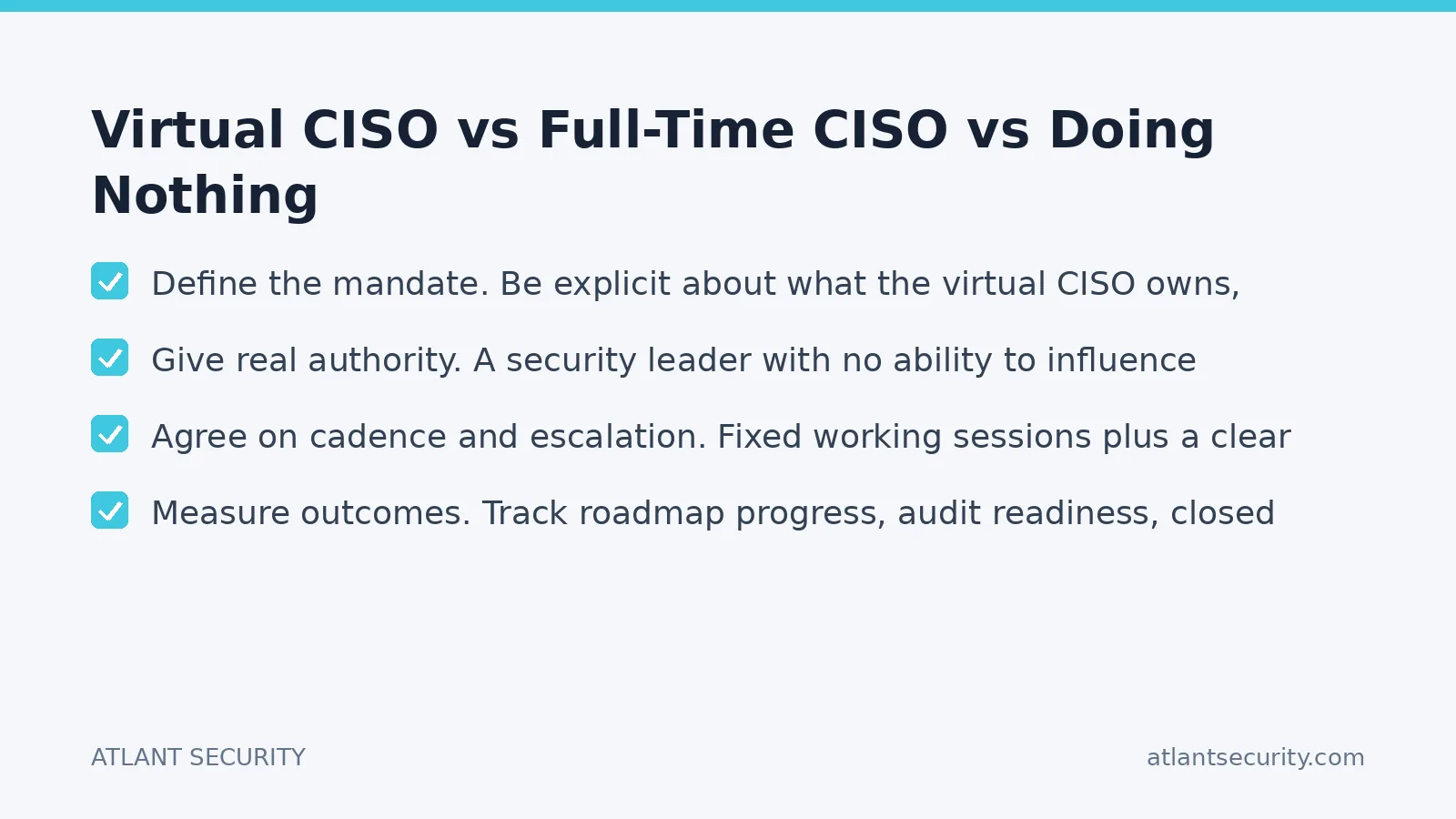
- Define the mandate. Be explicit about what the virtual CISO owns, from compliance readiness to incident response to board reporting.
- Give real authority. A security leader with no ability to influence decisions is decorative. The role needs a direct line to leadership.
- Agree on cadence and escalation. Fixed working sessions plus a clear path for urgent issues avoids the availability gap that critics of the model worry about.
- Measure outcomes. Track roadmap progress, audit readiness, closed findings, and questionnaire turnaround, not hours billed.
Frequently Asked Questions
What is the difference between a virtual CISO and a managed security service?
A managed security service runs tools and monitors your environment. A virtual CISO provides leadership: strategy, risk decisions, compliance ownership, and accountability. The two are complementary. Many companies use a virtual CISO to direct the program and a managed service or internal team to execute the hands-on work.
How many hours does a virtual CISO engagement typically involve?
It varies with your size and goals. Many mid-sized companies are well served by a few days a month for steady-state leadership, scaling up during an audit, an incident, or a major project. The point is to match the commitment to actual need rather than paying for a full-time seat you do not use.
Can a virtual CISO get us through a SOC 2 or ISO 27001 audit?
Yes. Driving compliance readiness is one of the most common reasons companies engage a virtual CISO. The role owns the roadmap, closes the gaps, prepares the evidence, and manages the auditor relationship. See our SOC 2 readiness and ISO 27001 readiness services.
Is a virtual CISO only for companies without any IT staff?
No. Many clients have capable IT teams that simply lack security leadership. A virtual CISO sets direction, mentors that existing team, and makes them more effective. It is about adding strategic ownership, not replacing the people you have.
When should we hire a full-time CISO instead?
When your scale, regulatory exposure, or security operations grow to the point where you need daily, in-house executive presence and a dedicated team. A good virtual CISO will tell you when you have reached that point rather than holding on to the engagement.
Is a Virtual CISO Right for You?
If you hold sensitive data, face compliance pressure, or field security questionnaires from enterprise buyers, but you cannot justify a full-time security executive, the virtual CISO model was built for your situation. You get experienced leadership, an outside perspective, and a security program that stands up to customer and auditor scrutiny, without a six-figure salary line. If you want to talk through whether it fits, look at our virtual CISO services and part-time CISO options, or book a discovery call and we will give you an honest answer either way.