
Two questions land on my desk together more often than you would think. The first is "we need SOC 2 to close deals, where do we start." The second is "our cyber insurance renewal came back with a questionnaire longer than our employee handbook, what do we do." Australian founders and CTOs usually treat these as separate chores. They are not. The controls a SOC 2 auditor tests and the controls a cyber insurance underwriter asks about overlap so heavily that doing one well makes the other dramatically easier. Handle them as one program and you save money, time, and a lot of duplicated evidence gathering.
I have run more than 200 security assessments since 2013, and I have sat on both sides of this: helping companies get SOC 2 reports that hold up, and helping them answer insurer questionnaires without accidentally voiding their own cover. Here is how the two actually fit together, and where the real leverage is.
What SOC 2 Is, Briefly and Honestly
SOC 2 is an attestation report produced by an independent CPA firm against the AICPA's Trust Services Criteria. There are five criteria: Security (mandatory, often called the Common Criteria), Availability, Processing Integrity, Confidentiality, and Privacy. Most companies start with Security and add the others as customers demand them.
There are two report types, and the difference matters for insurance conversations:
- Type I attests that your controls are suitably designed at a single point in time. It is a snapshot.
- Type II attests that those controls operated effectively over a period, usually three to twelve months. It is a track record.
A Type II report is far more valuable, both to enterprise buyers and to underwriters, because it demonstrates the controls actually run rather than merely exist on paper. If you are starting from scratch, a SOC 2 readiness assessment tells you which controls you are missing before an auditor does, which is a much cheaper place to find out.
What Cyber Insurance Underwriters Actually Ask For
The cyber insurance market has hardened considerably. A decade ago you could get meaningful cover with a one-page application. Today underwriters want evidence, and if you attest to controls you do not have, you hand the insurer grounds to reduce or deny a claim later. That last point is the one founders underestimate. An insurance application is a legal representation. Getting it wrong is worse than not having the control.
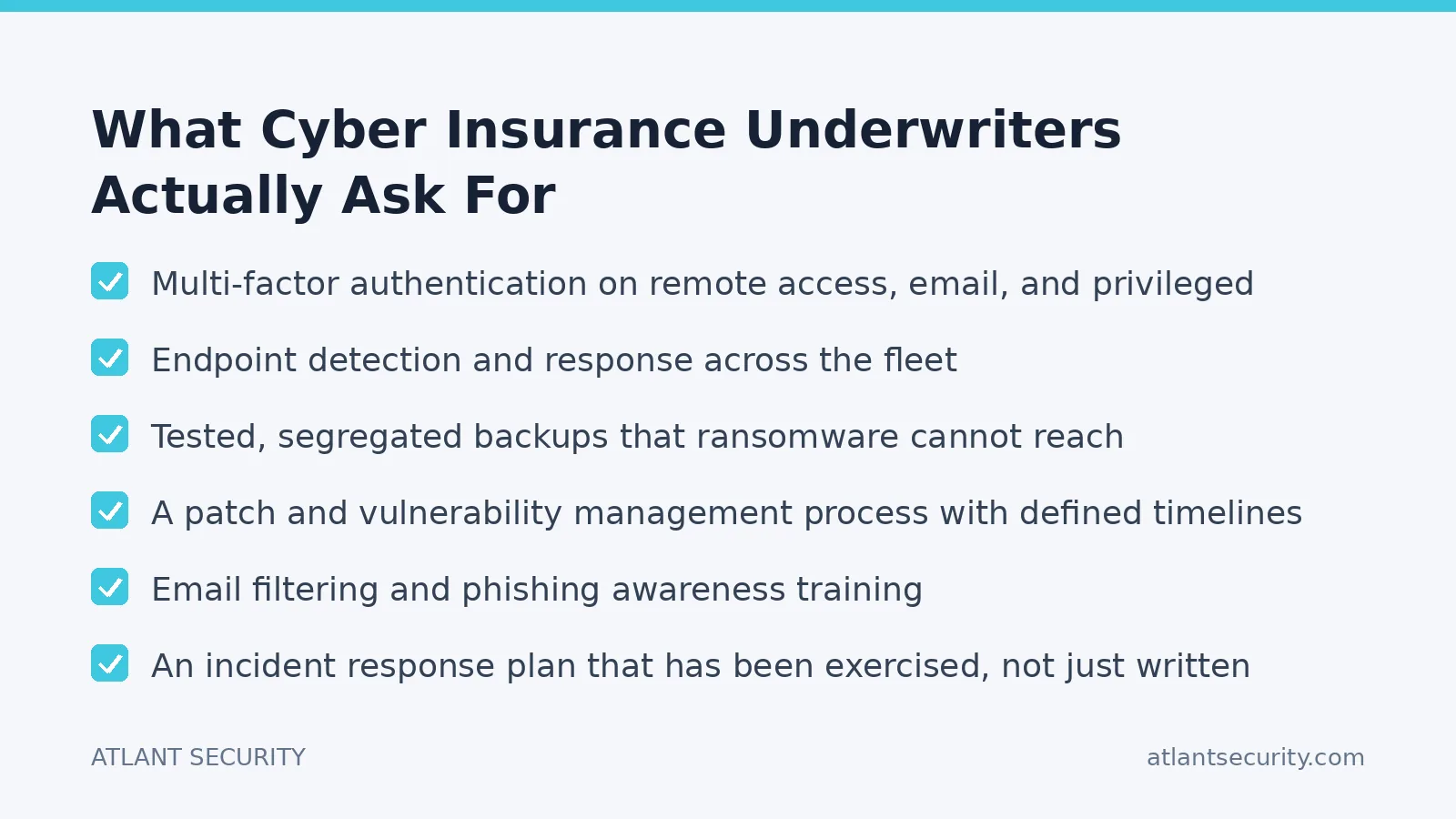
The controls insurers ask about most consistently are:
- Multi-factor authentication on remote access, email, and privileged accounts
- Endpoint detection and response across the fleet
- Tested, segregated backups that ransomware cannot reach
- A patch and vulnerability management process with defined timelines
- Email filtering and phishing awareness training
- An incident response plan that has been exercised, not just written
- Privileged access management and removal of standing admin rights
- Network segmentation and logging
Read that list again and compare it to a SOC 2 Security scope. The overlap is enormous. That is the whole point of this article.
Where SOC 2 and Insurance Overlap
When you build a SOC 2 control environment, you are producing exactly the evidence an underwriter wants to see. The table below maps common insurer questions to the SOC 2 controls that already answer them.
| Insurer question | Related SOC 2 control area | Evidence you already have |
|---|---|---|
| Is MFA enforced everywhere it matters? | Logical access controls | Access control policy, IdP configuration, access reviews |
| How fast do you patch critical vulnerabilities? | Change and vulnerability management | Patch SLAs, scan reports, remediation tickets |
| Are backups tested and isolated? | Availability and resilience | Backup policy, restore test records |
| Do you have an incident response capability? | Incident management | IR plan, tabletop exercise records, post-incident reviews |
| How is privileged access governed? | Access provisioning and review | Privileged access policy, quarterly access reviews |
| Do you train staff on security? | Control environment and awareness | Training completion records, phishing simulation results |
Do the SOC 2 work first, and the insurance questionnaire stops being a scramble and becomes a copy-and-paste exercise from evidence you already maintain. That is the practical win. A mature, evidenced control environment also puts you in a stronger negotiating position at renewal, because you are demonstrably a lower risk than an applicant answering "we think so" to the same questions.
What SOC 2 Will Not Do for Your Insurance
Let me be direct, because this is where marketing tends to overpromise. A SOC 2 report does not automatically slash your premium by some fixed percentage, and no honest consultant can quote you a guaranteed number. Premiums depend on your revenue, sector, data types, claims history, and the underwriter's own appetite in a given year. What SOC 2 does is remove the uncertainty that makes underwriters price in risk. It moves you from "unknown, assume the worst" to "documented, verifiable." That improves your terms and your negotiating leverage. It does not turn insurance into a discount coupon.
Equally, insurance is not a substitute for the controls. Cover pays out after an incident, net of your deductible, and only if you represented yourself accurately. The controls prevent the incident in the first place and keep the claim valid. You want both, working together.
A Sensible Sequence for an Australian SaaS Business
- Run a readiness assessment. Find the gaps between where you are and both the SOC 2 Security criteria and a typical insurer questionnaire. These are largely the same gaps.
- Close the high-impact controls first. MFA everywhere, tested and isolated backups, EDR on every endpoint, and removal of standing admin rights. These are the controls both auditors and underwriters weight most heavily.
- Write and exercise an incident response plan. A plan you have never run is a document, not a capability. Underwriters and auditors both want evidence you have tested it. A penetration test is a good forcing function to see whether your detection and response actually work under pressure.
- Operate the controls long enough for a Type II window. Evidence accumulates over the observation period. Start collecting it deliberately from day one.
- Complete the audit, then use the report at renewal. Bring the SOC 2 report and your evidence to the insurance conversation rather than filling in the questionnaire from memory.
Running these two workstreams as one program is where a virtual CISO earns their keep. Instead of one team chasing SOC 2 and another scrambling on the insurance renewal, you have a single owner making sure the evidence produced for one satisfies the other. For a lean SaaS team, that consolidation alone justifies the engagement.
Common Mistakes I See
- Attesting to controls you do not have on the insurance application. This is the dangerous one. It can void a claim exactly when you need it. Answer honestly, then close the gaps.
- Treating SOC 2 as a document exercise. Auditors test whether controls operate. A binder of policies with no operating evidence fails a Type II.
- Buying tools instead of building process. An EDR licence sitting half-deployed satisfies neither the auditor nor the underwriter. Coverage and operation are what get tested.
- Letting compliance lapse after the report. Controls decay. A Type II covers a window; if you stop operating the controls, the next window and your next renewal both suffer.
- Ignoring the overlap. Duplicating effort across two separate programs wastes the biggest efficiency available to you.
Getting Help That Pays for Itself
You can run this yourself if you have the internal expertise and time. Most growing SaaS companies have neither in the same person. Outside help is worth it for the readiness assessment that finds your real gaps, the sequencing so you build controls in the order that satisfies both auditor and insurer, and an honest review of your insurance application so you do not sign something that comes back to bite you in a claim.
If you want a single program that produces a defensible SOC 2 report and a clean, accurate insurance renewal, talk to Atlant Security. You see the readiness findings before any remediation begins, and the work is led by a former Microsoft security consultant rather than handed to a junior with a checklist. For teams that also want the ongoing management layer, our IT security audit and SOC 2 services keep the controls operating between report cycles.
Frequently Asked Questions
Does having SOC 2 lower my cyber insurance premium?
It can improve your terms and your negotiating position, but no one can promise a fixed discount. Premiums depend on your revenue, sector, data, and claims history. SOC 2 removes the uncertainty underwriters price in, which helps, but it is not a guaranteed price cut.
Do insurers require SOC 2?
Most do not require the report itself, but they ask about the same controls a SOC 2 Security scope covers. Having SOC 2 means you can answer their questionnaire with real evidence instead of guesses, which is exactly what they want to see.
Should I get SOC 2 Type I or Type II?
Type II is more valuable to both customers and underwriters because it shows controls operated effectively over time. Type I is a reasonable stepping stone if you need something quickly, but plan for Type II.
What is the single most important control for both?
Multi-factor authentication, closely followed by tested, isolated backups. Underwriters weight MFA heavily, and it is central to the SOC 2 access controls. Backups determine whether a ransomware incident is a bad week or an extinction event.
Can a small Australian business realistically do both?
Yes. Small teams do this regularly by treating it as one program rather than two, closing the high-impact controls first, and using outside help for the readiness assessment and sequencing. The overlap works in your favour.
What happens if I claim controls I do not actually have?
On an insurance application that is a misrepresentation, and it gives the insurer grounds to reduce or deny a claim later. Always answer accurately, then remediate the gaps. An inaccurate application is worse than an honest one that admits a weakness.
