Most SaaS companies treat SOC 2 Type 2 as a cost of doing business: a box that enterprise procurement makes them tick. That framing leaves value on the table. Handled well, a Type 2 report is a sales asset that shortens deal cycles, removes friction from security reviews, and opens doors that stay closed to uncertified competitors. The certification does not sell your product for you, but it removes one of the biggest reasons deals stall.
This article is about turning a SOC 2 Type 2 report into growth, honestly and without hype. No inflated promises, just the specific ways the report moves revenue for a US SaaS company and how to make the most of it. If you have not yet decided how to approach the audit, start with our SOC 2 readiness guidance, then use this to plan how you will use the report once you have it.
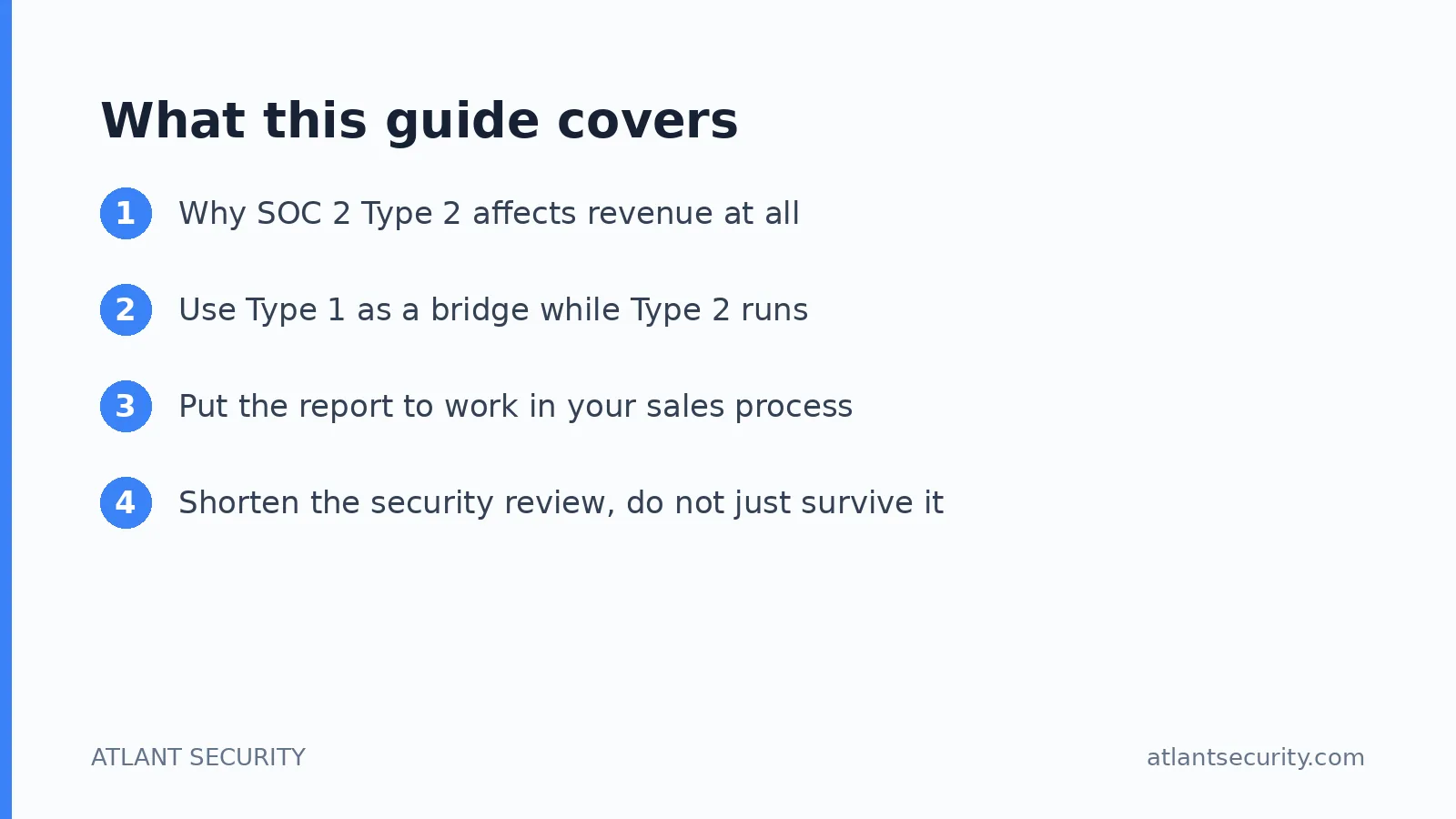
Why SOC 2 Type 2 affects revenue at all
Enterprise and mid-market buyers run security reviews before they sign. Those reviews are slow, they involve people outside your buyer's team, and they are where a surprising number of promising deals quietly die. A current SOC 2 Type 2 report answers most of the questions in that review before they are asked. It is third-party evidence that your controls operated over time, which is exactly what a security team needs to sign off.
The growth effect is not magic. It comes from three concrete things: fewer deals lost to security objections, shorter time from interest to signature, and access to buyers who filter out uncertified vendors entirely. Everything below is a way to amplify one of those three.
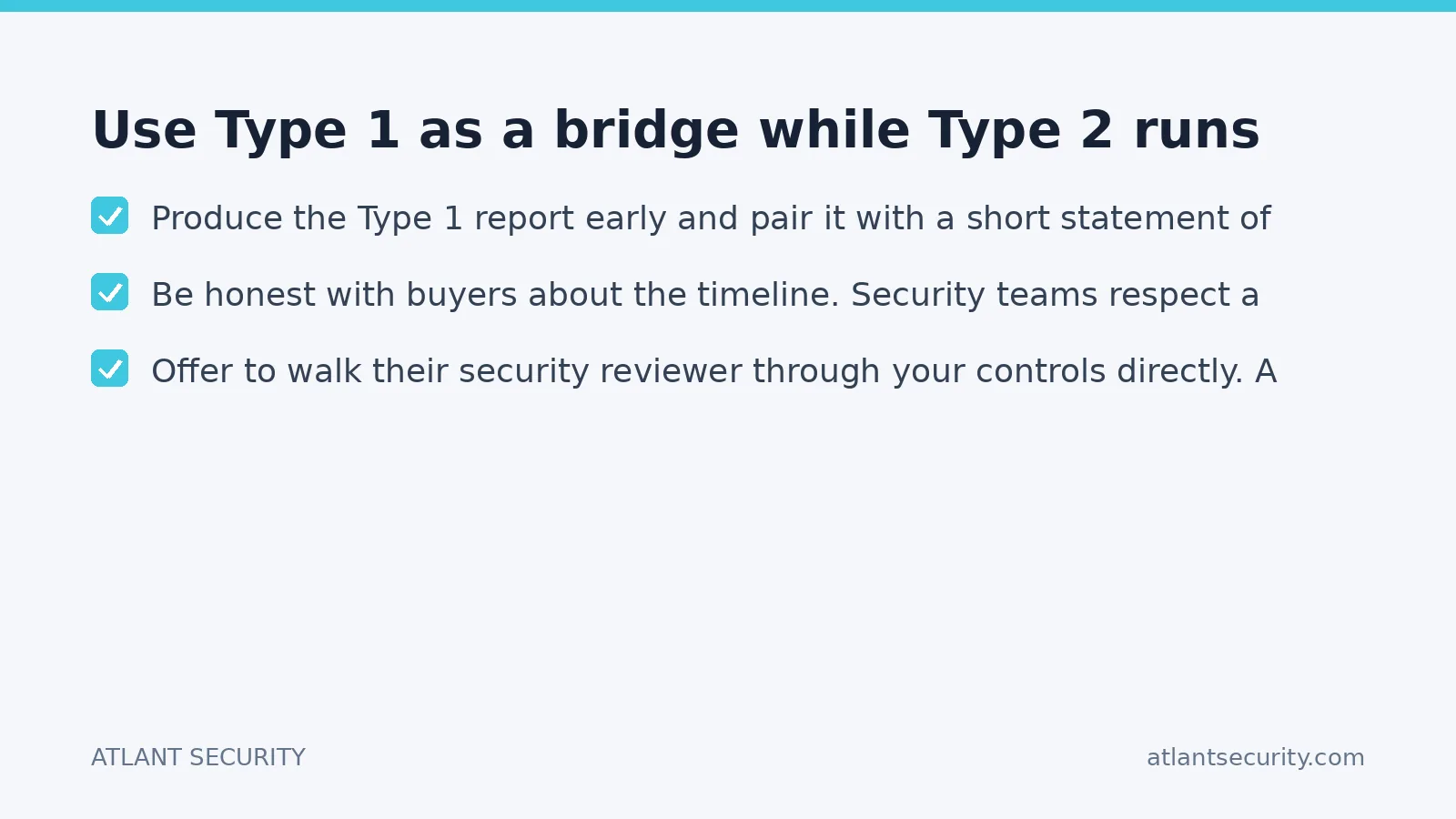
Use Type 1 as a bridge while Type 2 runs
The Type 2 observation window takes months, and you do not have to wait idle. A Type 1 report confirms your control design at a point in time and can be produced relatively quickly. For a buyer who requires SOC 2, a Type 1 report plus a clear roadmap to Type 2 is often enough to keep the deal moving rather than losing it to a certified competitor.
To use the bridge well:
- Produce the Type 1 report early and pair it with a short statement of when your Type 2 window completes.
- Be honest with buyers about the timeline. Security teams respect a credible plan far more than vague reassurance.
- Offer to walk their security reviewer through your controls directly. A live conversation often unblocks a deal faster than another document.
Put the report to work in your sales process
A report sitting in a folder does nothing. The companies that get growth out of SOC 2 build it into how they sell:
- Maintain a trust page or security overview that states your SOC 2 status and how to request the report under NDA. This alone deflects a large share of inbound security questions.
- Prepare a short, plain-language summary of your controls mapped to the questions buyers ask most. Your sales team should be able to answer the common ones without escalating to engineering.
- Keep your security questionnaire answers current and reusable so each new review does not start from scratch.
Reducing the manual effort in every security review is where the time savings compound. A structured security program, whether led internally or through virtual CISO services, keeps these assets accurate as your product changes.
Shorten the security review, do not just survive it
The security review is the slowest step in most enterprise SaaS deals. A Type 2 report shortens it because the reviewer can rely on an independent auditor's testing instead of re-verifying everything themselves. You accelerate it further by anticipating what they need:
- Offer the report proactively rather than waiting to be asked.
- Have your subprocessor list, data flow description, and incident response summary ready to share.
- Assign one person to own security reviews so responses are fast and consistent.
Every day you cut from the review is a day closer to signature, and across a pipeline that adds up to meaningfully faster revenue.
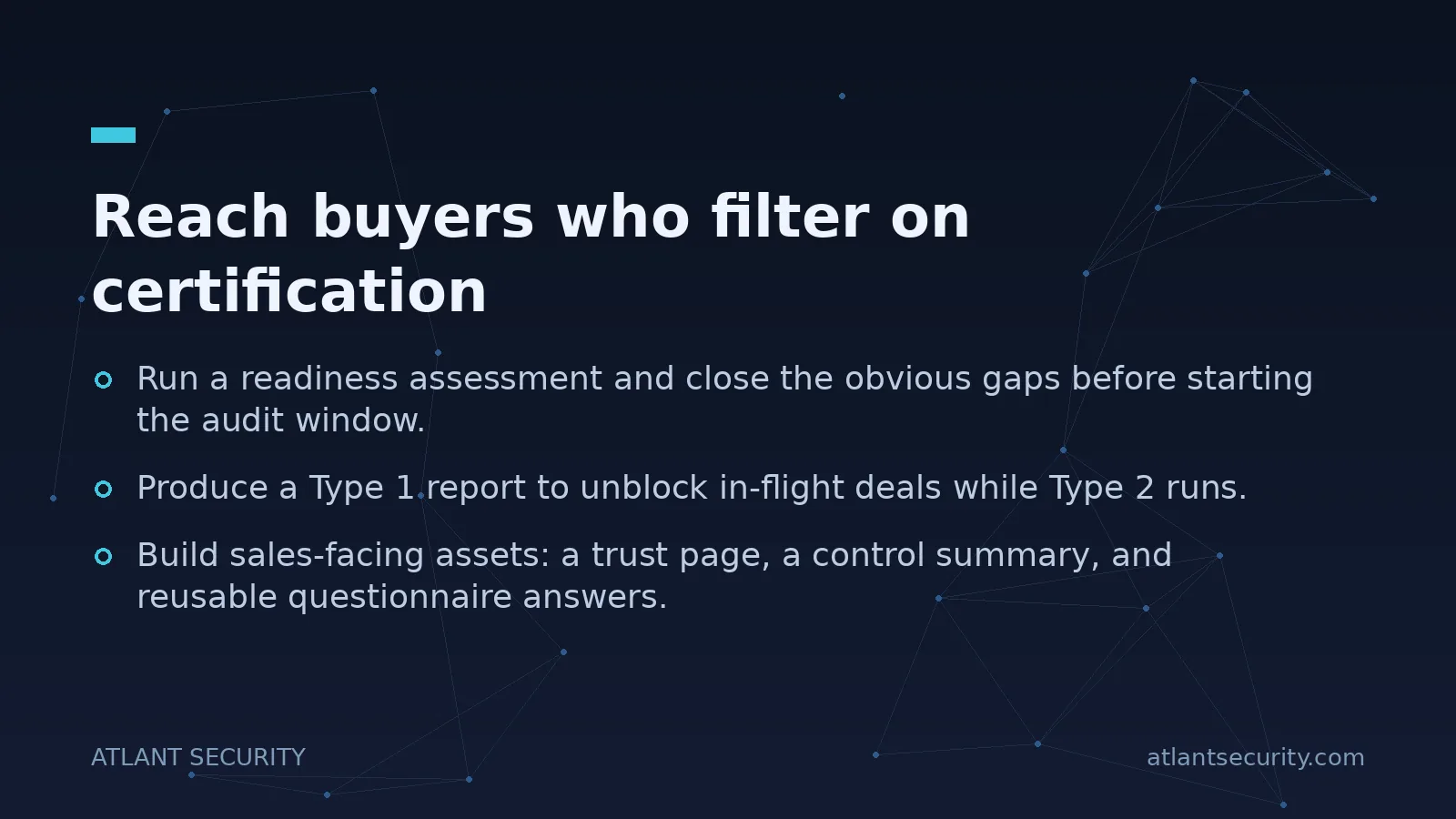
Reach buyers who filter on certification
Some channels and buyers simply will not engage without SOC 2. Cloud marketplaces, regulated industries, and larger enterprises often use certification as a first-pass filter. A current report makes you eligible for opportunities that were previously invisible to you. This is less about winning a specific deal and more about widening the top of your funnel to include buyers who never would have taken the first call.
If your growth plan targets regulated sectors, SOC 2 rarely stands alone. Buyers in healthcare will also ask about HIPAA, payment-adjacent businesses will ask about PCI DSS, and international expansion often brings up ISO 27001. Planning these together avoids repeating the same evidence work three times.
Support premium and enterprise tiers
A credible security posture lets you offer and defend an enterprise tier. This is not about charging more for the same thing; it is that enterprise buyers genuinely need more (stronger access controls, audit support, defined uptime and response commitments) and SOC 2 is the foundation those commitments rest on. When your security program is real and documented, the enterprise tier is easy to justify because the underlying controls actually exist.
Keep the certification current
SOC 2 reports cover a defined period and then need renewal. Letting a report lapse is a quiet way to lose the very advantage you paid for, because a buyer checking your status finds an expired report. Treat renewal as a standing part of operations: keep controls running continuously, collect evidence throughout the year, and schedule the next audit well before the current report ages out. Continuous operation is also far cheaper than re-preparing from scratch each cycle.
Common mistakes that waste the certification
Plenty of companies pay for SOC 2 and get almost no growth from it. The pattern is always the same: they treat the report as a finish line rather than a tool. The most common ways the investment gets wasted:
- Hiding the report. Buyers cannot benefit from what they do not know exists. If your SOC 2 status is not visible on your site and not mentioned early in the sales conversation, you are paying for an asset nobody sees.
- Making it hard to request. A report locked behind a slow, manual approval process adds friction at exactly the moment you want to remove it. A simple NDA-gated request flow keeps momentum.
- Letting sales stay uninformed. If your account executives cannot answer a basic security question and have to escalate every time, the review drags. Arm them with a short control summary.
- Scoping too narrowly to look good. A report that excludes the systems buyers actually care about invites more questions than it answers. Scope to what your customers rely on.
Avoiding these is mostly discipline, and it is where a security leader earns their keep. If you do not have one in-house, a part-time CISO can own both the audit and the go-to-market side of using it.
What growth actually looks like
Be realistic about the mechanism. SOC 2 does not create demand; it removes friction from demand you already have. The measurable effects are a shorter average sales cycle for enterprise deals, a lower rate of deals lost to security objections, and a larger set of qualified opportunities because certification-filtered buyers now see you. Track those metrics before and after certification and you will see the return, without needing any of the inflated figures that get thrown around in marketing copy. For businesses selling into regulated or high-assurance markets, pairing SOC 2 with an ongoing security program signals maturity that a one-off audit never can.
Where SOC 2 Type 2 moves the needle
| Growth lever | How the report helps | What to do with it |
|---|---|---|
| Deal velocity | Answers security review questions up front | Offer the report early; keep questionnaires reusable |
| Win rate | Removes security as a reason to say no | Build a trust page and control summary |
| Funnel reach | Makes you eligible for filtered buyers | Target marketplaces and regulated sectors |
| Pricing | Underpins a credible enterprise tier | Tie tier commitments to real controls |
| Retention | Ongoing assurance to existing accounts | Renew on time, never let it lapse |
A realistic sequence for getting growth from SOC 2
- Run a readiness assessment and close the obvious gaps before starting the audit window.
- Produce a Type 1 report to unblock in-flight deals while Type 2 runs.
- Build sales-facing assets: a trust page, a control summary, and reusable questionnaire answers.
- Complete the Type 2 window with controls operating cleanly throughout.
- Use the report proactively in every security review and to reach certification-filtered buyers.
- Renew on schedule so the advantage never lapses.
None of this requires exaggeration to be worth doing. Faster reviews, fewer lost deals, and access to buyers who were previously out of reach are real, measurable gains. For a full view of how the report is built and maintained, see our SOC 2 service page.
Frequently Asked Questions
Does SOC 2 Type 2 actually help close deals?
Indirectly but reliably. It does not make the sale, but it removes security as a blocker, shortens the review that slows most enterprise deals, and makes you eligible for buyers who filter on certification. The effect shows up as higher velocity and fewer deals lost to security objections.
Is Type 1 enough to win enterprise customers?
Sometimes, as an interim step. A Type 1 report plus a credible roadmap to Type 2 often keeps a deal alive while your observation window runs. Most large buyers ultimately want Type 2, so treat Type 1 as a bridge rather than a destination.
How soon after certification do we see a sales impact?
As soon as you put the report to work. The impact is not automatic; it comes from offering the report proactively, building a trust page, and having reusable answers ready. Companies that leave the report in a folder see very little; those that build it into their sales motion see faster reviews almost immediately.
Do we need other certifications alongside SOC 2?
It depends on your buyers. Healthcare customers ask about HIPAA, payment-adjacent businesses about PCI DSS, and international or security-mature buyers about ISO 27001. If those markets are in your plan, scope them together with SOC 2 so you reuse the same underlying evidence.
What happens if our SOC 2 report lapses?
You lose the advantage exactly when a buyer checks. An expired report reads as a red flag during a security review. Keep controls operating year-round and schedule renewal before the current report ages out so there is never a gap.
Turn the report into pipeline
SOC 2 Type 2 is worth far more than the compliance checkbox it starts as. Used deliberately, it accelerates enterprise sales, widens your funnel, and supports the premium tiers that drive growth. If you want help building the report and, just as importantly, turning it into a sales advantage rather than a filed document, get in touch and we will help you plan both the audit and how you use it.