
Most Australian companies that come to me about SOC 2 are not chasing a badge for its own sake. They are chasing a US or global enterprise customer whose procurement team will not sign until they see a SOC 2 report. That is the real driver, and it changes how you should think about hiring a consultant. You are not buying compliance theatre. You are buying the fastest credible route to a report that a sceptical enterprise security reviewer will accept. This is a straight guide to choosing a SOC 2 consultant in Australia: what these engagements actually involve, the trap most first-timers fall into, and the criteria that separate a consultant worth their fee from one who will waste six months of your runway.
First, the distinction that saves you money: consultant versus auditor
The single most useful thing I can tell an Australian founder is that the consultant and the auditor are two different roles, and they must be. SOC 2 is a framework and attestation standard from the American Institute of Certified Public Accountants (AICPA). The report itself can only be issued by a licensed CPA firm acting as your auditor. A consultant cannot issue your SOC 2 report, and any auditor with proper independence will not consult on and then audit the same controls, because that destroys the independence the report depends on.
So the structure of a well-run SOC 2 project in Australia is:
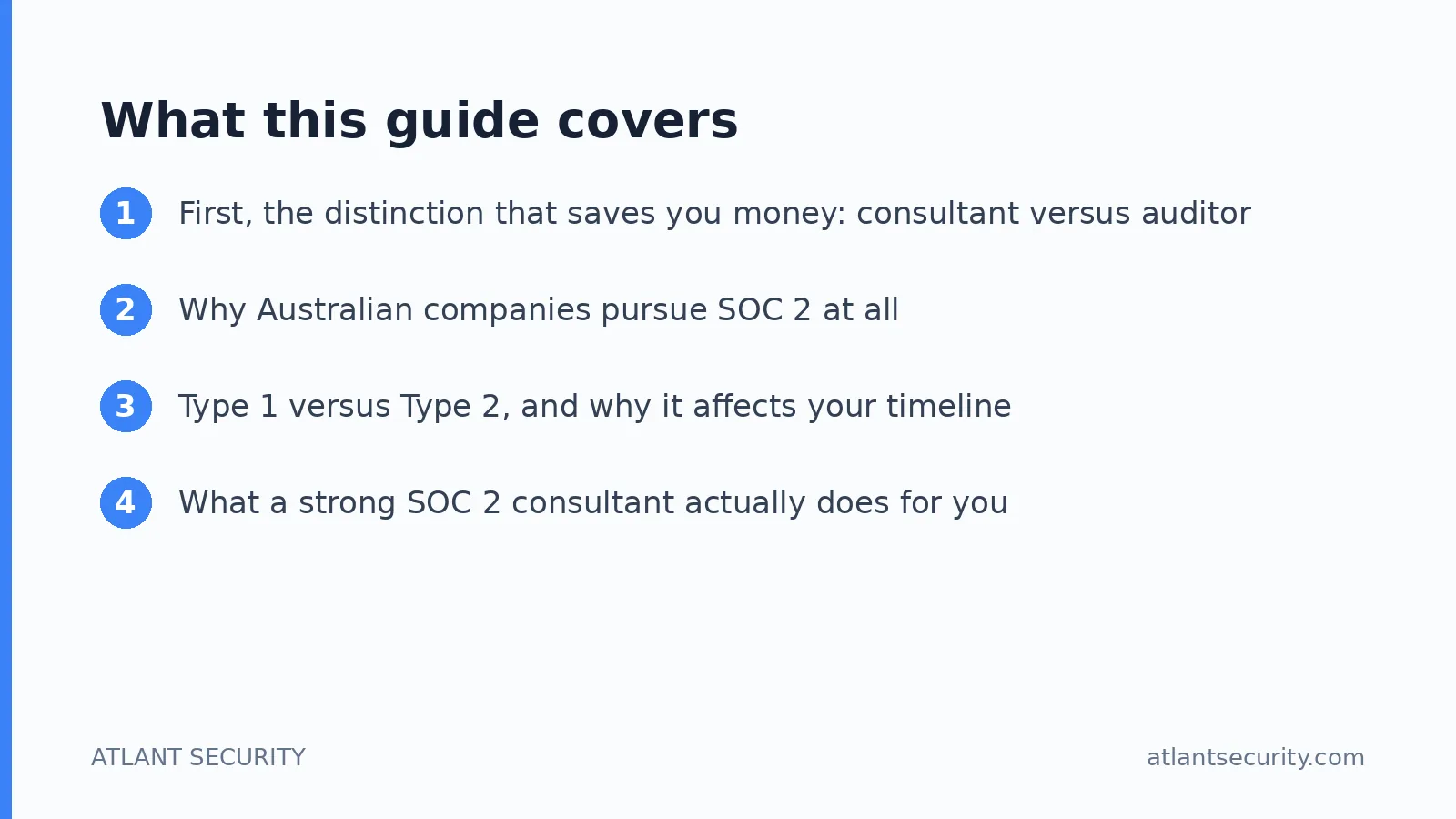
- The consultant (readiness partner) helps you scope, close gaps, build controls and evidence, and get audit-ready. This is where a security firm like ours earns its keep.
- The auditor (CPA firm) independently examines your controls and issues the SOC 2 report.
If a vendor tells you they will "certify" your SOC 2, be careful. Strictly speaking, SOC 2 is an attestation, not a certification, and only the CPA auditor issues the report. A good consultant will happily explain this distinction and will often introduce you to reputable independent auditors rather than pretend to do both.
Why Australian companies pursue SOC 2 at all
SOC 2 is a US standard, so why do so many Australian SaaS, fintech, and technology firms invest in it? Because it is the language enterprise buyers in the US and increasingly worldwide use to gauge whether a vendor can be trusted with their data. A SOC 2 report is built around five Trust Services Criteria: security (the mandatory one, also called the common criteria), availability, processing integrity, confidentiality, and privacy. You choose which criteria are in scope based on what you promise customers.
The practical payoffs are concrete:
- Shorter sales cycles. A current SOC 2 report answers most of a security questionnaire before it is even sent, removing a common blocker to closing enterprise deals.
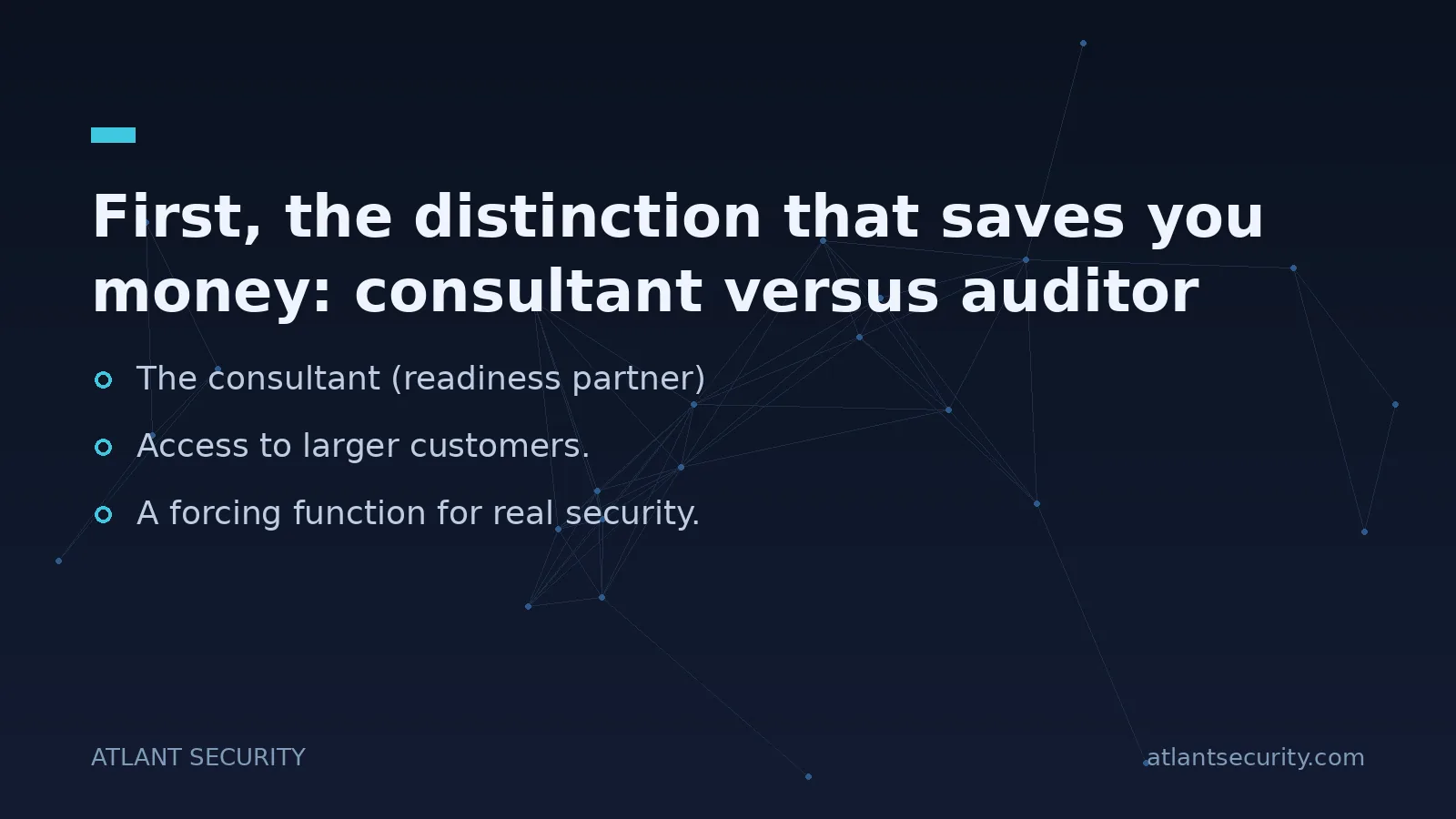
- Access to larger customers. Many US enterprises simply will not onboard a vendor without one.
- A forcing function for real security. Done honestly, the process makes you materially more secure, not just more presentable.
If you want the deeper local picture, we cover it in our guide to SOC 2 certification in Australia and in SOC 2 outcomes for Australian businesses.
Type 1 versus Type 2, and why it affects your timeline
There are two kinds of SOC 2 report, and the choice shapes both your schedule and your consultant's role.
| Aspect | SOC 2 Type 1 | SOC 2 Type 2 |
|---|---|---|
| What it assesses | Design of controls at a single point in time | Design and operating effectiveness over a period |
| Observation period | A specific date | Typically 3 to 12 months |
| What buyers prefer | Accepted as a first step | The report most enterprises really want |
| Consultant's focus | Get controls designed and documented | Get controls running consistently and generating evidence over time |
Many companies start with a Type 1 to satisfy an urgent customer, then run the observation window for a Type 2. A good consultant will tell you honestly which path fits your deadline and your buyer, rather than selling you the most expensive option by default. For realistic timing, see our note on how long SOC 2 actually takes.
What a strong SOC 2 consultant actually does for you
The value of a readiness partner is compressing the timeline and preventing the expensive mistakes. Concretely, expect them to:
- Scope the engagement. Decide which Trust Services Criteria apply, define the system boundary, and identify which of your systems, teams, and vendors are in scope. Getting scope wrong is the most common and most costly early error.
- Run a gap assessment. Compare your current controls against what the audit will require and produce a prioritised remediation plan grounded in evidence, not a generic checklist.
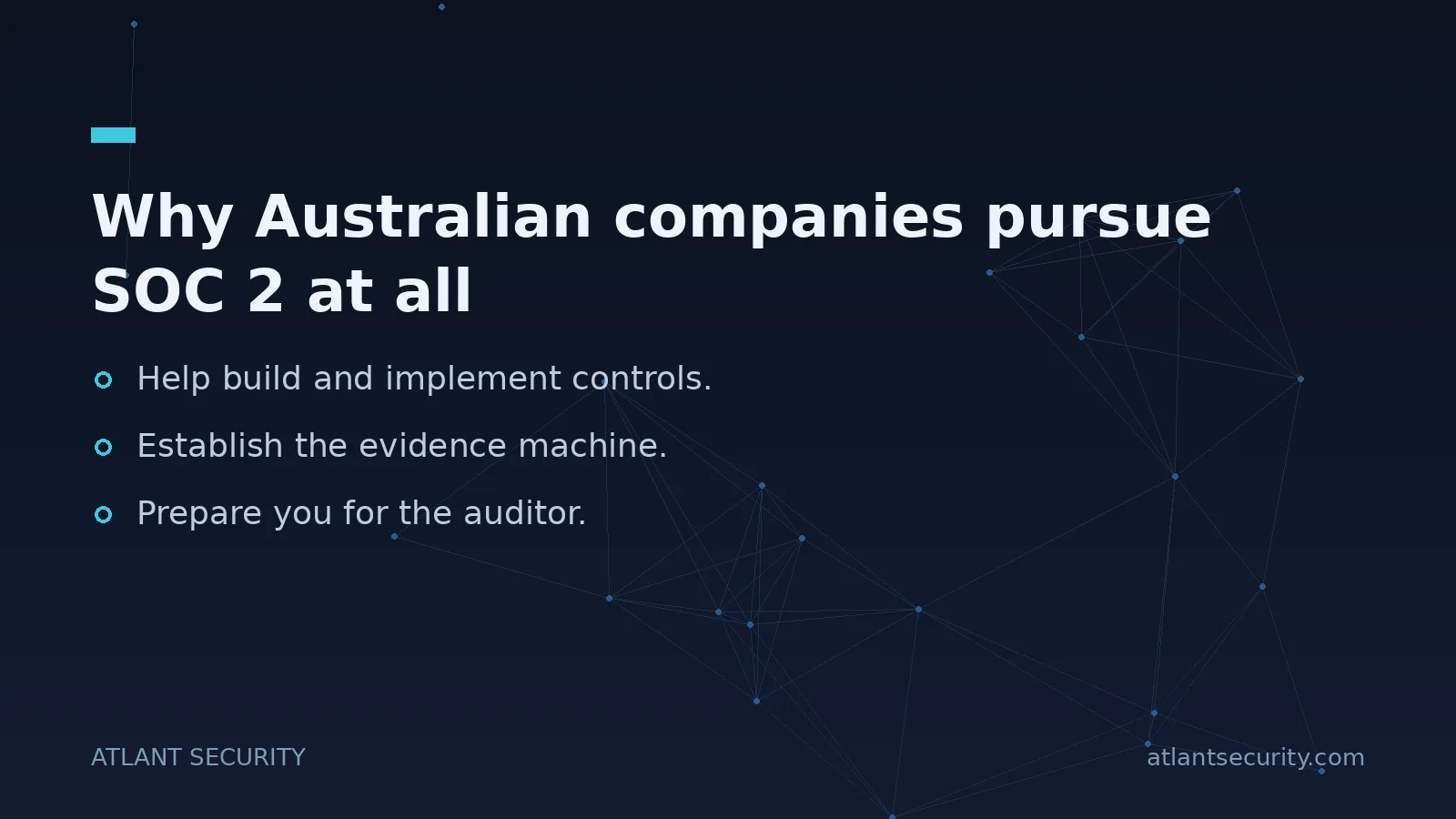
- Help build and implement controls. Access management and multi-factor authentication, change management, logging and monitoring, vulnerability management, vendor risk, and incident response, all sized to your actual environment.
- Establish the evidence machine. Type 2 lives or dies on evidence collected consistently over the observation period. A good consultant sets up the processes and tooling so evidence accumulates automatically rather than in a panic before the audit.
- Prepare you for the auditor. Dry-run the examination, tidy documentation, and coordinate with the CPA firm so the audit is a confirmation rather than a discovery exercise.
Our own SOC 2 readiness and SOC 2 consulting work follows exactly this shape, and for companies without an in-house security leader we often deliver it through a virtual CISO engagement so the program has continuous ownership rather than a one-off push.
How to choose the right consultant in Australia
Here are the criteria I would actually weigh, having sat on both sides of these engagements.
Genuine SOC 2 and security depth
SOC 2 is a security exercise wearing an audit costume. You want a partner who understands the controls at a technical level, not one who only knows how to fill in a policy template. Ask them to explain how they would approach change management or access reviews for your specific stack. Vague, generic answers are a warning sign.
Experience with companies like yours
A cloud-native SaaS startup, a fintech handling payments, and an established enterprise have very different control environments. A consultant who has repeatedly guided companies of your size and architecture through SOC 2 will anticipate the issues rather than discover them on your budget. If you are early stage, our overview of SOC 2 for startups is a useful primer.
Honesty about scope and cost
The strongest signal of a good consultant is that they narrow your scope rather than inflate it. Every extra system and criterion in scope adds cost and audit effort. A consultant motivated by your outcome trims scope to what your buyers actually require. One motivated by billing does the opposite.
Independence from the auditor
Confirm that your consultant is not also going to audit you, and ideally that they can recommend several reputable independent CPA auditors. That separation protects the credibility of your final report.
A plan for continuous compliance
SOC 2 is not one and done. Type 2 reports cover a period, and enterprise customers expect a fresh report annually. The right partner helps you build a program that keeps producing evidence year after year, not a one-time sprint that decays the moment they leave.
The mistakes that cost Australian firms the most
Across readiness engagements, the same avoidable errors recur:
- Treating SOC 2 as documentation only. Auditors test whether controls operate, not just whether policies exist. Policies without operating evidence fail a Type 2.
- Scoping too broadly. Pulling every system into scope to look thorough inflates cost and lengthens the audit for no commercial benefit.
- Starting evidence collection too late. If your observation period has begun and no one is capturing evidence, you are already behind.
- Confusing consultant and auditor roles. Expecting one party to both build and attest to your controls creates an independence problem that a serious auditor will reject.
- Ignoring the security substance. A report built on shallow controls may pass, but it will not protect you, and sophisticated buyers read the exceptions section closely.
Underneath all of these sits a single principle: SOC 2 should reflect security you actually have. Independent penetration testing and a real look at your cloud security posture give you both stronger controls and better evidence for the audit.
Where SOC 2 fits alongside ISO 27001
Australian companies often ask whether they should pursue SOC 2 or ISO 27001. It depends on your buyers. SOC 2 is dominant with US enterprise customers; ISO 27001 carries more weight in Europe, the UK, and parts of Asia. The two overlap heavily in their control expectations, so if you need both, a consultant can build one control set that supports each with far less duplicated effort. If ISO is on your horizon, our ISO 27001 readiness service is designed to dovetail with SOC 2 work rather than repeat it.
Getting started
If you are staring down a customer deadline, the right first move is a scoping conversation and a gap assessment, not a rushed commitment to a full Type 2. That tells you honestly how far you are from audit-ready, what it will cost, and which report your buyer actually needs. For an Australian-specific walk-through of the audit itself, see how to prepare for a SOC 2 audit in Australia. If you want an outside assessment of where you stand and a realistic plan to a report your customers will accept, get in touch.
Frequently Asked Questions
Can a consultant issue my SOC 2 report?
No. A SOC 2 report can only be issued by an independent licensed CPA firm acting as your auditor. A consultant or readiness partner helps you scope, close gaps, build controls, and prepare, but the attestation itself must come from the CPA auditor. Be wary of any firm that claims it will both consult on and issue your SOC 2, because that undermines the independence the report relies on.
Is SOC 2 a certification?
Not technically. SOC 2 is an attestation report produced under AICPA standards, not a pass or fail certification. People commonly say "SOC 2 certified" as shorthand, but what you actually receive is an auditor's report describing your controls and any exceptions. Enterprise buyers read that report, including the exceptions, so the quality of the underlying controls matters, not just having a document.
How long does SOC 2 take for an Australian company?
A Type 1, which assesses control design at a point in time, can often be reached in a few months of readiness work. A Type 2 requires an observation period of typically three to twelve months on top of readiness, because the auditor examines how controls operate over time. Your timeline depends heavily on how mature your controls already are when you start.
Do we need SOC 2 or ISO 27001?
It depends on your customers. SOC 2 is expected by US enterprise buyers, while ISO 27001 is more recognised in Europe, the UK, and parts of Asia. The control requirements overlap substantially, so if you need both, you can build a single control programme that supports each and avoid paying twice for the same evidence.
How much does SOC 2 cost in Australia?
Total cost splits between the readiness work (consulting, tooling, and the internal effort to build and run controls) and the auditor's fee for the examination. It varies widely with your scope, the number of Trust Services Criteria in scope, your existing maturity, and whether you pursue Type 1 or Type 2. The most reliable way to control cost is to keep scope tight to what your buyers actually require.
Which Trust Services Criteria should we include?
Security, the common criteria, is mandatory for every SOC 2 report. The other four, availability, processing integrity, confidentiality, and privacy, are optional and should be included only if you make relevant commitments to customers. Adding criteria you do not need increases audit effort without commercial benefit, which is why good scoping is one of the most valuable things a consultant does.
