How Long Does SOC 2 Take? Realistic Timelines, Phase-by-Phase Breakdown & What Actually Causes Delays
Alexander Sverdlov
Security Analyst

💫 Key Takeaways
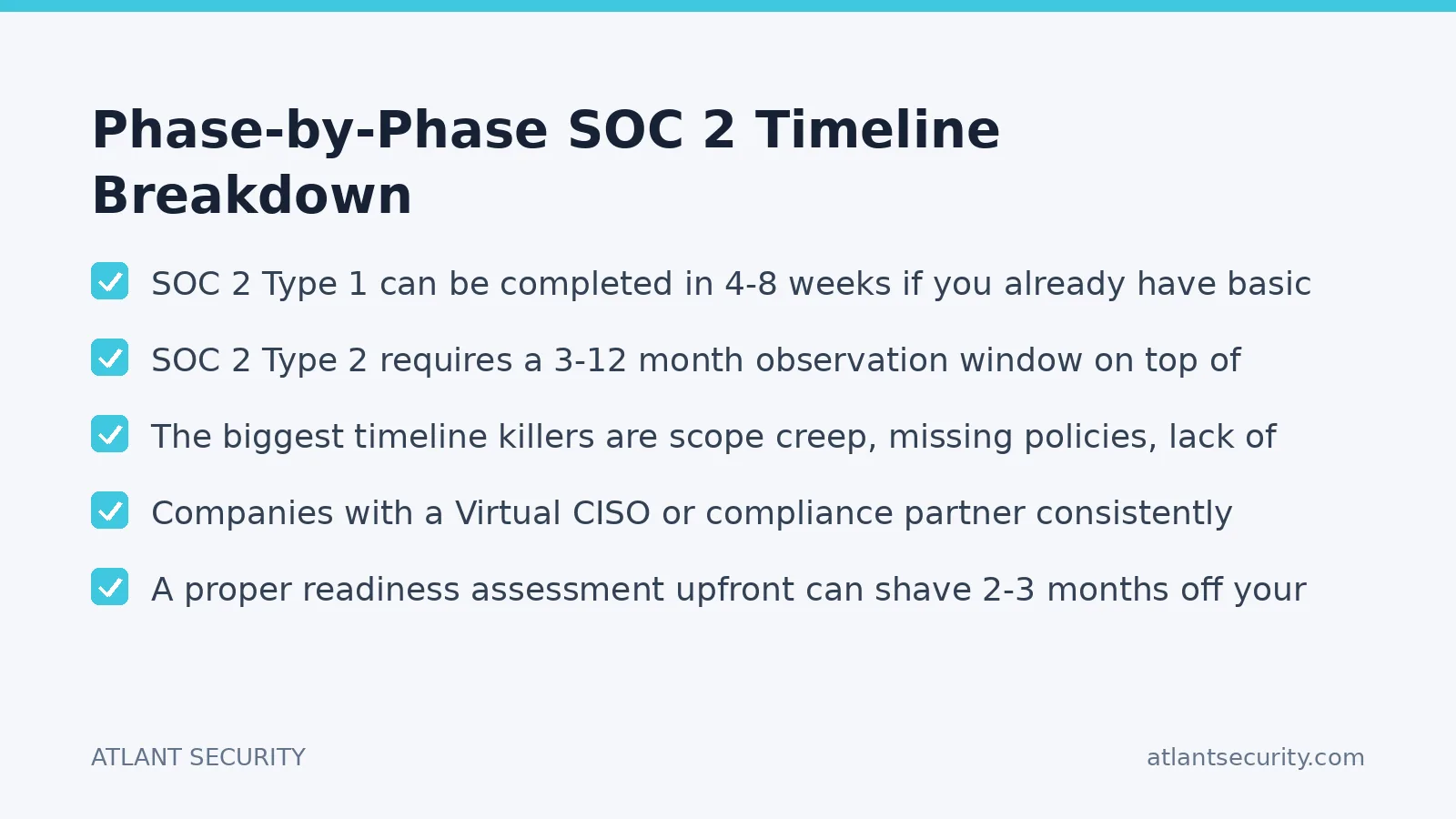
- SOC 2 Type 1 can be completed in 4-8 weeks if you already have basic security controls in place
- SOC 2 Type 2 requires a 3-12 month observation window on top of preparation - total timeline is typically 6-15 months
- The biggest timeline killers are scope creep, missing policies, lack of internal ownership, and auditor scheduling backlogs
- Companies with a Virtual CISO or compliance partner consistently finish 40-60% faster than those going it alone
- A proper readiness assessment upfront can shave 2-3 months off your total timeline by eliminating surprises during the audit
I’m going to tell you something embarrassing. The first time I helped a company pursue SOC 2 certification, I told the CEO it would take “about three months, tops.” I even said it with a straight face. That was a Tuesday. By the following March - yes, nearly a full year later - we were still chasing down evidence for a control that nobody had documented because “everyone just knew how it worked.”
That project didn’t fail. We got the report. But I learned a lesson that now sits at the top of every kickoff presentation I deliver: the question “how long does SOC 2 take?” has no single answer. It depends on your current security posture, your team’s bandwidth, which Trust Services Criteria you’re including, how organized your documentation is, and whether your auditor has capacity this quarter or next.
What I can give you is something better than a vague range: a phase-by-phase breakdown with realistic timelines, the specific factors that speed things up or slow them down, and the most common delays I’ve seen across dozens of engagements - with concrete advice on avoiding each one. Whether you’re a startup founder wondering if SOC 2 is worth the time investment or an IT director who just got told “we need this done by Q4,” this guide will help you plan honestly.
The Fundamentals
SOC 2 Type 1 vs. Type 2: Two Very Different Timelines
Before we talk timelines, let’s make sure we’re speaking the same language. SOC 2 comes in two report types, and confusing them is one of the most common mistakes companies make when planning their compliance journey.
SOC 2 Type 1 - Point-in-Time Snapshot
A Type 1 report evaluates whether your security controls are designed appropriately as of a specific date. Think of it as a photograph: the auditor looks at your controls on, say, June 15th and confirms they exist and are properly designed. They do not test whether those controls have been operating effectively over time.
Typical timeline: 4-8 weeks from audit-ready state to final report
Total timeline including preparation: 2-5 months depending on current maturity
SOC 2 Type 2 - Sustained Operations Over Time
A Type 2 report evaluates whether your controls were operating effectively over a defined observation period - typically 3, 6, 9, or 12 months. This is the one enterprise customers actually want. It’s proof that you don’t just have good policies on paper, but that you’ve been consistently following them.
Observation window: 3-12 months (6 months is most common for first-time reports)
Total timeline including preparation: 6-15 months depending on readiness and chosen observation window
"Most of our clients start with a Type 1 to show immediate progress, then transition to Type 2 within the same year. This gives your sales team something to share with prospects while you build operational maturity."
| Dimension | SOC 2 Type 1 | SOC 2 Type 2 |
|---|---|---|
| What it evaluates | Control design at a point in time | Operating effectiveness over a period |
| Observation period | Single date (e.g., June 15) | 3-12 months (6 mo. typical) |
| Prep time | 2-4 months | 2-4 months before observation starts |
| Audit fieldwork | 2-4 weeks | 3-6 weeks |
| Report delivery | 2-4 weeks after fieldwork | 4-8 weeks after fieldwork |
| Total end-to-end | 2-5 months | 6-15 months |
| Customer acceptance | Good for initial conversations | Required by most enterprise buyers |
| Best for | Quick proof of commitment | Closing enterprise deals, renewals |
The Full Journey
Phase-by-Phase SOC 2 Timeline Breakdown
Every SOC 2 engagement - whether Type 1 or Type 2 - follows a predictable sequence of phases. Here’s what each phase involves, how long it takes, and where teams most commonly get stuck.
Phase 1: Readiness Assessment
⏲ Duration: 2-4 weeks
This is the diagnostic phase. A qualified assessor - whether your Virtual CISO, an internal team, or a consulting partner - evaluates your current security posture against the AICPA Trust Services Criteria you plan to include in scope.
What happens:
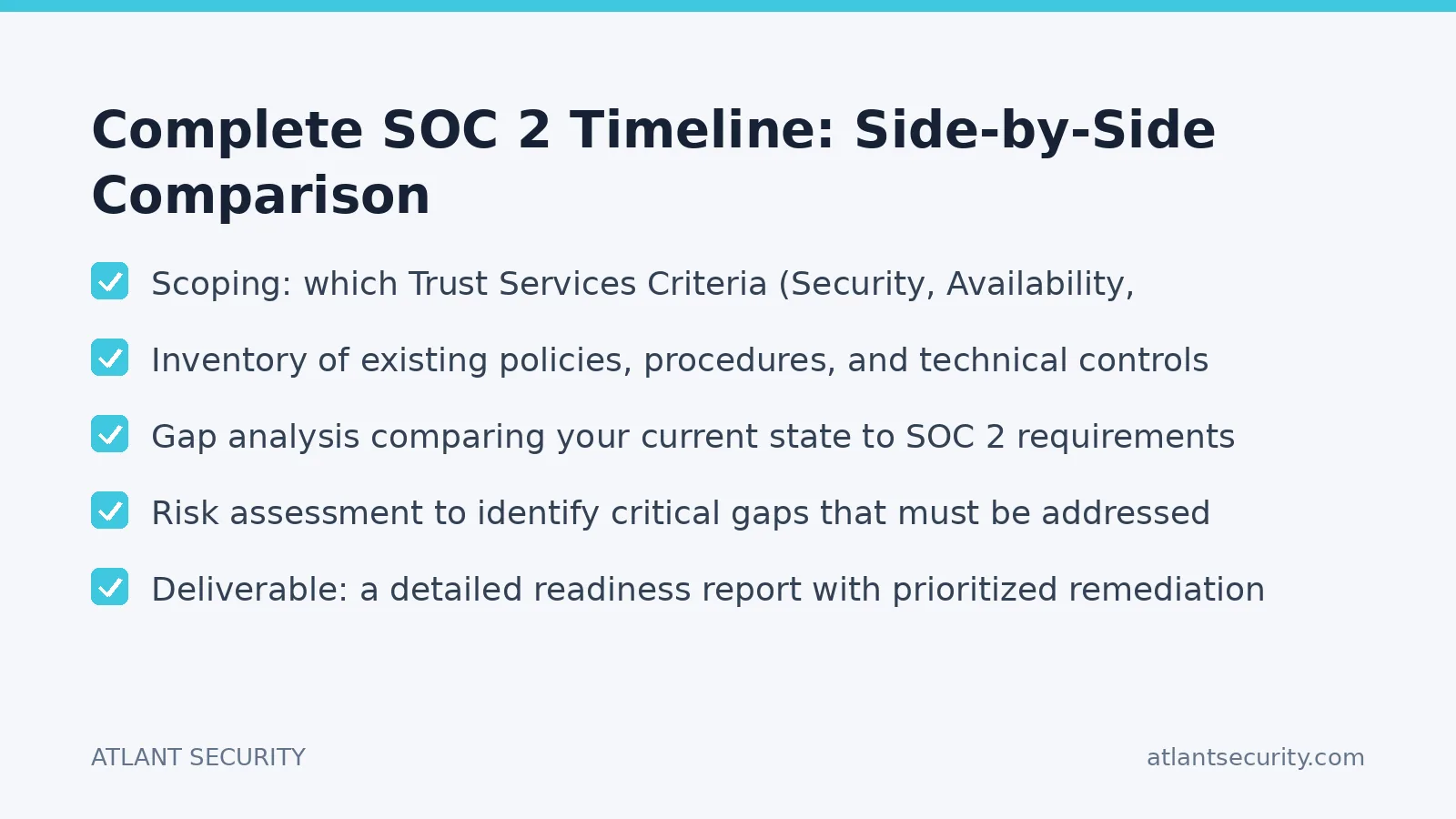
- Scoping: which Trust Services Criteria (Security, Availability, Processing Integrity, Confidentiality, Privacy) apply to your business
- Inventory of existing policies, procedures, and technical controls
- Gap analysis comparing your current state to SOC 2 requirements
- Risk assessment to identify critical gaps that must be addressed before the audit
- Deliverable: a detailed readiness report with prioritized remediation roadmap
Why it matters: Companies that skip the readiness assessment routinely add 2-3 months to their total timeline. You don’t want to discover during audit fieldwork that your change management process was never documented.
Phase 2: Gap Remediation & Control Implementation
⏲ Duration: 4-12 weeks (highly variable)
This is the phase that makes or breaks your timeline. Based on the readiness assessment, your team addresses every gap identified - writing missing policies, implementing new technical controls, configuring monitoring tools, and establishing processes that didn’t previously exist.
Common remediation tasks:
- Drafting or updating 15-25 security policies (access control, incident response, change management, vendor management, etc.)
- Enabling MFA across all critical systems
- Deploying endpoint detection and response (EDR) tools
- Configuring centralized logging and monitoring (SIEM or log aggregation)
- Implementing formal onboarding/offboarding procedures with access reviews
- Establishing a vulnerability management cadence
- Setting up a compliance automation platform (Vanta, Drata, Secureframe, or similar)
Timeline variance: A SaaS company that already uses SSO, has an MDM solution, and runs on AWS with basic guardrails might need only 4 weeks. A company with no formal security program could need 12+ weeks. This is where a Virtual CISO pays for itself - they know exactly which controls auditors actually test and can prioritize accordingly.
Phase 3: Evidence Collection & Observation Period
⏲ Duration: 0 weeks (Type 1) or 3-12 months (Type 2)
For Type 1, this phase is essentially simultaneous with Phase 2 - you implement controls and document evidence that they exist. For Type 2, this is where the clock really runs: your controls must operate effectively for the entire observation window.
What the observation period involves:
- Executing your controls consistently - quarterly access reviews, regular vulnerability scans, incident response tests
- Collecting and organizing evidence: screenshots, system logs, ticket records, meeting minutes
- Maintaining your compliance platform with up-to-date evidence mapped to each control
- Conducting internal audits or spot-checks to catch problems before the external auditor does
- Documenting exceptions and remediation - auditors expect minor issues, but they want to see how you handled them
Pro tip: Most first-time Type 2 reports use a 6-month observation window. This balances speed with credibility. A 3-month window is possible but some enterprise buyers view it skeptically. A 12-month window is gold standard but extends your timeline significantly.
Phase 4: Audit Fieldwork
⏲ Duration: 2-6 weeks
This is where your CPA firm (the auditor) conducts the formal examination. They’ll review evidence, interview key personnel, test control samples, and evaluate whether your system description is accurate.
What to expect:
- Initial evidence request list (IRL) - typically 80-150 items depending on scope
- Walkthroughs with control owners to explain how processes work
- Sample testing: the auditor selects samples of transactions, changes, access grants, etc. to verify controls operated as described
- Follow-up requests - expect 1-3 rounds of additional evidence requests
- Management representation letter and final sign-off
Timeline note: Fieldwork for Type 1 typically takes 2-3 weeks. Type 2 fieldwork takes 3-6 weeks because auditors must test a larger volume of evidence across the entire observation period. The biggest delay here is slow evidence delivery from your team - if you can’t produce requested evidence within 48 hours, fieldwork stalls.
Phase 5: Report Issuance
⏲ Duration: 2-8 weeks
After fieldwork concludes, the auditor drafts the report, which goes through internal quality review at the CPA firm. You’ll review the draft for factual accuracy (you cannot change audit opinions, but you can correct descriptions of your systems).
What the report contains:
- Independent auditor’s opinion
- Management’s assertion
- System description (your environment, people, processes, technology)
- Applicable Trust Services Criteria and related controls
- Test results and any exceptions noted
Timeline variable: Boutique audit firms often turn reports around in 2-3 weeks. Big Four firms can take 6-8 weeks due to internal review layers. If your report has exceptions (control failures), expect additional back-and-forth that adds 1-2 weeks.
At a Glance
Complete SOC 2 Timeline: Side-by-Side Comparison
Here’s the full picture. Note that phases overlap slightly in practice - for example, you might begin auditor selection during gap remediation, and evidence collection runs concurrently with the observation period.
| Phase | Type 1 Timeline | Type 2 Timeline | Key Dependencies |
|---|---|---|---|
| Readiness Assessment | 2-4 weeks | 2-4 weeks | Assessor availability, stakeholder schedules |
| Gap Remediation | 4-8 weeks | 4-12 weeks | Current maturity, team bandwidth, tooling |
| Observation Period | N/A | 3-12 months | Chosen window length, control consistency |
| Auditor Selection | 2-4 weeks | 2-4 weeks | Auditor capacity, proposal reviews |
| Audit Fieldwork | 2-3 weeks | 3-6 weeks | Evidence readiness, team responsiveness |
| Report Delivery | 2-4 weeks | 4-8 weeks | Auditor review process, exceptions found |
| TOTAL | 2-5 months | 6-15 months | Everything above |
Realistic scenario: A 60-person B2B SaaS company with basic AWS infrastructure, some existing security controls, but no formal compliance program. They hire a Virtual CISO to guide the process. Type 1 report in hand within 4 months. Type 2 report (6-month window) completed 10 months after the project kicked off.
Speed vs. Delays
Factors That Speed Up or Slow Down SOC 2
After guiding dozens of companies through SOC 2, patterns emerge. Some organizations fly through the process. Others crawl. Here are the factors that actually move the needle.
🚀 What Speeds Things Up
1. Compliance automation platform from day one. Tools like Vanta, Drata, or Secureframe automate evidence collection, monitor control health continuously, and map your controls directly to SOC 2 criteria. Companies using these tools typically cut 30-40% off their gap remediation and evidence collection time. The $10,000-$25,000/year cost pays for itself in reduced consulting hours alone.
2. Dedicated compliance owner. Having one person (not a committee) who owns the SOC 2 project with authority to make decisions and pull resources eliminates the scheduling and approval bottlenecks that kill timelines. This is exactly what a Virtual CISO provides when you don’t have someone internal.
3. Cloud-native infrastructure. Companies running on AWS, Azure, or GCP with infrastructure-as-code already have many SOC 2 controls baked in: encryption at rest, audit logging, network segmentation, access controls. On-premise environments require significantly more remediation work.
4. Prior framework experience. If you’ve already gone through ISO 27001, HIPAA, or even just a structured IT security audit, you’ll have policies, processes, and documentation muscle memory that transfers directly to SOC 2.
5. Choosing a focused scope. Starting with Security only (the common criteria) rather than all five Trust Services Criteria is the single fastest way to shrink your timeline. You can always add Availability, Confidentiality, or Privacy in subsequent years.
🐘 What Slows Things Down
1. No existing security policies. Writing 15-25 policies from scratch takes 4-8 weeks alone. And they can’t be copied from templates without customization - auditors verify that policies reflect your actual environment and practices.
2. Engineering team resistance. If your developers see SOC 2 as “compliance theater” and deprioritize control implementation, everything stalls. MFA rollout that should take a day takes a month. Code review processes that need documentation get deferred to “next sprint” indefinitely.
3. Scope creep mid-project. Adding Availability or Confidentiality criteria after you’ve started remediation can set you back weeks. Lock your scope before Phase 2 begins.
4. Auditor scheduling backlogs. Q4 is the busiest season for SOC 2 auditors. If you wait until September to book an auditor for a December year-end, you might not get a slot. Book 2-3 months in advance.
5. Complex or legacy infrastructure. On-premise servers, custom-built applications with no audit logging, third-party integrations without security documentation - each of these adds weeks to remediation and makes evidence collection exponentially harder.
| Factor | Impact if Present | Impact if Absent |
|---|---|---|
| Compliance automation tool | Saves 4-8 weeks | Adds 4-8 weeks of manual work |
| Dedicated project owner | Keeps momentum daily | Tasks sit in queues for weeks |
| Existing security policies | Minor updates (1-2 weeks) | 4-8 weeks to draft from scratch |
| Cloud-native infrastructure | Many controls built-in | Weeks of infrastructure changes |
| Executive buy-in | Budgets and resources unlocked fast | Constant justification delays |
| Prior compliance experience | Reuse 60-70% of work | Steep learning curve for team |
Pitfalls to Avoid
The 8 Most Common SOC 2 Delays (and How to Avoid Each One)
These are not hypothetical. Every single one of these has cost a real company real weeks on a real engagement. I’ve seen all eight happen on the same project.
1. “We’ll figure out scope as we go”
Time cost: 3-6 weeks of rework
How to avoid it: Lock your Trust Services Criteria scope during the readiness assessment. Involve your auditor in the scoping conversation early. A proper SOC 2 readiness assessment eliminates this problem entirely.
2. Policies that don’t match reality
Time cost: 2-4 weeks of rewriting and re-testing
How to avoid it: Write policies based on what you actually do, not what you aspire to do. If your access review policy says quarterly but you do it annually, the auditor will flag it. Document reality, then improve the reality.
3. Vendor management gaps
Time cost: 2-6 weeks chasing vendor SOC reports and contracts
How to avoid it: Start collecting vendor SOC 2 reports, BAAs, and DPAs in Phase 1. Some vendors take weeks to respond. The earlier you start, the less this blocks your audit.
4. No centralized evidence repository
Time cost: 3-5 weeks during fieldwork scrambling for artifacts
How to avoid it: Whether you use a compliance platform or a well-organized shared drive, establish your evidence repository before the observation period starts. Map every control to a specific evidence artifact with a named owner.
5. Auditor availability crunch
Time cost: 4-10 weeks waiting for auditor availability
How to avoid it: Begin auditor selection in Phase 1 or early Phase 2. Get at least three proposals. Book your fieldwork window 2-3 months in advance, especially if your observation period ends in Q4.
6. Control gaps discovered during fieldwork
Time cost: 2-8 weeks (or a failed audit requiring a restart)
How to avoid it: Run an internal mock audit 4-6 weeks before your audit window. Have someone who isn’t a control owner test each control. If you’re working with a Virtual CISO, they should be doing this for you.
7. Key person dependencies
Time cost: 1-3 weeks per vacation/departure
How to avoid it: Distribute control ownership across at least two people per critical area. Document tribal knowledge before the audit - if only Dave knows how the firewall rules work and Dave goes on holiday mid-fieldwork, you’re stuck.
8. Underestimating the observation period discipline
Time cost: Extends observation period by 1-3 months or forces a restart
How to avoid it: SOC 2 Type 2 observation is not passive. If you miss a quarterly access review or forget to run your monthly vulnerability scans for two months, the auditor will note it as an exception - or worse, you’ll need to extend the window. Set calendar reminders. Assign owners. Build compliance into your team’s actual workflow.
Real-World Scenarios
How Long SOC 2 Takes for Different Company Profiles
Timelines mean nothing without context. Here are three realistic scenarios based on composite profiles from actual engagements.
Scenario A: Well-Prepared SaaS Startup (30 employees)
Starting point: AWS-native, uses Okta SSO, has basic policies, founder has compliance experience from a previous company. No existing SOC 2 report.
Approach: Hired Atlant Security as their Virtual CISO. Deployed Vanta for automation. Targeted Security criteria only.
Type 1 timeline: 8 weeks (2-week readiness, 4-week remediation, 2-week audit)
Type 2 timeline: 9 months total (8-week prep + 6-month observation + 4-week audit + 3-week report)
Scenario B: Mid-Stage B2B Platform (120 employees)
Starting point: Multi-cloud (AWS + GCP), some policies exist but are outdated, no formal access reviews, engineering team resistant to process changes. No compliance automation.
Approach: Internal IT lead manages the project with guidance from an IT security audit partner. Deploys Drata mid-project. Scope includes Security + Availability.
Type 1 timeline: 4 months (3-week readiness, 10-week remediation, 3-week audit, 3-week report)
Type 2 timeline: 13 months total (3-month prep + 6-month observation + 5-week audit + 6-week report, plus delays from engineering pushback)
Scenario C: Legacy-Heavy Services Company (250 employees)
Starting point: Mix of on-premise and cloud, no formal security policies, no MFA on most systems, manual processes everywhere, no compliance background. Enterprise customer is requiring SOC 2 within 12 months.
Approach: Engages Atlant Security for a comprehensive SOC 2 readiness assessment and ongoing Virtual CISO support. Full infrastructure modernization required.
Type 1 timeline: 5 months (4-week readiness, 12-week remediation, 3-week audit, 4-week report)
Type 2 timeline: 15+ months (4-month prep + 9-month observation window chosen for credibility + 6-week audit + 6-week report)
Practical Advice
7 Ways to Compress Your SOC 2 Timeline Without Cutting Corners
You can’t skip the observation period, but you can dramatically reduce the time spent on everything around it. Here are seven strategies that work in practice, not just in theory.
1. Start the readiness assessment before you’ve committed to a timeline. A readiness assessment costs a fraction of the overall project and gives you the data to make accurate timeline commitments. Do this first, then tell the board when you’ll be done.
2. Run remediation and auditor selection in parallel. There’s no reason to wait until remediation is complete to engage auditors. Start the RFP process in Week 2 of remediation. By the time you’re audit-ready, your auditor is already booked.
3. Use a Type 1 as a stepping stone. Get your Type 1 within 2-3 months, then immediately begin your Type 2 observation period. This gives you something to show customers now while building toward the report they actually want.
4. Start with a 3-month observation window for your first Type 2. Yes, 6 months is more common, but a 3-month window is perfectly valid under AICPA standards. If you need the report faster, this is the single biggest time-saver. You can extend to 12 months in subsequent years.
5. Deploy compliance automation before remediation starts. Set up Vanta, Drata, or Secureframe during the readiness phase. By the time remediation begins, your evidence collection is already running. This prevents the end-of-project scramble that delays fieldwork.
6. Assign evidence owners, not just control owners. Every control should have a named person responsible for ensuring evidence is collected and uploaded. “The engineering team handles it” means nobody handles it.
7. Bring in experienced help. A Virtual CISO who has been through 20+ SOC 2 engagements will save you weeks of trial and error. They know which controls auditors actually test thoroughly, which evidence formats auditors prefer, and how to write policies that pass on the first review.
Common Questions
FAQs About SOC 2 Timelines
How long does SOC 2 Type 1 take from start to finish?
For most companies, SOC 2 Type 1 takes 2-5 months from project kickoff to receiving the final report. Companies with existing security controls and policies on the shorter end, those building a security program from scratch on the longer end. The audit itself (fieldwork + report delivery) takes 4-8 weeks; the rest is preparation.
How long does SOC 2 Type 2 take?
SOC 2 Type 2 typically takes 6-15 months total. This includes 2-4 months of preparation, a 3-12 month observation window (6 months is most common), and 5-14 weeks for audit fieldwork and report delivery. The observation period cannot be compressed - it’s the minimum time your controls must operate before the auditor can evaluate them.
Can we do SOC 2 Type 1 and Type 2 at the same time?
Not exactly at the same time, but you can run them sequentially without gaps. Get your Type 1 report on, say, June 15, and immediately begin your Type 2 observation period starting June 16. Many auditors will offer bundled pricing for this approach. You’ll have a Type 1 to share with prospects within weeks while building toward the Type 2.
What’s the fastest anyone has completed SOC 2?
We’ve seen SOC 2 Type 1 completed in as few as 6 weeks for a small, cloud-native SaaS company with strong existing controls. For Type 2, the absolute fastest with a 3-month observation window is about 5 months total - but this requires near-perfect readiness at the start. Rushing is rarely worth it; a clean report matters more than a fast one.
Do we need a consultant or can we do SOC 2 ourselves?
You cannot self-audit - SOC 2 reports must be issued by a licensed CPA firm. But you can prepare internally. Whether that’s wise depends on your team. Companies with no prior compliance experience consistently take 30-50% longer when self-managing. A Virtual CISO who has done this dozens of times will compress your timeline and reduce audit exceptions.
How much does SOC 2 cost in addition to the time investment?
Budget $20,000-$100,000+ depending on company size and complexity. This includes auditor fees ($15,000-$50,000), compliance automation tooling ($10,000-$25,000/year), consulting or vCISO support ($3,000-$15,000/month), and internal labor costs. The cost is front-loaded in Year 1 - renewals are typically 40-60% less.
How long does SOC 2 renewal take each year?
SOC 2 renewal (annual Type 2 re-audit) typically takes 4-8 weeks of active work, plus the continuous observation period. Since controls are already in place and evidence collection is automated, the effort is significantly less than the initial certification. Most companies settle into a rhythm where SOC 2 maintenance requires 5-10 hours per week of ongoing attention.
What happens if we fail the SOC 2 audit?
Technically, you don’t “pass” or “fail” SOC 2 - the auditor issues an opinion on your controls. A “qualified” opinion (meaning exceptions were found) is not ideal but is not catastrophic. Significant exceptions may require extending the observation period or re-testing controls, adding 1-3 months. The goal is an “unqualified” (clean) opinion, which proper preparation virtually guarantees.
The Bottom Line
Plan Honestly, Execute Systematically, Finish Faster
So, how long does SOC 2 take? The answer is 2-5 months for Type 1 and 6-15 months for Type 2 - but those ranges are meaningless without understanding your starting point. A company with existing security controls, a compliance automation platform, and experienced guidance will finish in the lower end of those ranges. A company starting from zero will be at the upper end, or beyond.
The most important thing I’ve learned across all these engagements is this: the companies that finish fastest aren’t the ones that cut corners. They’re the ones that invested upfront in a proper readiness assessment, assigned a dedicated owner (whether internal or a Virtual CISO), and treated compliance as a project with real milestones, real accountability, and real deadlines.
Don’t repeat my mistake of promising “three months, tops.” Instead, get a readiness assessment, build a realistic plan, and execute with the right support. You’ll have your report in hand while your competitors are still arguing about which Trust Services Criteria to include.
"The companies that finish SOC 2 fastest aren’t the ones that rush. They’re the ones that start with clear scope, realistic timelines, and experienced guidance. Everything else follows."
Published: March 2026 · Author: Alexander Sverdlov
This article is for informational purposes only and does not constitute professional compliance or legal advice. Timelines cited reflect industry averages across dozens of engagements and may vary based on organizational size, complexity, scope, auditor selection, and current security maturity. Contact a qualified compliance professional for guidance specific to your organization.

Alexander Sverdlov
Founder of Atlant Security. Author of 2 information security books, cybersecurity speaker at the largest cybersecurity conferences in Asia and a United Nations conference panelist. Former Microsoft security consulting team member, external cybersecurity consultant at the Emirates Nuclear Energy Corporation.