Cost of SOC 2 Certification in Australia: Unlock $50M Contracts Without Breaking the Bank
Alexander Sverdlov
Security Analyst
Most Australian SaaS and technology companies do not go looking for SOC 2. It finds them. A US enterprise prospect sends over a security questionnaire, or a procurement team asks for your "SOC 2 report" as a condition of signing, and suddenly a framework designed by American accountants becomes the thing standing between you and a signed contract. I have guided companies through this exact moment across 14 countries since 2013, and the pattern in Australia is consistent: the deal is real, the deadline is short, and nobody internally knows what SOC 2 actually costs or how long it takes.
This article breaks down what SOC 2 certification really costs for an Australian business, where the money goes, and how to avoid the two most common mistakes: overspending on tooling you do not need, and underspending on the controls that auditors actually test. No inflated promises, no invented case studies. Just the economics of getting a clean report.
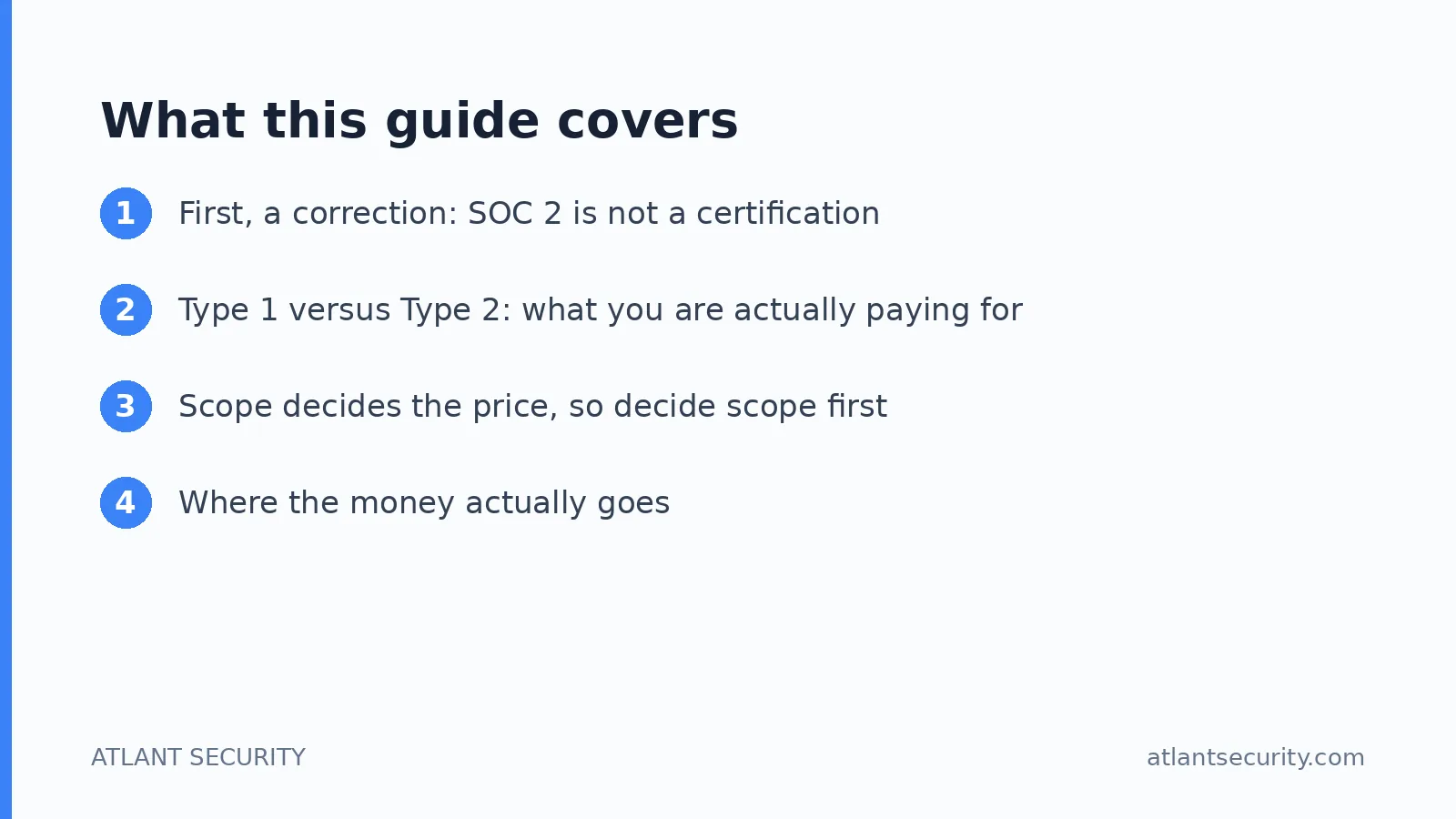
First, a correction: SOC 2 is not a certification
You cannot be "SOC 2 certified." SOC 2 is an attestation report produced by a licensed CPA firm under the AICPA's SSAE 18 standard. The auditor examines your controls against the Trust Services Criteria and issues an opinion. There is no certificate and no logo you earn. What you receive is a detailed report you hand to customers under NDA.
This matters for budgeting, because it means two separate parties are involved and you pay both:
- The CPA audit firm that performs the examination and issues the report. In Australia this is often a US-based or global firm, since the report needs to carry weight with American buyers.
- The readiness work to actually build and evidence the controls before the auditor arrives. This is where most of the real effort, and most of the cost, sits.
Type 1 versus Type 2: what you are actually paying for
The single biggest cost driver is which report you need.
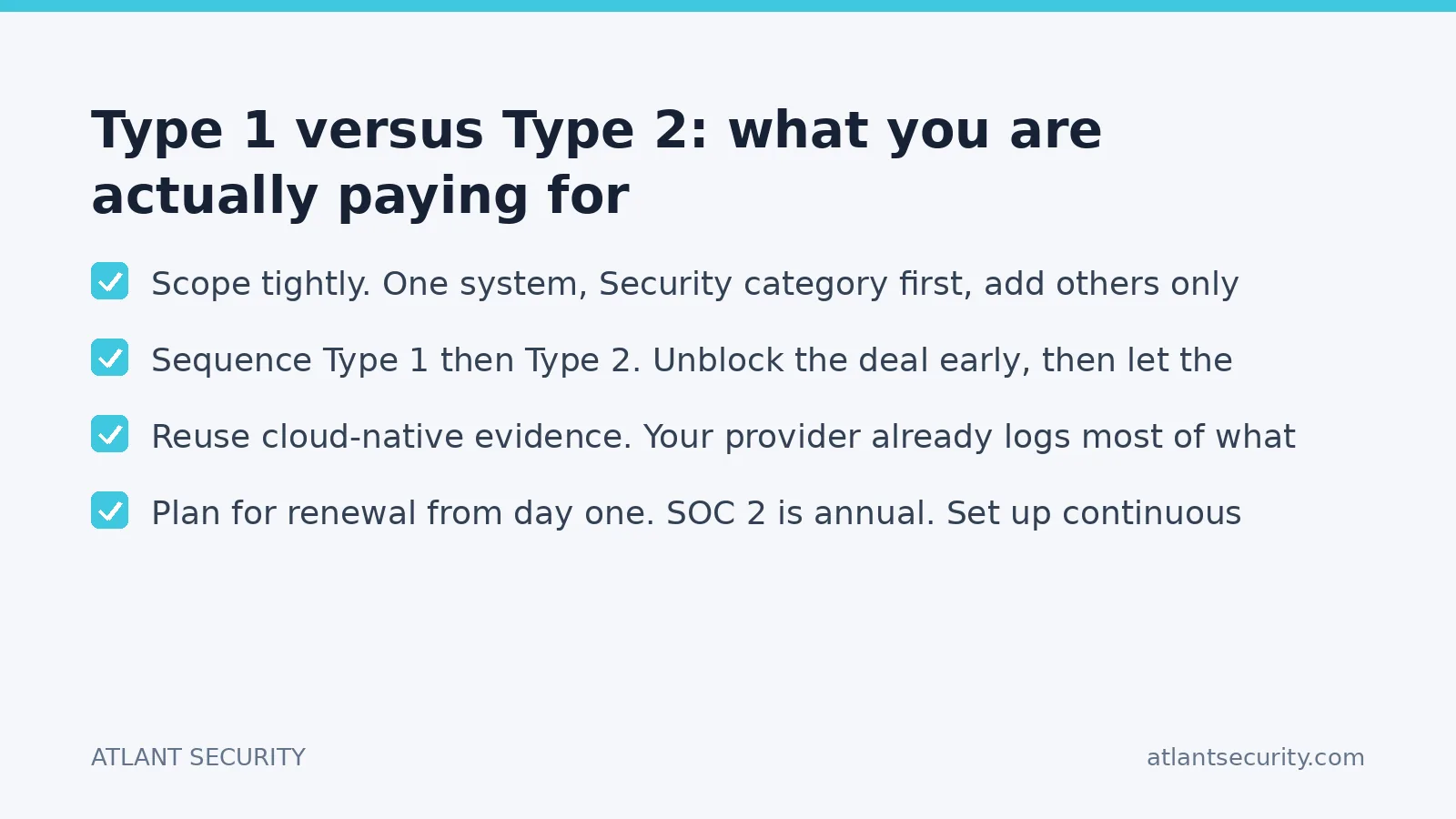
- SOC 2 Type 1 assesses whether your controls are designed correctly at a single point in time. It is faster and cheaper, and it is often enough to unblock a procurement conversation while you work toward the full report.
- SOC 2 Type 2 assesses whether those controls actually operated effectively over an observation period, typically three to twelve months, with six months being the common choice for a first report. This is the report most serious enterprise buyers want, because it proves the controls work over time rather than on paper.
A practical, honest sequencing that works for most Australian companies chasing US deals: complete a Type 1 first to satisfy immediate procurement, then let the Type 2 observation window run and produce the stronger report a few months later. You reuse almost all the same controls and evidence, so the incremental cost of moving from Type 1 to Type 2 is far smaller than doing each from scratch.
| Cost element | What drives it up | What keeps it down |
|---|---|---|
| Auditor fees | Type 2 scope, extra trust categories, large or complex environment | Security-only scope, tight system boundary, clean readiness work |
| Readiness and remediation | Many gaps, no existing policies, manual evidence | Existing controls, cloud-native logging, clear ownership |
| Tooling and automation | Buying every module of a compliance platform | Using cloud provider tools you already pay for |
| Internal staff time | Untrained team, no single owner | A named owner or virtual CISO driving the project |
| Annual renewal | Rebuilding evidence each year | Continuous evidence collection carried over |
Scope decides the price, so decide scope first
SOC 2 covers five Trust Services Criteria: Security, Availability, Processing Integrity, Confidentiality, and Privacy. Only Security, the "common criteria," is mandatory. Every additional category you include expands the controls the auditor tests and raises the cost.
The mistake I see repeatedly is companies including all five because it sounds more impressive. It rarely is. Ask your prospects what they actually require. For most SaaS deals, Security alone, sometimes with Availability and Confidentiality, is exactly what the buyer expects. Adding Privacy or Processing Integrity without a customer requirement is spending money to test controls nobody asked to see.
Tightening the system boundary matters just as much. SOC 2 applies to the specific system that serves your customers, not your entire company. A well-defined boundary, one product, its production infrastructure, and the people and processes that support it, keeps both readiness and audit fees down. A vague boundary drags in corporate IT, side projects, and legacy systems that add cost and risk with no customer benefit.
Where the money actually goes
Rather than quote invented figures, here is where budget genuinely gets consumed, in rough order of impact for a first-time Australian company.
1. Readiness and gap remediation
This is the largest line item for almost everyone. Before an auditor can attest to anything, you need written policies, access controls, change management, vulnerability management, logging and monitoring, vendor risk management, and incident response, all operating with evidence. If you are starting from a typical fast-growing engineering culture, most of these exist informally but are not documented or consistently enforced. Closing that gap is the work.
2. Auditor fees
The CPA firm's fee scales with report type, number of trust categories, and environment complexity. Shopping only on price here is a false economy: a report from a firm your US customers do not recognise can fail to unblock the deal you spent all that money to win. Choose an auditor with a track record your buyers will accept.
3. Tooling
Compliance automation platforms can genuinely save time by collecting evidence continuously and mapping it to controls. They are not free, and they are not a substitute for having real controls. Before buying, check how much you can achieve with tools you already pay for: your cloud provider's native logging, identity provider's access reviews, and your existing ticketing system for change management. Automate the evidence collection that is genuinely repetitive, not everything.
4. Internal time and a clear owner
The hidden cost is your team's hours. SOC 2 without a single accountable owner drifts, and drift is expensive because the observation window keeps resetting. A dedicated internal lead, or an external virtual CISO who has run the process before, is usually cheaper than the delay caused by having no one in charge.
Cross-border factors specific to Australian companies
SOC 2 is an American framework, and running it from Australia adds a few wrinkles worth budgeting for:
- Time zones. Audit fieldwork, evidence requests, and remediation questions bounce between Australian and US business hours. Build slack into the schedule.
- Overlap with local obligations. If you handle personal information you are already subject to the Australian Privacy Act and the Notifiable Data Breaches scheme. Many of those controls overlap with SOC 2, so map them once and use them for both rather than building twice.
- ISO 27001 as an alternative or complement. Some buyers accept ISO 27001 instead of SOC 2, and the control sets overlap heavily. If you serve both US and European or Australian enterprise customers, plan the two together. Our ISO 27001 readiness and SOC 2 readiness work is often run as a single programme for exactly this reason.
How to spend less without cutting corners
Genuine ways to reduce SOC 2 cost, none of which weaken the report:
- Scope tightly. One system, Security category first, add others only when a customer requires them.
- Do a proper gap assessment before engaging the auditor. Walking into the audit with known gaps is the most expensive way to discover them. A focused security audit or readiness assessment finds them cheaply.
- Sequence Type 1 then Type 2. Unblock the deal early, then let the observation window produce the stronger report using the same controls.
- Reuse cloud-native evidence. Your provider already logs most of what the auditor wants. Use it before buying another tool.
- Fix vulnerabilities before the audit, not during. A penetration test and vulnerability assessment ahead of fieldwork means the auditor sees a clean environment rather than an open findings list.
- Plan for renewal from day one. SOC 2 is annual. Set up continuous evidence collection during the first cycle so year two is a fraction of the effort.
What a realistic first-year timeline looks like
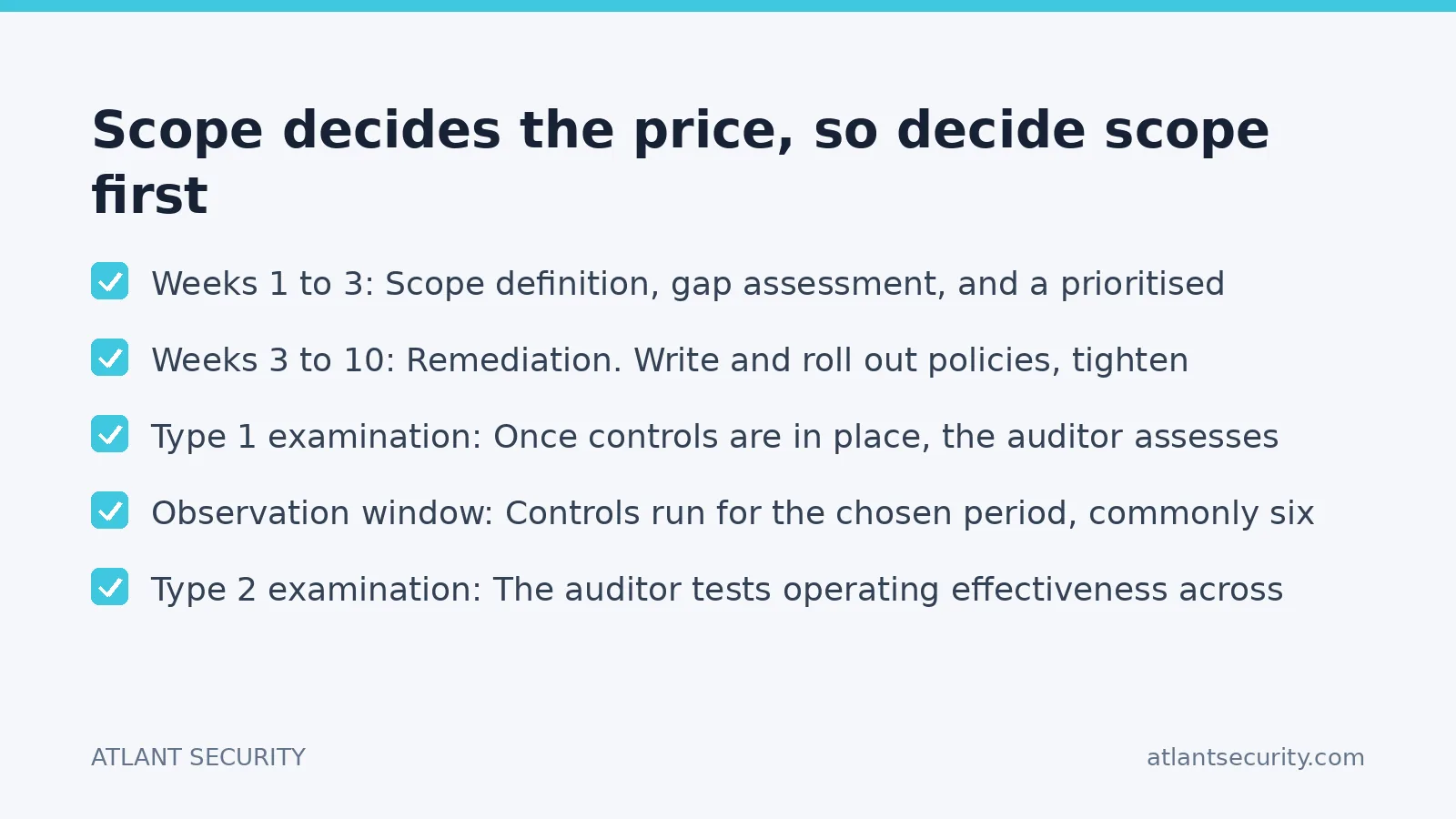
- Weeks 1 to 3: Scope definition, gap assessment, and a prioritised remediation plan.
- Weeks 3 to 10: Remediation. Write and roll out policies, tighten access, stand up logging and monitoring, formalise change and vendor management.
- Type 1 examination: Once controls are in place, the auditor assesses design at a point in time and issues the Type 1 report.
- Observation window: Controls run for the chosen period, commonly six months, while you collect evidence.
- Type 2 examination: The auditor tests operating effectiveness across the window and issues the Type 2 report.
Trying to compress this hurts you twice: rushed remediation produces weak controls, and the observation window is a fixed calendar cost you cannot buy your way out of. Start earlier rather than paying more.
Getting help without overpaying
You do not need a large consultancy to get a clean SOC 2 report. What you need is someone who has run the process, can define a tight scope, close gaps efficiently, and speak the auditor's language so fieldwork goes smoothly. That is exactly what we do at Atlant Security. I have led over 200 security assessments, and our SOC 2 service is built to get growing companies to a defensible report without the tooling bloat and padded scopes that inflate the bill. If a US deal is waiting on your report, get in touch and we will map the fastest honest path to it.
Frequently Asked Questions
Is SOC 2 mandatory in Australia?
No. SOC 2 is not a legal requirement anywhere. It is a commercial expectation, usually imposed by enterprise customers, most often US-based ones, as a condition of doing business. Australian firms pursue it because it unblocks sales, not because a regulator demands it.
Should I start with Type 1 or Type 2?
If a deal is waiting, start with Type 1 to satisfy procurement quickly, then let the observation window run and produce the Type 2. Most enterprise buyers ultimately want Type 2 because it proves controls worked over time, but Type 1 buys you room to get there without stalling the sale.
Which Trust Services Criteria do I actually need?
Security is mandatory and is enough for many deals. Add Availability, Confidentiality, Processing Integrity, or Privacy only when a customer specifically requires them. Including categories nobody asked for simply raises your cost.
Can I use ISO 27001 instead of SOC 2?
Sometimes. Some buyers accept ISO 27001, and the control sets overlap heavily. If your customers are split between the US and Europe or Asia-Pacific, it is often cheapest to plan both together and reuse the shared controls rather than run two separate programmes.
How much internal effort does SOC 2 require?
More than most teams expect, concentrated in the readiness phase. The biggest cost saver is naming a single accountable owner, internal or an external virtual CISO, so the project does not drift and reset the observation window.
How much does the audit cost by itself?
Auditor fees depend on report type, number of trust categories, and environment complexity, and they are only part of the total. For most first-time companies the readiness and remediation work costs more than the audit itself. Get a fixed quote from your chosen CPA firm once your scope is defined.

Alexander Sverdlov
Founder of Atlant Security. Author of 2 information security books, cybersecurity speaker at the largest cybersecurity conferences in Asia and a United Nations conference panelist. Former Microsoft security consulting team member, external cybersecurity consultant at the Emirates Nuclear Energy Corporation.