Cloud Security Best Practices for 2026: Securing Your Business in the Cloud
Alexander Sverdlov
Security Analyst

Cloud adoption is no longer a trend to prepare for. It is the default. By 2026, most companies I assess run the majority of their workloads in AWS, Azure, or Google Cloud, and many have no on-premises footprint left at all. What has not kept pace is the security discipline around those environments. The convenience that makes the cloud so productive (spin up a resource in seconds, grant access with a click) is exactly what makes it so easy to leave a door open. Almost every serious cloud incident I have investigated traced back not to a clever attacker but to a setting somebody got wrong and nobody caught.
This is a practical guide to the cloud security practices that actually matter, drawn from more than 200 assessments across 14 countries since 2013. I am not going to list every control in existence. I am going to focus on the handful that, done consistently, prevent the overwhelming majority of real-world cloud breaches: encryption, identity and access, monitoring, and regular auditing. Get these right and you are ahead of most organizations already in the cloud.
Start With the Shared Responsibility Model
Before any specific control, understand where your responsibility begins. Cloud providers secure the infrastructure their platform runs on. You secure what you put on it: your data, your configurations, your identities, and your access rules. The most expensive mistakes I see come from teams assuming the provider handles security they were actually responsible for. The provider will keep the data center locked. It will not stop you from making a storage bucket public. That line is yours to defend, and everything below assumes you know which side you are standing on.
Data Encryption: The Non-Negotiable Baseline
Encryption is the control that limits the damage when something else fails. If an attacker reaches your data but cannot read it, an exposure becomes a non-event. Treat it as a baseline, not a premium feature.
- Encrypt data at rest. Every storage service, database, and disk should be encrypted. Modern cloud platforms make this a default toggle, so there is no excuse to leave it off. Use strong algorithms such as AES with 256-bit keys.
- Encrypt data in transit. All traffic, both between your users and the cloud and between services inside it, should use TLS. Internal service-to-service traffic is the part teams forget.
- Own your key management. Use the provider's key management service, rotate keys on a schedule, restrict who can access them, and keep secure backups. Consider customer-managed keys where compliance or sensitivity demands tighter control than provider-managed defaults.
Encryption is cheap and mostly automatic today. The failures I find are almost always about keys left unmanaged or one service that got missed, not about the cryptography itself.
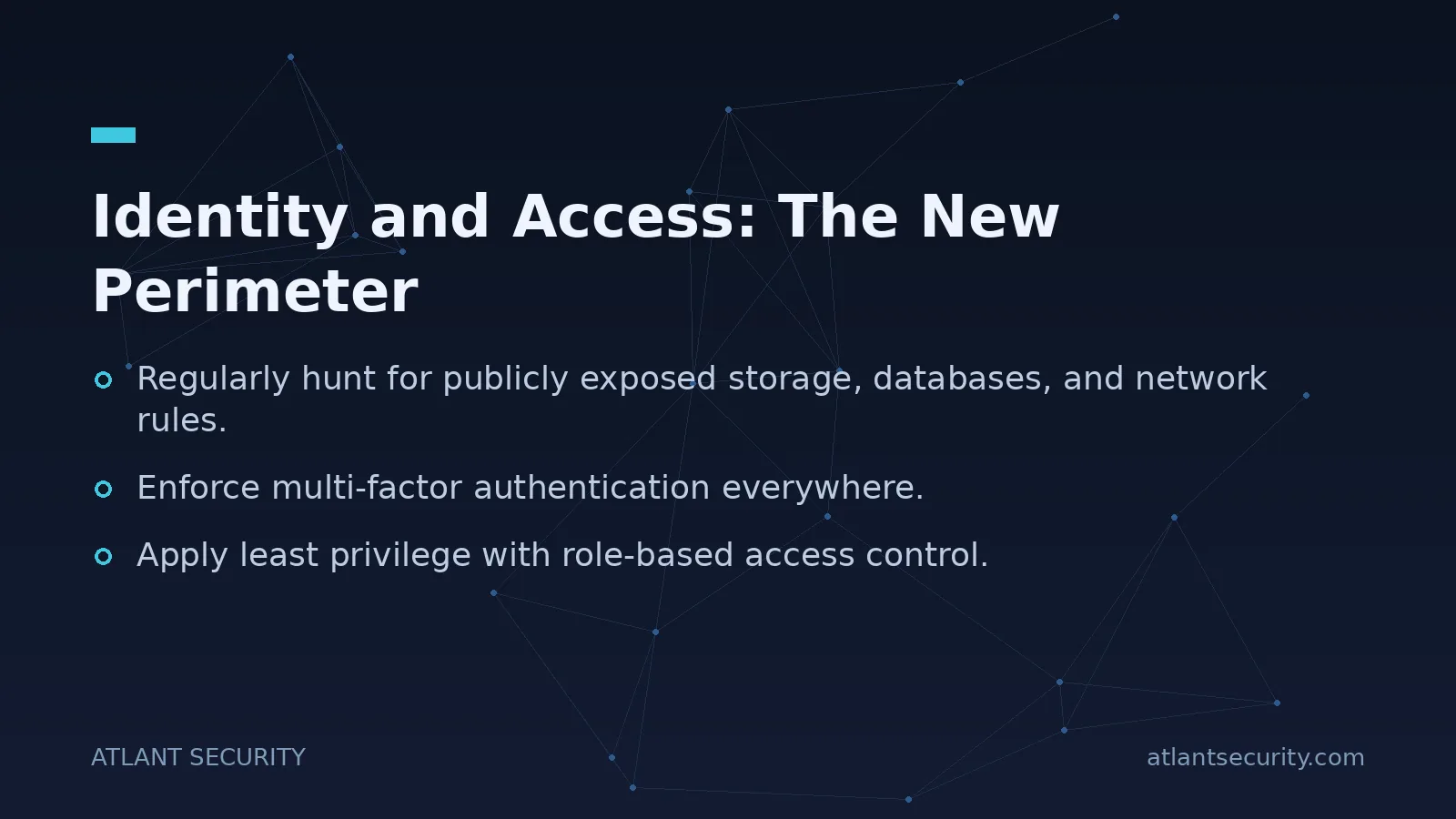
Identity and Access: The New Perimeter
In the cloud there is no network edge to defend. Identity is the perimeter. Who can authenticate and what they can do afterward is the single most important security decision you make, and it is where the highest-severity audit findings almost always come from.
- Enforce multi-factor authentication everywhere. MFA is the highest-impact control you can deploy, and it is not optional for administrative accounts. It blocks the large majority of account-takeover attempts even when a password is stolen. In 2026 there is no defensible reason for a privileged account without it.
- Apply least privilege with role-based access control. Grant each identity only the permissions its job requires. Review and prune roles regularly, because permissions accumulate and rarely get removed on their own.
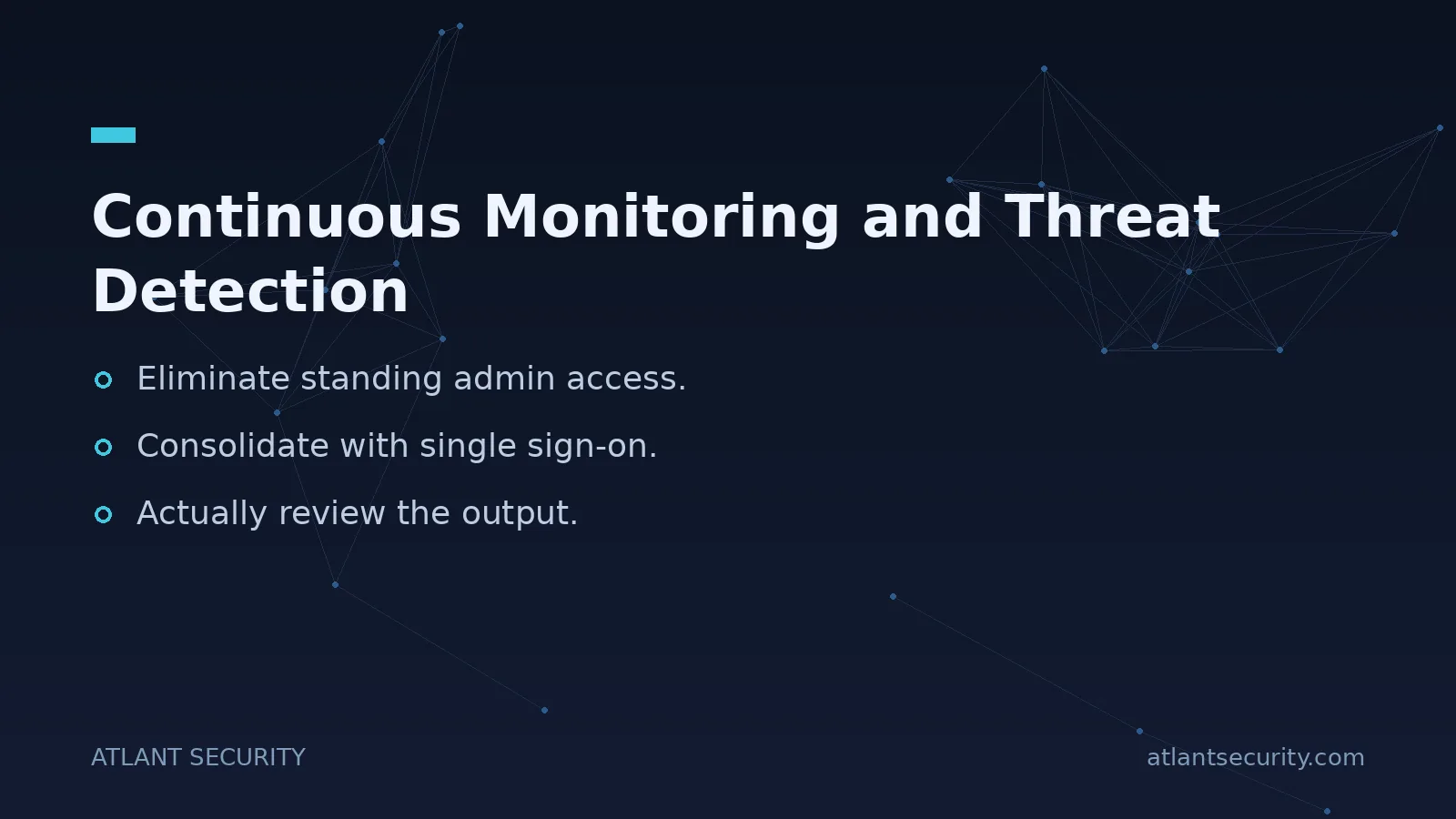
- Eliminate standing admin access. Use just-in-time elevation so nobody carries permanent god-mode rights. A dormant over-privileged account is a breach waiting for a trigger.
- Kill long-lived secrets. Hardcoded access keys in code repositories are a recurring source of breaches. Use short-lived credentials, a secrets vault, and automated rotation.
- Consolidate with single sign-on. SSO reduces password sprawl and gives you one place to enforce policy and cut off access when someone leaves.
Continuous Monitoring and Threat Detection
You cannot respond to what you cannot see, and cloud environments are notoriously easy to lose track of. Resources appear and disappear, permissions change, and shadow assets accumulate. Visibility is a control in its own right.
- Turn on native logging. Services like AWS CloudTrail, Azure Monitor, and Google Cloud audit logs are inexpensive and essential. Enable them across every account, not just production.
- Detect anomalies. Use the provider's threat detection services and set alerts for unusual activity: access from new locations, permission escalations, large data movements, and configuration changes to critical resources.
- Actually review the output. A log nobody reads is not a control. Assign ownership, and route high-severity alerts to someone who will act on them.
- Have an incident response plan for the cloud. Define who investigates, how you contain a compromised account or resource, how you preserve evidence, and how you recover. Cloud incidents move fast; you do not want to be writing the plan during one.
Continuous Configuration Management
Misconfiguration is the leading cause of cloud breaches, full stop. And because cloud environments change daily, a configuration that was secure last month drifts into an insecure state without anyone touching it deliberately. Point-in-time hardening is not enough.
- Adopt cloud security posture management tooling that continuously scans for misconfigurations and flags drift.
- Benchmark your settings against recognized baselines such as the CIS Benchmarks for your provider.
- Manage infrastructure as code so changes are reviewed, version-controlled, and repeatable rather than clicked into a console and forgotten.
- Regularly hunt for publicly exposed storage, databases, and network rules. This one check prevents a disproportionate share of real incidents.
Regular Audits and Compliance Reviews
Even a well-run cloud environment needs periodic independent verification. An audit catches what daily operations normalize and stop seeing.
- Schedule security audits. At least annually, and after any major architecture change, validate that your controls work as intended. An external IT security audit brings a fresh perspective and a methodology your internal team cannot replicate on its own systems.
- Run compliance reviews. Confirm your environment meets the standards that apply to you, whether that is SOC 2, ISO 27001, HIPAA, PCI DSS, or GDPR. The underlying controls overlap heavily, so fixing fundamentals pays off across every obligation at once.
- Bring in independent assessors. An outside team has no stake in the decisions being audited, which is precisely what makes their findings trustworthy.
A Priority Order for Getting Started
If you are staring at a long list and wondering where to begin, this is the order I recommend. It front-loads the controls that block the most common attack paths.
| Priority | Action | Why it comes first |
|---|---|---|
| 1 | Enforce MFA on all accounts | Blocks most account takeovers immediately |
| 2 | Close public exposure | Removes the easiest path to your data |
| 3 | Enable logging and alerts | Makes intrusions visible while you can still act |
| 4 | Apply least privilege | Limits how far any single compromise spreads |
| 5 | Continuous config scanning | Catches drift before it becomes an incident |
Common Cloud Security Mistakes to Avoid
Knowing the good practices is only half the picture. It helps to recognize the recurring mistakes that undo them, because these are the patterns I write up again and again across very different organizations.
- Securing production but not everything else. Dev, staging, and sandbox accounts hold real credentials and real data far more often than teams admit, and they are usually the weakest link because nobody treats them as important.
- Treating MFA as optional for machines and contractors. Service accounts, API integrations, and third-party users are frequently exempted from the controls applied to staff, and attackers know it.
- Collecting logs without reviewing them. Enabling logging feels like progress, but logs that nobody monitors only help you reconstruct a breach after the fact instead of stopping it.
- Leaving old resources running. Forgotten instances, unused buckets, and stale access keys expand your attack surface silently. If you do not know it exists, you are not securing it.
- Assuming a passed audit means you are done. An audit is a snapshot. Without continuous scanning and clear ownership, your posture drifts back within weeks.
Every item on that list is cheap to fix and expensive to ignore. Reviewing your environment against it is a useful hour of work in its own right.
Where Teams Get Stuck
Most companies know what good cloud security looks like in principle. Where they get stuck is ownership and consistency. Controls get deployed in production but not in the dev account. MFA is enforced for staff but not for the third-party contractor. The annual audit finds the same three issues it found last year because nobody owned the remediation. Cloud security is less about knowing the right practices and more about someone being accountable for keeping them in place as the environment evolves. For companies without a full-time security leader, a virtual CISO or cloud security consulting engagement is the most efficient way to close that gap.
Frequently Asked Questions
What is the single most important cloud security control?
Multi-factor authentication, without hesitation. It blocks the overwhelming majority of account-takeover attempts even when passwords are compromised, and stolen or phished credentials are the entry point for most cloud breaches. Enforce it on every account, and treat any exception for administrators as unacceptable.
Why do so many cloud breaches happen despite the provider's security?
Because most breaches exploit the customer's side of the shared responsibility model, not the provider's. Publicly exposed storage, over-permissive roles, missing MFA, and disabled logging are customer configuration choices. The provider secures the infrastructure; securing what you deploy on it is your job.
How often should we audit our cloud environment?
Conduct a thorough audit at least annually and after any significant architecture change. Between audits, run continuous configuration scanning, because cloud environments change daily and a once-a-year snapshot cannot keep up with the drift that accumulates in between.
Do these practices apply to small businesses?
Yes, and they are well within reach. The core controls (MFA, least privilege, encryption, logging) are built into every major cloud platform and cost little to enable. Small teams are frequent targets precisely because attackers assume these basics are missing. See our guidance on cybersecurity for small business.
Can strong cloud security help with compliance?
Absolutely. The controls that make a cloud environment secure are largely the same ones that frameworks like SOC 2, ISO 27001, HIPAA, and PCI DSS require. Implementing them well positions you to pass a formal examination with far less last-minute scrambling. Explore our SOC 2 readiness support.
Make Security Keep Pace With the Cloud
The cloud rewards speed, and security has to move at the same pace or it becomes theater. The practices here are not exotic; they are disciplined execution of fundamentals, applied consistently across every account you own and revisited as your environment changes. If you want an independent read on where your cloud environment stands and a prioritized plan to fix it, get in touch and we will scope an assessment around your platforms and compliance needs.
Related reading: a guide to cloud data protection, cloud security strategies for small businesses, and why continuous audits beat one-off checks.

Alexander Sverdlov
Founder of Atlant Security. Author of 2 information security books, cybersecurity speaker at the largest cybersecurity conferences in Asia and a United Nations conference panelist. Former Microsoft security consulting team member, external cybersecurity consultant at the Emirates Nuclear Energy Corporation.