Strengthening Your Supply Chain Cybersecurity with IT Security Audits
Alexander Sverdlov
Security Analyst
The most efficient way to break into a well-defended company is to not attack it directly at all. Attack a smaller vendor it trusts, and let that trust carry you inside. I have watched this pattern play out across engagements for years: the target organization had solid perimeter defenses, mature endpoint protection, and a competent team, yet the attacker walked in through a software update, a managed service provider's remote access, or a supplier's compromised credentials. Your security is only as strong as the weakest link you have connected to your network, and in a modern business you are connected to dozens of them.
Supply chain cybersecurity is the discipline of managing that risk: the exposure you inherit from every vendor, contractor, software dependency, and partner with access to your systems or data. It is one of the most underinvested areas of security precisely because it sits outside your direct control, which makes it feel like someone else's problem. It is not. When a supplier is breached and it costs you customers, downtime, and regulatory attention, no one accepts "our vendor let us down" as an excuse. This article lays out where supply chain risk actually comes from, how to find it in your own environment, and the practical controls that reduce it.
Why the Supply Chain Became the Soft Target
Two things changed over the last decade. First, direct defenses got better. MFA, endpoint detection, and cloud security tooling raised the cost of a frontal attack. Second, businesses became radically more interconnected. The average company now runs on a web of SaaS platforms, open-source libraries, cloud providers, outsourced IT, and specialized vendors, each with some level of access. Attackers are rational: when the front door is reinforced, they look for a side entrance, and the supply chain is full of them.
A supply chain attack is attractive because it offers leverage. Compromise one widely used component or service provider, and you gain a path into every organization that uses it. That is why these incidents make headlines: a single upstream compromise can cascade into hundreds or thousands of downstream victims. Even if you are not a household name, you can be collateral damage in an attack aimed at a supplier you happen to share with the real target.
Where Supply Chain Risk Actually Lives
To manage supply chain risk you first have to see it clearly. In practice it concentrates in a handful of recurring places.
Third-Party Access
Vendors, contractors, and service providers routinely hold credentials into your systems: a support tool with admin rights, a marketing platform connected to your customer data, a managed IT provider with remote access to your servers. Every one of those integrations is a door. If the vendor's security is weaker than yours, or if they get phished, that door opens for an attacker too. Standing, over-privileged third-party access is one of the most common and most dangerous exposures I find.
Software Dependencies
Modern applications are assembled, not written. A typical product pulls in hundreds of open-source packages and third-party libraries, each maintained by people you have never met. A vulnerability or a deliberately malicious change in any one of them becomes a vulnerability in your product. Attackers have learned to poison this well directly, slipping malicious code into popular packages or compromising the build pipelines that produce the software you install.
Compromised Software Updates
The update mechanism you trust to keep software secure can itself be turned into an attack vector. If an attacker compromises a vendor's build or distribution system, they can push malicious code to every customer through a signed, legitimate-looking update. This is among the hardest supply chain attacks to detect, because the malicious payload arrives through exactly the channel you were told to trust.
Lack of Visibility
Most organizations cannot produce a complete list of their vendors, let alone the access each one holds and the data each one touches. You cannot secure what you cannot see. This visibility gap is why supply chain risk so often goes unmanaged: it is not that companies decide to accept the risk, it is that they never measured it in the first place.
Uneven Security Maturity
Your smallest supplier may be a two-person shop with no security program at all, yet it may hold a key to your environment. Attackers deliberately target the least mature link because it offers the same access at a fraction of the effort. A company handling sensitive payment or customer data cannot afford to inherit a supplier's weak controls, which is a core theme in ecommerce cybersecurity where third-party plugins and processors are everywhere.
Finding Your Supply Chain Exposure With a Security Audit
The good news is that supply chain risk is measurable, and a structured IT security audit is the most direct way to surface it. A thorough audit examines the problem from several angles.
- Third-party access review. Enumerate every external party with access to your systems or data, then examine what access each actually has versus what they need. This almost always reveals dormant integrations, over-privileged accounts, and forgotten vendor credentials that should have been revoked long ago.
- Vendor security posture assessment. Evaluate the security practices of your critical suppliers. Do they have their own certifications such as SOC 2 or ISO 27001? Do they run vulnerability management and incident response? A supplier's posture is your inherited risk, and you are entitled to ask for evidence, not assurances.
- Software supply chain review. Examine how your own software is built and what it depends on. Do you maintain a software bill of materials? Do you scan dependencies for known vulnerabilities? Are your build and deployment pipelines locked down against tampering? A vulnerability assessment extends this into the components you run.
- Monitoring and detection review. Assess whether you would even notice a supply chain compromise. Do you monitor third-party access for anomalies? Would an unexpected action from a vendor account trigger an alert? Detection is your last line when prevention fails.
The output of such an audit is not a vague warning that supply chain risk exists. It is a concrete, prioritized list of who can reach your environment, how, and what to fix first.
Building a Cyber-Resilient Supply Chain
Once you can see the risk, a consistent set of practices brings it down to a manageable level. None of these are exotic; the difficulty is in doing them consistently rather than once.
1. Vet Vendors Before You Connect Them
Security due diligence belongs in your procurement process, not as an afterthought. Before granting access, assess a vendor's security posture proportionate to the access and data involved. Require evidence: certifications, assessment results, and documented practices. A vendor that cannot answer basic security questions is telling you something important.
2. Apply Least Privilege to Third Parties
Give each vendor the minimum access needed for their specific function, and nothing more. Scope it tightly, time-box it where possible, and prefer just-in-time access over standing credentials. When a support engagement ends, revoke the access. This single discipline shrinks the blast radius of any vendor compromise dramatically.
3. Put Security in the Contract
Contractual obligations turn security expectations into enforceable requirements. Specify the controls a vendor must maintain, their obligation to notify you of breaches within a defined window, your right to audit, and their responsibilities if an incident originates with them. Clear expectations, communicated up front, prevent the finger-pointing that follows most third-party incidents.
4. Maintain a Software Bill of Materials
You cannot respond to a vulnerability in a component you did not know you were running. Maintaining an inventory of the software components and dependencies in your products and systems means that when the next widely used library turns out to be vulnerable, you can answer "are we affected?" in minutes instead of days.
5. Monitor Continuously, Not Annually
Vendor risk is not static. A supplier that was secure at onboarding can be breached next month. Continuous monitoring of third-party access, combined with periodic reassessment of your critical vendors, catches the drift that point-in-time reviews miss. Treat your most connected vendors with the same ongoing attention you give your own environment.
6. Plan for a Supplier Breach Before It Happens
Assume that one of your vendors will be compromised eventually, and build your incident response plan around that reality. Know in advance how you would detect it, contain it by cutting off the affected integration, and communicate with customers if their data is involved. The organizations that handle third-party breaches well are the ones that rehearsed the scenario before it arrived.
| Risk Area | Primary Control |
|---|---|
| Third-party access | Least privilege, just-in-time access, prompt revocation |
| Weak vendor security | Due diligence, certification evidence, contractual controls |
| Software dependencies | Software bill of materials, dependency scanning |
| Compromised updates | Pipeline hardening, code signing verification, monitoring |
| Lack of visibility | Vendor inventory, continuous monitoring |
Regulation Is Catching Up
Supply chain security is no longer just good practice; regulators increasingly require it. Frameworks like the EU's NIS 2 Directive place explicit obligations on organizations to manage supply chain and vendor risk, and many industry standards now demand documented third-party risk management. If you operate in a regulated sector, getting ahead of these requirements through NIS 2 compliance support is far easier than scrambling to meet them under audit pressure. Either way, the direction of travel is clear: you are expected to be accountable for the security of the partners you rely on.
Where to Start
If your supply chain security is currently ad hoc, do not try to fix everything at once. Begin with visibility and the highest-leverage controls:
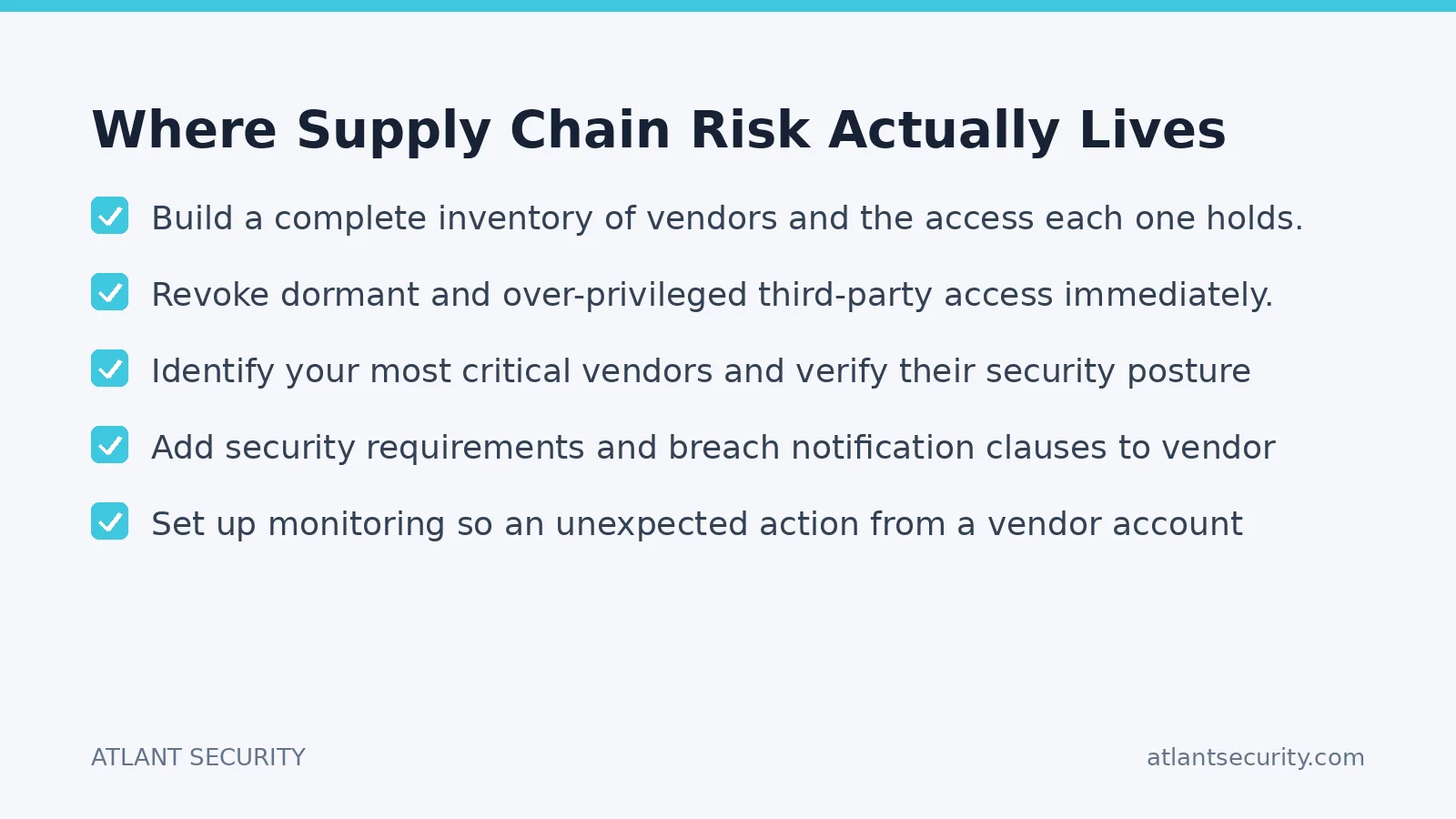
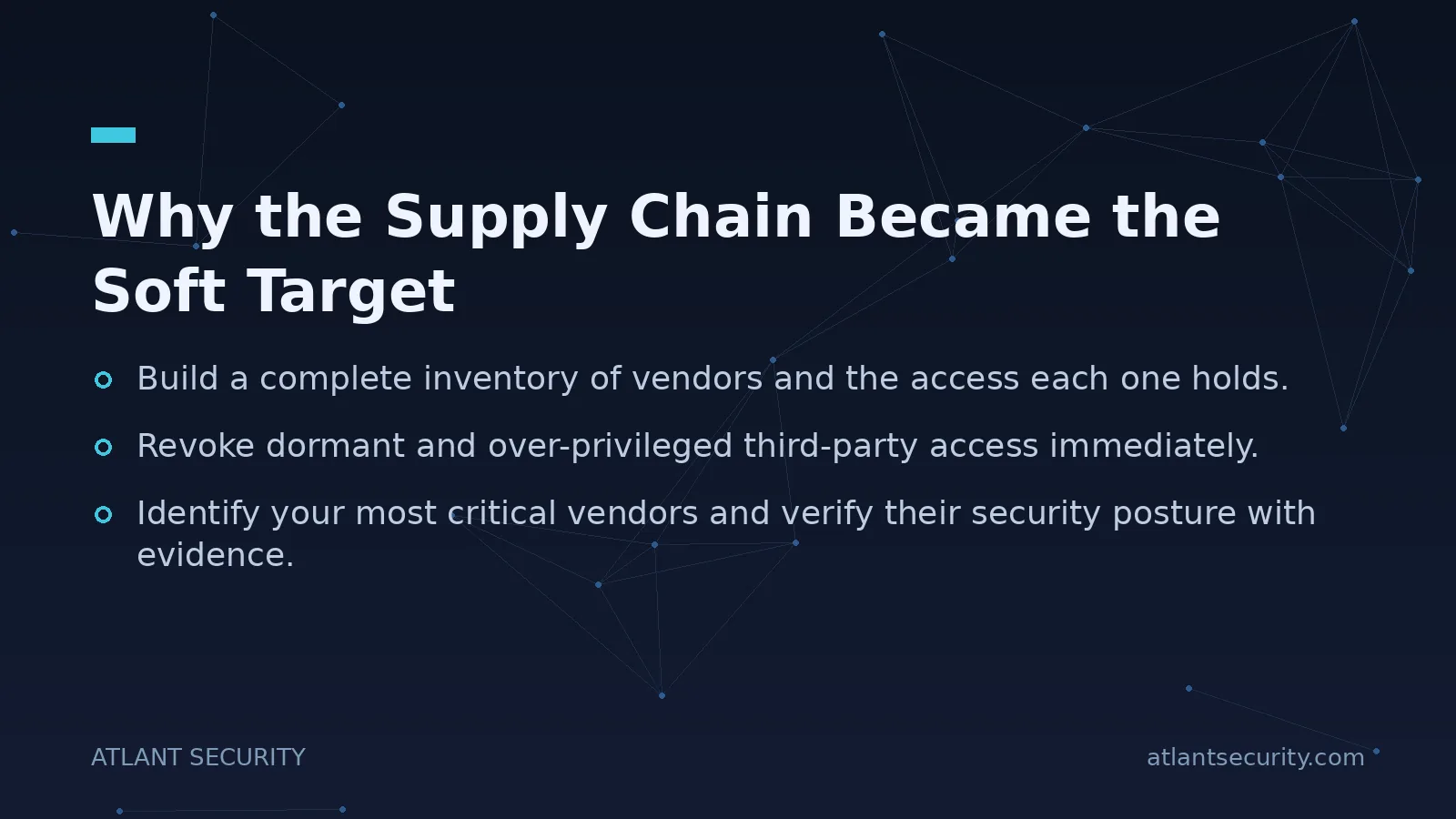
- Build a complete inventory of vendors and the access each one holds.
- Revoke dormant and over-privileged third-party access immediately.
- Identify your most critical vendors and verify their security posture with evidence.
- Add security requirements and breach notification clauses to vendor contracts going forward.
- Set up monitoring so an unexpected action from a vendor account gets noticed.
Those steps alone eliminate a large share of the risk, and they mostly cost discipline rather than budget. For organizations without in-house security leadership to drive this, a virtual CISO can own the vendor risk program and make sure it keeps running rather than lapsing after the initial push.
Frequently Asked Questions
What exactly is a supply chain cyberattack?
It is an attack that reaches your organization indirectly, through a trusted third party rather than by attacking you head-on. Common forms include compromising a software vendor to push malicious updates, poisoning an open-source dependency your product relies on, or stealing the credentials of a service provider with access to your systems. The attacker exploits the trust between you and your suppliers.
Why can't our own security stop supply chain attacks?
Because these attacks arrive through channels you have deliberately trusted: signed software updates, authenticated vendor access, legitimate integrations. Your perimeter defenses are designed to stop untrusted traffic, but a supply chain attack rides in on trusted traffic. Defending against it requires managing the trust itself through vendor vetting, least privilege, and monitoring, not just stronger walls.
How do we assess a vendor's security without being experts in their environment?
You rely on evidence and standardized signals rather than inspecting their systems directly. Ask for independent certifications such as SOC 2 or ISO 27001, request the results of recent security assessments, and use a structured questionnaire proportionate to the access and data involved. For critical vendors, contractual audit rights let you verify claims. A security partner can run this vendor assessment process on your behalf.
What is a software bill of materials and do we need one?
A software bill of materials is an inventory of the components and dependencies that make up your software. You need one because you cannot respond to a newly disclosed vulnerability in a library if you do not know whether you use it. With an SBOM, answering "are we exposed?" takes minutes; without one, it can take days of manual investigation while attackers are already exploiting the flaw.
Does supply chain security apply to small businesses?
Yes, and small businesses are often at greater relative risk because they rely heavily on external vendors and SaaS platforms while lacking the resources to scrutinize them. The controls scale down: you may have fewer vendors, but each one matters more. Focusing on vendor inventory, least privilege, and verifying your most critical suppliers delivers strong protection without enterprise budgets.
How often should we reassess our vendors?
Critical vendors that hold significant access or sensitive data warrant at least annual reassessment, plus continuous monitoring of their access in between. Lower-risk vendors can be reviewed less frequently. The key point is that vendor risk changes over time, so a one-time check at onboarding is not enough; a supplier secure last year may be breached today.
See Your Real Supply Chain Exposure
You cannot manage the risk you cannot see, and for most organizations the supply chain is the largest unmeasured exposure they have. A focused assessment will show you exactly which vendors, integrations, and dependencies could carry an attacker into your environment, and what to fix first. Contact us to scope an IT security audit that includes your third-party and supply chain risk, and turn an invisible weakness into a managed one.

Alexander Sverdlov
Founder of Atlant Security. Author of 2 information security books, cybersecurity speaker at the largest cybersecurity conferences in Asia and a United Nations conference panelist. Former Microsoft security consulting team member, external cybersecurity consultant at the Emirates Nuclear Energy Corporation.