Cloud Security and Compliance: What an IT Security Audit Reveals
Alexander Sverdlov
Security Analyst

Moving to the cloud does not move your security problems to someone else. It changes their shape. I have lost count of the companies I have assessed that migrated to AWS, Azure, or Google Cloud believing the provider would handle security, then discovered during an audit that their most sensitive data sat in a public storage bucket, their admin accounts had no multi-factor authentication, and nobody could say who had access to what. The cloud did not fail them. Their understanding of who owns which risk did.
This article is about closing that gap. I will walk through the security and compliance challenges that are specific to cloud environments, how a proper IT security audit examines them, and the concrete controls that separate a cloud setup that passes a SOC 2 or ISO 27001 examination from one that quietly fails. I have run security assessments across 14 countries since 2013, and cloud misconfiguration is the most common serious finding I write up, year after year.
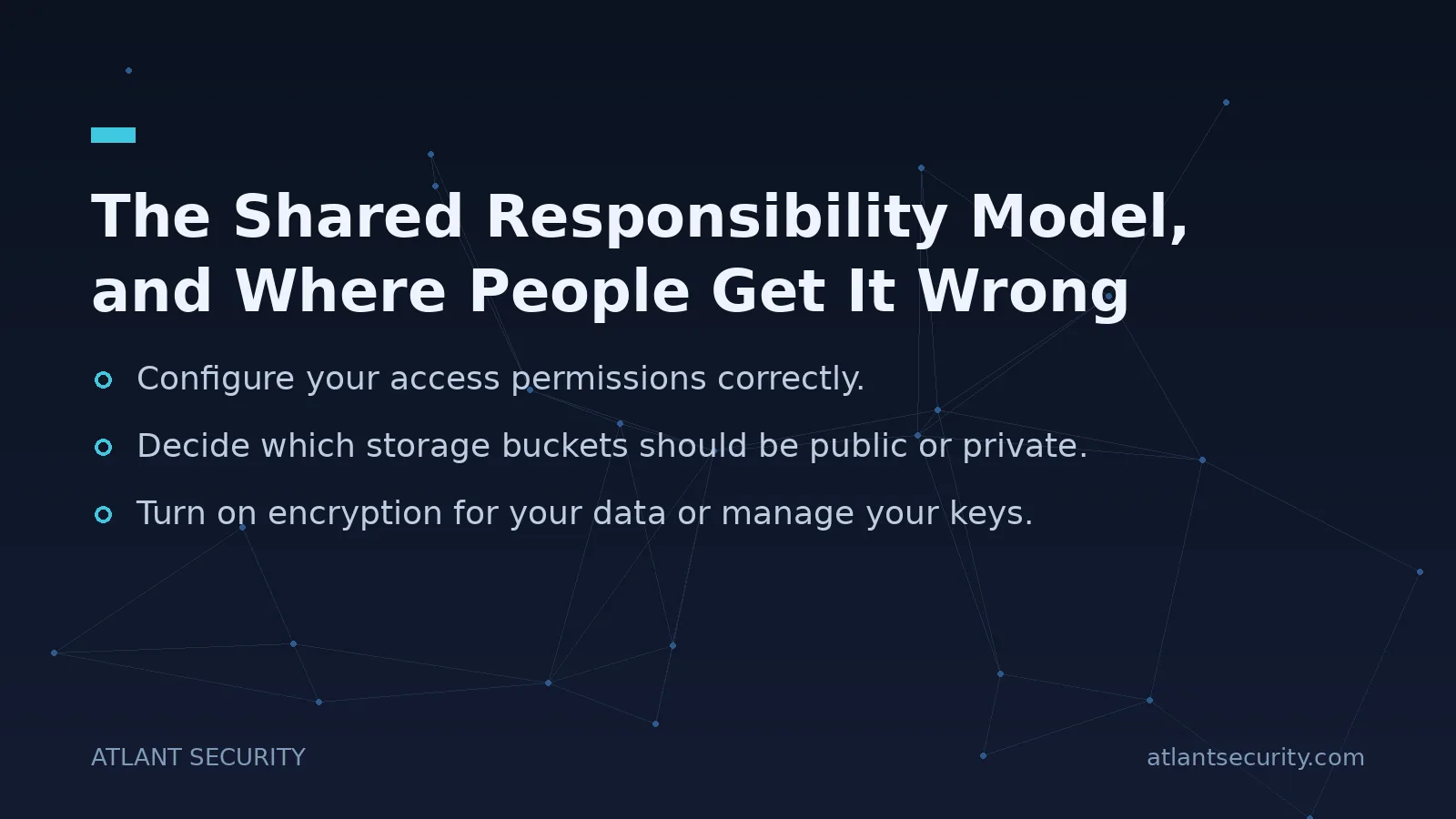
The Shared Responsibility Model, and Where People Get It Wrong
Every major cloud provider operates on a shared responsibility model. Simplified: the provider secures the infrastructure (the physical data centers, the hypervisor, the network backbone), and you secure what you put on it (your data, your configurations, your identities, your access rules). The dividing line shifts depending on whether you use infrastructure, platform, or software as a service, and that shifting line is exactly where mistakes happen.
The provider will not:
- Configure your access permissions correctly.
- Decide which storage buckets should be public or private.
- Turn on encryption for your data or manage your keys.
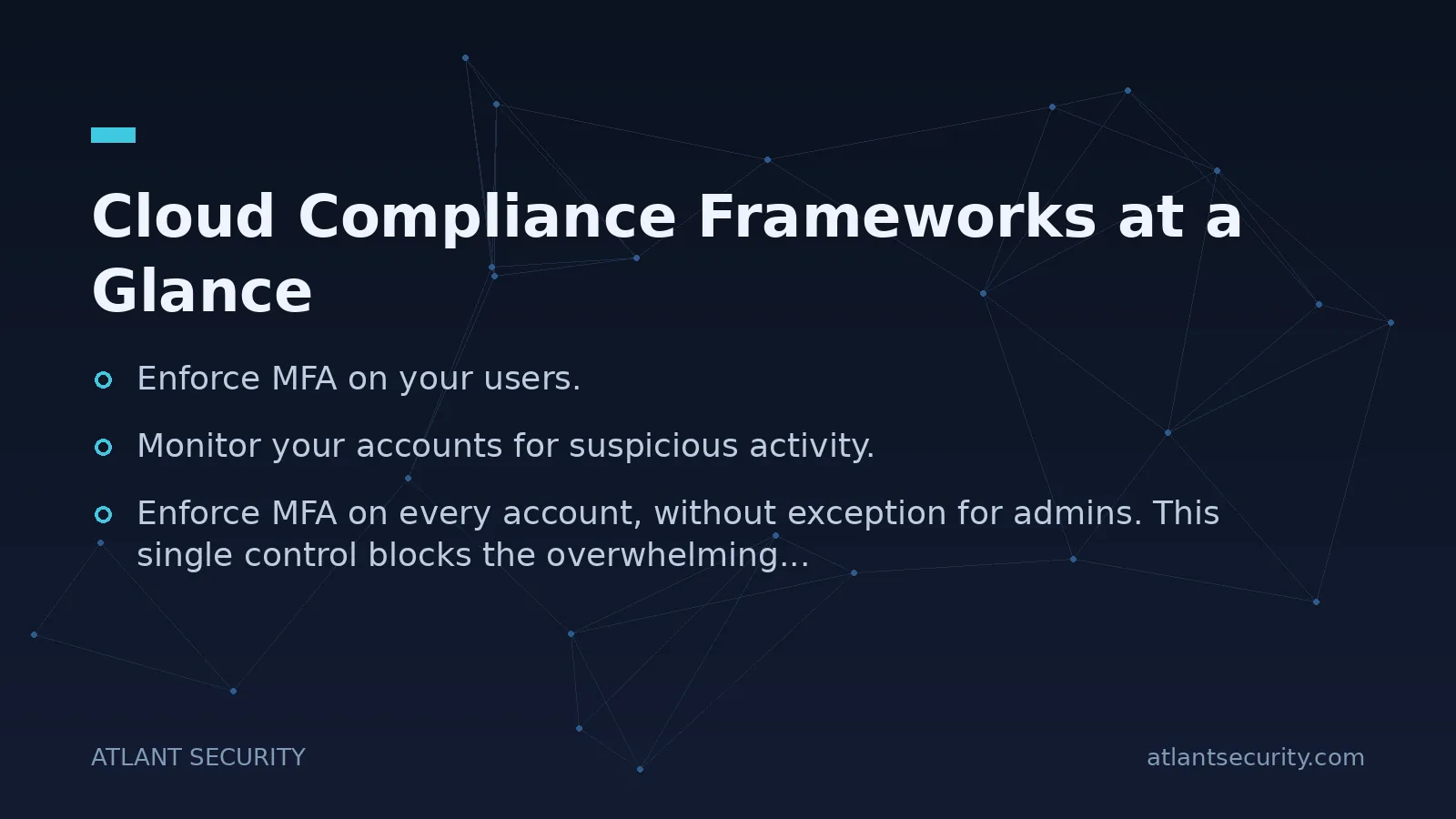
- Enforce MFA on your users.
- Monitor your accounts for suspicious activity.
Those are yours. An audit that assumes the provider handles security is auditing the wrong side of the line. Understanding this model is the foundation, and it is where every serious cloud security consulting engagement starts.
Cloud-Specific Security and Compliance Challenges
Cloud environments introduce risks that on-premises infrastructure simply did not have. These are the four I flag most often.
Misconfiguration is the number one cause of cloud breaches
Not zero-days. Not sophisticated nation-state attacks. Plain misconfiguration: an open storage bucket, an over-permissive identity role, a database exposed to the internet, security logging left switched off. Cloud platforms are powerful and complex, and a single wrong setting can expose everything. The speed and self-service nature of the cloud means these mistakes get made fast and stay unnoticed until someone finds them, and it is not always you who finds them first.
Identity and access management replaces the perimeter
In a cloud-first environment there is no network perimeter to defend. Identity is the new perimeter. Who can authenticate, what they can do once authenticated, and how those permissions are governed becomes the central security question. Over-privileged roles, unused accounts, hardcoded access keys in code repositories, and service accounts with god-mode permissions are the vulnerabilities that matter most.
Data privacy and sovereignty
Data in the cloud crosses regions and borders easily, which collides with regulations that dictate where data may live and how it must be protected. GDPR, HIPAA, and sector-specific rules impose strict controls on personal and sensitive data regardless of which data center it happens to sit in. If you do not know which region holds your data, you cannot claim compliance.
Multi-tenancy and visibility
In shared cloud infrastructure, logical separation between tenants is enforced by the provider, but you are still responsible for how you segment your own workloads and data. Add to that the reduced visibility many teams have into their sprawling cloud estate, and you get shadow resources: instances, databases, and buckets nobody remembers creating and nobody is monitoring.
How an IT Security Audit Examines a Cloud Environment
A cloud audit is not a checkbox exercise against a generic template. Here is the framework I use, and the one you should expect from any serious assessor.
- Define the scope. Inventory every cloud account, subscription, and project. You cannot secure what you have not enumerated, and shadow accounts are where the worst findings hide. Identify the platforms, workloads, and data that matter most.
- Review identity and access. Map who has access to what. Look for over-privileged roles, dormant accounts, missing MFA, long-lived access keys, and violations of least privilege. This is usually where the highest-severity findings come from.
- Assess configuration against benchmarks. Check settings against recognized baselines such as the CIS Benchmarks for your provider and the provider's own security best practices. Storage exposure, network rules, encryption defaults, and logging configuration all get tested here.
- Evaluate data protection. Confirm encryption at rest and in transit, verify key management, and check that data classification and residency requirements are actually enforced, not just documented.
- Check monitoring and logging. Are provider-native logging and threat detection services enabled? Is anyone reviewing the output? A log nobody reads is not a control.
- Map findings to compliance requirements. Tie each gap to the frameworks that apply to you, then prioritize remediation by real risk, not by how easy it is to fix.
Cloud Compliance Frameworks at a Glance
Different regulations examine different parts of your cloud environment. Here is how the common ones map to the controls an audit tests.
| Framework | Applies to | Key cloud controls examined |
|---|---|---|
| SOC 2 | SaaS and service providers | Access control, encryption, logging, change management |
| ISO 27001 | Any organization | Risk management, access, cryptography, operations security |
| HIPAA | Healthcare and PHI handlers | Encryption, access control, audit logging, BAAs |
| PCI DSS | Card data processors | Segmentation, encryption, access control, monitoring |
| GDPR | EU personal data | Data residency, encryption, access, breach notification |
Most companies I work with are subject to more than one of these at once. The good news is that the underlying controls overlap heavily. Strong identity management, encryption, and logging satisfy large parts of every framework in the table, which is why fixing the fundamentals pays off across all your obligations at once.
The Controls That Actually Move the Needle
After hundreds of assessments, the same handful of controls separate secure cloud environments from breach waiting to happen. Prioritize these.
- Enforce MFA on every account, without exception for admins. This single control blocks the overwhelming majority of account-takeover attempts.
- Apply least privilege to identities and remove standing admin access. Use just-in-time elevation where the platform supports it.
- Encrypt everything and manage your own keys. Turn on encryption at rest and in transit by default, and control the key lifecycle.
- Close public exposure. Audit storage buckets, databases, and network rules for anything reachable from the internet that should not be.
- Turn on native logging and threat detection, and review it. Provider services like CloudTrail, Azure Monitor, and Google Cloud audit logs are inexpensive and essential.
- Use configuration scanning continuously. Cloud security posture management tools catch drift and new misconfigurations between audits.
None of this is exotic. It is disciplined execution of fundamentals, applied consistently across every account you own.
How Small Misconfigurations Chain Into Real Breaches
Individual cloud mistakes rarely look alarming in isolation. The danger is how they combine. A typical chain I trace during assessments runs like this: a developer account without MFA gets phished, the attacker logs in, and because that account holds a broadly permissive role, they can read across dozens of resources they were never meant to touch. From there they find a long-lived access key hardcoded in a repository, use it to reach a storage service, and discover an unencrypted bucket of customer data with logging switched off so nobody sees the exfiltration. Every link in that chain was a known, fixable gap. No single one felt urgent on its own.
This is exactly why auditors think in attack paths rather than isolated checkboxes. The value of a good assessment is not just a list of misconfigurations; it is understanding which combinations create a route to your crown-jewel data. When you prioritize remediation, break the chains first: enforce MFA to stop the initial foothold, tighten roles so a single compromise does not cascade, rotate and vault secrets so stolen keys expire, and turn on logging so an intrusion is visible while there is still time to respond. Fixing one link in every likely chain buys more security than fixing every low-severity finding in a single system.
Why Cloud Security Is Not a One-Time Project
The single biggest mistake I see is treating cloud security as a project with an end date. Cloud environments change daily: new resources spin up, permissions get granted, developers push infrastructure-as-code that alters your posture in minutes. A configuration that was secure last quarter drifts. An audit is a snapshot; security is a continuous process. This is why smaller and mid-sized companies increasingly bring in a virtual CISO or part-time CISO to own cloud governance over time rather than commissioning a single audit and considering the job done.
Frequently Asked Questions
Isn't the cloud provider responsible for security?
Only for part of it. Under the shared responsibility model, the provider secures the underlying infrastructure while you remain responsible for your data, configurations, identities, and access controls. Most cloud breaches stem from customer-side misconfiguration, not provider failure. An audit focuses precisely on the part you own.
What is the most common cloud security problem you find?
Misconfiguration, consistently. Publicly exposed storage, over-permissive identity roles, missing MFA, and disabled logging appear in the majority of environments I assess. These are not sophisticated attacks; they are settings left in an insecure state, which is precisely what makes them so common and so preventable.
How is a cloud security audit different from a traditional IT audit?
A cloud audit centers on identity, configuration, and data governance rather than network perimeter defenses. It reviews access policies, storage exposure, encryption and key management, and provider-native logging against benchmarks like the CIS Benchmarks. The perimeter-based thinking of traditional audits does not translate to a cloud-first environment where identity is the perimeter.
Can a cloud audit help with SOC 2 or ISO 27001?
Yes, directly. The controls a cloud security audit examines (access management, encryption, logging, change management) are the same ones SOC 2 and ISO 27001 assess. A cloud audit is an efficient way to find and close gaps before a formal examination. See our SOC 2 readiness and ISO 27001 readiness services.
How often should we audit our cloud environment?
Run a thorough audit at least annually, and after any major architecture change. Between audits, use continuous configuration scanning to catch drift, because cloud environments change far too quickly for an annual snapshot alone to keep you secure.
Secure the Part You Own
The cloud gives you speed, scale, and flexibility. It also hands you a share of responsibility that is easy to underestimate until an audit or a breach makes it concrete. If you are not certain what sits in your cloud accounts, who can reach it, and whether it is configured to a recognized benchmark, that uncertainty is the finding. Talk to us about a cloud security audit scoped to your environment and the frameworks you need to satisfy.
Related reading: cloud security best practices, a guide to cloud data protection, and cloud security strategies for small businesses.

Alexander Sverdlov
Founder of Atlant Security. Author of 2 information security books, cybersecurity speaker at the largest cybersecurity conferences in Asia and a United Nations conference panelist. Former Microsoft security consulting team member, external cybersecurity consultant at the Emirates Nuclear Energy Corporation.