Safeguarding Sensitive Data: Leverage IT Security Audits with Atlant Security
Alexander Sverdlov
Security Analyst

Every organization I have assessed since 2013 believes it knows where its sensitive data lives. Almost none of them are right. The customer records are not only in the CRM, they are in a dozen exported spreadsheets, in an analyst's downloads folder, in an email thread from 2021, in a backup nobody encrypted, and in a SaaS tool someone signed up for without telling IT. You cannot protect data you cannot see, and the gap between where you think your sensitive data is and where it actually lives is precisely where breaches happen.
That gap is the reason IT security audits exist. Not to generate a compliance certificate, but to answer three uncomfortable questions honestly: what sensitive data do we hold, where does it actually reside, and who or what could reach it. Once you can answer those, protecting the data becomes a solvable engineering and process problem. Until you can, every security control you buy is guesswork.
What Counts as Sensitive Data
Sensitive data is any information whose exposure would harm your customers, your business, or your legal standing. It falls into a few practical categories, and most organizations hold all of them:
- Personal data (PII). Names, addresses, government identifiers, health records, anything that identifies a person. This is the category regulators care about most, and the one most tightly bound to laws like GDPR, HIPAA, and CCPA.
- Financial data. Payment card details, bank accounts, transaction records. If you touch cards, you are inside PCI DSS scope whether you have acknowledged it or not.
- Intellectual property. Source code, designs, trade secrets, the proprietary knowledge that is your competitive edge. Its theft rarely triggers a fine but can quietly gut the business.
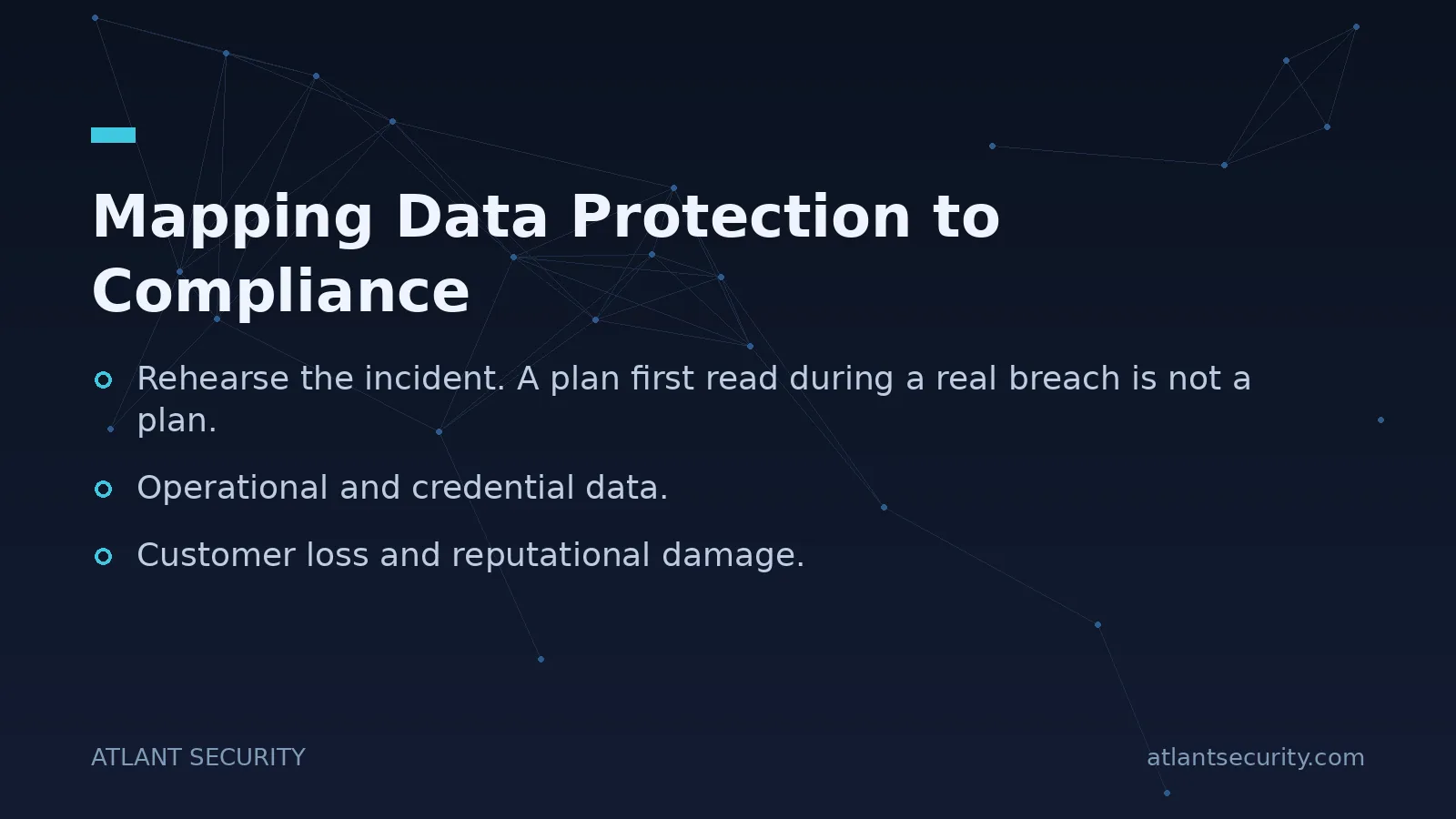
- Operational and credential data. Access keys, passwords, internal system details, the material an attacker uses to turn a small foothold into full compromise.
The reason categorization matters is that different data carries different obligations and different consequences. An audit forces you to distinguish between them so you can protect the crown jewels like crown jewels rather than spreading thin protection evenly across everything.
The Real Cost of Getting This Wrong
When sensitive data is exposed, the damage arrives on several fronts at once, and the direct breach cost is often the smallest part:
- Regulatory penalties. Data protection regimes carry serious fines, and enforcement is no longer theoretical. Non-compliance discovered during breach investigation compounds the problem.
- Customer loss and reputational damage. Trust, once broken by a breach notification, is slow and expensive to rebuild. Customers leave, and prospects hesitate.
- Operational disruption. Incident response, forensics, legal counsel, and remediation consume the attention of your whole team for weeks.
- Competitive loss. Stolen intellectual property does not make headlines, but it can hand a rival years of your research for free.
The organizations that weather these events best are the ones that did the unglamorous work of finding, classifying, and protecting their data before anything went wrong. That work is what a security audit drives.
How an IT Security Audit Protects Your Data
A data-focused audit is a structured investigation, not a scan. When I assess how well an organization protects sensitive data, I work through four layers, each answering a question the previous one raises.
1. Data Discovery and Classification
First, find the data. This means mapping structured stores like databases and the messy unstructured reality of file shares, cloud drives, endpoints, email, and shadow SaaS. Then classify what is found by sensitivity. This step alone reshapes most security programs, because it reveals sensitive data sitting in places that have no business holding it and no controls protecting it.
2. Access Control Review
Next, who can reach it? I examine permissions against the principle of least privilege and almost always find sprawling access: whole departments who can read customer databases, service accounts with standing keys, former projects whose permissions were never revoked. Tightening this is one of the fastest ways to shrink your exposure, and in Windows environments an Active Directory security assessment often surfaces the privilege paths that quietly undermine your intended controls.
3. Encryption and Storage Analysis
Is the data protected at rest and in transit? I check that encryption is actually applied where it matters, that keys are managed sensibly rather than sitting next to the data they protect, and that backups, the copy attackers love and defenders forget, are encrypted and tested.
4. Policy, Process, and Response
Finally, the human layer. Are there data handling policies people actually follow? Is there an incident response plan someone has read? Does security awareness training reflect how your staff really work? Technology fails silently when process does not back it up.
Practical Steps to Strengthen Data Protection
Audit findings only matter if they turn into action. These are the moves that consistently deliver the most protection per unit of effort for the organizations I work with:
- Minimize what you hold. The safest data is the data you never collected or have already deleted. Reducing your data footprint reduces your risk and your compliance scope at the same time.
- Enforce least privilege and MFA. Restrict access to sensitive data to those who genuinely need it, and require phishing-resistant multi-factor authentication on the accounts that can reach it.
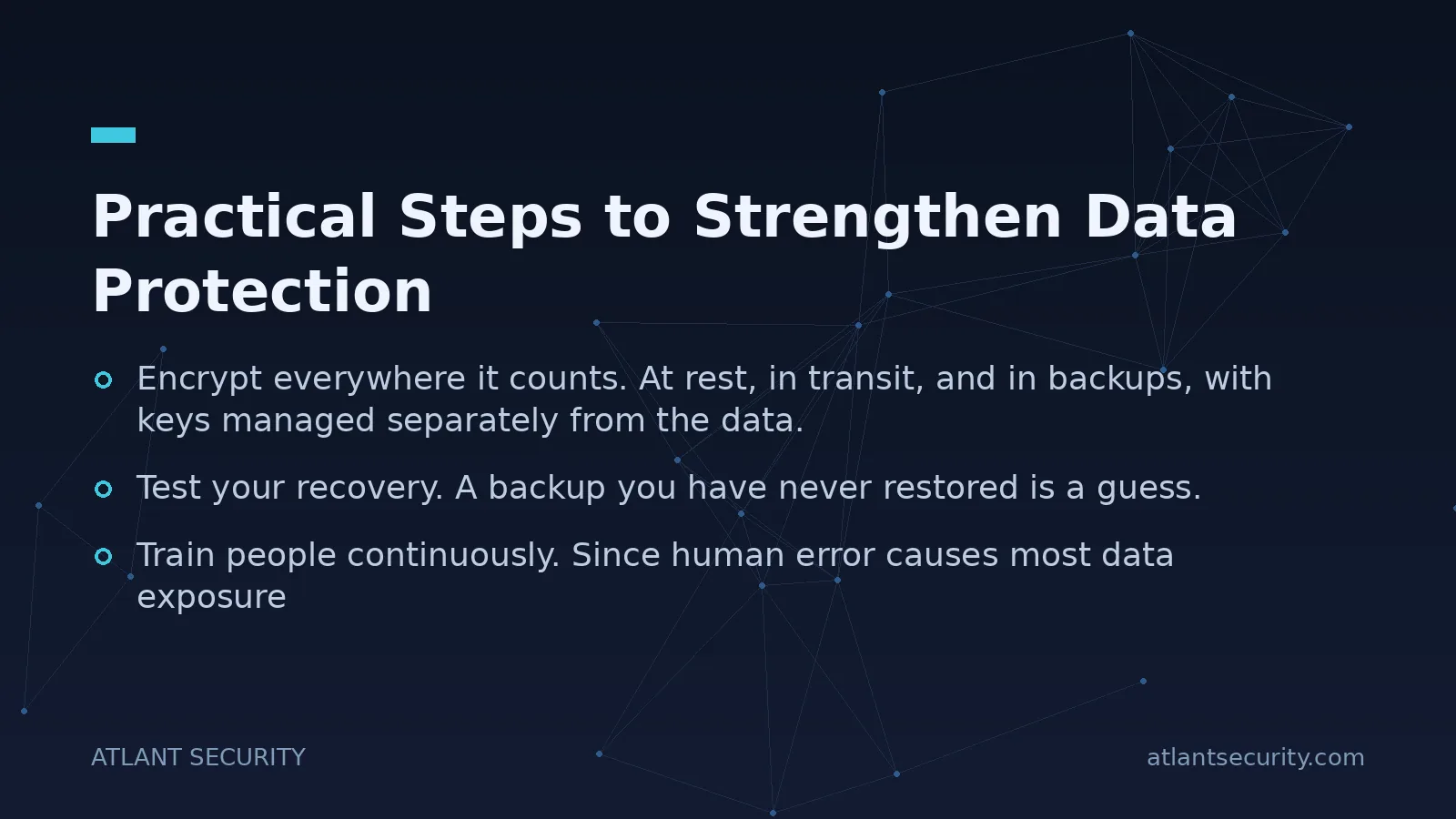
- Encrypt everywhere it counts. At rest, in transit, and in backups, with keys managed separately from the data.
- Test your recovery. A backup you have never restored is a guess. Ransomware resilience depends on proven recovery, not hopeful configuration.
- Train people continuously. Since human error causes most data exposure, ongoing awareness is a genuine control, not a compliance chore.
- Rehearse the incident. A plan first read during a real breach is not a plan. Walk through it before you need it.
Mapping Data Protection to Compliance
For many organizations, the pressure to protect data arrives as a specific requirement from a customer or regulator. The reassuring truth is that solid data protection satisfies most frameworks at once, because they all rest on the same fundamentals. The table below shows how the audit work maps to common obligations.
| Your Situation | Relevant Framework | What the Audit Supports |
|---|---|---|
| Handling health data | HIPAA | Safeguards for protected health information |
| Processing card payments | PCI DSS | Cardholder data scoping and controls |
| SaaS selling to enterprises | SOC 2 | Evidence of data security controls |
| Building a formal ISMS | ISO 27001 | Data classification and risk treatment |
If you are working toward any of these, our IT security audit service is designed to produce both the immediate risk reduction and the evidence base that compliance requires.
The Shadow Copies Nobody Talks About
The single most consistent finding in my data protection work is not weak encryption or missing access controls. It is proliferation. Sensitive data breeds copies. A customer database is exported to a spreadsheet for a quarterly report, that spreadsheet is emailed to three people, one of them saves it to a personal cloud drive, another uploads it to an analytics tool, and within weeks the same records exist in five places with five different levels of protection. Your carefully secured database becomes irrelevant when an unencrypted copy sits in someone's downloads folder.
This is why data discovery is not a one-time exercise and why access control alone is insufficient. You have to address the behaviors that create copies: give people the reports they need so they stop building their own, apply controls on the paths data escapes through, and periodically hunt down and delete the copies that have accumulated. The organizations with the cleanest data posture are ruthless about this. They treat every copy of sensitive data as a liability that must justify its existence, and they delete aggressively. Less data in fewer places is not just easier to secure. It is easier to prove secure when an auditor or regulator comes asking.
Building a Culture That Protects Data
Technology enforces rules, but people decide whether to work around them. Every strong data protection program I have helped build shares one trait: employees understand why the controls exist and see them as protecting the business rather than obstructing their work. That understanding does not come from an annual training video. It comes from leadership treating data protection as a real priority, from making the secure path the easy path, and from responding to honest mistakes with correction rather than punishment. When people are afraid to report that they accidentally emailed a sensitive file to the wrong address, you lose your best early-warning system. When they report it immediately because they know that is what good looks like, you contain problems while they are still small. For organizations that need an experienced hand to lead this cultural and technical work, a part-time CISO can provide the ownership that makes data protection stick.
Frequently Asked Questions
How do we find sensitive data we do not know we have?
Through systematic discovery. Automated tools scan databases, file shares, cloud storage, and endpoints for patterns that match sensitive data types, while interviews with teams surface the informal copies tools miss, the exports, the shadow SaaS, the personal drives. The combination is what a data-focused audit provides, and the results almost always surprise the organization.
Is encryption enough to protect sensitive data?
No. Encryption protects data at rest and in transit, but it does nothing against an attacker using a legitimate, over-privileged account, because to that account the data decrypts normally. Encryption is necessary but must sit alongside strict access control, monitoring, and sound key management to actually protect anything.
How often should we audit our data protection?
At least annually, and after any significant change: a new system, a cloud migration, a merger, or entry into a regulated market. Data sprawls continuously as people work, so a point-in-time map goes stale. Regulated organizations should align the cadence with their specific compliance requirements.
We are a small business. Is this level of data protection realistic for us?
Yes, and it is scaled to your size. A small company usually has a smaller, more discoverable data footprint, which makes the work more tractable, not less. The fundamentals, know your data, limit access, encrypt, back up and test, train people, apply at every scale. Our cybersecurity services for small business are built exactly for this.
What is the first step if we have never audited our data protection?
Start with discovery and access review, because everything else depends on knowing what you hold and who can reach it. That baseline tells you where the real exposure is and lets you prioritize spending on the risks that matter rather than guessing. From there the remediation roadmap writes itself.
Protect What You Cannot Afford to Lose
Sensitive data is both the reason your business exists and its single largest liability if mishandled. The organizations that protect it well are not the ones with the biggest security budgets, they are the ones that took the time to find their data, understand who can reach it, and close the gaps deliberately. If you have never done that exercise, it is the highest-value security work available to you. Book a discovery call and we will scope an audit that shows you exactly where your sensitive data lives and how to keep it safe.

Alexander Sverdlov
Founder of Atlant Security. Author of 2 information security books, cybersecurity speaker at the largest cybersecurity conferences in Asia and a United Nations conference panelist. Former Microsoft security consulting team member, external cybersecurity consultant at the Emirates Nuclear Energy Corporation.