The Importance of Third-Party Risk Management in IT Security Audits
Alexander Sverdlov
Security Analyst

Most breaches I get called in to investigate did not start with the victim. They started with a vendor. A managed service provider with too much access, a small software supplier whose build system got compromised, a marketing tool holding a copy of the customer database that nobody remembered granting. The uncomfortable truth of modern IT is that your security is only as strong as the weakest company you have handed a key to, and in a typical mid-sized organization that is dozens of companies, sometimes hundreds.
Third-party risk management, or TPRM, is the discipline of knowing who those companies are, what access and data they hold, and whether they can be trusted with it. It is one of the most neglected areas of security precisely because the risk sits outside your own walls, where it is easy to ignore until it becomes your incident, your regulator's letter, and your customer's lost trust. In this article I will walk through what TPRM involves, why it belongs at the center of every IT security audit, and how to build a program that actually reduces risk instead of just generating paperwork.
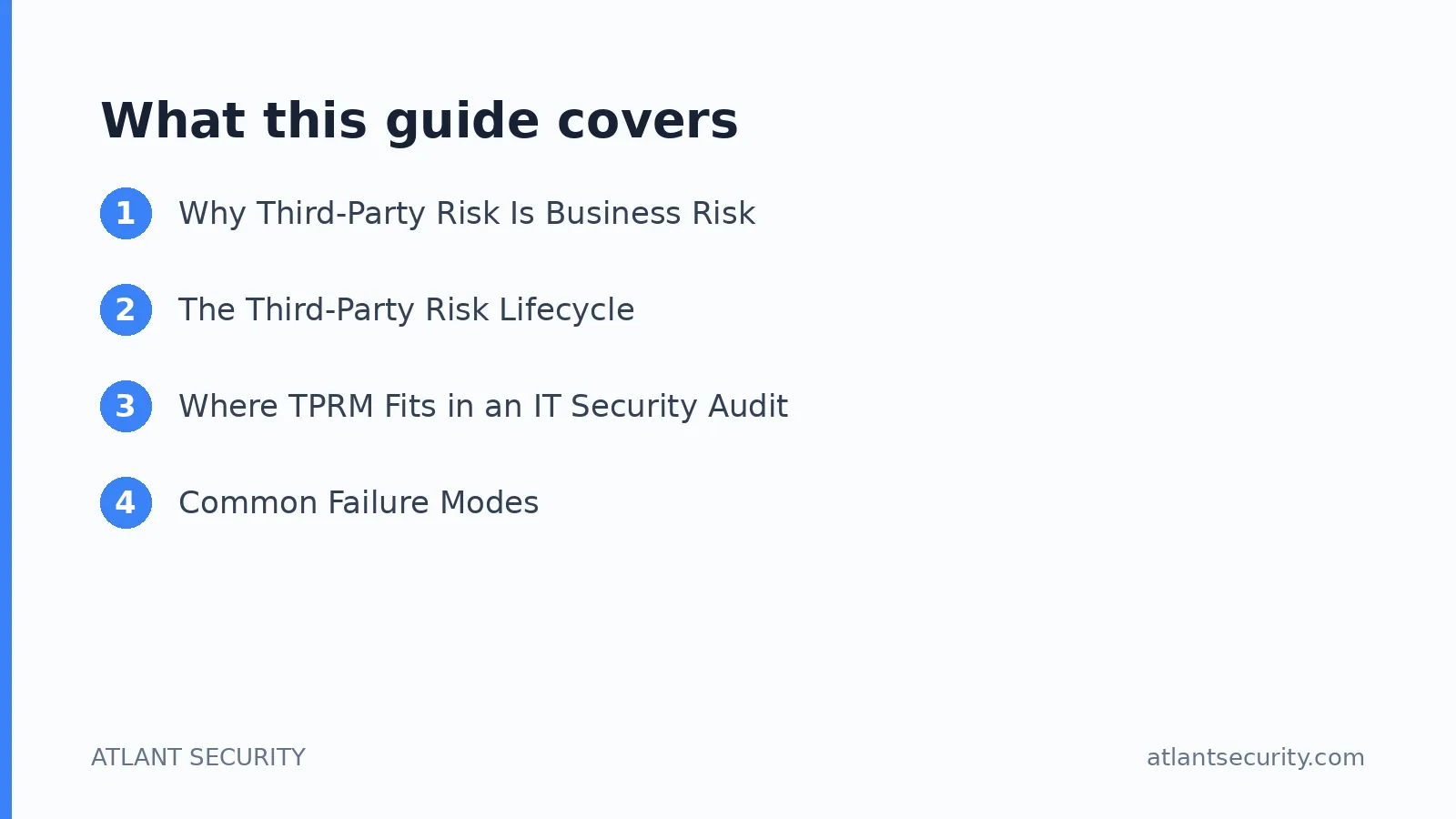
Why Third-Party Risk Is Business Risk
When you contract a vendor, you are not just buying a service. You are extending your attack surface to include theirs. If a supplier processes your data, connects to your network, or runs code inside your environment, then their vulnerabilities are effectively your vulnerabilities. Attackers understand this perfectly, which is why supply-chain attacks have become one of the most reliable ways into otherwise well-defended organizations.
Several forces have made this worse over the past decade:
- Cloud and SaaS sprawl. The average company now runs on dozens of software-as-a-service applications, each holding a slice of sensitive data and each a potential entry point.
- Deep integrations. APIs, single sign-on, and OAuth grants mean a third party often has standing, automated access to your systems rather than a one-off connection.
- Fourth-party risk. Your vendors have their own vendors. The chain of dependency runs several layers deep, and a failure three companies away can still land on your doorstep.
- Regulatory pressure. Frameworks like SOC 2, ISO 27001, HIPAA, PCI DSS, and the EU's NIS2 directive all now require you to demonstrate that you manage supplier risk, not just your own.
The regulatory point matters more than people expect. Under NIS2 in particular, supply-chain security is an explicit obligation for a wide range of organizations, and "we did not know our vendor was insecure" is no longer a defense. If NIS2 applies to you, our NIS2 compliance guidance covers how third-party obligations fit into the broader requirements.
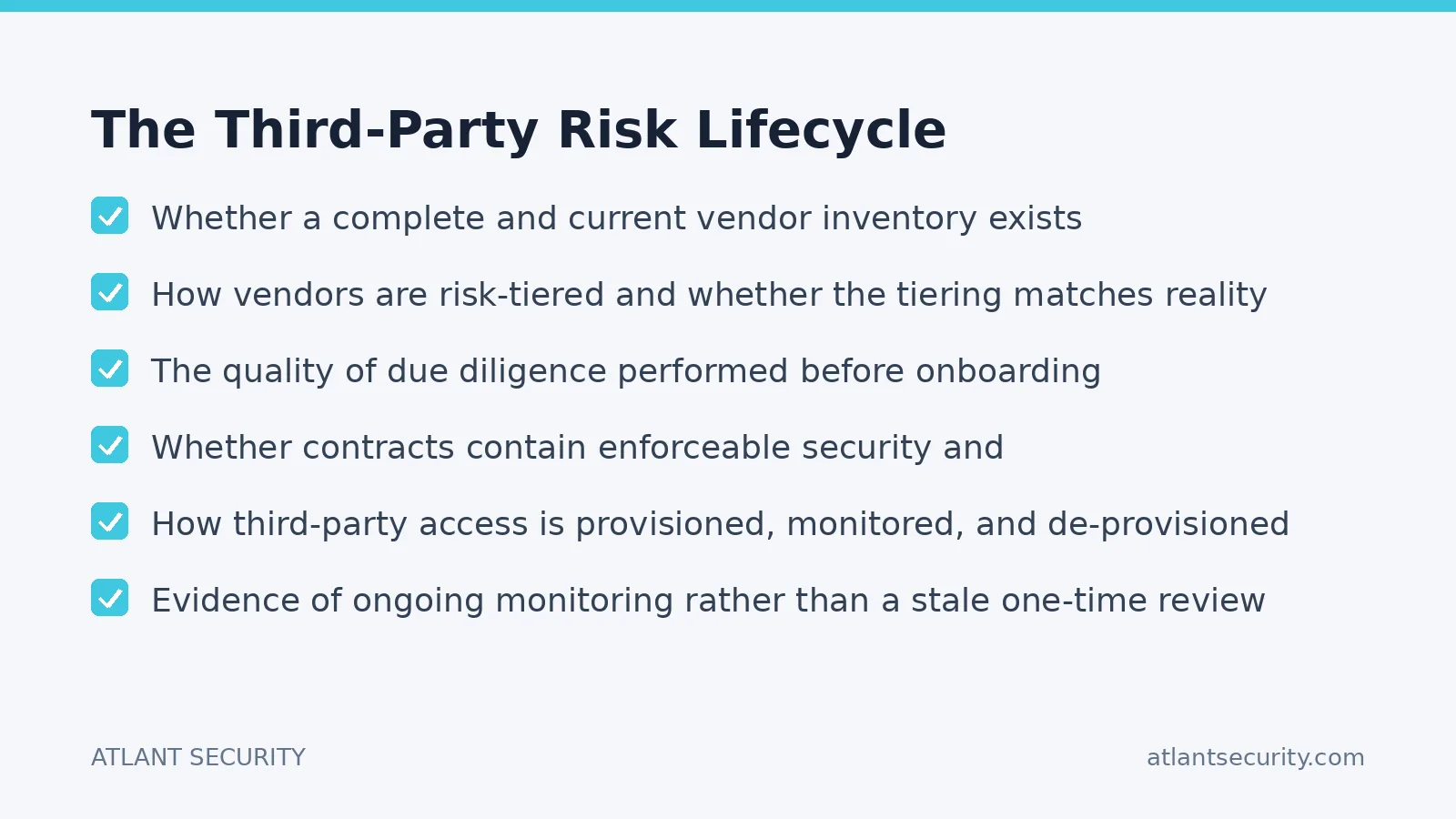
The Third-Party Risk Lifecycle
Good TPRM is not a one-time questionnaire you send at signing and forget. It is a lifecycle that follows the vendor relationship from first contact to offboarding. When I help clients build a program, I structure it around these stages.
1. Inventory and Discovery
You cannot manage what you have not listed. The first, most revealing step is building a complete inventory of every third party that touches your data or systems. Almost every organization I assess underestimates this list by a wide margin, because procurement, IT, and individual teams all sign up vendors independently. Shadow IT - the SaaS tools departments buy on a credit card without telling anyone - is where the nastiest surprises hide.
2. Risk Tiering
Not all vendors deserve the same scrutiny. A supplier hosting your production database is not in the same category as the company that services the office coffee machine. Tier vendors by the sensitivity of the data they handle, the level of access they have, and how badly a disruption would hurt. This lets you concentrate your effort where it matters instead of spreading it thin across everyone.
3. Due Diligence and Assessment
For each vendor, especially the higher tiers, you assess their security posture before you sign and periodically after. This is where security questionnaires, evidence review, and independent attestations come in. Do not accept marketing claims. Ask for a SOC 2 report, an ISO 27001 certificate, or penetration test summaries, and actually read them. If you are on the receiving end of these questionnaires yourself, our guide on how to fill a vendor security risk assessment questionnaire shows what good answers look like from both sides of the table.
4. Contractual Controls
Security requirements belong in the contract, not just in a hopeful email. Data protection obligations, breach notification timelines, right-to-audit clauses, and clear responsibility for security controls should all be written down and enforceable before money changes hands.
5. Continuous Monitoring
A vendor that was secure at signing can drift, get acquired, or suffer a breach a year later. Point-in-time assessments age quickly. Continuous monitoring - tracking public breach disclosures, certificate expirations, and changes in the vendor's risk profile - keeps your view current between formal reviews.
6. Offboarding
When a relationship ends, access has to end with it. I regularly find live credentials, active API keys, and standing VPN accounts belonging to vendors that were terminated years earlier. Every offboarding should revoke access, confirm data deletion, and close the accounts.
Where TPRM Fits in an IT Security Audit
Third-party risk is not a side topic in a security audit. It is a core section of one. When I run an IT security audit, vendor risk gets examined alongside your internal controls because the two are inseparable. An auditor will typically look at:
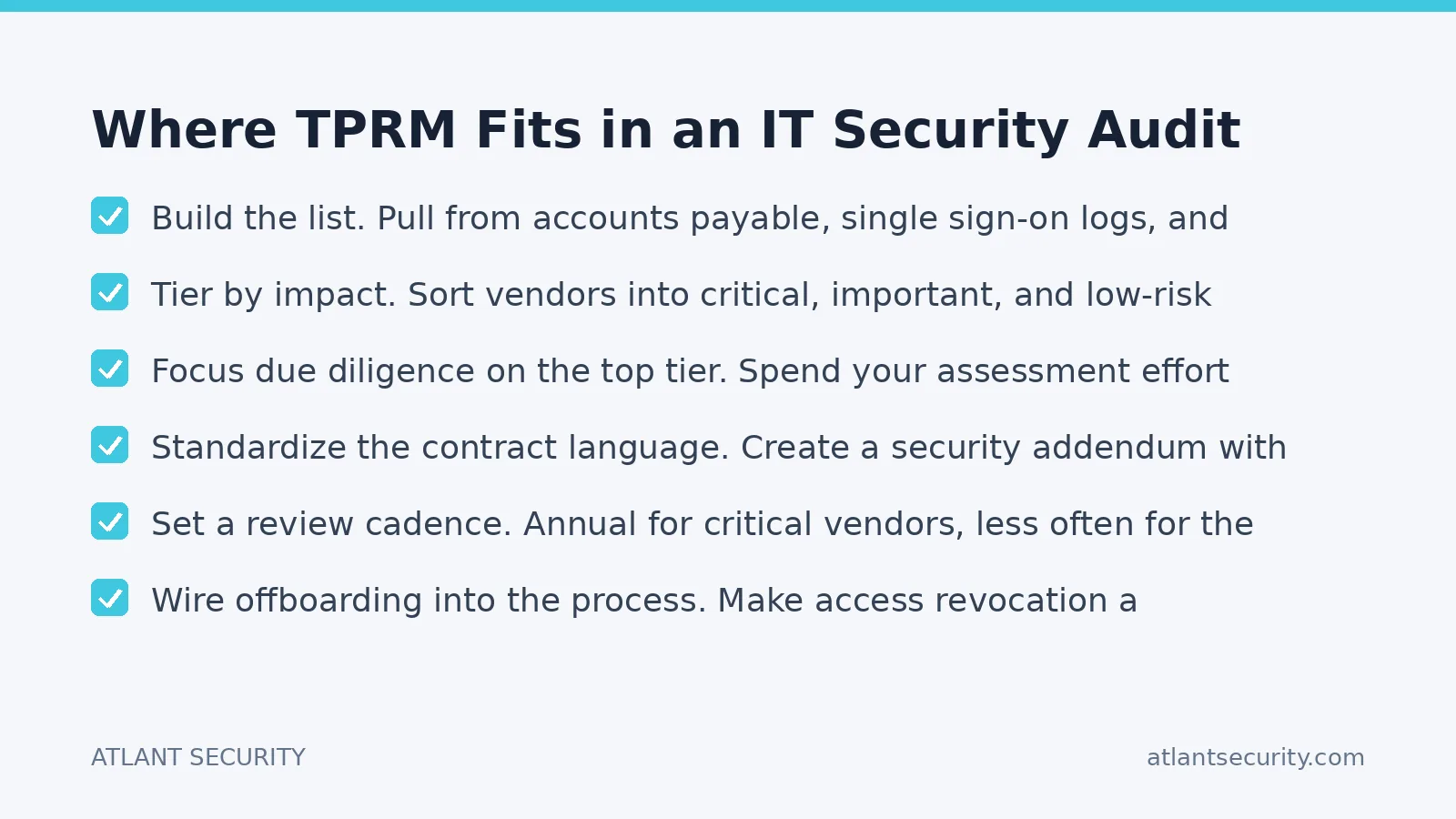
- Whether a complete and current vendor inventory exists
- How vendors are risk-tiered and whether the tiering matches reality
- The quality of due diligence performed before onboarding
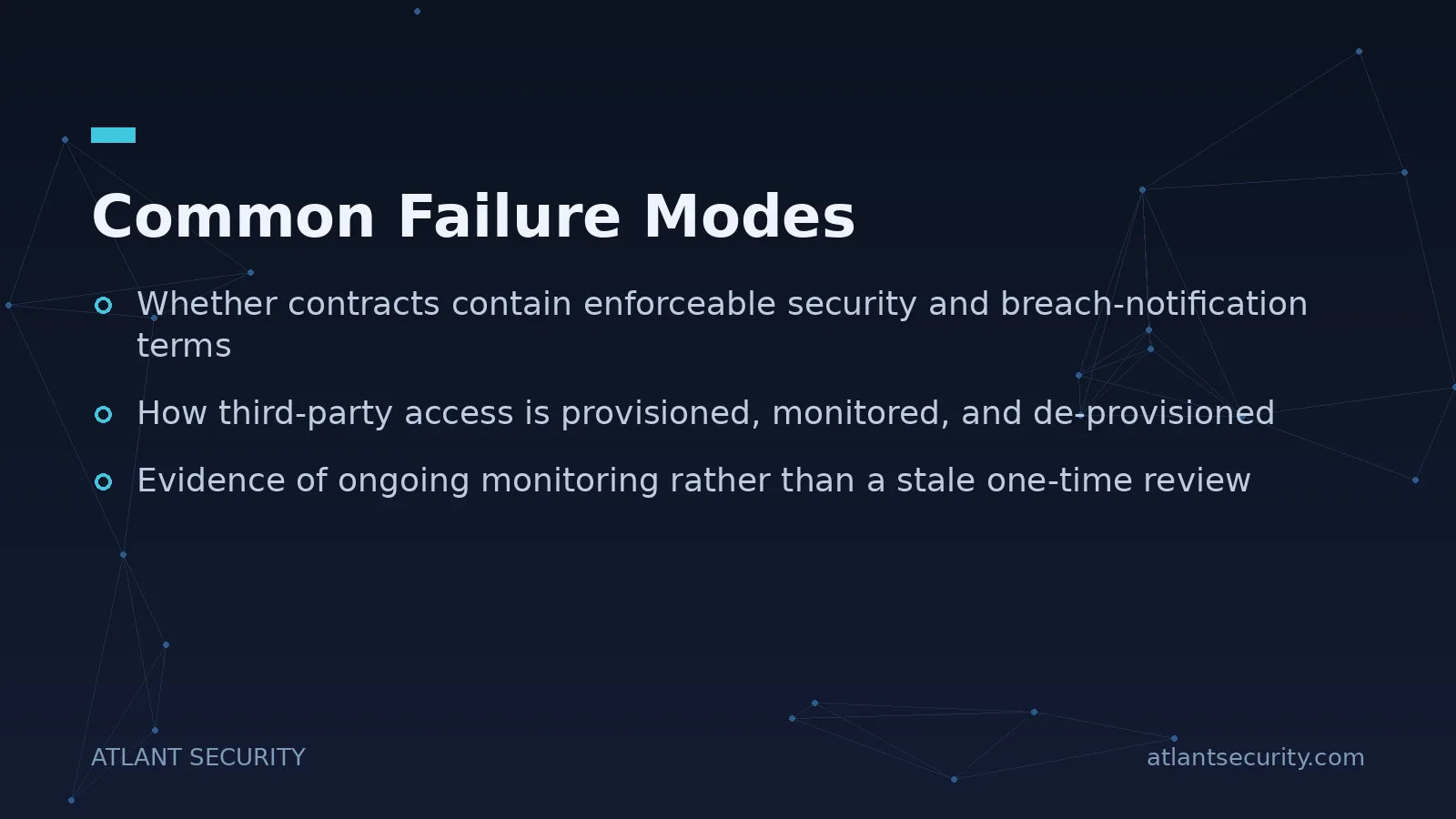
- Whether contracts contain enforceable security and breach-notification terms
- How third-party access is provisioned, monitored, and de-provisioned
- Evidence of ongoing monitoring rather than a stale one-time review
A mature TPRM program is also one of the fastest ways to smooth your own compliance journey. If you are pursuing SOC 2 or ISO 27001, vendor management is an explicit control area, and demonstrating a working program removes a common source of audit findings.
Common Failure Modes
| Failure | What it looks like | The fix |
|---|---|---|
| Incomplete inventory | Shadow SaaS bought on credit cards, no central list | Discovery sweep plus a procurement gate |
| Questionnaire theater | Forms filed and never read or verified | Review evidence, tier the follow-up |
| Set and forget | One review at signing, never revisited | Scheduled re-assessment and monitoring |
| Orphaned access | Terminated vendors still hold live keys | Offboarding checklist tied to contract end |
| No contract teeth | No breach-notice or audit clauses | Standard security addendum on every deal |
How to Build a Program That Actually Works
You do not need an enterprise governance platform to start. You need discipline and a few repeatable habits. Here is the pragmatic path I recommend for organizations that are starting from scratch:
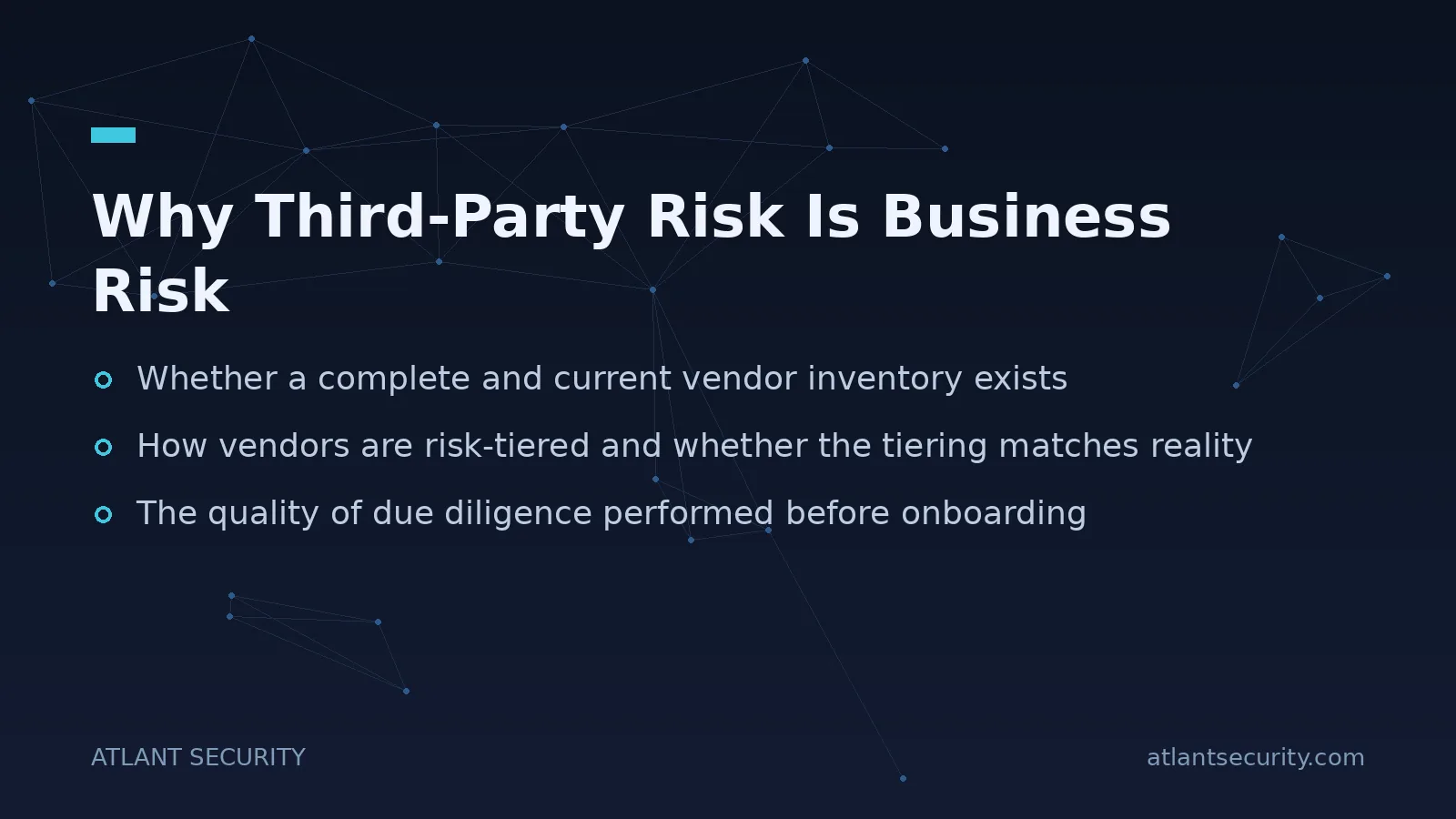
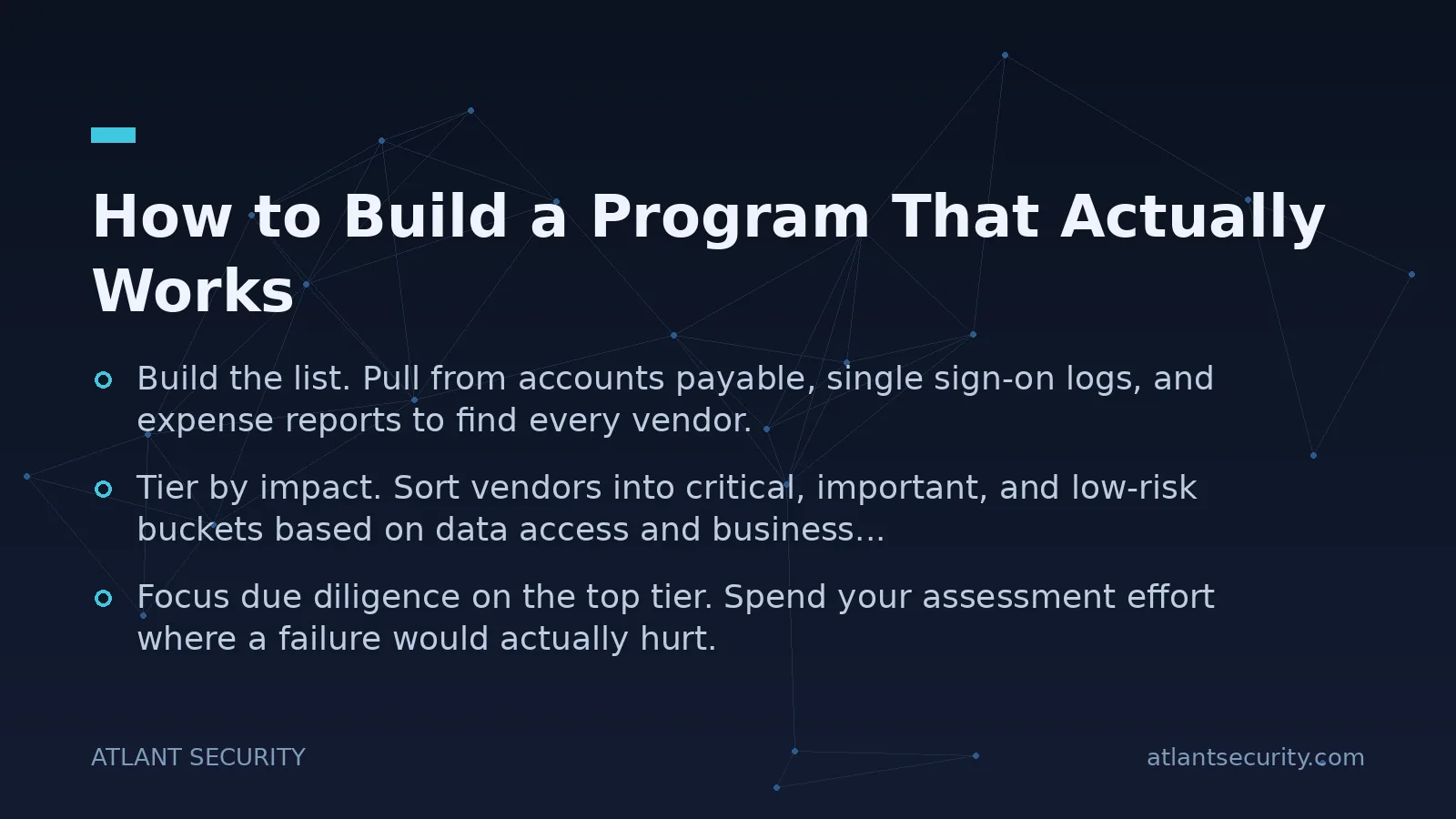
- Build the list. Pull from accounts payable, single sign-on logs, and expense reports to find every vendor. Expect the real number to surprise you.
- Tier by impact. Sort vendors into critical, important, and low-risk buckets based on data access and business dependency.
- Focus due diligence on the top tier. Spend your assessment effort where a failure would actually hurt. Ask for attestations and read them.
- Standardize the contract language. Create a security addendum with breach notification, data handling, and audit rights, and attach it to every new agreement.
- Set a review cadence. Annual for critical vendors, less often for the rest, plus event-driven reviews when a vendor is breached or acquired.
- Wire offboarding into the process. Make access revocation a mandatory step whenever a contract ends.
For smaller teams without a dedicated risk function, this is exactly the kind of program a fractional security leader can stand up quickly. A virtual CISO can own vendor risk, define the tiering, and run the review cadence without the cost of a full-time hire. If you would rather get an independent read on where your third-party exposure sits today, reach out and we can scope an assessment.
Frequently Asked Questions
What is the difference between third-party and fourth-party risk?
Third-party risk comes from the vendors you contract directly. Fourth-party risk comes from your vendors' vendors - the subprocessors and suppliers further down the chain that you have no direct relationship with but that still touch your data or services. Mature programs ask key vendors to disclose their critical subprocessors so you have visibility into that next layer.
How often should we reassess our vendors?
Tier-based. Critical vendors that hold sensitive data or have deep access deserve at least an annual review, plus an immediate reassessment if they suffer a breach or get acquired. Lower-risk vendors can be reviewed less frequently. The key is that reassessment happens on a schedule rather than never.
Is a SOC 2 report enough to trust a vendor?
It is a strong signal but not a rubber stamp. Read the report, not just the cover. Check the scope, the type (Type II is far more meaningful than Type I), the exceptions noted by the auditor, and whether the systems in scope are the ones you actually rely on. A SOC 2 report with a narrow scope can leave the parts you care about completely uncovered.
We are a small company. Do we really need a formal TPRM program?
You need a proportionate one. Small businesses often depend even more heavily on third parties because they outsource so much, which makes vendor risk more concentrated, not less. You do not need heavy tooling, but you do need an inventory, basic tiering, and offboarding discipline. Our small business cybersecurity services right-size this for lean teams.
How does third-party risk management help with compliance?
Vendor management is an explicit control area in SOC 2, ISO 27001, HIPAA, PCI DSS, and NIS2. A functioning TPRM program produces exactly the evidence auditors ask for and removes one of the most common categories of audit findings, so it pays off well beyond the security benefit.

Alexander Sverdlov
Founder of Atlant Security. Author of 2 information security books, cybersecurity speaker at the largest cybersecurity conferences in Asia and a United Nations conference panelist. Former Microsoft security consulting team member, external cybersecurity consultant at the Emirates Nuclear Energy Corporation.