The Critical Role of Third-Party Risk Management in IT Security Audits with Atlant Security
Alexander Sverdlov
Security Analyst

Some of the worst breaches I have investigated did not start with the victim at all. They started with a vendor. A managed service provider with too much access, a software supplier that shipped a compromised update, a small subcontractor whose stolen password opened a door into a much larger client. In every one of these cases, the organization had spent real money hardening its own systems while treating its suppliers as trustworthy by default. Third-party risk is the gap between how carefully you secure yourself and how little you actually know about the companies you hand your data and access to. This article explains how to close that gap in a way that is practical rather than bureaucratic.
Why Third-Party Risk Is Now a Board-Level Problem
Every modern business runs on an ecosystem of outside parties: cloud platforms, payment processors, payroll systems, marketing tools, IT contractors, logistics partners. Each connection is a convenience, and each is also an extension of your attack surface that you do not fully control. Attackers understand this arithmetic perfectly. Why break through your defenses when they can compromise a smaller, weaker supplier that already has trusted access to you?
This is why supply chain and third-party attacks have become a favourite tactic. A single compromised vendor can give an attacker a path into dozens or hundreds of downstream customers at once. Regulators have noticed too. Frameworks and laws increasingly hold you responsible for the security of the third parties handling your data, which means a vendor's failure can become your regulatory penalty.
The Main Categories of Third-Party Risk
It helps to be specific about what can actually go wrong, because "vendor risk" is too vague to act on. In practice the risks fall into a few clear buckets.
- Data exposure. A vendor with access to your customer or employee data suffers a breach, and your data leaks through their weak controls, not yours.
- Compromised software or hardware. A supplier ships an update, component, or device containing a vulnerability or malicious code that then runs inside your environment.
- Excessive access. An IT provider or contractor holds standing administrative access far beyond what their work requires, so a compromise of their systems becomes a compromise of yours.
- Operational and supply chain disruption. A cyber incident at a critical supplier halts your operations, even if your own systems are untouched.
- Compliance and legal exposure. A vendor mishandles regulated data under GDPR, HIPAA, PCI DSS, or sector rules, and you inherit the liability.
- Concentration risk. Too much of your business depends on a single provider, so their outage or failure becomes your crisis.
Building a Third-Party Risk Management Program That Works
The goal is not a mountain of paperwork. The goal is to know who has access to what, how well they protect it, and what happens if they fail. A program that achieves that, without drowning your team, has a few essential stages.
1. Inventory Every Vendor and Their Access
You cannot manage risk you have not identified. Build a living inventory of every third party, what data they touch, what systems they connect to, and how critical they are to your operations. Most organizations are surprised by how long this list is once they look honestly, and by how many forgotten integrations still hold live access.
2. Tier Vendors by Risk
Not every vendor deserves the same scrutiny. A supplier with deep access to sensitive customer data is a different risk than a tool that stores nothing important. Classify vendors into tiers, and concentrate your effort on the ones who could actually hurt you. This is the single most effective way to keep a program sustainable.
3. Do Real Due Diligence Before You Sign
Before onboarding a vendor, evaluate their security posture. Request evidence rather than assurances: recognized certifications, a SOC 2 report, penetration test summaries, and answers to a focused security questionnaire. If you are on the receiving end of these requests, my guide on how to fill a vendor security risk assessment questionnaire shows what good answers look like from both sides of the table.
4. Put Security in the Contract
Verbal promises are worthless after a breach. Contracts should spell out data protection obligations, breach notification timelines, the right to audit, minimum security standards, and what happens when the relationship ends. Include the requirement that access is revoked promptly when the engagement finishes, a step organizations forget constantly.
5. Enforce Least Privilege for Vendor Access
Give every third party the minimum access required and nothing more, ideally scoped, time-limited, and monitored. A contractor who needs one system for one project should not hold broad administrative rights indefinitely. This limits the damage when, not if, a vendor is compromised.
6. Monitor Continuously
Due diligence at onboarding is a snapshot. A vendor that was secure last year may not be today. Reassess your important vendors periodically, watch for public breach disclosures affecting them, and track whether they still meet the standards you agreed on. Risk is not static, and neither should your assessment be.
Warning Signs a Vendor Is a Liability
After enough assessments, you learn to spot the vendors who will eventually cause a problem. None of these are automatic disqualifiers, but each one should slow you down and prompt harder questions.
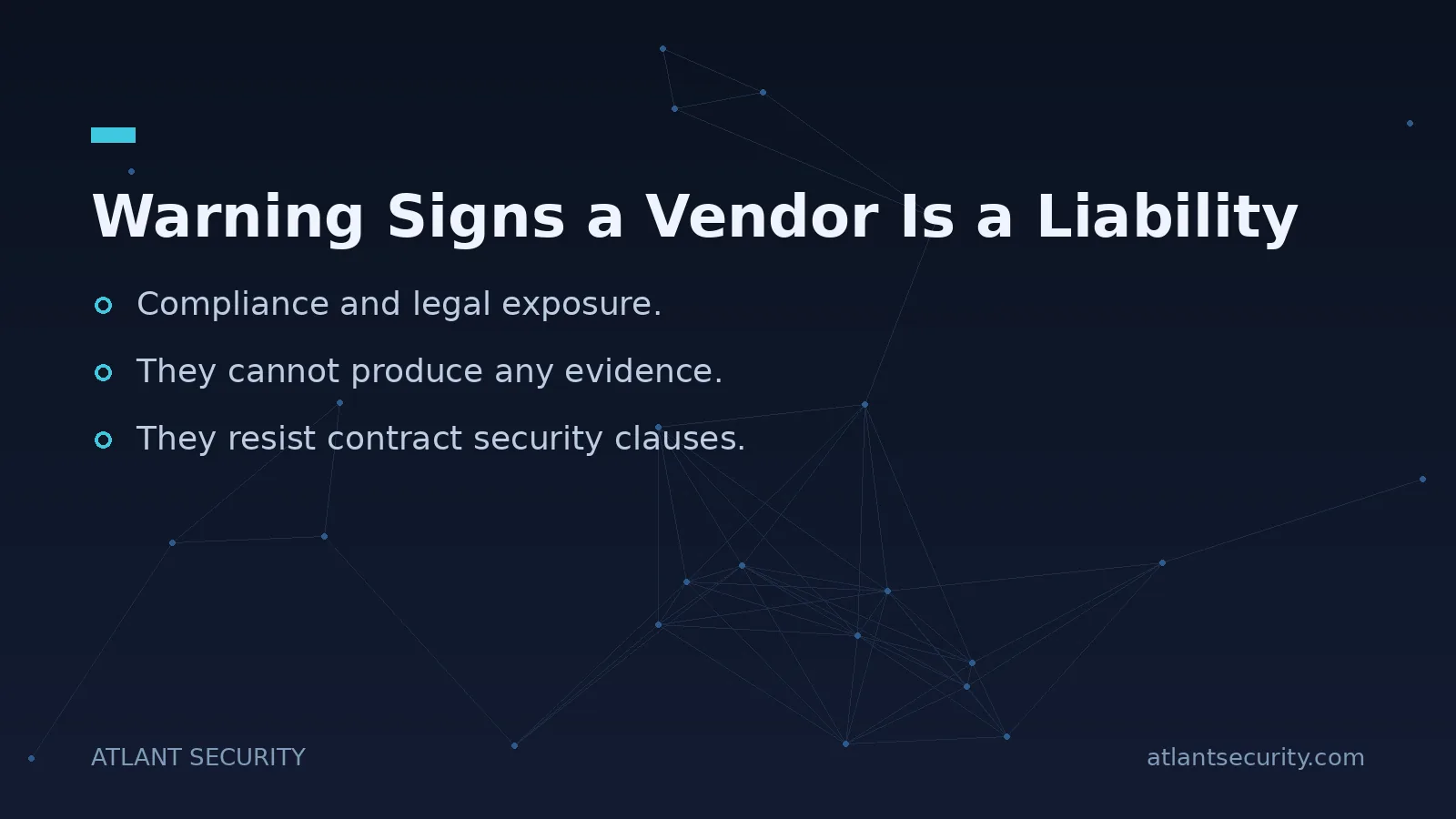
- They cannot produce any evidence. A vendor who cannot show a SOC 2 report, ISO certification, or even a completed security questionnaire is either immature or hiding something. Both are risks.
- They resist contract security clauses. Pushback on breach notification timelines, audit rights, or data handling terms tells you how they will behave during an actual incident.
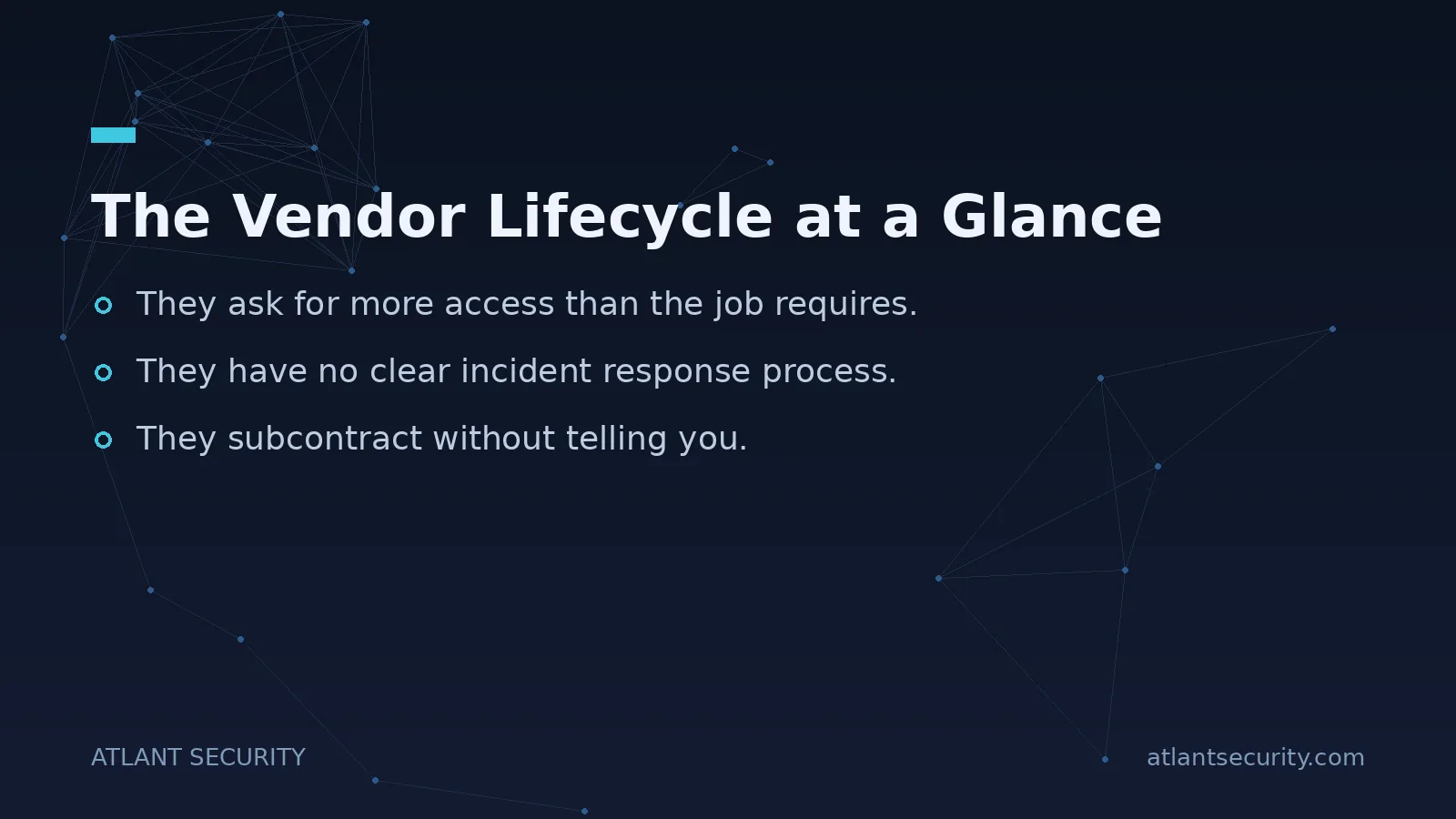
- They ask for more access than the job requires. A vendor requesting broad administrative rights "to make things easier" is a vendor whose compromise becomes your compromise.
- They have no clear incident response process. If they cannot explain how they would detect and tell you about a breach, assume you would find out last.
- They subcontract without telling you. Your data may be flowing to fourth and fifth parties you never approved. Ask directly where your data goes.
None of this requires you to become an adversary. It requires you to verify rather than trust, and to treat a vendor's security maturity as a real selection criterion alongside price and features.
The Vendor Lifecycle at a Glance
| Stage | Key Actions | Goal |
|---|---|---|
| Selection | Due diligence, security questionnaire, certifications review | Avoid risky partners before they are inside |
| Onboarding | Contract clauses, least-privilege access, data mapping | Set clear, enforceable boundaries |
| Operation | Continuous monitoring, periodic reassessment | Catch drift and new risks early |
| Offboarding | Revoke access, confirm data deletion | Close doors that outlive the relationship |
Where Third-Party Risk Meets the IT Security Audit
Third-party risk management is not a standalone exercise. It belongs inside your broader security program and, in particular, your IT security audit. When I audit an organization, vendor access is one of the first places I look, because it is so often the weakest link and the least monitored. An audit that ignores third parties gives you a false sense of security: your own house may be in order while the side door your suppliers use stands wide open.
The same logic extends deep into your supply chain, where risk compounds as one vendor relies on another. I cover that broader challenge in strengthening your supply chain cybersecurity, and for regulated financial institutions with strict outsourcing rules, the MAS TRM compliance checklist shows just how formal third-party oversight expectations have become.
Getting Help Without Building a Bureaucracy
Most organizations do not have the internal capacity to assess every vendor rigorously, and they should not try to do it by feel. This is where outside expertise pays for itself. Through virtual CISO services, I help clients build a right-sized third-party risk program: one that focuses scrutiny where it matters, uses standardized assessments to move quickly, and produces evidence that satisfies auditors and customers. For companies pursuing SOC 2 or ISO 27001, mature vendor management is not optional; it is a control the framework explicitly requires, and it is one of the areas assessors probe hardest.
Frequently Asked Questions
What is third-party risk management?
It is the process of identifying, assessing, and controlling the security and operational risks that come from the outside parties your business relies on, such as vendors, suppliers, contractors, and cloud services. The aim is to ensure that giving another company access to your data or systems does not become your security incident.
How is a vendor breach my responsibility?
Because the data is still yours. If a vendor handling your customer or employee data is breached, you typically carry the notification obligations, regulatory exposure, and reputational damage. Regulations increasingly treat you as accountable for the security of the third parties you choose, so their weakness becomes your liability.
Do we need to assess every single vendor the same way?
No, and trying to would exhaust your team. Tier vendors by the risk they pose. A supplier with deep access to sensitive data warrants thorough, recurring assessment, while a low-risk tool with no important data needs only light review. Focus your effort where a failure would actually hurt.
What should we ask a vendor before signing?
Ask for evidence of their security posture: recognized certifications, a current SOC 2 report, penetration test results, their breach notification commitments, and how they protect and segregate your data. Insist on contract language covering data protection, breach notification, and the right to audit or revoke access.
How often should we reassess existing vendors?
Reassess higher-risk vendors at least annually, and immediately if a vendor discloses a breach or materially changes their service. Security posture drifts over time, so a one-time check at onboarding is not enough to keep you protected.
Turn Vendor Risk Into a Managed Advantage
Third parties are not going away, and you would not want them to. The businesses that handle this well are not the ones with the thickest questionnaires; they are the ones who know exactly who has access to what, who verify rather than assume, and who limit the blast radius when a supplier fails. Build the inventory, tier by risk, do real due diligence, enforce least privilege, and keep watching. If you want an experienced set of eyes on your vendor exposure as part of a broader security review, get in touch and we can find the doors you did not know were open.

Alexander Sverdlov
Founder of Atlant Security. Author of 2 information security books, cybersecurity speaker at the largest cybersecurity conferences in Asia and a United Nations conference panelist. Former Microsoft security consulting team member, external cybersecurity consultant at the Emirates Nuclear Energy Corporation.