For an Australian SaaS or cloud company, SOC 2 is usually the price of entry into serious deals, especially with North American buyers whose procurement teams treat a SOC 2 report as table stakes. I have taken companies through this process across 14 countries since 2013, and the pattern in Australia is consistent: strong engineering teams that have never faced a formal attestation, unsure which of their existing practices count as controls and which gaps will trip them up. This guide lays out the real steps to implement SOC 2, written for Australian founders and technology leaders who want a defensible report rather than a rushed checkbox.
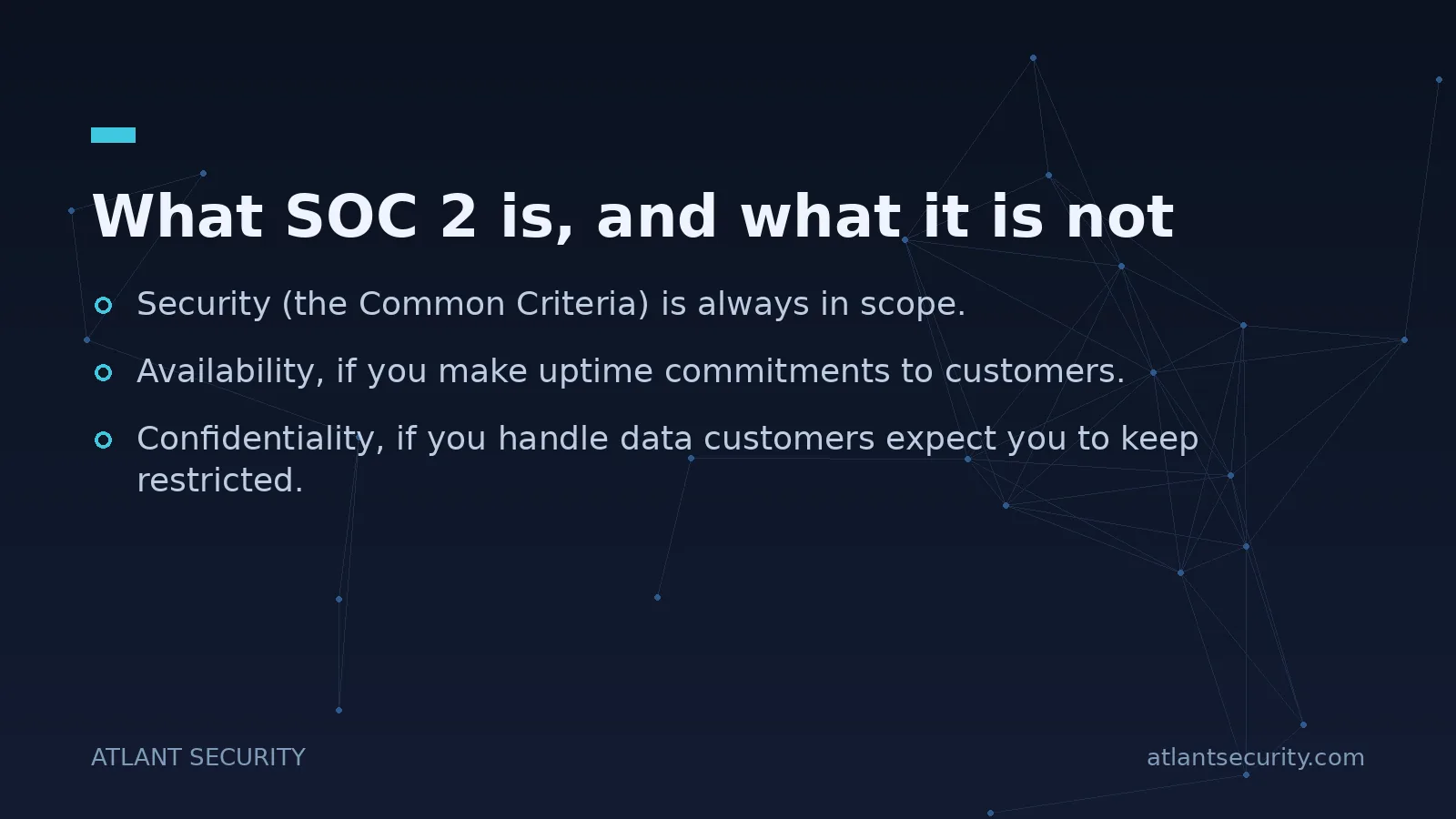
What SOC 2 is, and what it is not
SOC 2 is an attestation performed by an independent CPA firm against the AICPA Trust Services Criteria. It is not a certificate and there is no pass or fail badge. The auditor issues a report describing your controls and their professional opinion on them. That distinction matters for Australian companies because it differs from ISO 27001, which many local buyers know better. ISO 27001 certifies a management system; SOC 2 attests to controls over a period. If your customers are American, they will usually ask for SOC 2. If they are Australian, European, or enterprise across regions, they may ask for both, and the good news is the underlying controls overlap heavily.
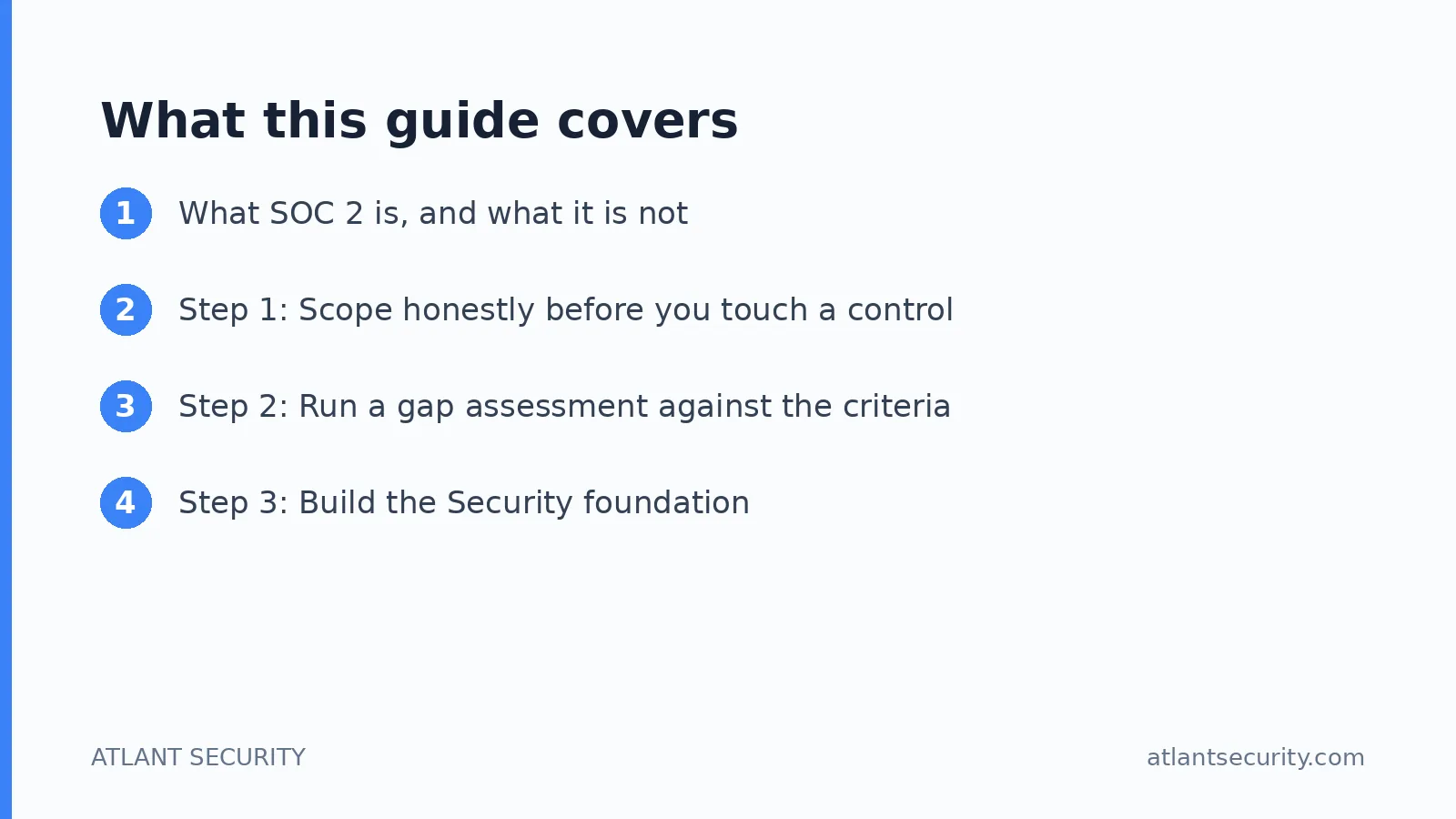
There are two report types:
- Type 1 assesses whether your controls are suitably designed at a single point in time.
- Type 2 assesses whether those controls operated effectively across an observation window, typically three to twelve months.
Type 2 is what most enterprise buyers ultimately want, because a snapshot proves intent while an observation window proves discipline. A realistic Australian path is to reach Type 1 readiness first to unblock a live deal, then run the Type 2 window immediately after.
Step 1: Scope honestly before you touch a control
SOC 2 covers five Trust Services Criteria. Only the first is mandatory:
- Security (the Common Criteria) is always in scope.
- Availability, if you make uptime commitments to customers.
- Confidentiality, if you handle data customers expect you to keep restricted.
- Processing Integrity, if the correctness of your processing is part of what you sell.
- Privacy, if you handle personal information in ways that warrant it.
The most expensive early mistake is scoping in all five to look thorough. Each added criterion means more controls, more evidence, and a higher audit fee. Choose criteria based on the actual promises in your contracts and marketing. For most Australian SaaS companies, Security plus Availability, and often Confidentiality, is the right starting set. Our SOC 2 readiness work almost always begins here, because getting scope wrong makes every later step heavier.
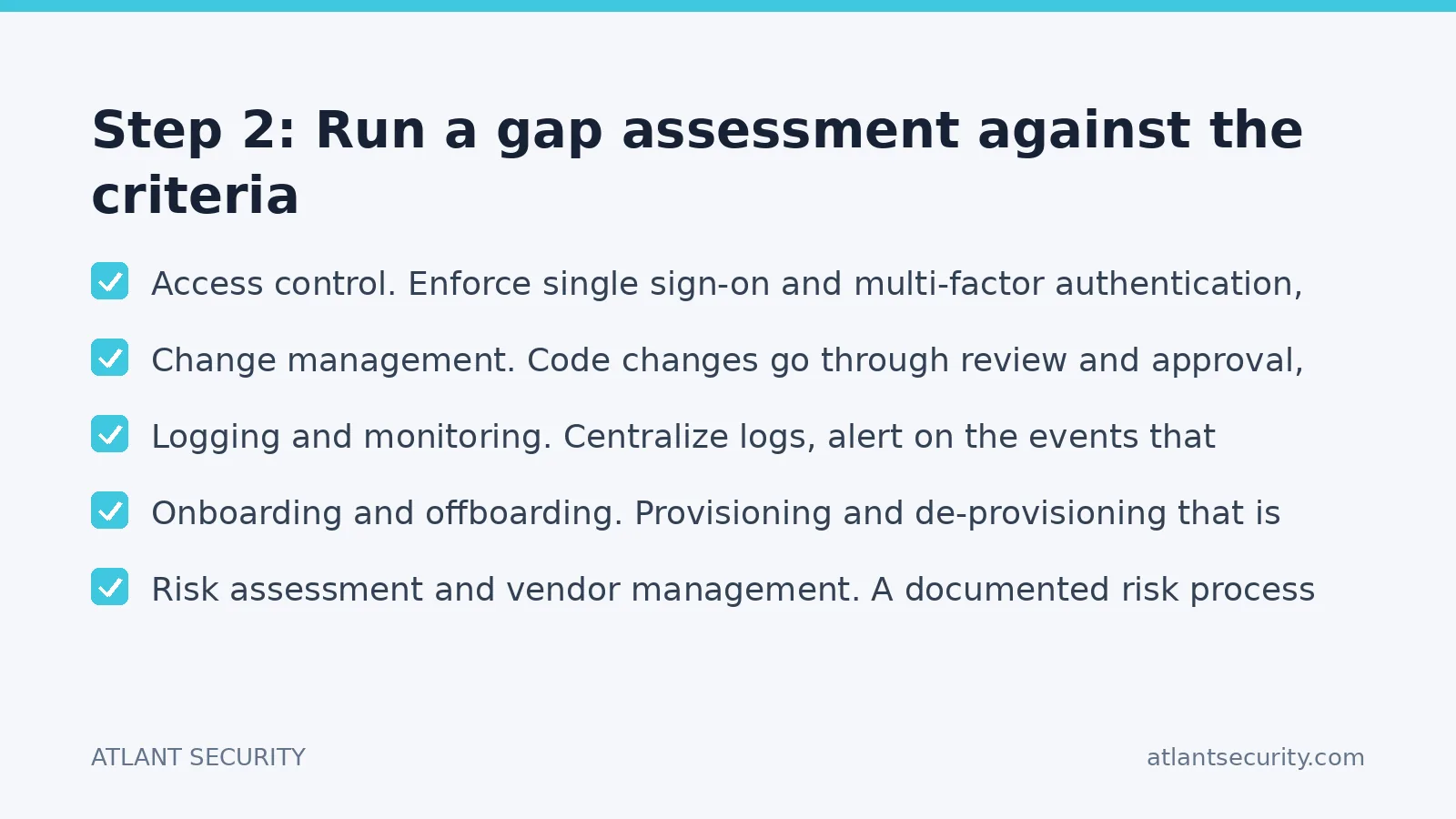
Step 2: Run a gap assessment against the criteria
Map your current state to the criteria you selected and produce a prioritized list of what is missing. In Australian companies I typically find the technical foundations are decent (cloud infrastructure, encryption in transit) but the governance controls are thin: no formal access reviews, informal change management, offboarding that relies on someone remembering, and no documented incident response. The gap assessment turns vague anxiety into a concrete backlog. A structured IT security audit at this stage doubles as both your gap analysis and a broader posture check.
Step 3: Build the Security foundation
The Common Criteria is the bulk of the work. Concretely, this means putting real controls behind these areas:
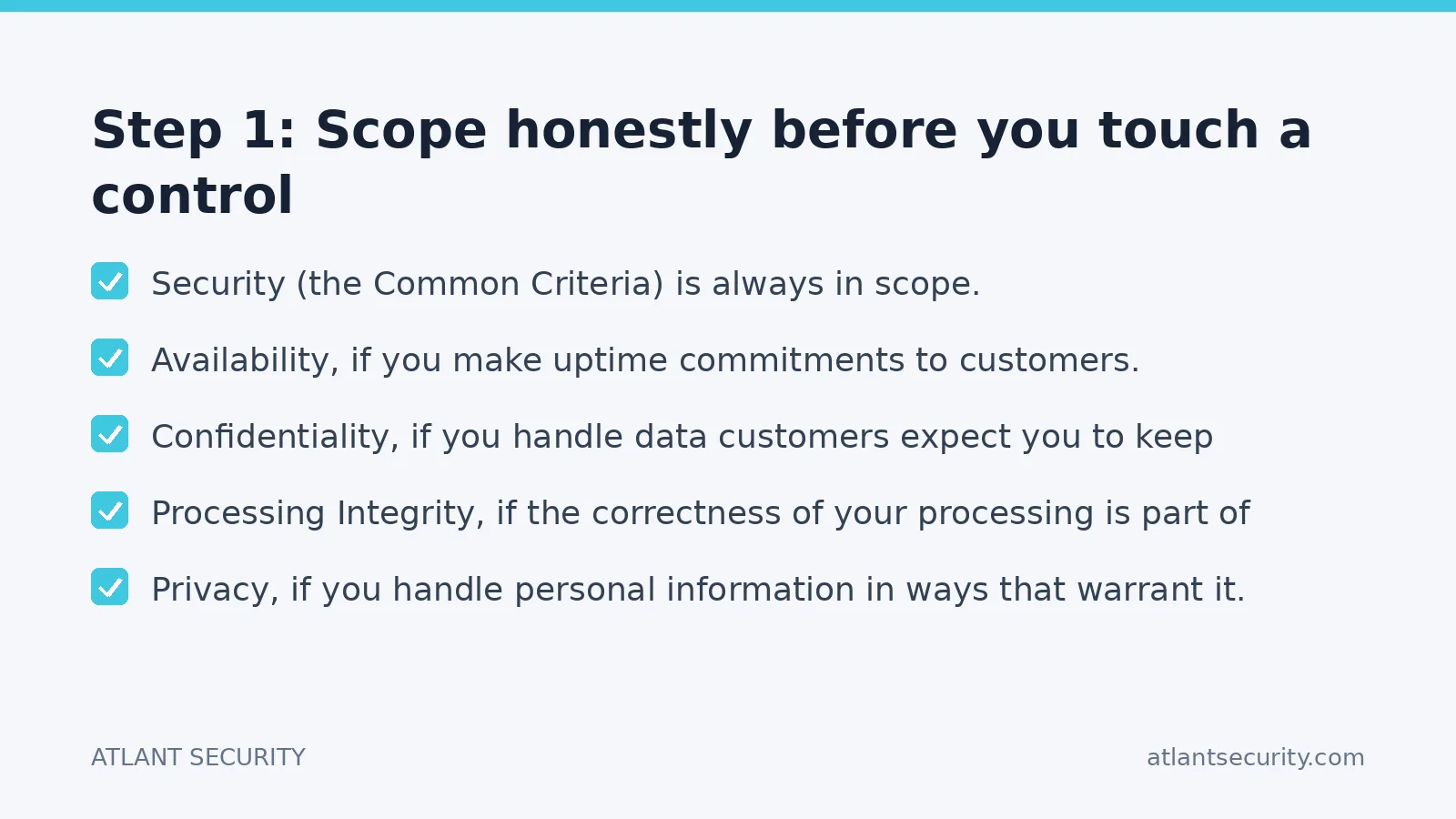
- Access control. Enforce single sign-on and multi-factor authentication, apply least privilege, and run periodic access reviews you can evidence.
- Change management. Code changes go through review and approval, with a trail. Auditors look hard at this.
- Logging and monitoring. Centralize logs, alert on the events that matter, and be able to show you review them.
- Vulnerability management. Scan regularly, triage by severity, and remediate on a defined timeline. A recurring vulnerability assessment gives you the cadence auditors expect.
- Onboarding and offboarding. Provisioning and de-provisioning that is documented and consistent, not tribal knowledge.
- Risk assessment and vendor management. A documented risk process and a register of your subprocessors and their obligations.
Step 4: Address the optional criteria you scoped in
If you included Availability, you need evidence of capacity planning, backups, and tested recovery, not just a claim of high uptime. If you included Confidentiality, you need defined data classification and handling. If you included Processing Integrity or Privacy, expect controls specific to how your system processes and protects data. Australian companies handling personal information should note the overlap with the Privacy Act and the Notifiable Data Breaches scheme: controls you build for SOC 2 Privacy often support your local obligations too, though the frameworks are distinct and one does not automatically satisfy the other.
Step 5: Write policies you will actually follow
SOC 2 requires documented policies: information security, access control, change management, incident response, business continuity, vendor management, and more. The trap is downloading templates, signing them, and then operating differently in practice. Auditors test whether reality matches the policy. Write policies that describe what you genuinely do, then close the gap where practice falls short. A policy you cannot evidence is worse than no policy, because it becomes an exception in your report.
Step 6: Stand up evidence collection
Type 2 lives or dies on evidence gathered across the observation window. Decide early how you will capture it: access review records, change approvals, monitoring alerts, incident tickets, training completion, and vendor reviews. Compliance automation platforms genuinely help here by pulling evidence from your cloud accounts and identity provider continuously. Just remember the tool automates collection, it does not decide what good looks like or design your controls. That judgment is what a Virtual CISO brings, and for most Australian companies without a full-time security leader, a fractional one is the right level of investment at this stage.
| Phase | What you produce | Typical duration |
|---|---|---|
| Scope and gap assessment | Selected criteria, prioritized remediation backlog | A few weeks |
| Remediation | Implemented controls, policies, evidence pipeline | Several weeks, depending on gaps |
| Type 1 audit | Point-in-time report to unblock deals | Weeks, once ready |
| Type 2 observation window | Continuous evidence of operating effectiveness | 3 to 12 months |
| Type 2 audit | The report enterprise buyers want | Weeks, after the window |
Step 7: Add a penetration test
A penetration test is not strictly mandated by the criteria, but two things make it effectively required. Auditors expect evidence of a vulnerability management program, and enterprise buyers reviewing your SOC 2 report almost always ask for a recent pen test alongside it. Schedule one so its report is current when your SOC 2 lands, and feed the findings back into your remediation.
Step 8: Choose and engage the auditor
The CPA firm that issues your report must be independent from whoever built your controls. So you engage preparation help and the auditor separately. Pick an auditor with genuine experience in SaaS and cloud, ask about their process and timelines, and have your evidence organized before fieldwork begins. A clean, well-prepared audit package is the difference between a smooth attestation and a stream of follow-up requests.
Step 9: Treat SOC 2 as ongoing, not a one-off
SOC 2 renews annually, and Type 2 covers a rolling window, so the controls have to keep running. Build the operational muscle to sustain access reviews, change approvals, monitoring, and vendor checks continuously. Companies that re-cram every year eventually get caught by an exception. Companies that operate their controls as normal engineering hygiene find each subsequent report almost routine.
If you want this more often than once a year without a retainer, AI penetration testing is the route: AI-driven testing across web, API, cloud, network and mobile, with results back in five to ten days.
How this fits with ISO 27001 and other frameworks
Many Australian companies end up needing more than SOC 2. If European or enterprise buyers ask for ISO 27001, the good news is that a large share of the control base overlaps, so building for SOC 2 gets you most of the way. If you process payments, PCI DSS enters scope. If you serve healthcare, HIPAA may too. Map these together once so you build a single control set that satisfies several frameworks, rather than running disconnected projects that duplicate effort.
Common mistakes Australian teams make
A handful of avoidable errors account for most of the delay and rework I see locally:
- Over-scoping. Including all five criteria to look rigorous multiplies the work and the audit fee for no commercial benefit.
- Template policies that do not match reality. Signed documents that describe controls you do not operate become exceptions in your report.
- Treating the tool as the expert. Automation platforms collect evidence well, but they do not scope your engagement, design controls, or make judgment calls.
- Leaving the pen test to the end. If its report is stale or its findings unaddressed when buyers ask, it undermines the trust your SOC 2 was meant to build.
- Under-resourcing the observation window. Controls that lapse mid-window produce gaps that show up in a Type 2 report. Someone has to own them day to day.
None of these are exotic. They come from underestimating the governance side of SOC 2 while overestimating how much a tool can do on its own. Getting senior input early, whether through a Virtual CISO or a focused readiness engagement, is what keeps a first attempt from turning into a second one.
Frequently asked questions
Is SOC 2 mandatory in Australia?
No law requires it. SOC 2 is driven by customer demand, particularly from North American enterprise buyers whose procurement processes expect it. If your target customers ask for it, it becomes commercially mandatory even though it is not legally required.
How long does SOC 2 take for an Australian SaaS company?
Reaching Type 1 readiness typically takes several weeks to a few months depending on your starting gaps. Type 2 then requires an observation window of three to twelve months during which controls must operate. Anyone promising a full Type 2 in a couple of weeks is misunderstanding what Type 2 measures.
Should we do SOC 2 or ISO 27001 first?
It depends on your buyers. North American customers usually ask for SOC 2; European and many enterprise buyers ask for ISO 27001. The control bases overlap substantially, so whichever you build first gets you most of the way to the other. Choose based on which deals you are trying to unblock now.
Do we need a full-time security hire to get SOC 2?
Usually not for your first report. Most Australian SaaS companies get further faster with a fractional or Virtual CISO who has run audits before, combined with a compliance automation tool for evidence. A full-time hire makes sense once your ongoing security needs justify one.
Does SOC 2 cover our Australian Privacy Act obligations?
Not automatically. If you scope in the Privacy criterion, the controls you build often support your Privacy Act and Notifiable Data Breaches obligations, but the frameworks are distinct and one does not substitute for the other. Treat local privacy law as a separate, related requirement.
Where to start
The highest-leverage first step is an honest scoping and gap conversation before you build anything, so you implement the right controls once instead of reworking the wrong ones. If you want that, talk to us. We help Australian SaaS and cloud companies get to a clean, defensible report through our SOC 2 and SOC 2 readiness practices.